
Amnesty International: Israel Using 'Unlawful' Force in Jerusalem

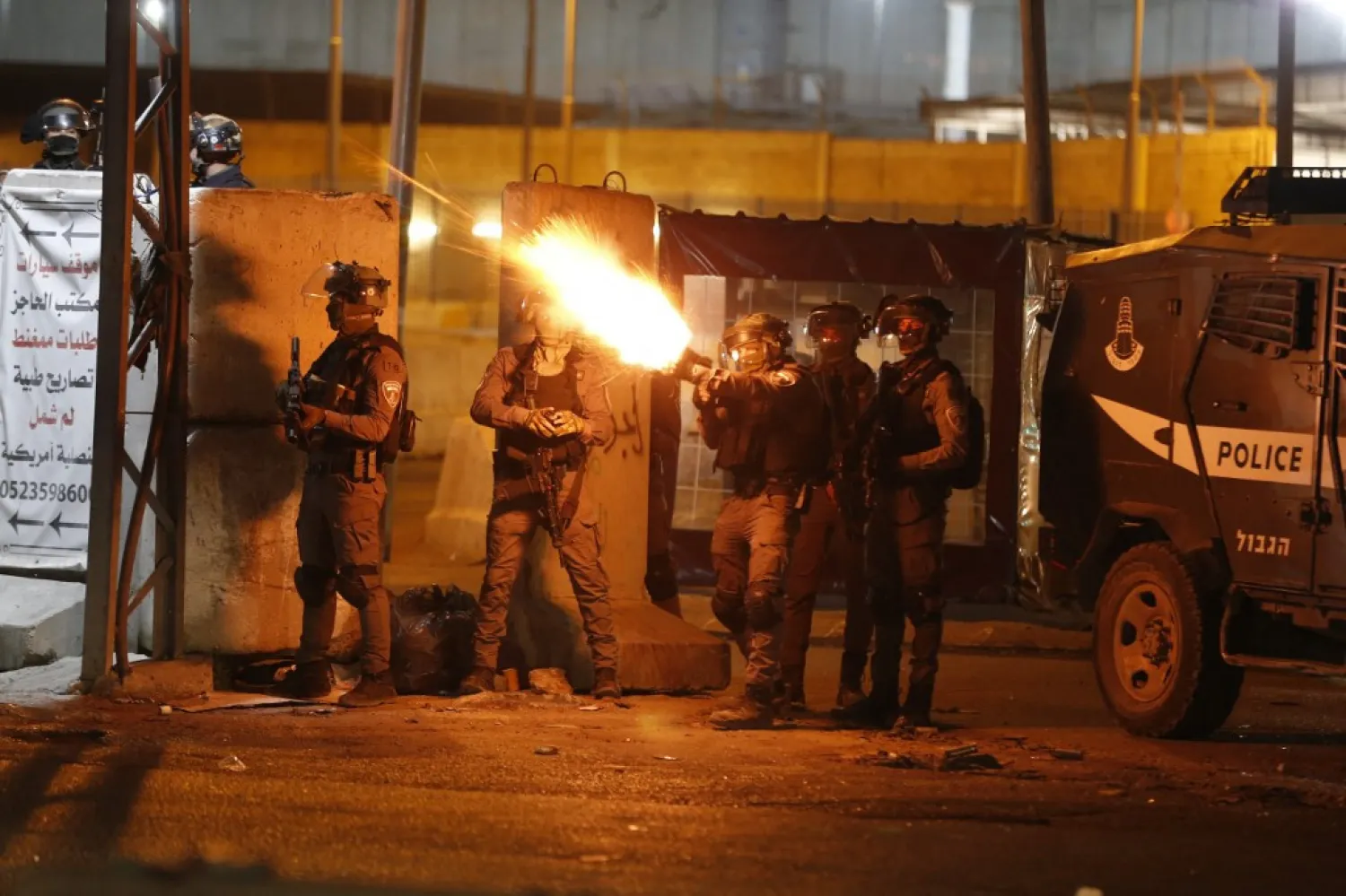
Israeli soldiers fire tear gas at Palestinian demonstrators in Jerusalem, at the Qalandiya checkpoint between Ramallah and Jerusalem, in the occupied West Bank, on May 11, 2021. (AFP)
TT

Amnesty International: Israel Using 'Unlawful' Force in Jerusalem

Israeli soldiers fire tear gas at Palestinian demonstrators in Jerusalem, at the Qalandiya checkpoint between Ramallah and Jerusalem, in the occupied West Bank, on May 11, 2021. (AFP)

Amnesty International said Israel is using "abusive and wanton force against largely peaceful Palestinian protesters" in east Jerusalem clashes that have wounded hundreds of demonstrators and dozens of police.

Israel on Tuesday firmly defended the conduct of its officers, insisting they have responded to violent Palestinian rioters with appropriate measures.

But the London-based human rights group described some of those measures as "disproportionate and unlawful", accusing security forces of "unprovoked attacks on peaceful demonstrators".

Amnesty's statement came amid surging tension in Israeli-annexed Jerusalem, much of it concentrated at the flashpoint Al-Aqsa Mosque compound, Islam's third holiest site.

At Al-Aqsa and in clashes elsewhere in east Jerusalem, police used stun grenades, rubber bullets, tear gas and skunk water cannons in response to Palestinians who hurled stones, bottles and fireworks at officers.

Amnesty said Israel has used excessive force over multiple weeks of east Jerusalem protests.

In one incident, it said Israeli forces last week broke up a peaceful circle of Palestinians chanting against an attempt by Israelis to evict them from their homes in the city's Sheikh Jarrah district.

Forces on horseback sprinted toward the crowd, trampling a man who was trying to run away, Amnesty said.

The rights group called on the international community "to hold Israel accountable for its systemic violations".

'Gloves off'
The Israeli police did not respond to specific allegations, but told AFP in an email: "We will not allow disturbance of order while harming the fabric of life, inciting to harm police forces and violence against police officers and civilians."

Police commissioner Kobi Shabtai told Israeli N12 TV on Monday that in Jerusalem in recent days "we showed too much restraint".

"We are at the stage of taking off the gloves," he said.

Clashes on Monday left more than 500 Palestinians wounded, while 37 officers were injured.

Amid the Jerusalem violence, Palestinian militant groups in Gaza fired more than 200 rockets towards Israel, including seven directed towards Israel.

Israel responded with more than 130 strikes on what it described as military targets in Gaza.

Health authorities in Gaza reported at least 22 deaths, including nine children.

The group Save the Children, also based in London, said it was "horrified" by the Israeli air strikes and demanded a stop to "the indiscriminate targeting and killing of civilians".

Israeli army spokesman Jonathan Conricus said Israel "was doing everything possible to limit collateral damage" and he said there was no confirmation Israeli strikes had impacted Gaza civilians.
Hemedti Says Ready to Cooperate with UN Envoy to End Sudan War

RSF commander receives the UN secretary-general’s personal envoy Pekka Haavisto in Nairobi. (Rapid Support Forces)
TT

Hemedti Says Ready to Cooperate with UN Envoy to End Sudan War

RSF commander receives the UN secretary-general’s personal envoy Pekka Haavisto in Nairobi. (Rapid Support Forces)

Commander of Sudan’s Rapid Support Forces Mohamed Hamdan Dagalo, known as Hemedti, said he is ready to “stop the war and cooperate to deliver humanitarian aid to all areas affected by the conflict in the country,” in talks with the United Nations secretary-general’s personal envoy, Pekka Haavisto.

Dagalo, who heads a parallel government, met Haavisto late Monday in the Kenyan capital, Nairobi, according to UN spokesman Stephane Dujarric.

In a statement on Facebook, Hemedti said he discussed with Haavisto “political and security developments, as well as the humanitarian situation and efforts aimed at achieving peace and stability.”

He added that his government, based in the Darfur city of Nyala, is “fully prepared to cooperate with the United Nations and work to provide the necessary assistance to help alleviate the suffering of the Sudanese people.”

Hemedti briefed the UN envoy on “the causes of the war ignited by the Muslim Brotherhood and its allies within the Sudanese army,” reiterating his government’s commitment to “the unity of the country to block attempts aimed at fragmenting Sudan and dismantling its social fabric.”

The RSF leader stressed “the importance of conducting a transparent and fair investigation into the violations suffered by Sudanese civilians, foremost among them the use of chemical weapons,” describing this as “a fundamental step toward ending the war and achieving peace in the country — a demand that is non-negotiable under any circumstances.”

Hemedti renewed his call for the United Nations to open offices in areas under the control of his government, known as Tasis, in the Darfur and Kordofan regions to deliver humanitarian assistance to civilians there.

For his part, Haavisto affirmed the UN’s efforts to end the war and achieve peace in Sudan.

He welcomed the RSF leader’s response to the meeting, during which they exchanged views on the overall situation in Sudan, noting that he has listened to a number of Sudanese parties as part of efforts to identify the most effective paths toward resolving the crisis.

Dujarric said the meeting between the UN envoy and the RSF commander provided a constructive opportunity to exchange views and explore practical ways to de-escalate and ensure the continued protection of civilians.

In a press briefing, he added that all Sudanese parties the envoy met in Nairobi expressed readiness to cooperate with the United Nations. He pointed in this regard to Haavisto’s meeting last week in the Sudanese capital, Khartoum, with army commander and Sovereign Council chief Abdel Fattah al-Burhan, during which they discussed international efforts to end the war.

The UN spokesman renewed the organization’s call on the parties to the conflict in Sudan to “immediately cease hostilities, protect civilians and infrastructure, and ensure rapid, safe and unhindered humanitarian access.”

He also stressed the need for additional funding for humanitarian assistance in Sudan, estimating that $2.9 billion is required to reach more than 20 million people across the country.


Burhan Reshuffles Sudanese Army Leadership

File photo showing Abdel Fattah al-Burhan with his aides and the chief of staff (Sudanese army)
TT

Burhan Reshuffles Sudanese Army Leadership

File photo showing Abdel Fattah al-Burhan with his aides and the chief of staff (Sudanese army)

Decisions by Sudan’s transitional Sovereign Council chief and army commander, Abdel Fattah al-Burhan, to dismiss several senior military leaders and reassign them to other top positions have fueled speculation that the moves are “not isolated” from imminent changes within the army-led governing authorities.

Al-Burhan issued a decree removing his deputy in army command, Shams al-Din Kabbashi, as well as his assistants Yasser al-Atta and Ibrahim Jaber. He followed it with another decision on the same day appointing Kabbashi, Jaber and Lt. Gen. Mirghani Idris as assistants to the army commander-in-chief.

Al-Burhan had begun the reshuffle last Thursday by appointing Sovereign Council member Lt. Gen. Yasser al-Atta as chief of staff, along with deputies drawn from senior officers across military divisions.

In this context, al-Burhan said the creation of new posts — assistants to the commander-in-chief — aims to “develop and rehabilitate military industries and enhance the capabilities of the armed forces.” He added that “leadership succession is a deeply rooted military tradition to ensure generational continuity and inject new blood to improve military performance.”

Al-Burhan denied “any regional criteria in the appointments.” He said al-Atta’s selection “was based on his field competence and his role in breaking the siege of the General Command and boosting morale,” describing him as “one of the pillars of the armed forces in resolving the Battle of Dignity and achieving victories.”

For his part, the newly appointed chief of staff, al-Atta, described the changes affecting the armed forces leadership as “routine annual measures in line with military hierarchy,” adding that he would work to develop the “joint forces” and “support forces” with the aim of integrating them into army units.

The reshuffle - the most significant within army leadership since the outbreak of war in April 2023 - is widely seen as an indication of a broader restructuring possibly involving changes to or the dissolution of the Sovereign Council, the country’s highest sovereign authority.

Under the latest decisions, al-Burhan appointed Kabbashi as assistant for construction and strategic planning affairs, Lt. Gen. Ibrahim Jaber as assistant for international relations and military cooperation, and Lt. Gen. Mirghani Idris Suleiman Idris as assistant for military industries.

For his part, crisis management and negotiation expert Maj. Gen. Amin Ismail Majzoub of the Strategic Studies and Research Center told Asharq Al-Awsat that changes to the army’s general command “are a routine procedure carried out every two years, though extensions may occur under exceptional circumstances,” referring to the ongoing war in the country.

Meanwhile, retired Sudanese army Maj. Gen. Kamal Ismail said the timing is “not appropriate” for reassignments and transfers among senior ranks, suggesting the latest reshuffle “may be the result of failure to achieve victory in the battlefield, necessitating a change in the general staff leadership to devise new plans for resilience and military progress.”


Attempted Abduction of Qassam Fighters Ends in Deadly Clashes in Central Gaza

Palestinians stand by the bodies of victims of an Israeli airstrike in central Gaza on Tuesday. (EPA)
TT

Attempted Abduction of Qassam Fighters Ends in Deadly Clashes in Central Gaza

Palestinians stand by the bodies of victims of an Israeli airstrike in central Gaza on Tuesday. (EPA)

An attempt by members of an armed group aligned with Israel to abduct operatives from the Izz ad-Din al-Qassam Brigades, the military wing of Hamas, in central Gaza left at least 10 Palestinians dead and about 15 wounded, according to field sources.

A source from an armed faction in Gaza said fighters from a group led by Shawqi Abu Nasira tried to lure Qassam operatives into an ambush on Monday evening near a school sheltering displaced people east of the Maghazi refugee camp.

The situation escalated into clashes, the source said, followed by Israeli intervention using drones and military vehicles positioned along what is known locally as the “yellow line,” separating Hamas-controlled areas from Israel. The intervention provided cover for the attackers, the source added.

At least 10 Palestinians were killed, including two who later died of their wounds, and around 15 others were injured, some critically. Multiple sources said the attackers failed to abduct any Qassam members.

Another field source from a faction close to Hamas said a member of the armed group who recently surrendered to Hamas security is suspected of acting as a double agent and orchestrating the ambush. The suspect allegedly lured Qassam operatives to the area under the pretext that rival fighters were planning an attack.

The source added that the “alertness” of Qassam fighters prevented the abduction attempt and led to clashes, with additional fighters already deployed nearby in anticipation of such an attack.

Three Hamas field sources in central Gaza declined to confirm that account but agreed that an abduction attempt had taken place.

One of the sources said the attackers took advantage of the dense civilian presence in the area, a few hundred meters west of the “yellow line.” Although the operation failed, families reported that two civilians were abducted, the source added.

Hamas-affiliated sources estimated the number of attackers at around 30, saying Israeli support and heavy firepower prevented significant casualties among them. There was no independent confirmation of deaths among the attackers.

Abu Nasira, a former Palestinian security officer and freed prisoner, leads a group that operates in northeastern Khan Younis and parts of central Gaza. Despite its relatively recent emergence, the group has expanded its activities and has been linked to several assassination attempts targeting Qassam members and Hamas security personnel.

Separately, the World Health Organization said it had suspended medical evacuations from Gaza to Egypt via the Rafah crossing for a second day after an Israeli strike killed a contracted driver despite his having a permit to pass near Bani Suheila in eastern Khan Younis.

WHO Director-General Tedros Adhanom Ghebreyesus said two staff members were present but unharmed, adding that the incident was under investigation and calling for the protection of civilians and humanitarian workers.