

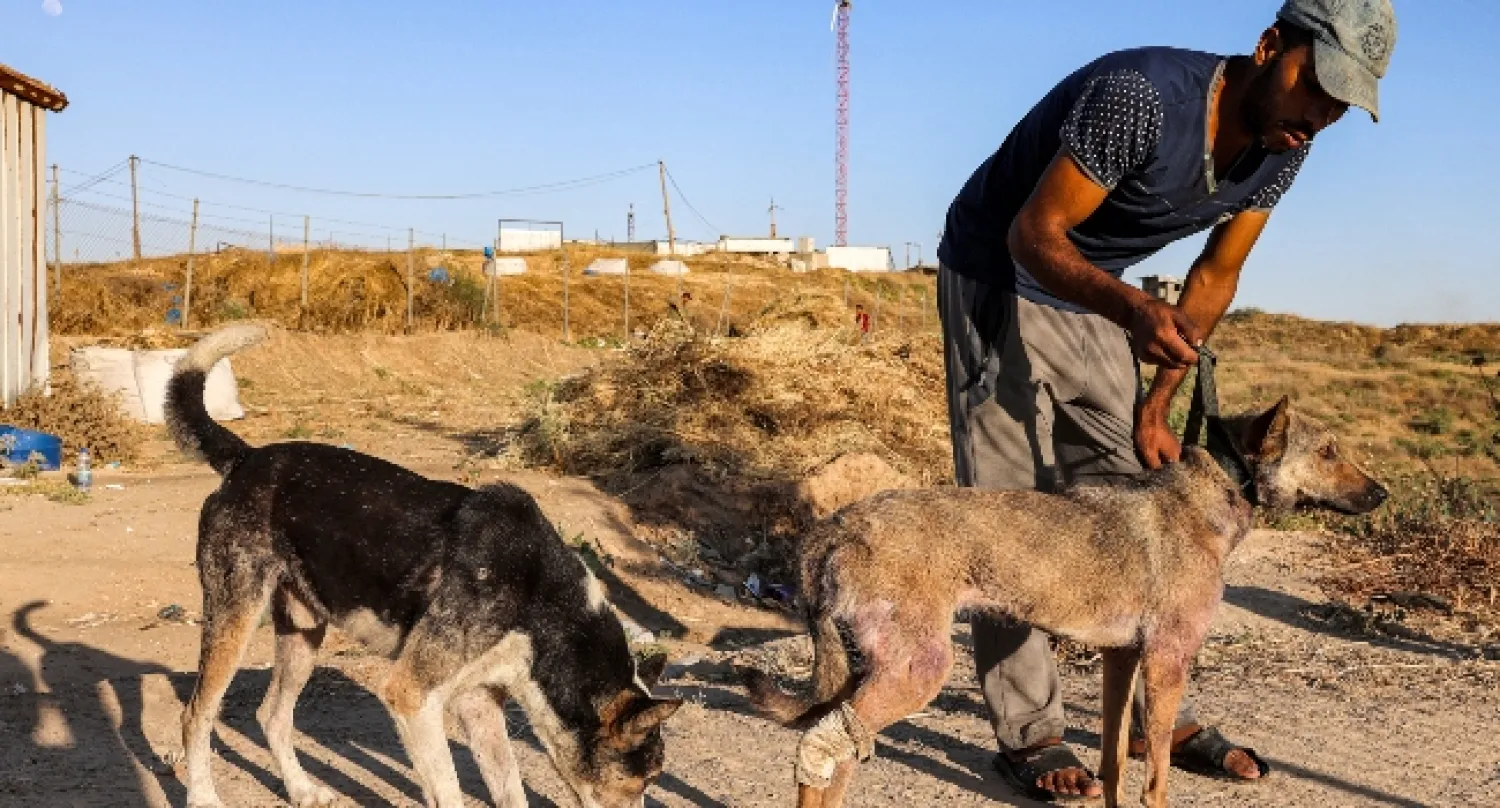

In Gaza, Traumatized Palestinians Tend to Shell-Shocked Pets

A worker tends to a dog at the Sulala dog shelter in Gaza City which has received several wounded animals after the 11-day conflict between Israel and the Islamist Hamas controlling the Palestinian enclave - AFP
TT

In Gaza, Traumatized Palestinians Tend to Shell-Shocked Pets

A worker tends to a dog at the Sulala dog shelter in Gaza City which has received several wounded animals after the 11-day conflict between Israel and the Islamist Hamas controlling the Palestinian enclave - AFP

A smashed goldfish bowl, panicked birds in a cage, scores of animals needing treatment. The loss or injury of treasured pets has added to the grief and trauma of Gaza residents after last month's deadly conflict.

Neriman, a nine-year-old Palestinian girl, clutched a glass jar holding her goldfish Hoor, delighted it had survived after her other one, Hooriya, died in an Israeli air strike in Gaza City.

In the latest war, Israeli strikes on Gaza killed 254 Palestinians, including 66 children, as well as some fighters, authorities there say.

Fire by Palestinian militants claimed 12 lives in Israel, including one child, a teenager and an Israeli soldier.

Pets also suffered, as well as the children who owned them, according to AFP.

"I was so sad that Hooriya died and I cried when I buried her in the field," said Neriman, of her first fish, whose name meant "Mermaid" in Arabic.

"But I was so happy that Hoor had survived," she added of her second fish.

At an animal clinic in Gaza City, Amani Abu Shaaban held a fluffy cat to her chest as they waited to see a vet.

"My cat has been very scared since the war. She refuses to eat, and her hair is falling out," she said.

"Even the sound of a mobile phone ringing freaks her out."

Nearby, vet Mutasem Qaddoura examined two cats, one after the other.

One needed an operation for a broken leg, the other was dehydrated and malnourished.

Dozens of pets owners have flocked to his clinic since Gaza's May 21 ceasefire though supplies to treat them are scarce.

"The state of veterinary medicine is disastrous in Gaza," Qaddoura said.

"We use X-ray machines intended for humans and platinum screws meant to fix children's bones to treat the animals."

- Pets left behind -

Neriman and her family had been forced to flee their home on May 13, after an Israeli officer warned neighbors of an imminent strike on a nearby bank.

In the panic she left behind her fish, as well as two parakeets, Alloosh and Malloosh, given to her by her father for her sixth birthday.

But soon after, she started worrying.

"I just had to go home with my father to get them," she said.

When they returned, she found a special outfit she had laid out on her bed for the Eid holidays covered in rubble, the bed collapsed and the windows blown in.

"I heard Alloosh and Malloosh chirping under the rubble, and I found the fish bowl broken," she said.

Hooriya had died, but they saved Hoor, a scene shown in a video which has since gone viral on social media.

- Desperate dogs -

South of Gaza city, 30-year-old Adel al-Wadia said he had tried to feed some of the dogs at the coastal strip's main dog shelter during the bombing.

"They were howling with fear and hunger and it made me sad, so I risked trying to get as close as possible to give them food," he said.

The shelter's founder, Saeed el-Aer, said he returned after the ceasefire to find many of his canine wards scared and famished.

Dozens had panicked and escaped during the 11-day war, and several were wounded, he said.

"At least three dogs need an operation, including one who needs a paw amputated," he said.

Other animals were even less lucky.

Aer pointed to an area beyond the shelter's fence.

"Over there, we buried the donkey and the horse after we found they had died from shrapnel wounds," he said.


China's Shenzhou-23 Spacecraft Carrying Pakistani Astronaut Begins Journey Back to Earth

A Long March-2F rocket carrying the Shenzhou-24 spacecraft, with a crew of two Chinese and one Pakistani astronauts, lifts off from the Jiuquan Satellite Launch Center in Jiuquan, in China's northwest Gansu province on November 25, 2026. (Photo by CNS / AFP)
TT

China's Shenzhou-23 Spacecraft Carrying Pakistani Astronaut Begins Journey Back to Earth

A Long March-2F rocket carrying the Shenzhou-24 spacecraft, with a crew of two Chinese and one Pakistani astronauts, lifts off from the Jiuquan Satellite Launch Center in Jiuquan, in China's northwest Gansu province on November 25, 2026. (Photo by CNS / AFP)

China's Shenzhou-23 spacecraft, carrying three astronauts including a Pakistani national, undocked from the country's space station on Sunday at 11:42 p.m. (1542 GMT) and began a journey back to earth, state news agency Xinhua reported.

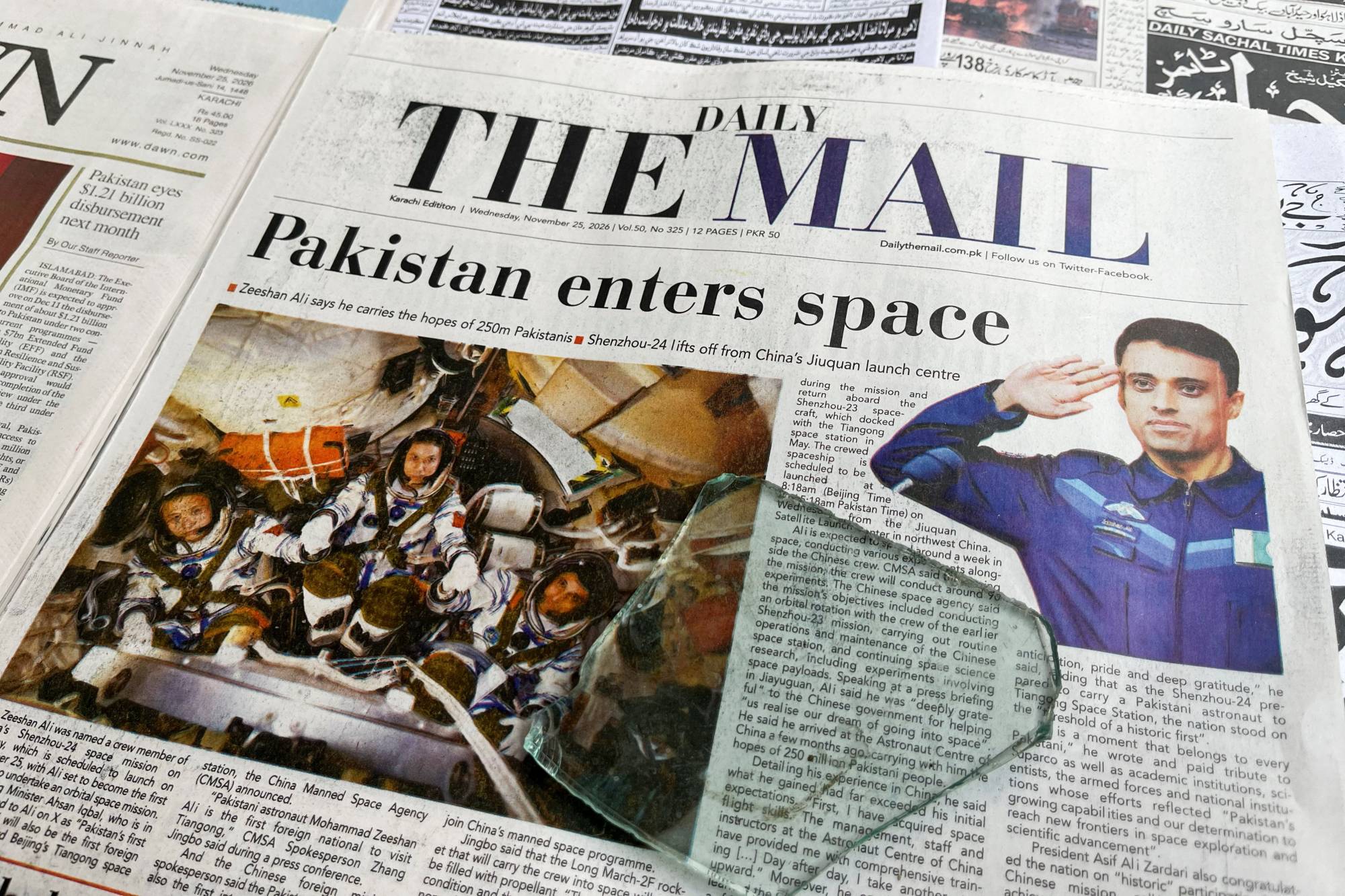
Zeeshan Ali, the first foreign astronaut to visit China's space station and also the first Pakistani in orbit, spent about five days aboard Tiangong space station.

Ali arrived at China's space station ⁠on November 25 ⁠aboard the Shenzhou-24 spacecraft, in a mission that marked China's first crewed spaceflight with a foreign cosmonaut.

The joint flight is part of a broader China-Pakistan space partnership that dates back to the early 1990s and ⁠began with Chinese-launched Pakistani satellites.

Though Ali's stay is much shorter than the roughly six-month rotation for a Chinese astronaut, it has been cause for huge celebration in Pakistan.

He is returning to earth alongside Shenzhou-23 crew members Zhang Zhiyuan, commander of the return mission, and Lai Ka-ying, the first astronaut from Hong Kong and China's fourth female space traveler.

A newspaper featuring photographs of Pakistani astronaut Muhammad Zeeshan Ali and reporting on the launch of the Shenzhou-24 spacecraft mission to China's Tiangong space station is displayed at a newspaper stand in Karachi, Pakistan, November 25, 2026. REUTERS/Akhtar Soomro

The Shenzhou-23 ⁠return ⁠capsule will later conduct a controlled re-entry and touch down at the Dongfeng Landing Site in northern China.

The journey from undocking to landing is expected to take about 5.5 hours under China's three-orbit autonomous fast-return profile.

As a payload specialist, Ali was tasked with four joint China-Pakistan experiments in life sciences and materials science while in orbit.


Poutine Headed for International Space Station

Poutine is a famous Canadian dish with fries, gravy and cheese. DAVID BOILY / AFP
TT

Poutine Headed for International Space Station

Poutine is a famous Canadian dish with fries, gravy and cheese. DAVID BOILY / AFP

Poutine, the famous Canadian gravy-soaked French fry dish, will soon be headed to the International Space Station as "a special treat" for astronaut Joshua Kutryk, the Canadian Space Agency (CSA) said Friday.

But the dish, a product of the French-speaking province of Quebec, has been modified for the trip.

While poutine is traditionally made with fries, gravy and cheese curds, the CSA worked with Quebec chef Yves Lowe to develop a dairy-free "space vegan poutine" to comply with guidelines for food that can be sent to the space station.

"I pictured Josh eating his poutine and feeling a bit more at home," Lowe, who is also the head chef for the NHL's Montreal Canadiens, posted on Instagram.

The freeze-dried poutine is scheduled to head to space as part of a resupply mission due to take off this weekend.


Missing Maryland Man with Alzheimer’s Shows Up in Philadelphia, Playing a Piano

Frank Grow was discovered playing the piano (Instagram)
TT

Missing Maryland Man with Alzheimer’s Shows Up in Philadelphia, Playing a Piano

Frank Grow was discovered playing the piano (Instagram)

No one may ever know exactly how Frank Grow made his way more than 100 miles from Maryland to Pennsylvania last week. But about a few hours after Grow, who has Alzheimer’s, disappeared, he turned up in Philadelphia, near where he grew up, and started playing a piano outside.

His daughter, Maggie Henkin, said she had left the car running, parked outside her home in Bowie, Maryland, last Thursday morning and went inside to get a cup of coffee.

“I was gone for literally two minutes and, when I came back out, the car was gone,” she said. “I just panicked. I didn’t know how far he had gotten.”

Speaking to The Washington Post, Henkin explained that her father had not driven since his diagnosis six years ago. It is difficult for him to write his own name, and he sometimes does not remember members of his family.

Henkin said that she panicked when she realized that her father had often asked to return to where he had grown up, Norristown in Pennsylvania, given how far it was from Bowie.

Her father's disappearance triggered a police search and a Silver Alert, she said. Helicopters were enlisted to find him.
Later that day, Angelo Torres, 65, was returning to his home in northeast Philadelphia when he noticed Grow by the corner of his house.

Torres said he couldn’t find any identification on Grow, so he began to check the vehicle that he arrived in. Eventually, Torres found an old invoice in the trunk with Henkin’s phone number.

“Around 1, I got a call from an unknown Philadelphia number, and I picked up and it was this man named Angelo, and he asked if I knew who Frank was. And I said, ‘Yes, that’s my dad,’” Henkin told NBC Philadelphia.

Henkin coordinated for her father's sister, who lives in Norristown, to pick up Grow, The Washington Post wrote. While waiting for her to arrive, Grow started playing the Baldwin piano that Torres's neighbor had left outside to throw out.

“I was blown away by it,” Torres said.

Playing the piano has been a hobby of Grow's for decades, and even with Alzheimer's, Henkin said her father still plays the instrument every day, sometimes for hours at a time.

By the time Grow's sister brought him back home to Maryland around 8 pm, Henkin said he didn’t remember what had happened.
