

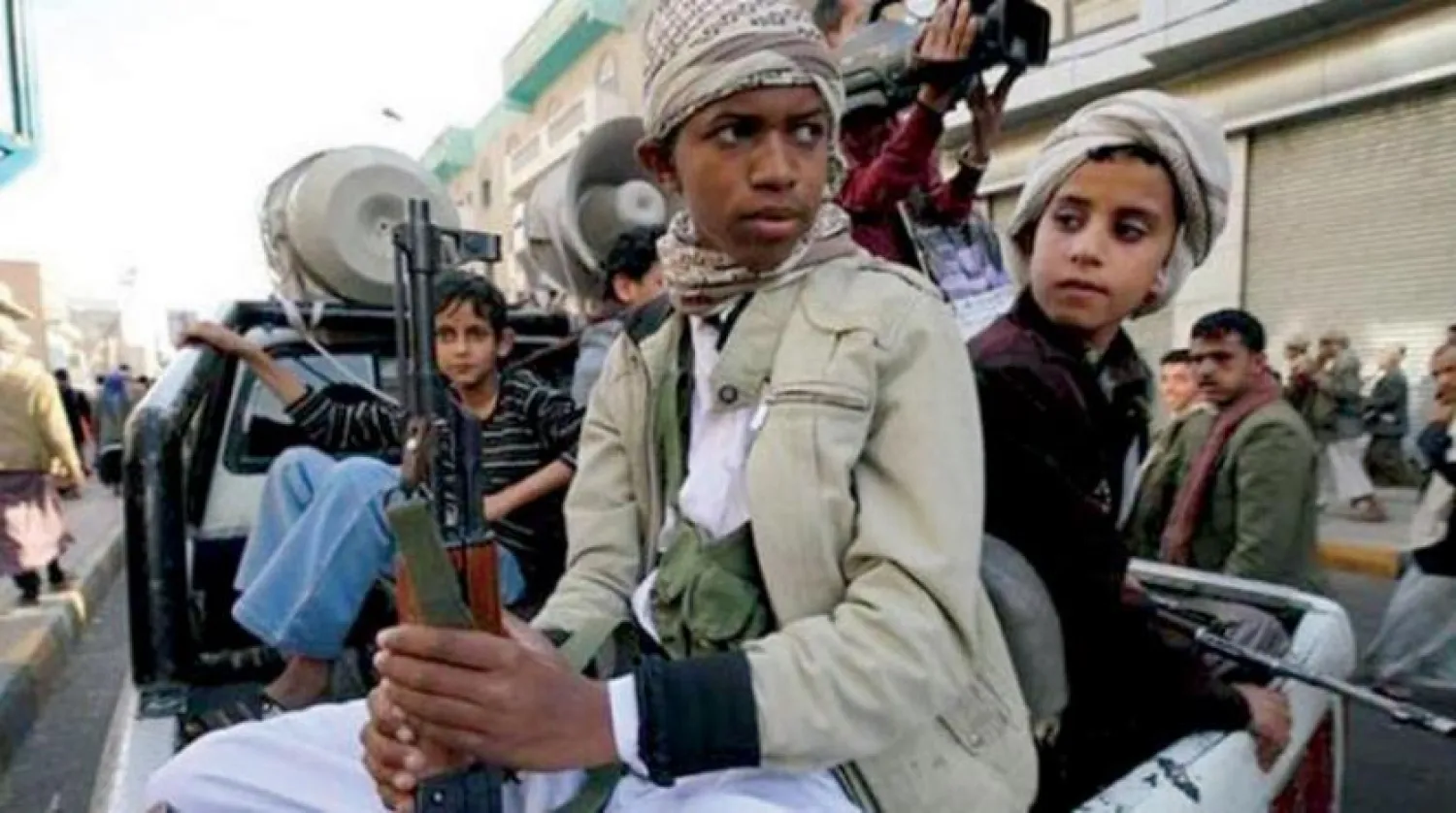

US: We are Beyond Fed up with Houthi Attacks

Children carrying weapons beside Houthi fighters in Sanaa (Reuters)
TT

US: We are Beyond Fed up with Houthi Attacks

Children carrying weapons beside Houthi fighters in Sanaa (Reuters)

The United States affirmed its dissatisfaction with the Houthis intransigence and their lack of commitment to the initiatives seeking a ceasefire, calling for the implementation of a nationwide ceasefire and the initiation of inclusive political talks to establish peace and end the crisis.

During a press briefing, State Department spokesperson Ned Price announced that Washington was beyond fed up with Houthi attacks, stressing: “We are horrified by the repeated attacks on Marib.”

“We strongly condemn the Houthi missile attack on a residential neighborhood in Marib on June 29th. It took civilian lives, including the life of a child. “

Price stressed that the US believes it is a long past time to end the conflict in Yemen and to provide immediate relief to the Yemeni people, noting that “Houthis’ offensive in Marib is exacerbating the humanitarian crisis faced by the people of Yemen.”

It is by many accounts home to the world’s “worst humanitarian catastrophe,” warned Price, indicating that the Houthis continue the “brutal offensive” while there is a serious proposal before them.

“A proposal that would meet their long-held and stated demands for a plan with practical steps to facilitate the flow of goods into and within Yemen, implement a nationwide ceasefire, and initiate inclusive political talks – that is what separates the Houthis from other Yemenis who are actively working towards peace, who strike us as being serious about peace.”

The official expressed US concerns over the loss of life and the fact that this offensive continues to set back the process for a durable political solution to this long-running conflict.

Meanwhile, the US Office to Monitor and Combat Trafficking in Persons condemned in its 2021 report the recruitment, training, and mobilization of African children and migrants as participants in the ongoing conflict.

“Human traffickers exploit domestic and foreign victims in Yemen, and traffickers exploit victims from Yemen who reside abroad. The ongoing conflict, lack of rule of law, economic degradation, pervasive corruption, and fractional territorial control have disrupted some trafficking patterns and exacerbated others.”

The report stated that “migrant workers from the Horn of Africa who remained or arrived in the country during the reporting period may have endured intensified violence.”

During the reporting period, pandemic-related movement restrictions and border closures led to a very low rate of migrant arrivals in Yemen; a total of 37,535 people arrived in 2020, mostly from Ethiopia and Somalia, as in previous years.

However, as Yemen is generally a transit point for migrants traveling to the Gulf for economic opportunity, restrictions, border closures, and bans on international flights stranded thousands of migrants for several months in dire living conditions and with minimal access to assistance and support, according to the report.

“With limited options for survival and decreased support from local communities in Yemen, migrants were forced to look elsewhere to meet basic needs, which traffickers exploit."

Moreover, during the reporting period, there was an increase in reports of migrants subjected to sex trafficking, forced labor, physical and sexual abuse, and abduction for ransom.

The report quoted an international organization stating that since May 2020, 7,652 migrants made their way from Yemen to Djibouti, traveling on smuggling boats or by foot, although the number could be higher as some arrivals may have not been officially captured due to arrivals at coastal locations.

The Government of Djibouti, in coordination with an international organization and the Ethiopian Embassy in Djibouti, reported facilitating the voluntary return of 537 migrants in 2020, the large majority of whom were Ethiopian.

Since the escalation of the armed conflict in March 2015, human rights organizations reported all parties to the conflict continued their unlawful recruitment and use of child soldiers.

“However, verification of such cases remained challenging during the reporting period due to intensified security threats against the monitors and communities of interest, in addition to more restrictive humanitarian access.”

Civil society organizations and media outlets assessed in the previous reporting period that trafficking of Yemeni children gradually increased since the civil war commenced, and children were disproportionately affected by its protracted escalation.

The report stated that Yemen remains a Special Case for the sixth consecutive year.

The civil conflict and humanitarian crisis continued during the reporting period, while the COVID-19 pandemic exacerbated the crisis and further hampered both government and NGO functioning.

It noted that information on human trafficking in the country has been increasingly difficult to obtain since March 2015, when much of the Republic of Yemen Government (ROYG) took refuge in Riyadh following the takeover of Sanaa by Iranian-backed Houthi rebels and lost control of significant portions of the country.

“Although a ROYG and Southern Transitional Council (STC) power-sharing agreement returned the ROYG to its temporary capital of Aden in December 2020, it remained unable to adequately combat trafficking or collect data on trafficking during the reporting period.”

NGOs reported vulnerable populations were at an increased risk of human trafficking due to the protracted armed conflict, civil unrest, and lawlessness, and worsening economic conditions, said the report.

It added that international organizations and NGOs remaining in the country focused primarily on providing humanitarian assistance to the local population and lacked adequate resources and capacity to gather reliable data on human trafficking.

“The vast majority of Yemenis required all types of assistance and basic social services, as the national infrastructure had collapsed.”

As reported over the past five years, human traffickers exploit domestic and foreign victims in Yemen, and traffickers exploit victims from Yemen who reside abroad.



Australia, Canada, France and United Kingdom Regret Postponement of Palestinian Elections

Palestinian President Mahmoud Abbas (Reuters)
TT

Australia, Canada, France and United Kingdom Regret Postponement of Palestinian Elections

Palestinian President Mahmoud Abbas (Reuters)

The foreign ministers of Australia, Canada, France and the United Kingdom on Tuesday expressed deep “regret” over the Palestinian President's decision to postpone the Palestinian Legislative Council elections and the Presidential elections to September 2027.

“Nearly two decades have passed since the last Palestinian Legislative Council elections and five years since the planned 2021 elections were postponed,” the ministers said in a joint statement.

“An entire generation of Palestinians has reached adulthood without the opportunity to choose their elected representatives,” they said, adding that this delay will be deeply disappointing and once again deprive Palestinians of the opportunity to vote and will further erode public confidence in democratic institutions.

“We acknowledge that significant challenges and impediments have affected the ability to conduct elections in a manner fully consistent with international standards and with the participation of all eligible Palestinians,” the ministers said.

They commended the important work of the Central Elections Commission in advancing practical preparations to address these challenges and facilitate voter participation.

The votes were set to happen next month. On Saturday, Palestinian President Mahmoud Abbas issued a decree calling for simultaneous presidential and legislative elections on Sept. 11, 2027, canceling a legislative vote scheduled for Nov. 28, 2026, after his Fatah movement and other Palestinian factions agreed to postpone it.

The widely anticipated decision sets a new date for Palestinians to elect both their president and lawmakers amid concerns over Israeli restrictions and the security situation in Gaza and the West Bank.

In their statement, the foreign ministers said credible elections are an important element of the commitment that Abbas and the Palestinian Authority made to reform, including democratic renewal and accountable governance, and are in line with the July 2025 New York Declaration.

They also noted that strengthening Palestinian governance is essential to continue building the institutional foundations of a viable two-state solution, which is the only path to lasting peace and security for both Israel and Palestine.

The ministers then called on the Palestinian Authority to reconsider the decision to postpone elections and to take the necessary steps to hold legislative and presidential elections, without further delay.

“We will continue to support efforts to deliver on these elections. We reiterate our call on Israel to refrain from actions that could impede the conduct of elections, including the practical arrangements necessary for all Palestinians to participate,” they said.

The four ministers also reiterated their longstanding position that Hamas can have no role in the future governance of Palestine.


Watchdog Chief Says Urgent to Find Remaining Assad-Era Chemical Weapons

Syrian Foreign Minister Asaad al-Shaibani (R) and OPCW Director General Dallafior (L) attend a joint press conference at the Tishreen Palace in Damascus, Syria, 13 October 2026. (EPA)
TT

Watchdog Chief Says Urgent to Find Remaining Assad-Era Chemical Weapons

Syrian Foreign Minister Asaad al-Shaibani (R) and OPCW Director General Dallafior (L) attend a joint press conference at the Tishreen Palace in Damascus, Syria, 13 October 2026. (EPA)

The head of the world's chemical weapons watchdog on a visit Tuesday to Syrian capital Damascus said the remaining chemical weapons from the era of ousted president Bashar al-Assad must be urgently identified and destroyed.

Assad was repeatedly accused of using chemical weapons during Syria's 13-year civil war, and there has been widespread concern about the fate of Syria's stocks since his 2024 ousting.

Sabrina Dallafior, the head of the Organization for the Prohibition of Chemical Weapons (OPCW), hailed cooperation with the new authorities over chemical weapons which Assad allegedly used in mass attacks against his own citizens during the war.

"The most urgent priority now is to assess those sites of most concern from a proliferation perspective," Dallafior said during a joint press conference with Syria's foreign minister.

"That means identifying and securing any remnants of the Assad-era chemical weapons program," she said.

She said that "the OPCW verified the destruction by Syria of 42 chemical aerial bombs for the first time. Verified destruction in cooperation with the new government. This is a milestone."

Syrian Foreign Minister Asaad al-Shaibani meanwhile said that eliminating chemical weapons was "a responsibility towards the victims and a commitment to ensuring that future generations never experience such atrocities again".

He said he had discussed with Dallafior "a roadmap to build on the progress made and move towards the final closure of the file".

The top diplomat said Syria had handed over more than 100,000 official documents to the OPCW and granted the watchdog access to records and witnesses.

Izumi Nakamitsu, head of the UN disarmament office, said an OPCW team in August "verified the irreversible destruction of 42 aerial bombs" by Syrian authorities.

"This significant development means that, for the first time since 2014, the OPCW has verified the destruction of chemical munitions from the Syrian Arab Republic," she said.

The OPCW reinstated Syria in July, following an unprecedented move in 2021 of stripping Syria of its voting rights after finding its air force had used nerve agent sarin and chlorine gas on its own people.

In 2013, Syria agreed to join the OPCW and disclose and hand over its toxic stockpile under Russian and US pressure, and to avert the threat of air strikes by Washington and its allies.

This came after a suspected chemical attack on the Eastern Ghouta suburb of Damascus that killed more than 1,000 people, according to US intelligence, and was attributed to the Syrian government, which denied involvement and blamed opposition forces.


Move to Repeal Syria’s Anti-Brotherhood Law Raises Questions over Group’s Political Return

Syrian President Ahmed al-Sharaa and several ministers attend a military parade in Damascus. (Syrian Defense Ministry)
TT

Move to Repeal Syria’s Anti-Brotherhood Law Raises Questions over Group’s Political Return

Syrian President Ahmed al-Sharaa and several ministers attend a military parade in Damascus. (Syrian Defense Ministry)

Syrian lawmakers are gathering signatures to propose repealing a law that makes membership in the Muslim Brotherhood punishable by death, as the group signals it wants to return to politics after decades of prohibition.

The parallel moves have raised questions about whether Syria’s transitional authorities will allow the Brotherhood back into political life, and how much room they will give political parties.

Abdel Nasser Houshan, chairman of the People’s Assembly’s Constitutional and Legislative Affairs Committee, told Asharq Al-Awsat that the proposal to repeal Law No. 49 of 1980 was still at the signature-gathering stage and had not been submitted to the assembly.

Under the assembly’s rules, 17 members must first approve the proposal before a bill can be drafted and submitted for referral to the relevant committee, he said.

The legacy of Law 49

Media leaks had suggested lawmakers could discuss the proposal at their next session, expected in the middle of this month. Houshan’s comments indicate that the steps needed to bring it before the assembly remain incomplete.

Enacted in July 1980 under former President Hafez al-Assad, Law 49 classified every member of the Muslim Brotherhood as a criminal punishable by death. It became a key weapon in the former government’s confrontation with the group, whose members and supporters faced decades of arrests and persecution.

Hussam Jazmati, a researcher on Islamist organizations and groups, expects “broad support inside and outside the assembly” for repealing the law, given the abuses associated with it under the former government.

Repealing the “strange” law matters regardless of whom it targeted, he told Asharq Al-Awsat.

He called it “one of the instruments of state terror under the Assad regime,” saying security agencies used it to pursue people merely suspected of belonging to the Brotherhood.

The law left a deep legacy of intimidation in Syrian society, particularly in conservative and religious communities, he said.

“Sympathy for its victims could provide a basis for supporting its repeal, even among groups that do not support the Brotherhood politically.”

Yet the law’s legal status is itself unclear.

The declaration issued at the “Victory Conference” on Jan. 29, 2025, after the fall of Bashar al-Assad’s government, suspended all exceptional laws. It remains unclear whether that covered Law 49 — or whether the law still requires a legislative repeal.

The declaration also dissolved the Baath Party, the parties of the National Progressive Front and their affiliated organizations, and banned their reconstitution.

It dissolved military factions and revolutionary political and civilian bodies, requiring their integration into state institutions.

But it did not dissolve all political parties without exception, leaving unresolved the legal basis for party activity during the transition.

A test of political will

For Abdel Rahman al-Haj, a researcher specializing in Islamist movements, bringing the repeal before the People’s Assembly would be “a test of the transitional government’s political will.”

An indefinite delay could signal that the authorities do not want to ease the Brotherhood’s return to politics or allow it an active role in the next phase, he told Asharq Al-Awsat.

“Leaving the law in place without invalidating it in the constitutional declaration, and leaving it to the People’s Assembly, will be understood as additional pressure on the group,” he said.

The Brotherhood had already faced various forms of pressure to dissolve itself, he added.

The Syrian Brotherhood’s Shura Council held its fifth regular session on Sept. 27, 2026, issuing a 16-point statement on political, security and economic developments, as well as regional and international issues.

The statement affirmed the group’s desire to participate in political life and called for pluralism and rules governing party activity. Observers read it as preparation for a return to politics inside Syria.

Al-Haj said its second and sixth points showed that “the group wants to engage in party competition and is preparing for the return of political life as set out in the constitutional declaration.”

The Brotherhood appears to feel it faces “systematic exclusion and marginalization,” he said. At this stage of the transition, he added, it needs to test how serious the government is about establishing a legal framework for political activity ahead of an agreed political transition.

Jazmati sees a more immediate obstacle.

“The return of political life depends on the authorities’ will,” he said, adding that they do not appear to want organized parties, at least during the transition.

Still, he believes the Brotherhood could return to political activity “in one way or another.” Syria has a broad religious current that could find expression in several political parties and organizations, whether or not a new political parties law is enacted.

Sympathy for victims, doubts about the group

Jazmati draws a distinction between sympathy for the Brotherhood’s treatment under Assad and support for the organization today.

“There is widespread sympathy for the victims of arrests, persecution and abuses committed by the former regime, and support for addressing the injustices and providing redress for the harm they suffered,” he said.

That sympathy, however, “does not necessarily mean support for the group’s return in its current organizational form.”

The Brotherhood’s record during the Syrian revolution draws a less favorable assessment, he said, citing accusations that it tried to dominate opposition institutions and bore some responsibility for their failures, along with criticism of its management of political and relief work.

He described that negative view as resting on “a set of facts as well as a set of exaggerations,” stressing the need to distinguish between former detainees and victims of the government and the political organization that exists today.

Early in the revolution, sections of the Brotherhood’s support base welcomed its participation in preparatory conferences to establish the opposition Syrian National Council. Criticism of its performance within opposition institutions later intensified.

“The group’s popularity declined during those years, while other Islamist currents rose, particularly the current from which the leaders of Syria’s present authorities emerged,” Jazmati said.

Could a return spur other groups?

The Brotherhood’s signals have also raised questions about what its return could mean for Islamist organizations and other political forces waiting for rules governing party activity.

Al-Haj sees the prospect of its return encouraging other Islamist organizations as “possible, but unlikely.”

The Brotherhood’s presence rests on “its organizational and political history, rather than solely on its Islamist ideology,” he said. Other currents compete to represent that ideology, including the one from which Hayat Tahrir al-Sham emerged.

He expects the group to attract some Syrians who share its ideological outlook and are dissatisfied with the course of the transition.

Its return could do more to encourage non-Islamist organizations than Islamist ones to prepare for political participation, he said. But the transition’s uncertain contours make the consequences difficult to predict.

With the repeal proposal still at an early stage and the rules for party activity unresolved, the Brotherhood’s return to politics would test more than its own future.

It would also test the limits of pluralism Syria’s transitional authorities are prepared to allow.