

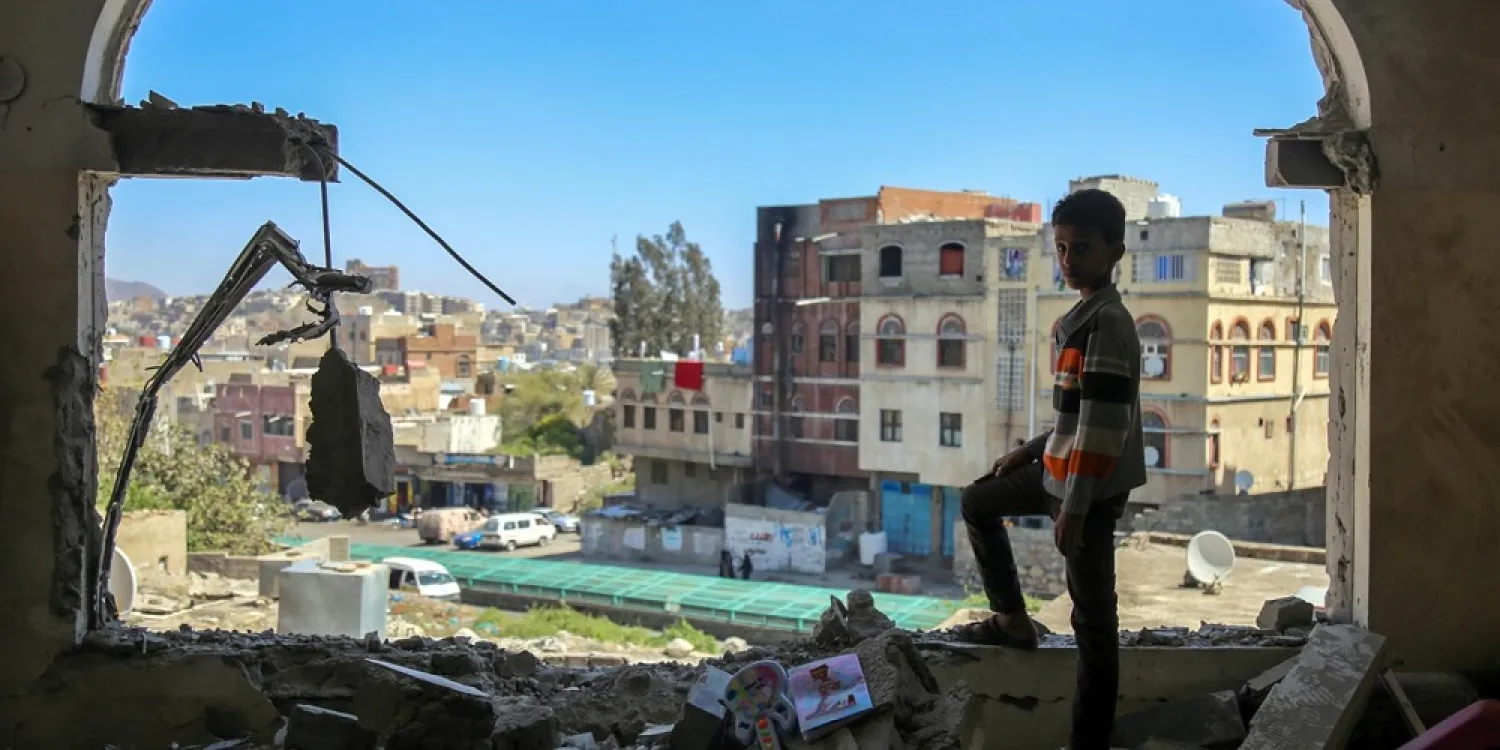

Yemenis Exasperated with Prolonged War, Houthi Coup

A Yemeni boy checks damage following a mortar attack in the city of Taiz, February 2016. (Getty Images)
TT

Yemenis Exasperated with Prolonged War, Houthi Coup

A Yemeni boy checks damage following a mortar attack in the city of Taiz, February 2016. (Getty Images)

Yemenis are growing increasingly frustrated and exasperated with the prolongation of their country’s conflict and the Iran-backed Houthi militias’ ongoing coup against the legitimate authorities.

The conflict has entered its fourth year with political efforts to resolve it stumbling at the Houthis’ rejection of a solution and their insistence on alone ruling Yemen to fulfill Iran’s expansionist ambitions.

The legitimate authorities, meanwhile, are fragmented and divided and have been unable throughout the years to achieve military victory despite the unlimited support offered to it by the Saudi-led Arab coalition on all levels.

The stalemate is deepening the suffering of some 30 million Yemenis, who are mired in poverty, lack basic services and have to content with Houthi oppression.

Several officials urged through Asharq Al-Awsat the need to speed up efforts to overcome the stalemate. They called for ending the division within the national front that is opposed to the coup, underscoring the need for political and military reform to enable the legitimate powers to achieve a decisive victory and reclaim the country from the militias.

Opportunistic political powers
Yemeni journalist Waddah Al-Jaleel blamed the frequent setbacks in the country on the state of fragmentation and division within the national front.

Speaking to Asharq Al-Awsat, he slammed the political powers as “opportunistic,” saying they are competing with each other over “narrow interests” and “hording gains.”

These powers are a product of “long decades of tutelage, marginalization, ideological struggle and years of pent-up frustration against each other,” he explained. “They have reached such a point that they can no longer set aside their grudges and work within a united front to confront the fateful challenges posed by the Houthis.”

These political powers have “obstructed society’s ability to produce groups and formations that can wage crucial battles. On the one hand, society has fallen in the trap of the stagnation of these forces in performing their duties. On the other, large segments of the youth belong to these forces and powers. They too have fallen into the trap of political bickering and have grown suspicious and spiteful of each other.”

This has all allowed the Houthis vast room to manipulate Yemeni society with the support of the regime in Iran, stressed Al-Jaleel.

The Yemenis need to overcome this state by setting aside these parties and forming new ones that can properly address the fateful challenges confronting the country, including the Houthis and Iran’s influence, he suggested.

Errors
Researcher and academic Dr. Fares Al-Beel was quick to blame the Yemeni forces for prolonging the war due to their mistakes and lax approach in handling issues.

He told Asharq Al-Awsat: “The Yemenis have reached a desperate conclusion over their crisis. (…) They are caught between the Houthis, whose fire can only be doused by tackling the root. These flames started off as minor but have since grown due to the errors of the Yemenis and their laziness in dealing with them.”

He lamented how for seven years the Houthis have been able to expand in Yemen while the world has offered them options, instead of viewing them as the aggressors. The militias even refuse peace agreements that would make them a legitimate force, he noted.

The Houthis don’t even need such deals because the “powerlessness” of their rivals encourages them to maintain the current status quo.

He blamed the “weakness, fragmentation and corruption of the legitimate forces” for their failure to achieve a decisive victory in the conflict against the Houthis. This weakness has led to the failure in restoring the state. The power of the state does not come close to the strength and size of the Houthis.

Moreover, al-Beel criticized the legitimate authorities for limiting themselves to political negotiations with the Houthis despite realizing that such talks will not restore the state.

The weakness of the legitimate power and brutality of the Houthis are destroying the Yemenis, who are grappling with the worst crisis on earth, he added.

Their legitimate government is not even carrying out the bare minimum of its duties, he noted. “It can do a lot in easing the suffering of the people, but it is too preoccupied with internal disputes.”

“The Yemenis have one choice: For the legitimate authority to wake up and amend its mistakes immediately. It should sincerely and transparently dedicate all of its efforts in restoring the state and defeating the Iranian agenda. Only then will all sides support it and will the Houthis be defeated,” he explained.

Division and lack of planning
Political analyst Mahmoud Al-Taher criticized the legitimate forces for their “division and lack of strategic planning.”

In remarks to Asharq Al-Awsat, he also blamed a political faction, which he did not name, for “controlling the legitimacy, while other combat units refuse to take part in the fateful national battle.”

Moreover, he slammed the paranoid state of political factions that constantly question each other’s loyalties to the detriment of the military battles.

“Unfortunately, the real problem lies in the Yemeni legitimate forces. Had they been vigilant to this battle, they would not have allowed the tribes to rise up in al-Bayda and wage the fight alone against the Houthis. The legitimacy should have instead waged battles on all the fronts at the same time to force the Houthis to accept peace,” he stated.

After the liberation of southern provinces, the Yemeni government paused to hear out the international community’s advice on stopping the war, he continued. “This allowed the Houthis to catch their breath, play the game of prolonging the conflict and infiltrate tribes and deepen its political, ideological and financial influences. They therefore, managed to shift from a defensive position to an offensive one.”

He blamed political disputes within the legitimate forces and all other groups that are opposed to the Houthis for the delay in achieving victory against the militias.

Furthermore, he spoke of “the corruption of politician and military commanders, who have turned the war into a way of achieving economic interests.” He further criticized “weak strategic political, military and media planning” in confronting the Houthis.

Al-Taher said he feared the prolongation of the war would lead to Yemen’s division into statelets and the elimination of all opponents of the Iranian agenda.

At the same time, he expressed some optimism that the Yemenis would be capable of victory if they “amend their errors and unite all political forces towards a common goal.”

“The Yemenis will not achieve victory as long as some forces in the southern provinces are prepared to fight each other, in complete disregard of the imminent Iranian threat,” he warned.

He also doubted that international efforts can resolve the war. “Only the Yemenis or legitimacy will be victorious. Waiting on the international community will not lead to peace because the victor on the ground is the one who sets conditions, changes the course of events and writes history.”



Why Metal Prices are Soaring to Record Highs

A salesman displays gold chains at an Indian jewelry store in September. Idrees MOHAMMED / AFP
TT

Why Metal Prices are Soaring to Record Highs

A salesman displays gold chains at an Indian jewelry store in September. Idrees MOHAMMED / AFP

Precious and industrial metals are surging to record highs as the year ends, driven by economic and geopolitical uncertainty, robust industrial demand and, in some cases, tight supply.

Below AFP examines the reasons for the surge in demand.

- Safe havens -

Gold and silver are traditionally seen as safe-haven assets, and demand has soared amid mounting geopolitical tensions, from US President Donald Trump's tariffs onslaught to wars in Ukraine and Gaza, as well as recent pressure by Washington on Caracas.

Investors are also uneasy about rising public debt in major economies and the risk of a bubble in the artificial intelligence sector.

These uncertainties are driving up gold and silver, with other metals now starting to see the impact as investors seek to diversify their portfolios, explained John Plassard, an analyst at Cite Gestion Private Bank.

"Metal is once again becoming insurance rather than just a speculative asset," he told AFP.

- A weak dollar -

Traditional safe havens like the dollar and US Treasuries have become less attractive this year.

Uncertainty around Trump's presidency and the prospect of further Federal Reserve interest rate cuts, have weakened the dollar, reducing its appeal to investors.

As a result, many investors are turning to gold and silver.

Gold has climbed more than 70 percent this year and passed $4,500 an ounce for the first time on Wednesday, while silver reached a record high of $72 an ounce, with prices up about 2.5 times since January.

A weak dollar is also boosting industrial metals, since commodities priced in dollars become cheaper for buyers when the currency falls.

- Fresh demand -

Industrial demand has surged in recent months, driven by the rise of artificial intelligence and the energy transition.

Copper, used for solar panels, wind turbines, electric vehicle batteries and data centers, has seen strong gains as a result.

Prices hit a record on Wednesday, topping $12,000 a ton, helped further by China, the world's largest copper consumer, announcing new measures to boost demand.

Aluminium, a cheaper alternative to copper, and silver are also benefiting from the AI boom and the shift to renewable energy.

Platinum and palladium, used in car catalytic converters, have also risen, reaching a record high and a three-year high respectively, after the European Union decided to allow sales of new internal combustion vehicles beyond 2035.

- Tight supply -

Copper prices have been lifted this year by fears of US tariffs, prompting companies to stockpile ahead of their introduction, with duties imposed on semi-finished products and potentially extending to refined copper.

Supply risks from disruptions at mines in the Democratic Republic of Congo, Chile and Indonesia have added to the price surge.

Physical markets for silver, platinum, and aluminium are also tight.

According to Ole Hansen, an analyst at Saxo Bank, thin holiday trading, which increases volatility, and investor fear of missing out have further amplified the rise at the end of the year.


How Trump’s Decisions Reshaped Syria

A photo of US President Donald Trump meeting Syrian President Ahmed al-Sharaa in Washington on Nov. 10 (AFP)
TT

How Trump’s Decisions Reshaped Syria

A photo of US President Donald Trump meeting Syrian President Ahmed al-Sharaa in Washington on Nov. 10 (AFP)

In a crowded regional and international landscape shaped by overlapping security, strategic, economic, and political pressures, the administration of US President Donald Trump has moved since its return to the White House in January 2025 to recalibrate its approach to Syria.

After years of US policy marked by hesitation and competing agendas, particularly under the administrations of Barack Obama and Joe Biden, Washington is now pursuing a more direct and openly pragmatic course, one focused on achieving tangible results on the ground and managing delicate balances, rather than ideological commitments or long-term strategic gambles.

The shift reflects profound changes inside Syria itself, led by the collapse of the former regime and the emergence of a new government seeking to consolidate domestic legitimacy and secure international recognition.

These developments coincide with the persistent threat posed by ISIS, a retreat in Iranian influence, and the expanding regional roles of Saudi Arabia, Türkiye, and Qatar.

Within this evolving landscape, Washington is repositioning its policy in line with what officials describe as Trump’s Middle East doctrine, centered on enforcing stability, limiting the costs of direct military involvement, and opening pathways for reconstruction, development, and investment.

Interests before ideology

Commenting on this shift, Firas Fahham, a researcher at the Abaad Studies Center, said President Trump’s policy toward Syria could be described as “decidedly pragmatic,” focusing primarily on international and economic interests while setting aside the ideological or intellectual background of Syria’s new government.

Fahham said the central pillar of the emerging convergence between Washington and Damascus was preventing the return of Iranian influence to Syria, a goal that sits at the top of the current US administration’s priorities.

He added that this approach could not be separated from the positions of Arab states allied with the United States, which have openly supported the new Syrian government, led by Saudi Arabia, followed by Türkiye and Qatar.

Fahham said the Trump administration had shown a willingness to respond to these positions, viewing them as a key foundation for rebuilding regional alliances.

Comparing the approach with previous administrations, Fahham said the policies of Obama and Biden had been closer to allowing Iran a free hand in the region and supporting minority influence, particularly through close cooperation with the Syrian Democratic Forces, known as the SDF.

He said this had complicated the landscape and weakened prospects for establishing a strong central state capable of maintaining security and preventing the return of extremist groups.

From Riyadh to Washington...turning points

Fahham traced key milestones in Trump’s new policy, saying the starting point came during meetings held in Riyadh in June, when the US president, at the request of Saudi Crown Prince Mohammed bin Salman, announced the lifting of sanctions on Syria.

He described the move as the first positive signal from Washington toward Damascus. This was followed by a trilateral meeting bringing together Trump, the Saudi Crown Prince, and Syrian President Ahmed al-Sharaa, during which the US president offered notable praise for his Syrian counterpart, reflecting Washington’s desire for political openness.

The most important moment, Fahham said, came at the Washington summit held in November, when Trump received President al-Sharaa at the White House in what he described as a pivotal turning point.

Following the meeting, the US administration began concrete efforts to pressure Congress to repeal the Caesar Act, while announcing Syria’s inclusion in the international coalition against ISIS.

This, Fahham said, shifted the relationship from limited coordination to something resembling an alliance.

The SDF and the future of eastern Syria

On the issue of the Syrian Democratic Forces, Fahham said the Trump administration was dealing with the matter from a strictly practical standpoint, balancing its interests with Syria’s new government, reflected in reduced support for the SDF compared with the Biden era, and its interests with its Turkish ally.

Washington, he said, now views Damascus as the most effective actor in the fight against ISIS.

This assessment, he said, was based on recommendations from US research centers. They concluded that previous reliance on the Kurdish component alone, and practices associated with it in eastern Syria, had created a sense of grievance that ISIS later exploited for recruitment.

As a result, the administration became convinced that cooperation with Damascus was more effective.

In a related context, Fahham said Washington viewed Israeli incursions in southern Syria with dissatisfaction, considering them destabilizing and contrary to Trump’s vision for regional development.

The United States, he added, fears that weakening the Syrian government could reopen the door to renewed Iranian influence and ISIS activity.

As for the southern province of Sweida, Fahham said the US administration supports integrating the province into the state, citing remarks by US envoy Tom Barrack, who stated that decentralization had failed in the Middle East, reflecting a preference for backing a unified Syria.

A parallel reading from the military establishment

From another angle, researcher on armed groups Raed al-Hamed offered a complementary reading of the US position.

He said that although Trump, during his first term, had moved toward withdrawing forces and ending the partnership with the SDF, warnings from senior military commanders about a possible ISIS resurgence after the battle of Baghouz in March 2019 prompted him to keep about 2,000 troops in Syria.

Al-Hamed noted that the partnership with the SDF dated back to the battle of Kobani in 2015, when Washington relied on the group as a ground force.

However, he said the new policy following the fall of Bashar al-Assad’s regime and Syria’s entry into the international coalition was now based on refusing to recognize any independent entity east of the Euphrates and rejecting federal formulas similar to Iraq’s Kurdistan region.

Al-Hamed said the new policy offered no real US guarantees to the SDF in the face of Türkiye and coincided with pressure to integrate the group into Syria’s military and security institutions, in line with the vision of the Syrian government, which rejects any armed presence outside the framework of the state.

This, he said, is still rejected by the SDF as the deadline approaches for implementing the March agreement with the government in Damascus, scheduled for the end of this year.

Overall, the Syrian scene appears to have entered a pivotal phase that goes beyond traditional conflict equations, laying the groundwork for a new reality governed by the language of interests and reciprocal security arrangements.

While Washington and its regional allies, particularly Riyadh and Ankara, are betting on the ability of the new leadership in Damascus to impose stability and end years of chaos, observers say the success of this path will depend on developments on the ground in the coming months.

The ability of the “new republic” to balance the demands of internal reconciliation with the conditions of external alliances will be the decisive test in determining whether this turn truly marks the opening chapter of an end to years of US hesitation in the region.


Thousands Flock to Bethlehem to Revive Christmas Spirit after 2 Years of War in Gaza

 Palestinian scout bands parade toward the Manger Square near the Church of the Nativity, traditionally believed to be the birthplace of Jesus, on Christmas Eve, in the West Bank city of Bethlehem, Wednesday, Dec. 24, 2025. (AP Photo/Mahmoud Illean)
Palestinian scout bands parade toward the Manger Square near the Church of the Nativity, traditionally believed to be the birthplace of Jesus, on Christmas Eve, in the West Bank city of Bethlehem, Wednesday, Dec. 24, 2025. (AP Photo/Mahmoud Illean)
TT

Thousands Flock to Bethlehem to Revive Christmas Spirit after 2 Years of War in Gaza

 Palestinian scout bands parade toward the Manger Square near the Church of the Nativity, traditionally believed to be the birthplace of Jesus, on Christmas Eve, in the West Bank city of Bethlehem, Wednesday, Dec. 24, 2025. (AP Photo/Mahmoud Illean)
Palestinian scout bands parade toward the Manger Square near the Church of the Nativity, traditionally believed to be the birthplace of Jesus, on Christmas Eve, in the West Bank city of Bethlehem, Wednesday, Dec. 24, 2025. (AP Photo/Mahmoud Illean)

Thousands of people flocked to Bethlehem's Manger Square on Christmas Eve as families heralded a much-needed boost of holiday spirit. The giant Christmas tree that was absent during the Israel-Hamas war returned on Wednesday, overlooking a parade of scouts playing songs on bagpipes.

The city where Christians believe Jesus was born cancelled Christmas celebrations for the past two years. Manger Square had instead featured a nativity scene of baby Jesus surrounded by rubble and barbed wire in homage to the situation in Gaza, The AP news reported.

Cardinal Pierbattista Pizzaballa, the top Catholic leader in the Holy Land, kicked off this year's celebrations during the traditional procession from Jerusalem to Bethlehem, calling for “a Christmas full of light.”

Arriving in Manger Square, Pizzaballa said he came bearing greetings from Gaza's tiny Christian community, where he held a pre-Christmas Mass on Sunday. Among the devastation, he saw a desire to rebuild.

“We, all together, we decide to be the light, and the light of Bethlehem is the light of the world,” he told thousands of people, Christian and Muslim.

Despite the holiday cheer, the impact of the war in the Israeli-occupied West Bank is acute, especially in Bethlehem, where around 80% of the Muslim-majority city’s residents depend upon tourism-related businesses, according to the local government.

The vast majority of people celebrating were residents, with a handful of foreigners in the crowd. But some residents said they are starting to see signs of change as tourism slowly returns.

Loss of tourism devastates Bethlehem “Today is a day of joy, a day of hope, the beginning of the return of normal life here,” said Bethlehem resident Georgette Jackaman, a tour guide who has not worked in more than two years.

She and her husband, Michael Jackaman, another guide, are from established Christian Bethlehem families that stretch back generations. This is the first real Christmas celebration for their two children, aged 2 1/2 and 10 months.

During the war, the Jackamans pivoted to create a website selling Palestinian handicrafts to try to support others who have lost their livelihoods.

During the Gaza war, the unemployment rate in the city jumped from 14% to 65%, Bethlehem Mayor Maher Nicola Canawati said earlier this month.

A visitor from France, Mona Riewer, said that “I came because I wanted to better understand what people in Palestine are going through, and you can sense people have been through a very hard time."

Although friends and family cautioned her against coming due to the volatile situation, Riewer said being in Bethlehem helped her appreciate the meaning of the holiday.

“Christmas is like hope in very dark situations, a very vulnerable child experiencing harshness,” she said.

Despite the Gaza ceasefire that began in October, tensions remain high across much of the West Bank.

Israel’s military continues to carry out frequent raids in what it says is a crackdown on militants. Attacks by Israeli settlers against Palestinians have reached their highest level since the United Nations humanitarian office started collecting data in 2006. Israel captured the West Bank in the 1967 Mideast war.

The internationally recognized Palestinian Authority has limited autonomy in parts of the territory, including Bethlehem. Palestinian President Mahmoud Abbas is expected to attend midnight Mass for the first time in two years, the mayor said.

As poverty and unemployment have soared, about 4,000 people have left Bethlehem in search of work, the mayor said. It’s part of a worrying trend for Christians, who are leaving the region in droves.

Christians account for less than 2% of the West Bank’s roughly 3 million residents. Across the Middle East, the Christian population has steadily declined as people have fled conflict and attacks.

The beginning of a return to normal life Fadi Zoughbi, who previously worked overseeing logistics for tour groups, said his children were ecstatic to see marching bands streaming through Bethlehem's streets.

The scouts represent cities and towns across the West Bank, with Palestinian flags and tartan draped on their bagpipes, drummers spinning mallets adorned with pompoms. For the past two years, the scouts marched silently as a protest against the war.

Irene Kirmiz, who grew up in Bethlehem and now lives in Ramallah, said the scout parade is among her favorite Christmas traditions. Her 15-year-old daughter plays the tenor drum with the Ramallah scouts.

But her family had to wake up at 5 a.m. to arrive in time for the parade and waited upwards of three hours at Israeli checkpoints. The drive previously took 40 minutes without the checkpoints that have increasingly made travel difficult for Palestinians, she said.

“It's very emotional seeing people trying to bounce back, trying to celebrate peace and love,” Kirmiz said.

The Israeli Ministry of Tourism estimates 130,000 tourists will visit Israel by the end of December, including 40,000 Christians. In 2019, a banner year for tourism before the pandemic, the tourism ministry said 150,000 Christian tourists visited during Christmas week alone.

During the previous two years, the heads of churches in Jerusalem urged congregations to forgo “any unnecessarily festive activities.” They encouraged priests and the faithful to focus on Christmas’ spiritual meaning and called for “fervent prayers for a just and lasting peace for our beloved Holy Land.”