


Houthis Incur Losses South of Marib, Yemeni Govt Accuses Insurgency of Leaning on Iran

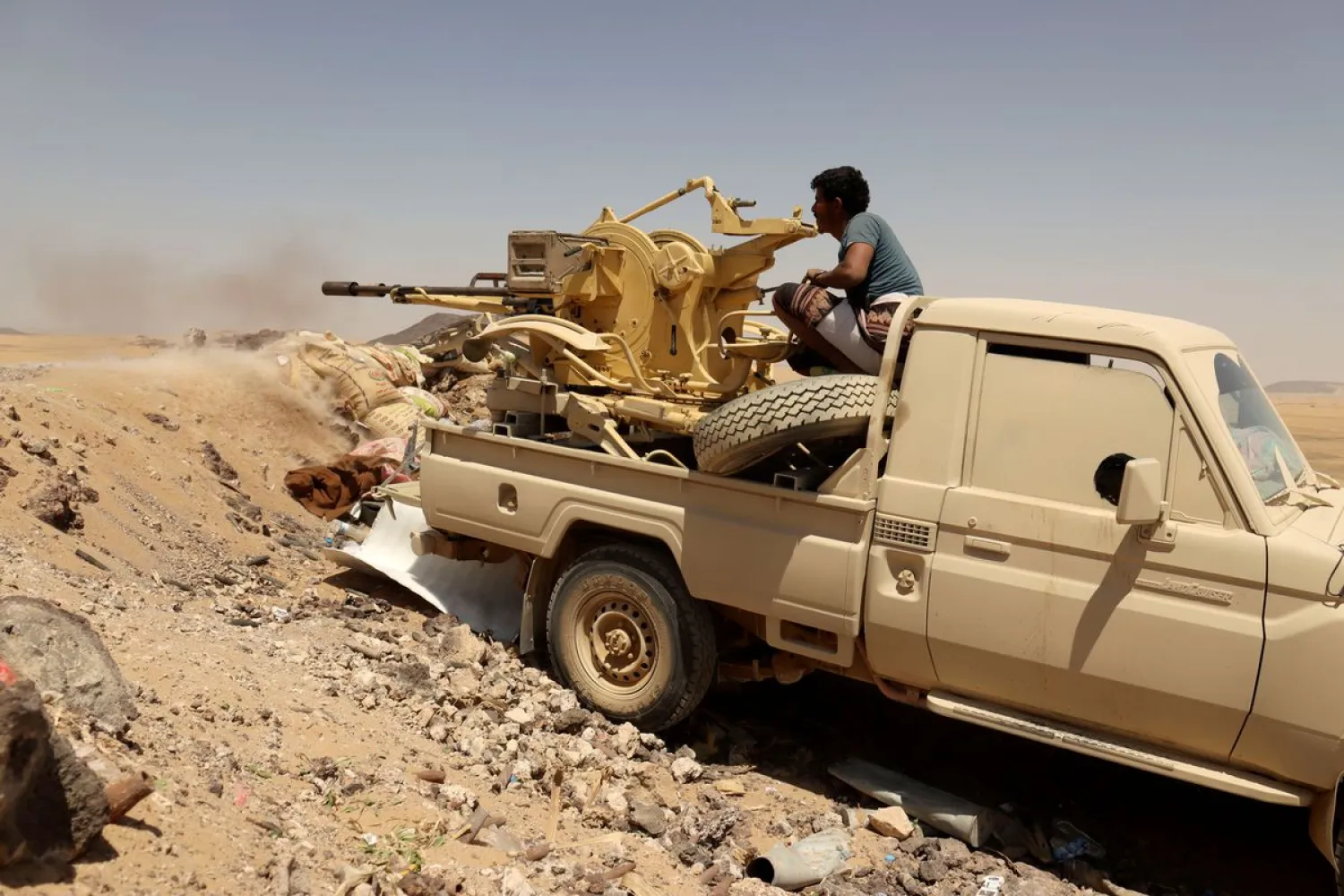
A Yemeni government fighter fires a vehicle-mounted weapon at a frontline position during fighting against Houthi militants in Marib, Yemen, March 28, 2021. Picture taken March 28, 2021. REUTERS/Ali Owidha/File Photo
TT

Houthis Incur Losses South of Marib, Yemeni Govt Accuses Insurgency of Leaning on Iran

A Yemeni government fighter fires a vehicle-mounted weapon at a frontline position during fighting against Houthi militants in Marib, Yemen, March 28, 2021. Picture taken March 28, 2021. REUTERS/Ali Owidha/File Photo

While continuing to mount attacks against Yemen’s northeastern governorate of Marib, Houthis reaffirmed allegiance to Tehran by sending a delegation to the Iranian capital to attend the swearing-in ceremony of the new President of Iran, Ebrahim Raeisi.

For the Yemeni internationally recognized government, a Houthi delegation participating at the Iranian event exposes how deeply aligned the insurgency group is with Tehran’s regional projects and ambitions.

Photos taken at the ceremony show Abdulsalam Fleitah, the de facto Houthi foreign minister, bowing down to salute the Iranian Revolutionary Guard Quds Force Commander Esmail Qaani.

Not only did the government decry Houthi behavior, but even insurgency loyalists criticized Fleitah for appearing next to Raeisi without the Yemeni flag in the background.

They also slammed the head of Houthi foreign affairs for sporting a luxurious watch to the event when millions of Yemenis are suffering back home.

Moammar Al-Eryani, Yemen’s minister for information, culture, and tourism, said that Iran hosting delegations from regional proxies and affiliated terrorist militias is an indicator that the cleric-led country will maintain hardline policies, especially at a time when it has stepped up its terror targeting of international navigation in Arab Gulf waters.

Eryani said that the ceremony also reflected the regional and international isolation Tehran suffers today.

“Instead of the new Iranian president sending positive messages on the sidelines of his inauguration ceremony… Tehran officially announces its sponsorship of terrorist militias, and its responsibility for crises and wars in the region, and terrorism that threatens the interests of the entire world,” said Eryani in an official statement.

As for battlefield developments, Yemeni army media reported that Arab Coalition fighter jets raided multiple Houthi positions in Marib’s southern Rahabah district, killing and injuring dozens of militiamen.

Other Arab Coalition airstrikes destroyed several pick-up vehicles carrying insurgency combatants across Rahabah.


Jailed Turkish Kurd Leader Calls on Government to Broker Deal for Syrian Kurds

(FILES) Supporters display a poster depicting jailed leader of the Kurdistan Workers' Party (PKK) Abdullah Ocalan, after he called on the Kurdistan Workers' Party (PKK) to disarm and dissolve itself in Diyarbakir, southeastern Türkiye, on February 27, 2025. (Photo by Yasin AKGUL / AFP)
TT

Jailed Turkish Kurd Leader Calls on Government to Broker Deal for Syrian Kurds

(FILES) Supporters display a poster depicting jailed leader of the Kurdistan Workers' Party (PKK) Abdullah Ocalan, after he called on the Kurdistan Workers' Party (PKK) to disarm and dissolve itself in Diyarbakir, southeastern Türkiye, on February 27, 2025. (Photo by Yasin AKGUL / AFP)

Jailed Turkish Kurd leader Abdullah Ocalan said Tuesday that it was "crucial" for Türkiye’s government to broker a peace deal between the Kurdish-led Syrian Democratic Forces (SDF) and the Damascus government.

Clashes between Syrian forces and the SDF have cast doubt over a deal to integrate the group's fighters into the army, which was due to take effect by the end of the year, reported AFP.

Ocalan, founder of the Kurdistan Workers' Party (PKK) group, called on Türkiye to help ensure implementation of the deal announced in March between the SDF and the Syrian government.

"It is essential for Türkiye to play a role of facilitator, constructively and aimed at dialogue," he said in a message released by Türkiye's pro-Kurdish DEM party.

"This is crucial for both regional peace and to strengthen its own internal peace," Ocalan, who has been jailed for 26 years, added.

"The fundamental demand made in the agreement signed on March 10 between the SDF and the government in Damascus is for a democratic political model permitting (Syria's) peoples to govern together," he added.

"This approach also includes the principle of democratic integration, negotiable with the central authorities. The implementation of the March 10 agreement will facilitate and accelerate that process."

The backbone of the US-backed SDF is the YPG, a Kurdish group seen by Türkiye as an extension of the PKK.

Türkiye and Syria both face long-running unrest in their Kurdish-majority regions, which span their shared border.

In Türkiye, the PKK agreed this year at Ocalan's urging to end its four-decade armed struggle.

In Syria, Sharaa has agreed to merge the Kurds' semi-autonomous administration into the central government, but deadly clashes and a series of differences have held up implementation of the deal.

The SDF is calling for a decentralized government, which Sharaa rejects.

Turkish Foreign Minister Hakan Fidan, whose country sees Kurdish fighters across the border as a threat, urged the SDF last week not to be an "obstacle" to stability.

Syrian Kurdish leader Mazloum Abdi said Thursday that "all efforts" were being made to prevent the collapse of talks.


Yemen's PLC Imposes No Fly-Zone, Sea and Ground Blockade on All Ports and Crossings

Chairman of Yemen's Presidential Leadership Council Dr. Rashad al-Alimi. (Saba)
TT

Yemen's PLC Imposes No Fly-Zone, Sea and Ground Blockade on All Ports and Crossings

Chairman of Yemen's Presidential Leadership Council Dr. Rashad al-Alimi. (Saba)

Chairman of Yemen's Presidential Leadership Council Dr. Rashad al-Alimi declared on Tuesday a state of emergency throughout the country in wake of the "internal strife caused by the military rebellion in eastern provinces aimed at dividing the republic."

He called for all military formations and forces in the Hadhramaut and Al-Mahra governorates to coordinate completely with the Coalition to Restore Legitimacy in Yemen, represented by Saudi Arabia, and to immediately return to their original positions without a fight. They should cede their positions in the two governorates to the National Shield forces.

Al-Alimi said the state of emergency will last 90 days, which can be extended. He also imposed a no fly-zone, sea and ground blockade on all ports and crossings for 72 hours.

The move also stems from "the commitment to the unity of Yemen, its sovereignty, independence, and territorial integrity and the need to confront the Houthi coup that has been ongoing since 2014," he stressed.

Moreover, al-Alimi called on "all United Arab Emirates forces to leave the country within 24 hours."

"We will firmly deal with any rebellion against state institutions," he warned.

He called on the Southern Transitional Council to "return to reason and quickly and unconditionally withdraw its forces from Hadhramaut and Al-Mahra."

Al-Alimi announced the state of emergency shortly after the Saudi-led Arab coalition carried out a "limited" airstrike targeting a military shipment that had arrived in Yemen's Al-Mukalla port.

In a statement, coalition spokesman Major General Turki al-Malki said the forces detected on Saturday and Sunday the arrival of two vessels from the Port of Fujairah to Mukalla without obtaining any permits from the Joint Forces Command.

Saudi Arabia expressed on Tuesday its disappointment in the United Arab Emirates for pressuring the STC to carry out military operations on the Kingdom's southern borders in Hadhramaut and Al-Mahra.

A Saudi Foreign Ministry statement said: "The steps taken by the UAE are considered highly dangerous, inconsistent with the principles upon which the Coalition to Restore Legitimacy in Yemen was established, and do not serve the coalition's purpose of achieving security and stability for Yemen."

"The Kingdom stresses that any threat to its national security is a red line, and the Kingdom will not hesitate to take all necessary steps and measures to confront and neutralize any such threat," it declared.


STC Accused of Committing Hundreds of Violations in Yemen's Hadhramaut 

A person waves a South Yemen flag during a rally in the southern port city of Aden, Yemen, 25 December 2025. (EPA)
TT

STC Accused of Committing Hundreds of Violations in Yemen's Hadhramaut 

A person waves a South Yemen flag during a rally in the southern port city of Aden, Yemen, 25 December 2025. (EPA)

Yemeni Defense Minister Mohsen Mohammed al-Daeri welcomed on Monday Saudi Defense Minister Prince Khalid bin Salman's message to the Yemeni people in which he called on the Southern Transitional Council (STC) to withdraw its forced from the Hadhramaut and al-Mahra governorates.

He said the message underscores "Saudi Arabia's firm support to Yemen and its legitimate authorities and its constant keenness on backing its unity."

The Kingdom has backed Yemen's efforts to restore state institutions, liberate all of its territories and achieve the goals of the Arab coalition and therefore bolster security and stability in Yemen and the region, he added in a post on Facebook.

He expressed his "absolute trust in the Saudi leadership and its ability to overcome and resolve any differences to help guide both northern and southern Yemen to safety."

He hailed the "Saudi sacrifices and its continuous generous support" to Yemen in all fields, voicing his pride "in this strategic partnership that will remain a cornerstone to completing the liberation and building a secure and prosperous future."

Hundreds of violations

Separately, as the STC continues its unilateral military escalation, reports have emerged of hundreds of violations it has committed in Hadhramaut.

The Yemeni Network for Rights and Freedoms (YNRF) documented 614 violations in the governorate between December 2 and 25. It spoke of a "systematic" targeting of civilians and social infrastructure that has displaced some 5,000 families.

In a report on Monday, it said that the "extent of the violations reflects a systematic pattern of practices that cannot be described as incidental. Rather, they are part of a methodical policy that threatens social peace and undermines the rule of law in one of Yemen's most relatively stable governorates."

The violations include murder, extrajudicial killings, arbitrary arrests, forced disappearances and displacement, and looting of private and public property. It documented the killing of 35 members of the army and 12 civilians, and the injury of 56 others, in Hadhramaut.

It documented seven cases of extrajudicial killings of prisoners and 316 cases of arbitrary arrest against civilians. It reported 216 cases of forced disappearances in Hadhramaut, Raymah, Hajjah, Taiz, Dhumar, Abyan, Ibb and other provinces.

The network noted the looting of 112 homes and 56 commercial establishments.

It said that it has received dozens of notices about the detention and forced disappearance of civilians. It revealed that hundreds of military personnel have been reported missing in grave violation of national law and international standards.

The network said the STC violations are a flagrant violation of international humanitarian law and commitments that have been made in Yemen. Some of the violations can also amount to war crimes and crimes against humanity.

It warned of the "catastrophic" humanitarian consequences of the violations, such as the breakup of the social fabric, greater internal displacement, and collapse of the local economy.

It demanded clear international condemnation of the violations in Hadhramaut, urging an immediate and unconditional end to them. It called for the immediate release of all arbitrarily held detainees and that looted property be returned to their owners. It also demanded that those responsible be held to account.

The developments in Hadhramaut "were not an isolated incident, but part of a systematic pattern that undermines the opportunities for stability and peace in Yemen," it warned.
