


Sweeping New Vaccine Mandates for 100 Million Americans

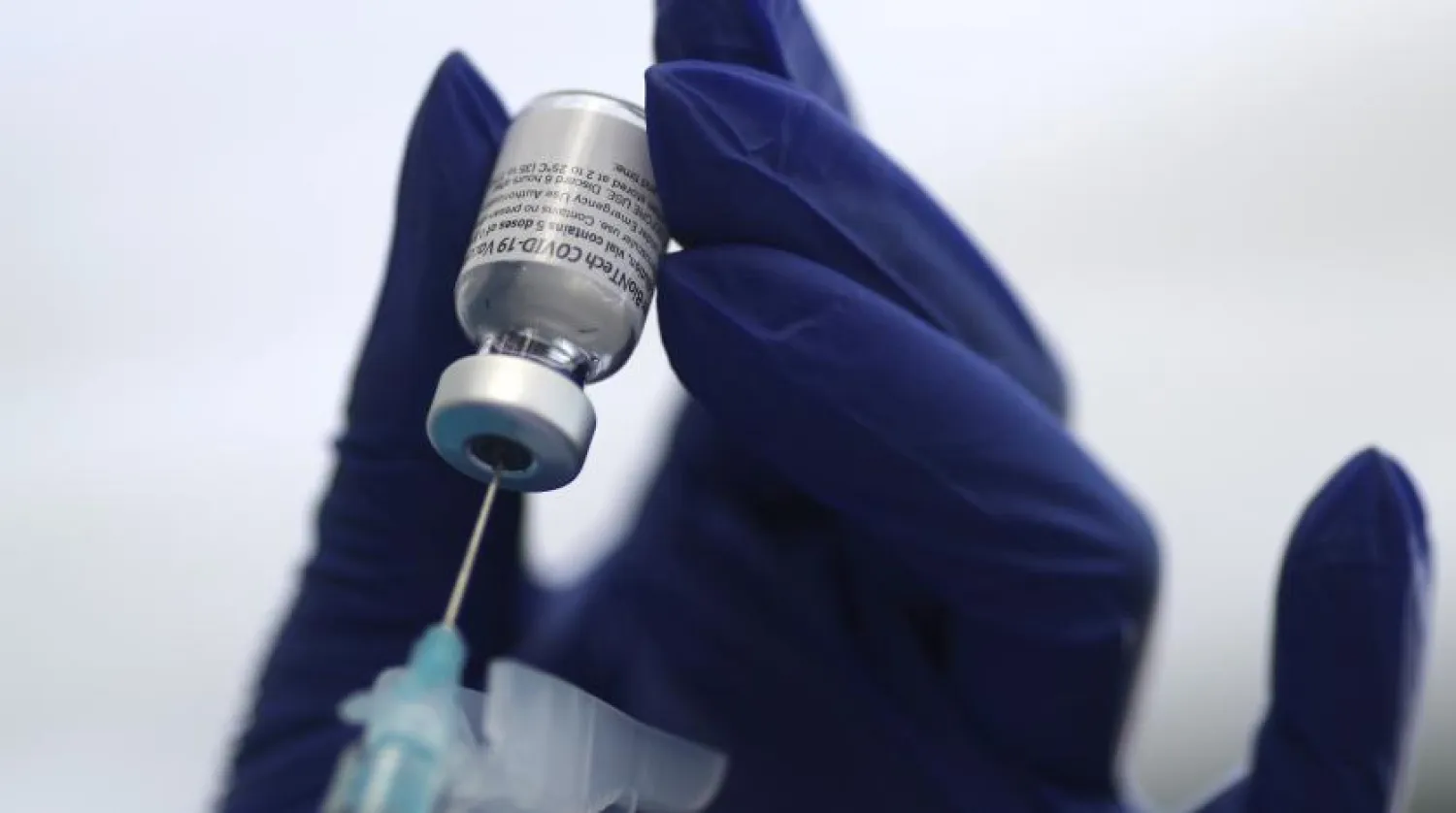
A healthcare worker prepares a Pfizer coronavirus disease (COVID-19) vaccination in Los Angeles, California, US, January 7, 2021. REUTERS/Lucy Nicholson
TT

Sweeping New Vaccine Mandates for 100 Million Americans

A healthcare worker prepares a Pfizer coronavirus disease (COVID-19) vaccination in Los Angeles, California, US, January 7, 2021. REUTERS/Lucy Nicholson

In his most forceful pandemic actions and words, President Joe Biden ordered sweeping new federal vaccine requirements for as many as 100 million Americans — private-sector employees as well as health care workers and federal contractors — in an all-out effort to curb the surging COVID-19 delta variant.

Speaking at the White House Thursday, Biden sharply criticized the tens of millions of Americans who are not yet vaccinated, despite months of availability and incentives.
“We’ve been patient. But our patience is wearing thin, and your refusal has cost all of us," he said, all but biting off his words. The unvaccinated minority “can cause a lot of damage, and they are.”

Republican leaders — and some union chiefs, too — said Biden was going too far in trying to muscle private companies and workers, a certain sign of legal challenges to come.

Gov. Henry McMaster of South Carolina said in a statement that “Biden and the radical Democrats (have) thumbed their noses at the Constitution," while American Federation of Government Employees National President Everett Kelley insisted that “changes like this should be negotiated with our bargaining units where appropriate.”

On the other hand, there were strong words of praise for Biden's efforts to get the nation vaccinated from the American Medical Association, the National Association of Manufacturers and the Business Roundtable — though no direct mention of his mandate for private companies.

The expansive rules mandate that all employers with more than 100 workers require them to be vaccinated or test for the virus weekly, affecting about 80 million Americans. And the roughly 17 million workers at health facilities that receive federal Medicare or Medicaid also will have to be fully vaccinated.

Biden is also requiring vaccination for employees of the executive branch and contractors who do business with the federal government — with no option to test out. That covers several million more workers.

Biden announced the new requirements in a Thursday afternoon address from the White House as part of a new “action plan” to address the latest rise in coronavirus cases and the stagnating pace of COVID-19 shots.

Just two months ago Biden prematurely declared the nation’s “independence” from the virus. Now, despite more than 208 million Americans having at least one dose of the vaccines, the US is seeing about 300% more new COVID-19 infections a day, about two-and-a-half times more hospitalizations, and nearly twice the number of deaths compared to the same time last year. Some 80 million people remain unvaccinated.

“We are in the tough stretch and it could last for a while,” Biden said.

After months of using promotions to drive the vaccination rate, Biden is taking a much firmer hand, as he blames people who have not yet received shots for the sharp rise in cases killing more than 1,000 people per day and imperiling a fragile economic rebound.

In addition to the vaccination requirements, Biden moved to double federal fines for airline passengers who refuse to wear masks on flights or to maintain face covering requirements on federal property in accordance with Centers for Disease Control and Prevention guidelines.

He announced that the government will work to increase the supply of virus tests, and that the White House has secured concessions from retailers including Walmart, Amazon and Kroger to sell at-home testing kits at cost beginning this week.

The administration is also sending additional federal support to assist schools in safely operating, including additional funding for testing. And Biden called for large entertainment venues and arenas to require vaccinations or proof of a negative test for entry.

The requirement for large companies to mandate vaccinations or weekly testing for employees will be enacted through a forthcoming rule from the Occupational Safety and Health Administration that carries penalties of $14,000 per violation, an administration official said.

The rule will require that large companies provide paid time off for vaccination.

Meanwhile, the Centers for Medicare & Medicaid Services will extend a vaccination requirement issued earlier this summer — for nursing home staff — to other healthcare settings including hospitals, home-health agencies and dialysis centers.

Separately, the Department of Health and Human Services will require vaccinations in Head Start Programs, as well as schools run by the Department of Defense and Bureau of Indian Education, affecting about 300,000 employees.

Biden's order for executive branch workers and contractors includes exceptions for workers seeking religious or medical exemptions from vaccination, according to press secretary Jen Psaki. Federal workers who don't comply will be referred to their agencies' human resources departments for counseling and discipline, to include potential termination.

An AP-NORC poll conducted in August found 55% of Americans in favor of requiring government workers to be fully vaccinated, compared with 21% opposed. Similar majorities also backed vaccine mandates for health care workers, teachers working at K-12 schools and workers who interact with the public, as at restaurants and stores.
Biden has encouraged COVID-19 vaccine requirements in settings like schools, workplaces and university campuses. On Thursday, the Los Angeles Board of Education v oted to require all students 12 and older to be fully vaccinated in the the nation’s second-largest school district.

Walmart, the nation’s largest private employer, said in late July it was requiring all workers at its headquarters in Bentonville, Arkansas, as well as its managers who travel within the US, to be vaccinated against COVID-19 by Oct. 4. But the company had stopped short of requiring shots for its frontline workers.

CVS Health said in late August it would require certain employees who interact with patients to be fully vaccinated by the end of October. That includes nurses, care managers and pharmacists.

In the government, several federal agencies have previously announced vaccine requirements for much of their staffs, particularly those in healthcare roles like the Department of Veterans Affairs, and the Pentagon moved last month to require all servicemembers to get vaccinated. Combined, the White House estimates those requirements cover 2.5 million Americans. Thursday's order is expected to affect nearly 2 million more federal workers and potentially millions of contractors.

Biden’s measures should help, but what’s really needed is a change in mindset for many people, said Dr. Joshua Sharfstein, vice dean at the Johns Hopkins Bloomberg School of Public Health in Baltimore.

“There is an aspect to this now that has to do with our country being so divided,” said Sharfstein. “This has become so politicized that people can’t see the value of a vaccination that can save their lives. Our own divisions are preventing us from ending a pandemic.”

More than 177 million Americans are fully vaccinated against the coronavirus, but confirmed cases have shot up in recent weeks to an average of about 140,000 per day with on average about 1,000 deaths, according to data from the Centers for Disease Control and Prevention.

Most of the spread — and the vast majority of severe illness and death — is occurring among those not yet fully vaccinated. So-called breakthrough infections in vaccinated people occur, but tend to be far less dangerous.

Federal officials are moving ahead with plans to begin administering booster shots of the mRNA vaccines to bolster protection against the more transmissible delta variant. Last month Biden announced plans to make them available beginning Sept. 20, but only the Pfizer vaccine will likely have received regulatory approval for a third dose by that time.

Officials are aiming to administer the booster shots about eight months after the second dose of the two-dose vaccines.



Risk of ‘Escalation’ if Iran Attacked, Warns Deputy Foreign Minister

Iranians walk past shops selling food ahead of Iftar, the Ramadan fast-breaking meal, in northern Tehran on February 23, 2026. (AFP)
TT

Risk of ‘Escalation’ if Iran Attacked, Warns Deputy Foreign Minister

Iranians walk past shops selling food ahead of Iftar, the Ramadan fast-breaking meal, in northern Tehran on February 23, 2026. (AFP)

Iran's deputy foreign minister Kazem Gharibabadi warned of a wider escalation if his country was attacked, after US President Donald Trump raised the threat of strikes.

Trump has sent a major deployment of air and sea power to the Middle East and has threatened to strike Iran if it does not reach a deal on key concerns starting with its nuclear program.

"We call upon all nations committed to peace and justice to take meaningful steps to prevent further escalation," Gharibabadi said at the Conference on Disarmament in Geneva.

"The consequences of any renewed aggression wouldn't remain confined to one country -- and responsibility would rest with those who initiate or support such actions."

Iranian and US negotiators held indirect talks in Geneva last week on Tehran's nuclear program, hosted by Oman.

A fresh round of talks in the Swiss city this Thursday has been confirmed by Muscat, though not by Washington.

"Iran remains committed to diplomacy and dialogue as the most effective path towards de-escalation and sustainable security," Gharibabadi said.

"Recent diplomatic engagement here in Geneva, which will continue this Thursday, demonstrates that a new window of opportunity exists for negotiations to address differences and build confidence -- provided that they uphold mutual respect, equitable treatment and non-selective application of international norms.

"Any sustainable and credible negotiation must respect the legitimate rights of all states under international law, and deliver tangible security benefits without coercion, unilateral demands or threats of force."

- 'Chaos and change' -

The United States and Israel threatened new military action against Iran after mass protests in the regime, which the Iranian authorities crushed at a cost of thousands of lives.

After last week's indirect talks with Washington through Omani mediators in Geneva, Tehran said they had reached broad agreement on a set of guiding principles.

Gharibabadi said that while Tehran sought the path of diplomacy, it was prepared to defend its sovereignty, territory and people, insisting it would exercise its right to self-defense "if necessary".

He said meaningful progress in disarmament and non-proliferation could only be achieved through mutual, balanced and legally-binding commitments.

He called upon nuclear weapons states to engage constructively in talks towards a comprehensive nuclear weapons convention, plus offer legally-binding security assurances for countries without nuclear weapons.

Speaking just before, UN Secretary-General Antonio Guterres said the world was living through a period of "chaos and change", with international law being brazenly violated.

"The international order that defined security relations for nearly eight decades is shifting rapidly. The reckless use of force in many regions is fomenting mistrust," he warned.


Netanyahu Says Israel Facing ‘Challenging Days’ with Iran-US Tensions

Israeli Prime Minister Benjamin Netanyahu delivers a speech during a plenary session of the Knesset, the Israeli parliament, in Jerusalem, 23 February 2026. (EPA)
TT

Netanyahu Says Israel Facing ‘Challenging Days’ with Iran-US Tensions

Israeli Prime Minister Benjamin Netanyahu delivers a speech during a plenary session of the Knesset, the Israeli parliament, in Jerusalem, 23 February 2026. (EPA)

Prime Minister Benjamin Netanyahu said Monday that Israel was facing "complex and challenging days" as tensions escalate between the United States and Iran following President Donald Trump's threat of strikes should Tehran refuse to accept a new nuclear agreement.

"We are in very complex and challenging days," Netanyahu told lawmakers in a brief address to parliament. "We are keeping our eyes open and are prepared for any scenario."

He also reiterated a warning to Iran's leadership: "I have conveyed to the Iranian regime that if they make the gravest mistake in their history and attack the State of Israel, we will respond with a force they cannot even imagine."

The premier further highlighted Israel's close military cooperation with the US, as Washington continues to build up its military presence near Iran and in the Middle East.

"The alliance with the United States has never been closer," Netanyahu said.

"Between the Israel forces and the United States military, between our security agencies and their security services, there has never been anything like this," he added.

Arch-foes Israel and Iran faced each other in a first direct confrontation last June during a 12-day war in which the Israeli military targeted Tehran's nuclear facilities and ballistic missile arsenal.

Iran responded with drone and missile strikes on Israel. Later on in the war, the United States joined Israel in targeting Iran's underground nuclear facilities.


Iranian Students Protest for Third Day as US Pressure Mounts

Iranians drive along a street in Tehran, Iran, 23 February 2026. (EPA)
TT

Iranian Students Protest for Third Day as US Pressure Mounts

Iranians drive along a street in Tehran, Iran, 23 February 2026. (EPA)

Iranian students ‌defied authorities with protests for a third day on Monday, weeks after security forces crushed mass unrest with thousands killed and as the United States weighs possible air strikes against the country.

State media outlets reported students chanting anti-government slogans at Tehran University, burning flags at the all-women al-Zahra University, and scuffles at Amir Kabir University, all located in the capital.

Reuters also verified video showing students at al-Zahra University chanting slogans including "we'll reclaim Iran", but was not able ‌to confirm ‌when it was recorded.

In a new ‌sign ⁠of the mounting ⁠tension in the Middle East, the United States began pulling non-essential personnel and family members from the embassy in Beirut, a senior State Department official said.

US President Donald Trump has repeatedly threatened Iran since major nationwide protests across the country in January, saying on Thursday that "really bad things will ⁠happen" if talks between the countries fail ‌to produce a deal.

Washington wants ‌Iran to give up much of its nuclear program, which ‌it believes is aimed at building a bomb, limit the ‌range of its missiles to short distances and stop supporting groups it backs in the Middle East.

It has built up forces across the Middle East, putting increased pressure on Iran ‌as it weighs its response to US demands amid ongoing talks.

Iranian Supreme Leader Ali ⁠Khamenei ⁠already faces the gravest crisis of his 36-year tenure, with an economy struggling under the weight of international sanctions and growing unrest that broke out into major protests in January.

On Sunday Iranian President Masoud Pezeshkian said negotiations with the US had "yielded encouraging signals" even as a second US aircraft carrier headed towards the Middle East.

Trump has not laid out in detail his thinking on any possible Iran strike. A senior White House official told Reuters last week there was still no "unified support" within the administration to go ahead with an attack.