

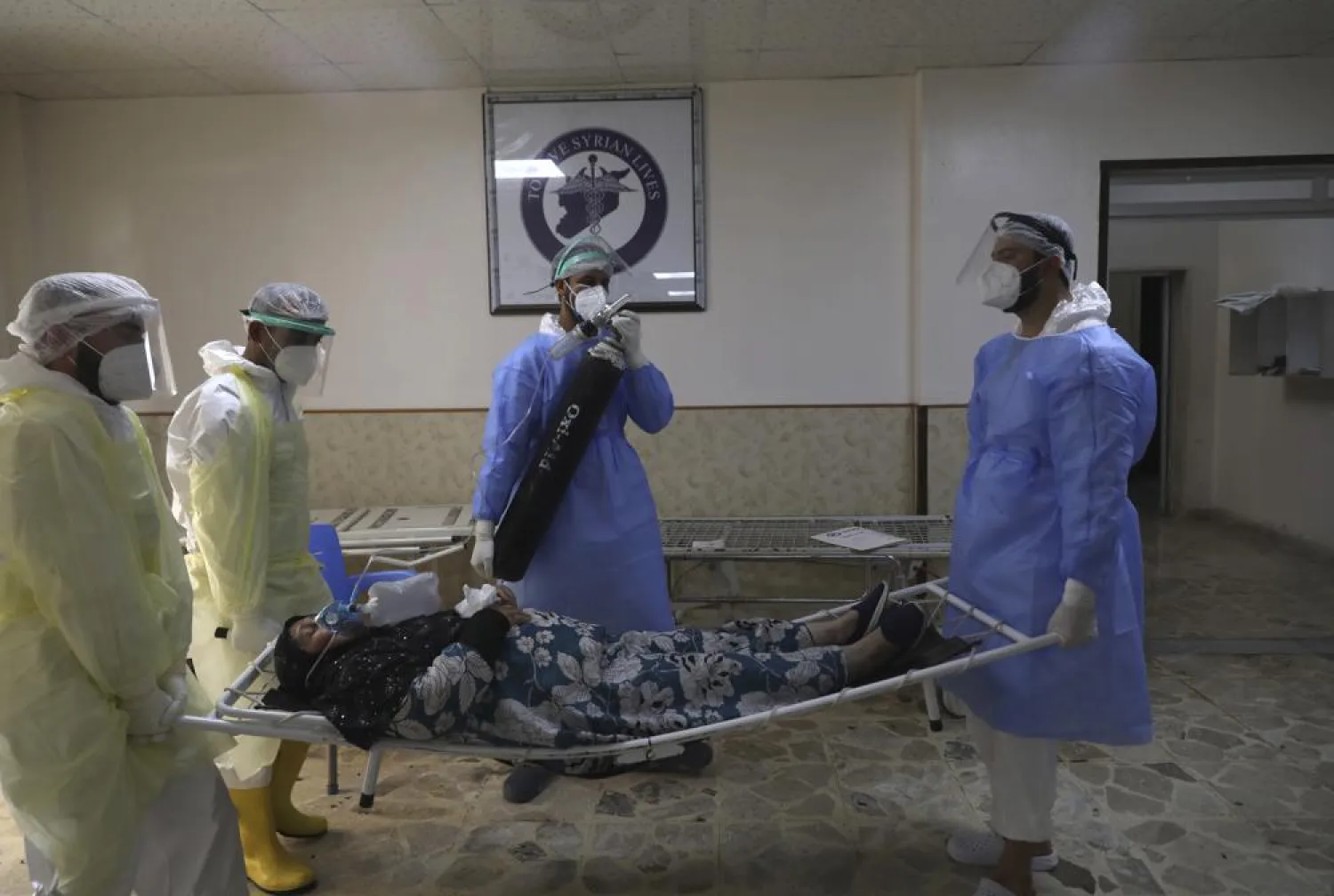

Idlib Struggles with COVID-19 Surge

Medical workers carry a patient infected with the coronavirus on a stretcher at the Syrian American Medical Society Hospital, in the city of Idlib, northwest Syria, Monday, Sept. 20, 2021. (AP Photo/Ghaith Alsayed)
TT

Idlib Struggles with COVID-19 Surge

Medical workers carry a patient infected with the coronavirus on a stretcher at the Syrian American Medical Society Hospital, in the city of Idlib, northwest Syria, Monday, Sept. 20, 2021. (AP Photo/Ghaith Alsayed)

Coronavirus cases are surging to the worst levels of the pandemic in Syria's Idlib province — a particularly devastating development in a region where scores of hospitals have been bombed and that doctors and nurses have fled in droves during a decade of war.

The total number of cases seen in Idlib — an overcrowded enclave with a population of 4 million, many of them internally displaced — has more than doubled since the beginning of August to more than 61,000. In recent weeks, daily new infections have repeatedly shot past 1,500, and authorities reported 34 deaths on Sunday alone — figures that are still believed to be undercounts because many infected people don’t report to authorities.

The situation has become so dire in the northwestern province that rescue workers known as the White Helmets who became famous for digging through the rubble of bombings to find victims now mostly ferry coronavirus patients to the hospital or the dead to burials, The Associated Press reported.

“What is happening is a medical catastrophe,” the Idlib Doctors Syndicate said this week as it issued a plea for support from international aid groups.

Idlib faces all the challenges that places the world over have during the pandemic: Its intensive care units are largely full, there are severe shortages of oxygen and tests, and the vaccination rollout has been slow.

But extreme poverty and the ravages of Syria’s civil war have made the situation in Idlib uniquely terrible. Half of its hospitals and health centers have been damaged by bombing, and the health system was close to collapse even before the pandemic. A large number of medical personnel have fled the country seeking safety and opportunities abroad. Tens of thousands of its residents live in crowded tent settlements, where social distancing and even regular hand-washing are all but impossible. And increasing violence in the region is now threatening to make matters worse.

Large parts of Idlib and neighboring Aleppo province remain in the hands of Syria’s armed opposition, dominated by radical groups including al-Qaeda-affiliated militants who have struggled to respond to the outbreak, which intensified in August, apparently driven by the more contagious delta variant and gatherings for the Muslim feast of Eid al-Adha.

Cases and deaths have also been increasing in recent weeks in government-held areas and those under the control of US-backed Kurdish-led fighters in the east, but the situation appears to be worse in Idlib, though it’s hard to measure the true toll anywhere.

What’s more, a population that has suffered through so much already is often too weary to follow restrictions that have tested people even in easier circumstances.

“It is as if people have gotten used to death,” said Salwa Abdul-Rahman, an opposition activist who reports on events in Idlib. “Those who were not killed by regime and Russian airstrikes are being killed now by coronavirus.”

The vaccination campaign meanwhile, has been slow, though the arrival of some 350,000 doses of a Chinese vaccine earlier this month could help. According to the World Health Organization, only about 2.5% of Idlib’s population has received at least one shot.

At al-Ziraa hospital, Dr. Muhammad Abdullah says there is no sign that the outbreak has reached its peak yet.

But for some Idlib residents, getting infected is the least of their worries.

“We have gone through more difficult situations than coronavirus,” said resident Ali Dalati, walking through a market without wearing a mask. “We are not afraid of coronavirus.”



Rescue Teams Search for Survivors in Building Collapse that Killed at Least 2 in Northern Lebanon

A Lebanese flag is pictured, in the aftermath of a massive explosion, in Beirut's damaged port area, Lebanon August 17, 2020. REUTERS/Hannah McKay
TT

Rescue Teams Search for Survivors in Building Collapse that Killed at Least 2 in Northern Lebanon

A Lebanese flag is pictured, in the aftermath of a massive explosion, in Beirut's damaged port area, Lebanon August 17, 2020. REUTERS/Hannah McKay

At least two people were killed and four rescued from the rubble of a multistory apartment building that collapsed Sunday in the city of Tripoli in northern Lebanon, state media reported.

Rescue teams were continuing to dig through the rubble. It was not immediately clear how many people were in the building when it fell.

The bodies pulled out were of a child and a woman, the state-run National News Agency reported.

Dozens of people crowded around the site of the crater left by the collapsed building, with some shooting in the air.

The building was in the neighborhood of Bab Tabbaneh, one of the poorest areas in Lebanon’s second largest city, where residents have long complained of government neglect and shoddy infrastructure. Building collapses are not uncommon in Tripoli due to poor building standards, according to The AP news.

Lebanon’s Health Ministry announced that those injured in the collapse would receive treatment at the state’s expense.

The national syndicate for property owners in a statement called the collapse the result of “blatant negligence and shortcomings of the Lebanese state toward the safety of citizens and their housing security,” and said it is “not an isolated incident.”

The syndicate called for the government to launch a comprehensive national survey of buildings at risk of collapse.


Israel to Take More West Bank Powers and Relax Settler Land Buys

A view of Israeli settlement of Maale Adumim, in the West Bank, Sunday, June 18, 2023. (AP)
TT

Israel to Take More West Bank Powers and Relax Settler Land Buys

A view of Israeli settlement of Maale Adumim, in the West Bank, Sunday, June 18, 2023. (AP)

Israel's security cabinet approved a series of steps on Sunday that would make it easier for settlers in the occupied West Bank to buy land while granting Israeli authorities more enforcement powers over Palestinians, Israeli media reported.

The West Bank is among the territories that the Palestinians seek for a future independent state. Much of it is under Israeli military control, with limited Palestinian self-rule in some areas run by the Western-backed Palestinian Authority (PA).

Citing statements by Finance Minister Bezalel Smotrich and Defense Minister Israel Katz, Israeli news sites Ynet and Haaretz said the measures included scrapping decades-old regulations that prevent Jewish private citizens buying land in the West Bank, The AP news reported.

They were also reported to include allowing Israeli authorities to administer some religious sites, and expand supervision and enforcement in areas under PA administration in matters of environmental hazards, water offences and damage to archaeological sites.

Palestinian President Mahmoud Abbas said the new measures were dangerous, illegal and tantamount to de-facto annexation.

The Israeli ministers did not immediately respond to requests for comment.

The new measures come three days before Prime Minister Benjamin Netanyahu is scheduled to meet in Washington with US President Donald Trump.

Trump has ruled out Israeli annexation of the West Bank but his administration has not sought to curb Israel's accelerated settlement building, which the Palestinians say denies them a potential state by eating away at its territory.

Netanyahu, who is facing an election later this year, deems the establishment of any Palestinian state a security threat.

His ruling coalition includes many pro-settler members who want Israel to annex the West Bank, land captured in the 1967 Middle East war to which Israel cites biblical and historical ties.

The United Nations' highest court said in a non-binding advisory opinion in 2024 that Israel's occupation of Palestinian territories and settlements there is illegal and should be ended as soon as possible. Israel disputes this view.


Arab League Condemns Attack on Aid Convoys in Sudan

A general view shows the opening session of the meeting of Arab foreign ministers at the Arab League Headquarters (Reuters)
TT

Arab League Condemns Attack on Aid Convoys in Sudan

A general view shows the opening session of the meeting of Arab foreign ministers at the Arab League Headquarters (Reuters)

Arab League Secretary-General Ahmed Aboul Gheit strongly condemned the attack by the Rapid Support Forces on humanitarian aid convoys and relief workers in North Kordofan State, Sudan.

In a statement reported by SPA, secretary-general's spokesperson Jamal Rushdi quoted Aboul Gheit as saying the attack constitutes a war crime under international humanitarian law, which prohibits the deliberate targeting of civilians and depriving them of their means of survival.

Aboul Gheit stressed the need to hold those responsible accountable, end impunity, and ensure the full protection of civilians, humanitarian workers, and relief facilities in Sudan.