


WHO Pleads for ‘Rational’ Omicron Response

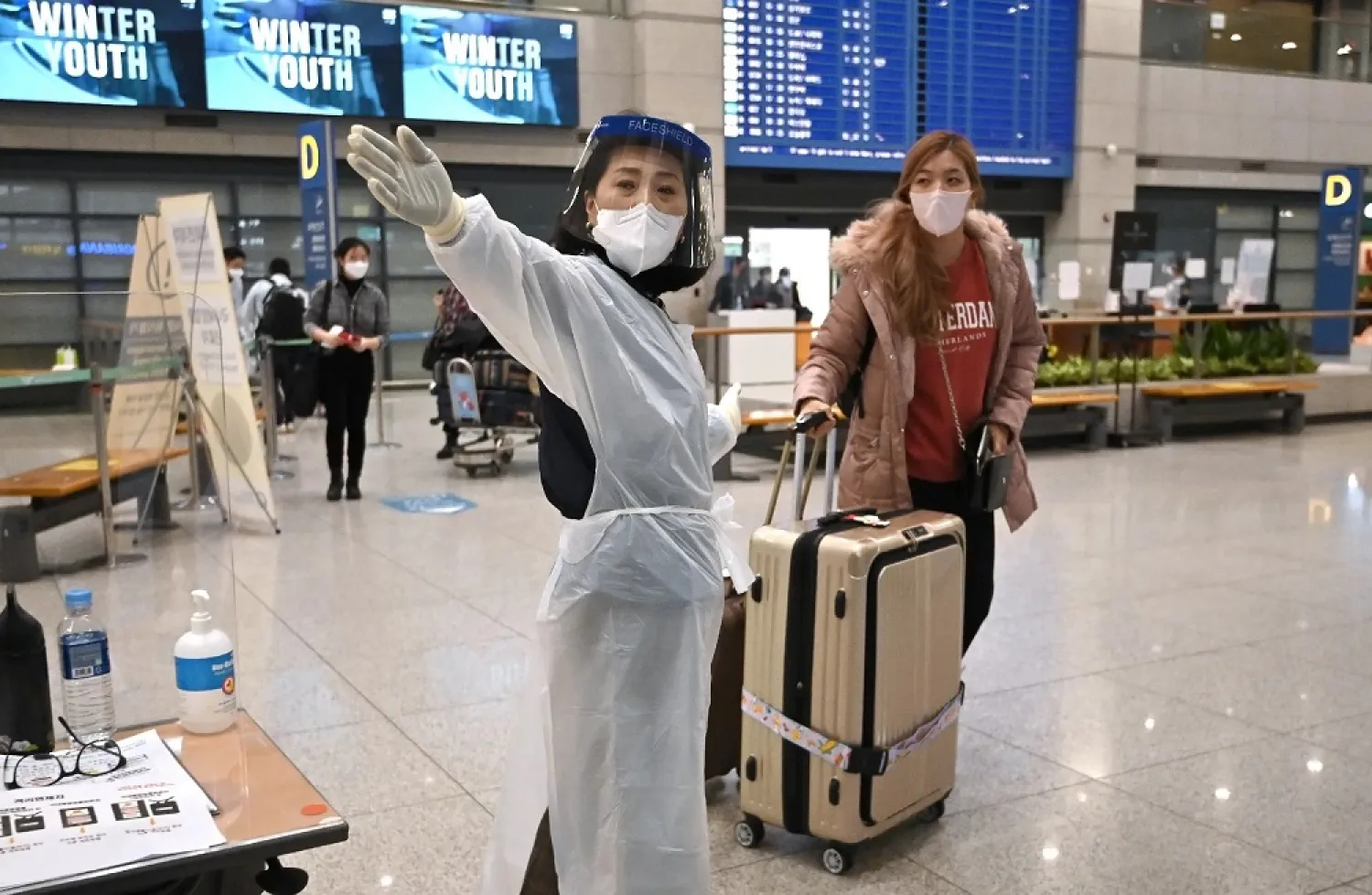
The first confirmed case of the Omicron variant was in South Africa on November 9, with infections spreading rapidly in the country. (AFP)
TT

WHO Pleads for ‘Rational’ Omicron Response

The first confirmed case of the Omicron variant was in South Africa on November 9, with infections spreading rapidly in the country. (AFP)

The WHO on Tuesday urged countries to remain calm and take "rational" measures against the fast-spreading Omicron coronavirus variant, as Germany's next chancellor voiced support for compulsory vaccinations.

The emergence of Omicron, first reported to the World Health Organization in South Africa less than a week ago, has already spread rapidly across the globe with borders shutting and dozens of countries rolling out travel restrictions in defiance of WHO advice.

While so much is still unknown -- no deaths have been reported from Omicron and it could take weeks to know how vaccine-resistant it could prove -- the new strain underscores how besieged the world remains by Covid-19, nearly two years after the first cases.

"We call on all member states to take rational, proportional risk-reduction measures," WHO chief Tedros Adhanom Ghebreyesus said in a briefing to countries. "The global response must be calm, coordinated and coherent."

The WHO chief said it was understandable that countries wanted to protect their citizens "against a variant that we don't yet fully understand," yet the UN health agency fears that blocking travel could be unfair and dissuade surveillance.

"I am equally concerned that several member states are introducing blunt, blanket measures that are not evidence-based or effective on their own, and which will only worsen inequities," said Tedros.

Governments, particularly in western Europe, have already struggled with rapid rises in case numbers and have reintroduced mandatory mask-wearing, social-distancing measures, curfews or lockdowns -- leaving businesses fearing another grim Christmas.

Germany crisis talks
In the European Union's largest economy, Germany's next chancellor Olaf Scholz indicated his support for compulsory Covid vaccines, with a source from his center-left Social Democratic Party telling AFP he "signaled his sympathy for such a regulation".

Scholz held crisis talks with regional leaders and was due to meet outgoing Chancellor Angela Merkel over introducing new restrictions amid soaring coronavirus cases and hospitalizations.

Germany's constitutional court ruled that sweeping restrictions such as curfews, school closures and contact restrictions were lawful, likely to pave the way for further curbs.

In neighboring France, Health Minister Olivier Veran warned the situation was worsening rapidly after the first Omicron variant was found on the French island of Reunion, with 1,700 Covid patients now in critical care.

With 47,000 new cases reported over the past 24 hours, he said average daily cases are rising 60 percent a week. "If these trends continue, they could surpass the peak of the third wave by the end of this week," he told lawmakers, referring to the surge in cases last spring.

In the Netherlands, health authorities revealed the Omicron variant had already entered the Netherlands before a cluster of cases emerged from two flights from South Africa.

Belgium and Germany have also reported finding Omicron cases before South Africa officially notified the WHO on November 24, while Japan confirmed its first case one day after barring all new foreign arrivals just weeks after relaxing tough regulations.

Markets in Asia, Frankfurt, London and Paris fell, while US markets and oil prices also tumbled after the boss of US vaccine manufacturer Moderna warned vaccines might be less effective at fighting the new variant.

'Not going to be good'
"All the scientists I've talked to ... are like 'this is not going to be good'," Moderna boss Stephane Bancel told the Financial Times, warning against a "material drop" in the effectiveness of current jabs against Omicron.

Moderna, US drug maker Pfizer and the backers of Russian vaccine Sputnik V have all announced they are already working on an Omicron-specific vaccine.

Scientists in South Africa said they had detected the new variant with at least 10 mutations, compared with three for Beta or two for Delta -- the strain that hit the global recovery and sent millions worldwide back into lockdown.

China warned Omicron would cause challenges in hosting next February's Winter Olympics in Beijing, with thousands of athletes, media and participants arriving from overseas required to enter a strict "closed-loop" bubble.

"But China has a lot of experience in responding to Covid-19," foreign ministry spokesman Zhao Lijian said. "I firmly believe the Winter Olympics will be conducted smoothly."

On Tuesday, Greece said coronavirus vaccines would be compulsory for over-60s, a day after Britain said all adults would be eligible for a third Covid jab.

Norway also said it would offer a booster shot to all adults before Easter, as preferable to lockdown.

And in Switzerland, ahead of what some had hoped would be a prosperous ski season, hoteliers said they were facing a wave of winter cancellations following quarantine restrictions being imposed on travelers from certain countries, including Britain.

The first confirmed case of the Omicron variant was in South Africa on November 9, with infections spreading rapidly in the country.



US Suspends Flights at El Paso Airport for 'Special Security Reasons'

FILE - A Federal Aviation Administration sign hangs in the tower at John F. Kennedy International Airport in New York, March 16, 2017. (AP Photo/Seth Wenig, File)
TT

US Suspends Flights at El Paso Airport for 'Special Security Reasons'

FILE - A Federal Aviation Administration sign hangs in the tower at John F. Kennedy International Airport in New York, March 16, 2017. (AP Photo/Seth Wenig, File)

The top US aviation agency said Tuesday it is stopping all flights to and from El Paso International Airport in Texas for 10 days over unspecified "security reasons."

The flight restrictions are in effect from 11:30 pm on Tuesday (0630 GMT Wednesday) until February 20 for the airspace over El Paso and an area in neighboring New Mexico's south, according to the Federal Aviation Administration (FAA).

"No pilots may operate an aircraft in the areas" covered by the restrictions, the FAA said in a notice, citing "special security reasons" without elaborating.

El Paso International Airport in a social media post said all flights, "including commercial, cargo and general aviation," would be impacted by the move.

The airport, which is served by major US airlines like Delta, American and United, encouraged travelers to "contact their airlines to get most up-to-date flight status information."

In a separate statement to the New York Times, it said that the restrictions had been issued "on short notice" and that it was waiting for guidance from the FAA.


Russia Says It Won’t Breach Limits of Expired Nuclear Treaty if US Does the Same 

Russian Foreign Minister Sergei Lavrov reacts during a meeting with Tanzanian Minister of Foreign Affairs and East African Cooperation Mahmoud Thabit Kombo (not pictured), in Moscow, Russia, 09 February 2026. (EPA)
TT

Russia Says It Won’t Breach Limits of Expired Nuclear Treaty if US Does the Same 

Russian Foreign Minister Sergei Lavrov reacts during a meeting with Tanzanian Minister of Foreign Affairs and East African Cooperation Mahmoud Thabit Kombo (not pictured), in Moscow, Russia, 09 February 2026. (EPA)

Russia will keep observing the missile and warhead limits in the New START nuclear treaty with the United States, which expired last week, as long as Washington continues to do the same, Foreign Minister Sergei Lavrov said on Wednesday.

The 2010 treaty ran out on February 5, leaving the world's two biggest ‌nuclear-armed powers ‌with no binding constraints on their ‌strategic ⁠nuclear arsenals for ⁠the first time in more than half a century.

US President Donald Trump declined a formal proposal from Russian President Vladimir Putin to voluntarily abide by the New START limits for another year. ⁠Lavrov said Moscow would stick ‌to the limits ‌itself for now anyway.

"Our position is that this ‌moratorium on our side that ‌was declared by the president is still in place, but only as long as the United States doesn't exceed the said limits," ‌Lavrov told parliament's lower house, the State Duma.

The treaty's expiry has ⁠spurred ⁠fears of a three-way arms race involving Russia, the US and China, which has far fewer warheads than the other two countries but is arming rapidly.

Some analysts say, however, that Russia is keen to avoid the cost of such a contest at a time when its state budget is feeling the strain from its four-year-old war in Ukraine.


After Vance Visit, the Kremlin Says Russia Will Develop Ties with Armenia and Azerbaijan 

A handout photo made available by the Press Service of the President of the Republic of Azerbaijan shows Azerbaijan's President Ilham Aliyev (R) and US Vice President JD Vance (L) during a meeting in Baku, Azerbaijan, 10 February 2026. (EPA/Azerbaijan Presidential Press Service Handout)
TT

After Vance Visit, the Kremlin Says Russia Will Develop Ties with Armenia and Azerbaijan 

A handout photo made available by the Press Service of the President of the Republic of Azerbaijan shows Azerbaijan's President Ilham Aliyev (R) and US Vice President JD Vance (L) during a meeting in Baku, Azerbaijan, 10 February 2026. (EPA/Azerbaijan Presidential Press Service Handout)

Russia intends to further develop its relations with both Armenia and Azerbaijan, the Kremlin said on Wednesday, after US Vice President JD Vance visited the two South Caucasus nations.

The United States and Azerbaijan signed a strategic partnership, and Vance signed a nuclear deal with Armenia which operates an ageing ‌Soviet-era nuclear ‌power plant and is ‌looking to ⁠commission a new ⁠one.

Kremlin spokesman Dmitry Peskov said Azerbaijan and Armenia were sovereign countries who had the right to develop their own foreign policies and that Moscow had deep mutually-beneficial ties with both nations.

"We have ⁠a huge range of bilateral ‌relations with both Baku ‌and Yerevan, covering all possible areas. These ‌include mutually beneficial trade and economic cooperation, ‌mutual investments, cultural relations, and so on.

"And, of course, we intend to further develop our relations with our partners so that they ‌are beneficial not only for us, but also for them."

Peskov said ⁠Russia ⁠was well placed to tender for any new nuclear power plant in Armenia.

"As the most advanced country in the world in this field, Russia is capable of withstanding the highest level of international competition," said Peskov. "If such competition is demanded by partners, Russia is capable of providing better quality for many years to come at a lower cost."