


'Eternal' Chancellor: Germany's Merkel to Hand over Power

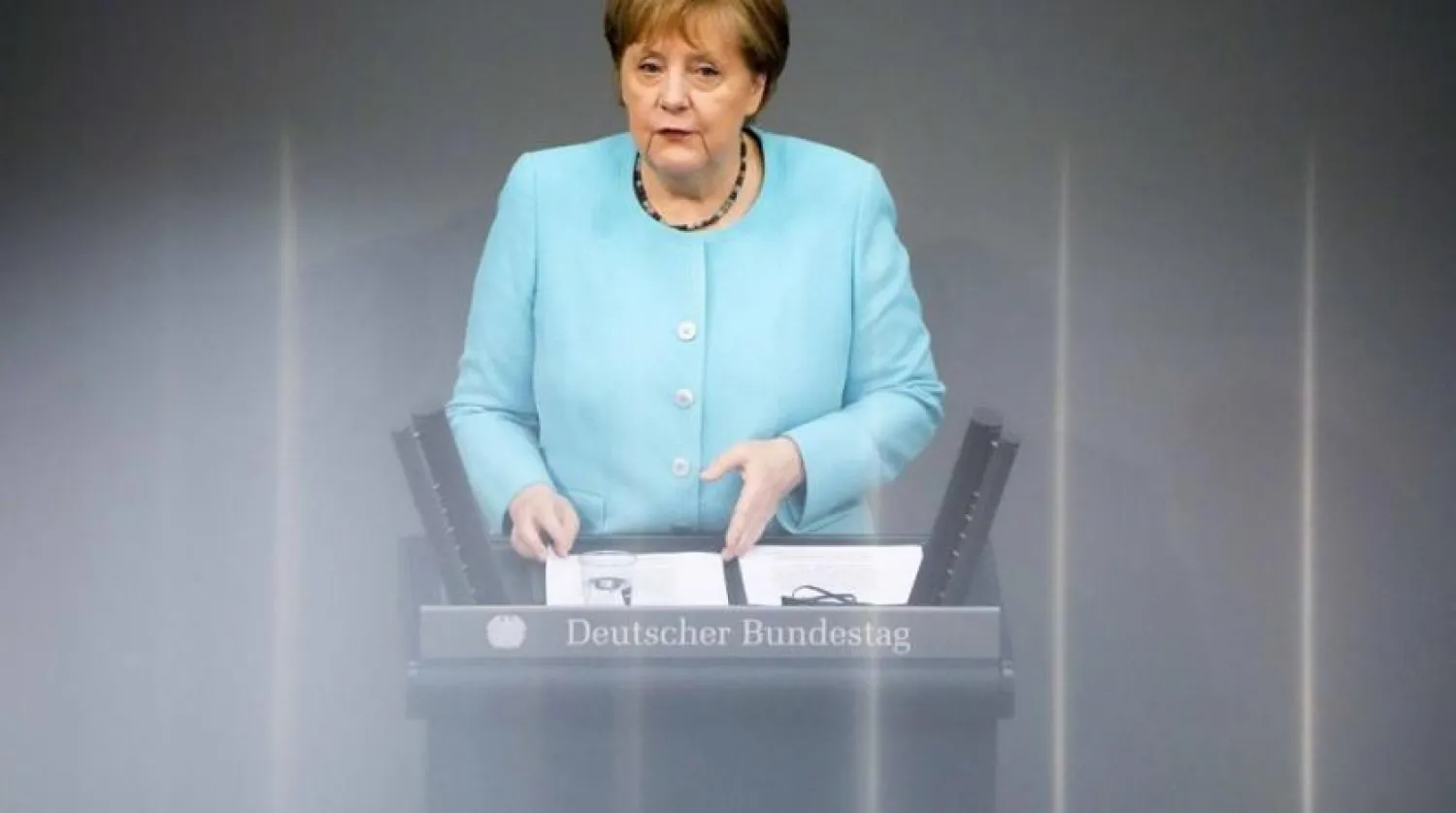
German Chancellor Angela Merkel addresses parliament on June 24. (AP)
TT

'Eternal' Chancellor: Germany's Merkel to Hand over Power

German Chancellor Angela Merkel addresses parliament on June 24. (AP)

She was called "the leader of the free world" against authoritarian populists on the march in Europe and the United States, but Angela Merkel is wrapping up a historic 16 years in power with a mixed legacy at home and abroad.

In office so long she was dubbed Germany's "eternal chancellor", Merkel, 67, leaves with her popularity so resilient she would likely have won a record fifth term had she sought it, AFP said.

Instead, Merkel will pass the baton as the first German chancellor to step down entirely by choice, with a whole generation of voters never knowing another person at the top.

Her supporters say she provided steady leadership through countless global crises as a moderate and unifying figure.

Yet critics argue a muddle-through style pegged to the broadest possible consensus lacked the bold vision to prepare Europe and its top economy for the coming decades.

What is certain is that she leaves behind a fractured political landscape, with her own CDU party divided as it struggles to emerge from her long shadow.

Social Democrat Olaf Scholz, who served as her vice chancellor and finance minister, successfully sold himself as the Merkel continuity candidate in the run-up to September's general election and will now succeed her.

With Scholz due to be officially elected by parliament as chancellor on Wednesday, Merkel will fall just days short of beating Helmut Kohl's record as Germany's longest-serving post-war leader.

- Do the right thing -
The unflappable Merkel has served for many in recent years as a multilateralist counterweight to the big, brash men of global politics, from Donald Trump to Vladimir Putin.

A Pew Research Center poll in September showed large majorities in most democracies around the globe having "confidence in Merkel to do the right thing in world affairs".

A trained quantum chemist raised behind the Iron Curtain, Merkel was long in sync with her change-averse electorate as a guarantor of stability.

Her major policy shifts reflected the wishes of large German majorities -- among them phasing out nuclear power after the 2011 Fukushima disaster -- and attracted a broad new coalition of women and urban voters to the once arch-conservative CDU.

However, the last days of her tenure have been marred by a vicious fourth wave of coronavirus, the worst since the start of the pandemic.

- 'Austerity queen' -
Before the pandemic, her boldest move -- keeping open German borders to more than one million asylum seekers in 2015 -- seemed set to determine her legacy.

But while many Germans rallied to Merkel's "We can do it" cry, the move also emboldened an anti-migrant party, Alternative for Germany (AfD), ushering a far-right bloc into parliament for the first time since World War II.

The woman once known as the "climate chancellor" for pushing renewables also faces a mass movement of young activists arguing she has failed to deal with the climate emergency, with Germany not meeting its own emission-reduction commitments.

The incoming coalition has pledged to improve on that legacy and to take a more assertive stance with Russia and China after the commerce-based pragmatism of the Merkel years.

Merkel became Europe's go-to leader during the eurozone crisis when Berlin championed swingeing spending cuts in return for international bailout loans for debt-mired countries.

Angry protesters dubbed her Europe's "austerity queen" and caricatured her in Nazi garb, while defenders credit her with holding the currency union together.

- Kohl's 'girl' to 'Mummy' -
Merkel, the EU and the G7's most senior leader, started as a contemporary of George W. Bush, Tony Blair and Jacques Chirac when she became Germany's youngest and first female chancellor in 2005.

She was born Angela Dorothea Kasner on July 17, 1954 in the port city of Hamburg, the daughter of a Lutheran clergyman and a schoolteacher.

Her father moved the family to a small-town parish in the communist east at a time when tens of thousands were heading the other way.

She excelled in mathematics and Russian, which has helped her maintain dialogue with the other veteran on the world stage, Russia's Putin, who was a KGB officer in Dresden when the Berlin Wall fell in 1989.

Merkel kept the name of her first husband, whom she married in 1977 and divorced five years later.

After the fall of the wall, Merkel, who was working in a chemistry lab, joined a pro-democracy group that would merge with Kohl's Christian Democrats.

The Protestant from East Germany whom Kohl nicknamed his "girl" would later be elected leader of a party until then dominated by western Catholic patriarchs.

As she rose to power, party rivals sneeringly called her "Mutti" (Mummy) behind her back but she deftly -- some said ruthlessly -- eliminated potential challengers.

Although her name has come up on wish lists for key EU or United Nations posts, Merkel has said she will leave politics altogether.

Her four terms in office were "eventful and often very challenging years", she said at a military ceremonial farewell. "They have challenged me politically and humanly and at the same time, they were also fulfilling."

Asked on her final trip to Washington in June what she looked forward to most, she replied: "not having to constantly make decisions".


Top Trump Iran Negotiator Says Visits US Aircraft Carrier in Middle East

US Special Envoy Steve Witkoff delivers a press conference upon the signing of the declaration on deploying post-ceasefire force in Ukraine, during the so-called "Coalition of the Willing" summit, at the Elysee Palace in Paris, France, January 6, 2026. (Reuters)
TT

Top Trump Iran Negotiator Says Visits US Aircraft Carrier in Middle East

US Special Envoy Steve Witkoff delivers a press conference upon the signing of the declaration on deploying post-ceasefire force in Ukraine, during the so-called "Coalition of the Willing" summit, at the Elysee Palace in Paris, France, January 6, 2026. (Reuters)

US President Donald Trump's lead Iran negotiator Steve Witkoff on Saturday said he visited the USS Abraham Lincoln aircraft carrier currently in the Arabian Sea, with Washington and Tehran due to hold further talks soon.

"Today, Adm. Brad Cooper, Commander of US Naval Forces Central Command, Jared Kushner, and I met with the brave sailors and Marines aboard the USS Abraham Lincoln, her strike group, and Carrier Air Wing 9 who are keeping us safe and upholding President Trump's message of peace through strength," said Witkoff in a social media post.

Iranian Foreign Minister Abbas Araghchi said on Saturday he hoped talks with the United States would resume soon, while reiterating Tehran's red lines and warning against any American attack.


Israel’s Netanyahu Expected to Meet Trump in US on Wednesday and Discuss Iran

Israeli Prime Minister Benjamin Netanyahu delivers a speech during a special session to mark the 77th anniversary of the Knesset's establishment and the 60th anniversary of the dedication of the current building at the Knesset, the Israeli parliament, in Jerusalem, 02 February 2026. (EPA)
TT

Israel’s Netanyahu Expected to Meet Trump in US on Wednesday and Discuss Iran

Israeli Prime Minister Benjamin Netanyahu delivers a speech during a special session to mark the 77th anniversary of the Knesset's establishment and the 60th anniversary of the dedication of the current building at the Knesset, the Israeli parliament, in Jerusalem, 02 February 2026. (EPA)

Israeli Prime Minister Benjamin Netanyahu is expected to meet US President Donald Trump on Wednesday in Washington, where they will discuss negotiations with Iran, Netanyahu's office said on Saturday.

Iranian and US officials held indirect nuclear ‌talks in the ‌Omani capital ‌Muscat ⁠on Friday. ‌Both sides said more talks were expected to be held again soon.

A regional diplomat briefed by Tehran on the talks told Reuters Iran insisted ⁠on its "right to enrich uranium" ‌during the negotiations with ‍the US, ‍and that Tehran's missile capabilities ‍were not raised in the discussions.

Iranian officials have ruled out putting Iran's missiles - one of the largest such arsenals in the region - up ⁠for discussion, and have said Tehran wants recognition of its right to enrich uranium.

"The Prime Minister believes that any negotiations must include limiting ballistic missiles and halting support for the Iranian axis," Netanyahu's office said in a ‌statement.


Italy FM Rules Out Joining Trump’s ‘Board of Peace’

Italy's Minister for Foreign Affairs Antonio Tajani speaks to the press during the EPP Leaders’ meeting, in Zagreb, Croatia, 30 January 2026. (EPA)
TT

Italy FM Rules Out Joining Trump’s ‘Board of Peace’

Italy's Minister for Foreign Affairs Antonio Tajani speaks to the press during the EPP Leaders’ meeting, in Zagreb, Croatia, 30 January 2026. (EPA)

Italy will not take part in US President Donald Trump's "Board of Peace", Italian Foreign Minister Antonio Tajani said Saturday, citing "insurmountable" constitutional issues.

Trump launched his "Board of Peace" at the World Economic Forum in Davos in January and some 19 countries have signed its founding charter.

But Italy's constitution bars the country from joining an organization led by a single foreign leader.

Prime Minister Giorgia Meloni, a Trump ally, last month noted "constitutional problems" with joining, but suggested Trump could perhaps reopen the framework "to meet the needs not only of Italy, but also of other European countries".

Tajani appeared Saturday to rule that out.

"We cannot participate in the Board of Peace because there is a constitutional limit," he told the ANSA news agency.

"This is insurmountable from a legal standpoint," he said, the day after meeting US Secretary of State Marco Rubio and US Vice President JD Vance at the Olympics in Milan.

Although originally meant to oversee Gaza's rebuilding, the board's charter does not limit its role to the Palestinian territory and appears to want to rival the United Nations.