


Penny Pinching and Power Cuts; Lebanon’s Middle Class Squeezed by Crisis

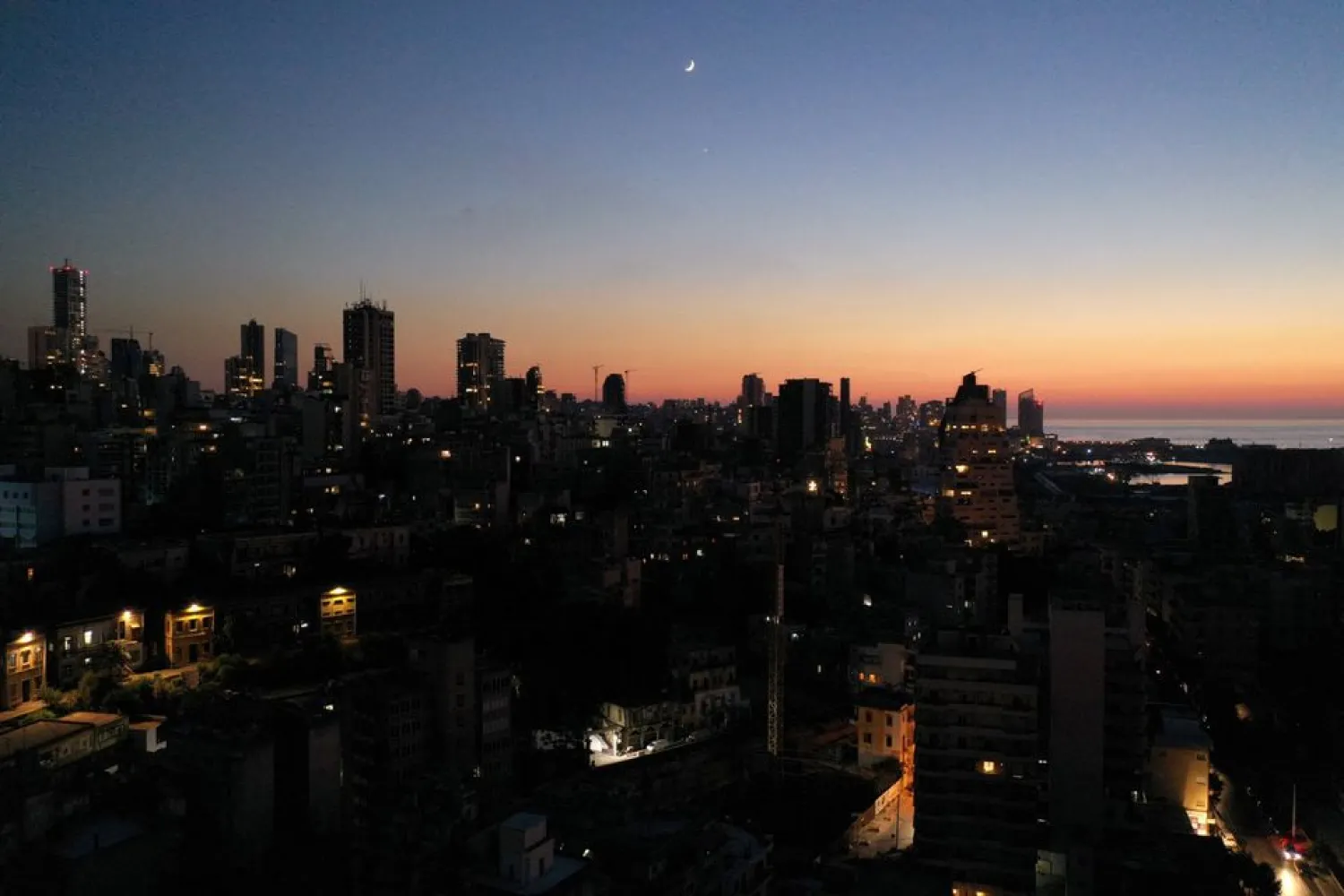
Unlit buildings are seen during a partial blackout in Beirut, Lebanon August 11, 2021. (Reuters)
TT

Penny Pinching and Power Cuts; Lebanon’s Middle Class Squeezed by Crisis

Unlit buildings are seen during a partial blackout in Beirut, Lebanon August 11, 2021. (Reuters)

Lebanese school teacher Sara Wissam and her husband were comfortably off before a run on the local currency decimated the value of their salaries and dragged them towards poverty.

The plight of the Beirut couple is common across Lebanon's middle class, which has been forced to make once unthinkable choices by the worsening economic crisis: cutting back on food, cancelling trips or applying to emigrate for good.

"It used to be that our income lasted a month," the mother of three told Reuters.

"Now it's not enough for one trip to the supermarket to buy essentials," said Wissam, describing how she rarely buys meat, has cut back on cheese and chooses even the smallest treats for her young kids carefully.

Ayman Hadad, a 28-year-old university graduate who found a job in a shop, earns the equivalent of $125 a month and wants to join friends who have emigrated. He has applied to go to Canada. "Enough of Lebanon. We lost hope," he said.

Lebanon's descent into financial ruin began in 2019, the result of a poorly managed spending binge that pushed up debt, political paralysis as rival factions squabbled and foreign lenders' reluctance to bail the country out unless it reformed.

The World Bank ranks the crisis as among the most severe globally since the mid-19th century, devastating a country once seen as a wealthy and liberal outpost in the Middle East before civil war broke out from 1975 to 1990.

About 80% of the population of 6.5 million are considered poor; in September, more than half of families had at least one child who skipped a meal, UNICEF said, compared with just over a third in April.

The currency has lost more than 90% of its value and banks have locked savers out of accounts. By some estimates, state debt reached 495% of gross domestic product in 2021, far above levels that crippled some European states a decade ago.

Adding to people's frustration is the government's failure so far to tackle the problems.

Caretaker administrations have led Lebanon for much of the last three years, and since the cabinet quit after a devastating Beirut port blast in 2020, politicians have been fighting over who should lead an investigation into who was to blame.

Meanwhile people see signs of social and economic collapse. The state telecom firm shut the Internet in parts of Beirut for lack of fuel in recent days and an armed man took hostages at a bank demanding access to his trapped savings.

'Fridge empty'

Lebanon's national power grid was creaking before the crisis, with rolling cuts across the country. Now, a bankrupt government can barely run its power plants and homes often receive only an hour of state electricity a day.

Yola al-Musan, who manages a supermarket in Beirut, uses electricity from a shared neighborhood generator to keep the lights on at home.

When the national grid does fire up, Musan races to switch on the washing machine as only then does she have a strong enough current.

For school teacher Wissam, putting enough food on the table for her family has become tough, even though she and her husband both have steady jobs.

Before the crisis, Wissam and her husband's combined salary was 3 million Lebanese pounds a month, which at the exchange rate at the time of 1,500 to the dollar was around $2,000.

Now their combined earnings are worth the equivalent of $140, even after Wissam's modest wage hike. The currency has plummeted to 25,000 to the dollar, sending the price of imported goods and local products soaring.

"Lebanon's leaders amuse themselves insulting each other and accusing each other of corruption. In fact, they are all corrupt and thieves," she said, echoing widespread public and international criticism of how the crisis has been handled.

Politicians, some former militia leaders and others from families who wielded influence for generations over the nation's Christian and Muslim communities, acknowledge corruption exists but deny they are responsible and say they are doing their best to rescue the economy.

But a lengthy and continuing dispute over who should preside over the port blast inquiry has contributed to delays in talks with the International Monetary Fund, seen as vital to unlocking overseas support led by France.

Gulf donors stepped back years ago, voicing anger at Iran's rising influence in Lebanon through Hezbollah.

Najib Mikati, the billionaire prime minister, has tried to mend Gulf ties. Hezbollah, in turn, stepped up criticism of Gulf states and hosted conferences for domestic opponents of the monarchies.

Meanwhile, the cabinet is expected to hold its first meeting in more than three months on Monday to discuss a draft budget it hopes will ease financial pressures and quell public anger.

"If each one of them donated a small amount of their wealth to the poor, there would be no poor in Lebanon," said Shadi Ali Hamoud, 39, after returning home to his family from work in a restaurant kitchen. "Look at the fridge, it's empty."



Lebanon Enforces Funds Checks Despite Hezbollah Objections

Lebanon’s Justice Minister Adel Nassar. (NNA)
TT

Lebanon Enforces Funds Checks Despite Hezbollah Objections

Lebanon’s Justice Minister Adel Nassar. (NNA)

A circular issued by Lebanon’s Justice Minister Adel Nassar, now in force, has placed notaries public on the front line of the country’s fight against money laundering, requiring them to verify the source of funds and the identities of parties involved in sales contracts, purchase agreements, and powers of attorney.

The measure, which took effect at the start of this year, is aimed at curbing the cash economy and boosting transparency in line with international standards on combating money laundering and terrorism financing.

It has also reignited and intensified a political campaign by Hezbollah, which says the move tightens pressure on the party and its support base.

The law requires notaries to carry out several key tasks, notably verifying that parties to transactions are not listed on national or international sanctions lists, refraining from completing any transaction if that proves otherwise, and notifying the Justice Ministry and the Special Investigation Commission at Lebanon’s central bank.

The circular also stresses the need to verify the source of funds and to state it explicitly in the transaction or contract, and to refrain from drafting or certifying any document if it is not possible to establish the identity of the beneficial owner.

The measure targets all those listed on the US sanctions lists and mainly affects Hezbollah, its officials, and its institutions. The party considers the step part of what it describes as a US blockade against it and says it strips citizens of their civil rights.

Hezbollah Secretary General Sheikh Naim Qassem said the justice minister was “not a judicial police officer for America and Israel” and should stop preventing citizens from completing their transactions.

Qassem asked: “Has Lebanon turned into a prison for its citizens under American management? Is the justice minister or the governor of the central bank an employee of the American administration in Lebanon’s American prison?”

The circular has moved beyond political and legal objections raised against it. The justice minister said all notaries had complied with its requirements since implementation began at the start of the year, noting ongoing coordination to address practical issues that emerged during execution.

Nassar told Asharq Al-Awsat that meetings had been held between representatives of notaries and the Special Investigation Commission at the central bank, during which mechanisms and standards were clarified.

He said an office within the commission had also been designated to respond to notaries’ inquiries and provide necessary information while transactions are being processed.

The minister said the measures put Lebanon on a path of transparency and would positively affect the Financial Action Task Force's view of the country’s situation.

He described the circular as part of a package of steps adopted by the state to exit the FATF gray list or at least avoid being placed on the blocklist, adding that the measure was a key factor in curbing money laundering without infringing on the civil rights of sellers or buyers.

Hezbollah continued its attack on those involved in the decision.

MP Ali Fayyad said in a speech to parliament during budget discussions that the justice minister, the foreign minister, and the central bank governor were “carrying out a systematic strangulation of our community, sheltering behind the law while overstepping it.”

“We are a people subjected to daily assassination by Israel, and there are those inside who are pouncing on us,” he said.

A number of those affected have filed an appeal before the Shura State Council seeking to annul the circular, arguing that its provisions are not practically applicable and that they impose responsibilities on notaries that exceed their legal authority.

The appellants warned that the circular could turn notaries into quasi-judicial police officers and entangle them in political and security matters unrelated to their work.

Despite objections that have reached the level of accusing anyone who complies with international anti-money laundering standards of treason, the justice minister said there would be no retreat from the circular.

He stressed that it meets international compliance requirements while providing notaries with a legal protective framework that shields them from future accountability if they adhere to the specified procedures.

Some notaries acknowledged that implementation has entered a practical phase, even if conditions and standards sometimes differ from one notary to another. One pointed to inconsistencies between notaries’ procedures and those of the land registry in property registration.

He told Asharq Al-Awsat that verifying the source of funds has become an established procedure, carried out in coordination with the Special Investigation Commission at the central bank.

“There is no doubt that many of the ambiguities that accompanied the issuance of the circular are gradually becoming clearer with implementation,” he said.


Iran War Fears Cast Shadow Over Gaza Ceasefire

A young girl carries a bag on her back as she walks along a road in the Nuseirat Palestinian refugee camp north of Deir al-Balah in central Gaza. (AFP)
TT

Iran War Fears Cast Shadow Over Gaza Ceasefire

A young girl carries a bag on her back as she walks along a road in the Nuseirat Palestinian refugee camp north of Deir al-Balah in central Gaza. (AFP)

As momentum builds around efforts to advance the second phase of the Gaza ceasefire agreement, the risk of a broader confrontation between the United States and Iran is resurfacing, threatening to upend regional priorities amid Israeli moves that are fueling growing concern.

Experts speaking to Asharq Al-Awsat warned that the Gaza agreement is increasingly vulnerable, saying any strike on Tehran would deliberately draw Israel into a broader escalation aimed at disrupting implementation of the second phase, covering Israeli violations and potentially derailing the deal altogether.

Their warnings came alongside explicit Egyptian caution, voiced on Friday by President Abdel Fattah al-Sisi, over the consequences of further escalation.

Those concerns coincided with a buildup of US military forces in the Middle East and threats by President Donald Trump to strike Iran, even as he has also said he does not oppose dialogue with Tehran.

On June 13, 2025, Israel, with US support, launched an attack on Iran that lasted 12 days, targeting military and nuclear sites as well as civilian facilities, and killing commanders and scientists. Iran responded by striking Israeli military and intelligence facilities with missiles and drones.

On June 22, the US attacked Iran’s nuclear facilities, claiming it had neutralized them. Tehran retaliated by shelling the US Al Udeid Air Base in Qatar, before Washington announced on June 24 a ceasefire between Tel Aviv and Tehran.

Egyptian warnings

Sisi said in remarks on Friday to students at the Police Academy east of Cairo that “the Iranian crisis is escalating and could have an impact on the region.”

He added: “We are making major efforts, quietly, to reach dialogue in any way possible to reduce escalation in the Iranian crisis. We are mindful that if fighting breaks out, it could have grave repercussions for our region, as well as economic consequences.”

The president’s remarks came a day after Israeli media reported that Prime Minister Benjamin Netanyahu had held a security meeting on Iran, and as Israel’s public broadcaster announced on Friday the arrival of a US destroyer at the port of Eilat.

Israeli media said the arrival of the destroyer had been planned and was part of cooperation between the Israeli and US militaries.

Rakha Ahmed Hassan, a member of the Egyptian Council for Foreign Affairs and a former assistant foreign minister, said Israel benefits from any war and could exploit it to expand what he described as its destructive plans in Gaza and to cover them up, further complicating matters.

Palestinian political analyst Nizar Nazzal said the indicators point to military action against Iran, with unmistakable Israeli efforts through incitement and mobilization, and a desire by Netanyahu to pursue such a course.

He added that Egypt has genuine concerns about the repercussions for the region, with the Gaza agreement likely to be among the first casualties.

Amid the potential escalation, a statement from Netanyahu’s office on Friday said that, in accordance with the ceasefire agreement and the directives of the political leadership, the Rafah crossing will be opened on Sunday in both directions for limited individual movement only.

It added that additional inspections will be conducted at a security checkpoint operated by the security establishment in the area under Israeli army control.

In his speech on Friday, in which he warned of the consequences of striking Iran, the Egyptian president also called for implementation of the second phase of the Gaza agreement, saying this was “extremely important.”

Nazzal said Netanyahu could exploit a strike on Iran to sabotage or delay the start of the second phase of the ceasefire.

Until any potential strike takes place in the coming days or weeks, he said, Netanyahu may divide the phase into parts and prolong its implementation, as seen in what he described as maneuvering and conditions aimed at undermining the opening of the Rafah crossing.

That, he added, allows Netanyahu to evade commitments such as withdrawing from Gaza.

Disruption to the Gaza agreement

Israel’s Yedioth Ahronoth newspaper reported that political and security circles stress Netanyahu is not currently seeking a full-scale war.

It said he is instead working to narrow the options available to Iran’s leadership through indirect coordination with the Trump administration, while projecting that Israel is ready for all scenarios and that a decision could be taken at any moment.

Hassan criticized what he described as US-Israeli propaganda, expressing concern over the killing of thousands of protesters in Tehran, while showing no concern over the killing of 75,000 Palestinians by Israel or the failure to open the Rafah crossing to allow aid for the starving.

He said the Gaza agreement is tied to Trump’s credibility, and that any threat to it would make him the biggest loser.

Nazzal said mediators of the Gaza agreement are working to prevent Israel from benefiting from any strike, and to ensure that halting or swiftly ending its repercussions is vital in forcing Israel to implement the deal.

He added that Netanyahu supports a strike because it would serve his interests, warning that if war breaks out, it will reach Israel and the Gaza agreement will be disrupted.


UN Says Yemen’s Houthis Removed Its Assets, Equipment in Latest Restrictions

People walk along a street at sunset in Sanaa, Yemen, 21 January 2026. (EPA)
TT

UN Says Yemen’s Houthis Removed Its Assets, Equipment in Latest Restrictions

People walk along a street at sunset in Sanaa, Yemen, 21 January 2026. (EPA)

Houthi militants in Yemen removed UN equipment and assets and took them to an undisclosed location without explanation, the world body said Friday, the latest in a series of restrictions by the Iran-backed group.

Julien Harneis, the United Nations' resident and humanitarian coordinator for Yemen, said the Houthis entered at least six unstaffed UN offices in Sanaa on Thursday and removed most of the telecommunications equipment and several UN vehicles without UN authorization.

The move will likely further hinder urgently needed humanitarian assistance in Houthi-controlled areas and marks the latest escalation in the Houthis’ crackdown on UN staff and aid groups.

The equipment removed Thursday was essential to carrying out UN programs and had been brought into Yemen in compliance with local protocols and with the necessary permissions, the UN said.

The Houthis, without explanation, have also not authorized United Nations Humanitarian Air Service flights to Sanaa for more than a month, or to the legitimate government-controlled Marib province for over four months, the UN said Friday.

The flights are the only means for international nonprofits to enter and leave Houthi-controlled areas to operate and deliver aid.

The Houthi decisions were made without discussion or an opportunity to reach a mutual agreement to set arrangements for aid delivery, Harneis said.

“This confiscation of UN assets and the blocking of UNHAS flights by the Sana’a DFA (Houthis), comes at a time when humanitarian needs in Yemen, particularly in areas under their control, are increasing. This will make the humanitarian situation worse in those parts of Yemen controlled by the DFA,” the Friday statement read.

UN officials said Thursday that the World Food Program will shut down operation in Houthi-controlled areas in Yemen due to Houthi restrictions and 365 staffers will lose their jobs by the end of March.

Aid operations in northern Yemen have long been hindered by Houthi-imposed constraints. Seventy-three UN staffers have been detained in recent years as well as staffers from other nonprofits and civil society groups in areas controlled by the militants. The detentions have severely restricted aid delivery in areas that account for around 70% of humanitarian needs nationwide, the UN said.

They intensified their crackdown by storming into UN facilities in Sanaa and elsewhere accusing staffers, without evidence, of espionage, allegations the UN rejected.