


Cyberattacks Accompany Russian Military Assault on Ukraine

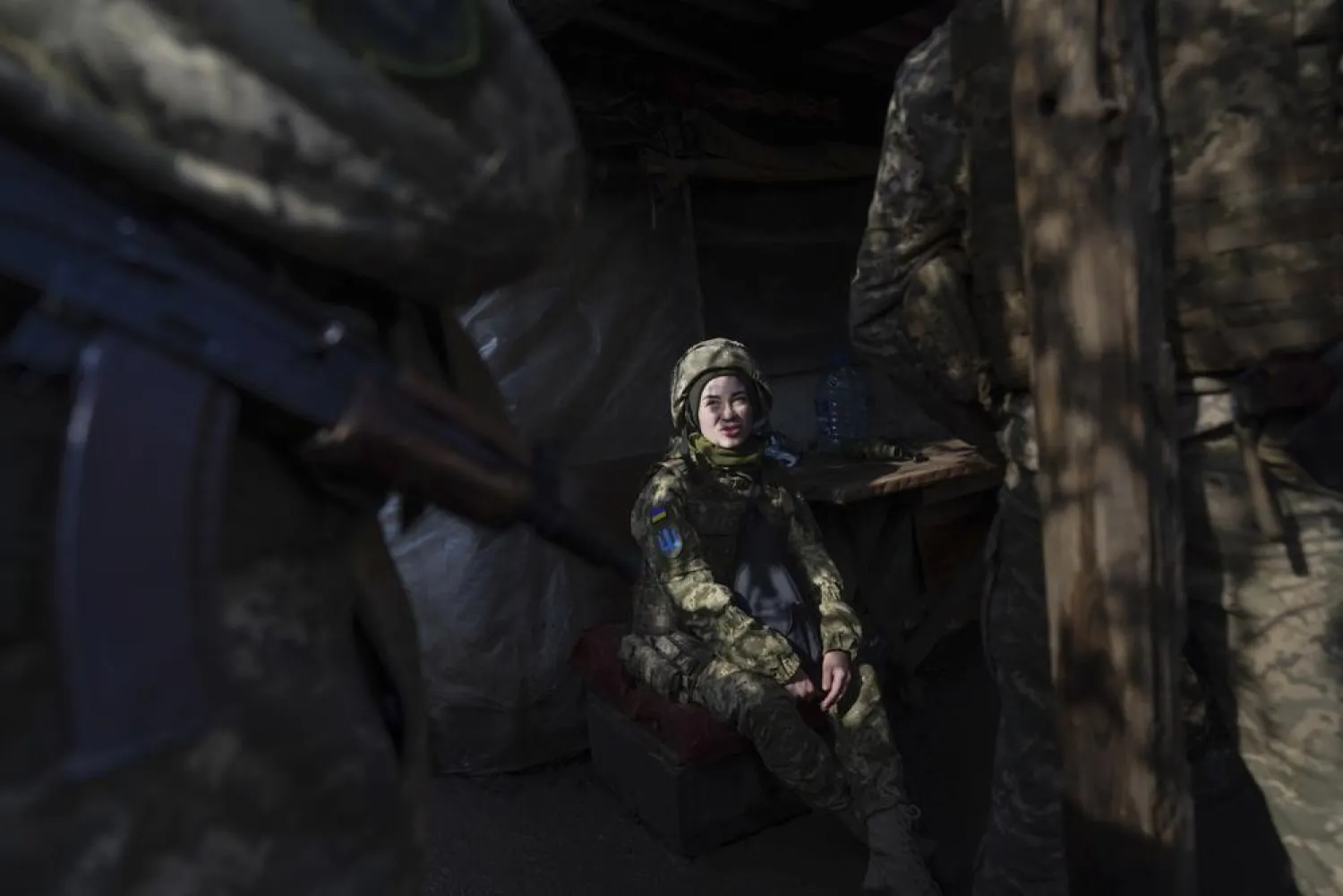
A Ukrainian soldier talks with her comrades sitting in a shelter at the line of separation between Ukraine-held territory and rebel-held territory near Svitlodarsk, eastern Ukraine, Wednesday, Feb. 23, 2022. (AP Photo/Evgeniy Maloletka)
TT

Cyberattacks Accompany Russian Military Assault on Ukraine

A Ukrainian soldier talks with her comrades sitting in a shelter at the line of separation between Ukraine-held territory and rebel-held territory near Svitlodarsk, eastern Ukraine, Wednesday, Feb. 23, 2022. (AP Photo/Evgeniy Maloletka)

The websites of Ukraine's defense, foreign and interior ministries were unreachable or painfully slow to load Thursday morning after a punishing wave of distributed-denial-of-service attacks as Russia struck at its neighbor, explosions shaking the capital of Kyiv and other major cities.

In addition to DDoS attacks on Wednesday, cybersecurity researchers said unidentified attackers had infected hundreds of computers with destructive malware, some in neighboring Latvia and Lithuania, said The Associated Press.

Asked if the denial-of-service attacks were continuing Thursday morning, senior Ukrainian cyber defense official Victor Zhora did not answer. “Are you serious?" he texted. "There are ballistic missiles here.”

"This is terrible. We need the world to stop it. Immediately,” Zhora said of the offensive that Russian President Vladimir Putin announced in the pre-dawn hours.

Officials have long expected cyber attacks to precede and accompany any Russian military incursion. The combination of DDoS attacks, which bombard websites with junk traffic to render them unreachable, and malware infections hewed to Russia's playbook of wedding cyber operations with real-world aggression.

ESET Research Labs said it detected a previously unseen piece of data-wiping malware Wednesday on “hundreds of machines in the country.” It was not clear how many networks were affected.

“With regards whether the malware was successful in its wiping capability, we assume that this indeed was the case and affected machines were wiped,” said ESET research chief Jean-Ian Boutin. He would not name the targets but said they were “large organizations.”

ESET was unable to say who was responsible.

Symantec Threat Intelligence detected three organizations hit by the wiper malware — Ukrainian government contractors in Latvia and Lithuania and a financial institution in Ukraine, said Vikram Thakur, its technical director. Both countries are NATO members.

“The attackers have gone after these targets without much caring for where they may be physically located,” he said.

All three had “close affiliation with the government of Ukraine,” said Thakur, saying Symantec believed the attacks were “highly targeted.” He said roughly 50 computers at the financial outfit were impacted, some with data wiped.

Asked about the wiper attack on Wednesday, Zhora had no comment.

Boutin said the malware’s timestamp indicated it was created in late December.

“Russia likely has been planning this for months, so it is hard to say how many organizations or agencies have been backdoored in preparation for these attacks,” said Chester Wisniewski, principal research scientist at the cybersecurity firm Sophos. He guessed the Kremlin intended with the malware to “send the message that they have compromised a significant amount of Ukrainian infrastructure and these are just little morsels to show how ubiquitous their penetration is.”

Word of the wiper follows a mid-January attack that Ukrainian officials blamed on Russia in which the defacement of some 70 government websites was used to mask intrusions into government networks in which at least two servers were damaged with wiper malware masquerading as ransomware.

Cyberattacks have been a key tool of Russian aggression in Ukraine since before 2014, when the Kremlin annexed Crimea and hackers tried to thwart elections. They were also used against Estonia in 2007 and Georgia in 2008. Their intent can be to sow panic, confuse and distract.

Distributed-denial-of-service attacks are among the least impactful because they don’t entail network intrusion. Such attacks barrage websites with junk traffic so they become unreachable.

The DDoS targets Wednesday included the defense and foreign ministries, the Council of Ministers and Privatbank, the country’s largest commercial bank. Many of the same sites were similarly knocked offline Feb. 13-14 in DDoS attacks that the US and UK governments quickly blamed on Russia’s GRU military intelligence agency
Wednesday’s DDoS attacks appeared less impactful than the earlier onslaught — with targeted sites soon reachable again — as emergency responders blunted them. Zhora’s office, Ukraine’s information protection agency, said responders switched to a different DDoS protection service provider.

Doug Madory, director of internet analysis at the network management firm Kentik Inc., recorded two attack waves each lasting more than an hour.
A spokesman for California-based Cloudflare, which provides services to some of the targeted sites, said Wednesday that DDoS attacks in Ukraine had been until then sporadic but on the rise in the past month but “relatively modest compared to large DDoS attacks we’ve handled in the past.”

The West blames Russia’s GRU for some of the most damaging cyberattacks on record, including a pair in 2015 and 2016 that briefly knocked out parts of Ukraine’s power grid and the NotPetya “wiper” virus of 2017, which caused more than $10 billion of damage globally by infecting companies that do business in Ukraine with malware seeded through a tax preparation software update.

The wiper malware detected in Ukraine this year has so far been manually activated, as opposed to a worm like NotPetya, which can spread out of control across borders.



US Imposes Sanctions on Network it Accuses of Recruiting Colombians in Support of Sudan’s RSF

Sudanese refugee children from el-Fasher stand at sunset in the Tine transit camp amid the conflict between the paramilitary Rapid Support Forces (RSF) and the Sudanese Army, in eastern Chad, November 23, 2025. (Reuters)
TT

US Imposes Sanctions on Network it Accuses of Recruiting Colombians in Support of Sudan’s RSF

Sudanese refugee children from el-Fasher stand at sunset in the Tine transit camp amid the conflict between the paramilitary Rapid Support Forces (RSF) and the Sudanese Army, in eastern Chad, November 23, 2025. (Reuters)

The US imposed sanctions on Tuesday on actors it accuses of fueling the war in Sudan, taking aim at what it said was a transnational network that recruits former Colombian military personnel and trains soldiers, including children, to fight for the paramilitary Rapid Support Forces.

The US Treasury Department said in a statement that it imposed sanctions on four individuals and four entities that were part of the network, which it said was largely comprised of Colombian nationals and companies.

“The RSF has shown again and again that it is willing to target civilians, including infants and young children. Its brutality has deepened the conflict and destabilized the region, creating the conditions for terrorist groups to grow,” Treasury Under Secretary for Terrorism and Financial Intelligence John Hurley said in the statement.

It said since the beginning of the conflict in April 2023, the RSF and its allied militias have repeatedly targeted civilians, systematically killing men and boys, even infants, and deliberately assaulting women and girls through rape and other forms of sexual violence. “Despite recent attempts to downplay its misdeeds, the RSF continues to perpetrate these atrocities, most recently in el-Fasher, the capital of North Darfur,” the statement continued.

It said that supported by Colombian fighters, the RSF captured El Fasher on October 26, 2025, after an 18-month siege, and subsequently engaged in mass killings of civilians, ethnically targeted torture, and sexual violence.

On January 7, 2025, the State Department announced its determination that members of the RSF committed genocide.

The US said it remains committed to the principles outlined in the September 12, 2025, Joint Statement on Restoring Peace and Security in Sudan, which calls for a three-month humanitarian truce followed by a permanent ceasefire and a transparent transition process leading to an independent, civilian-led government.

The Treasury statement said that since September 2024, hundreds of former Colombian military personnel have traveled to Sudan to fight alongside the RSF.

These Colombians provide the RSF with tactical and technical expertise, serving as infantry and artillerymen, drone pilots, vehicle operators, and instructors, with some even training children to fight in the RSF.

The Colombian fighters have participated in numerous battles across Sudan, including in its capital, Khartoum, as well as Omdurman, Kordofan, and el-Fasher. The presence of Colombian fighters in Sudan would not be possible without the assistance of numerous individuals and companies, mostly from Colombia.

Among those targeted was Alvaro Andres Quijano Becerra, a dual Colombian-Italian national, is a retired Colombian military officer based in the United Arab Emirates who plays a central role in recruiting and deploying former Colombian military personnel to Sudan.

Quijano, a former associate of the Colombia-based Notre del Valle Cartel, is supported by a network of associates and companies that specializes in recruiting fighters and facilitating the movement of funds related to their deployment.

In Colombia, Bogota-based International Services Agency (A4SI), an employment agency that Quijano co-founded, is the main recruiting node, having engaged in campaigns via its website, group chats, and townhalls to fill positions, including drone operators, snipers, and translators.

Quijano’s wife, Colombian national Claudia Viviana Oliveros Forero, is A4SI’s owner and manager.

As for Maine Global Corp SAS (Maine Global Corp), it is a Bogota, Colombia-based employment agency managed by dual Colombian-Spanish national Mateo Andres Duque Botero, who serves as the shareholder, president, director or manager of firms in Colombia, the United States, and the United Kingdom.

Maine Global Corp manages and disburses funds for Global Staffing and the company that hired the Colombians, with the support of US-based firms associated with Duque.

This includes processing payroll payments for the Colombian fighters and serving as a foreign exchange intermediary, converting euros and Colombian pesos to US dollars, the Treasury statement showed.

It said in 2024 and 2025, US-based firms associated with Duque engaged in numerous wire transfers, totaling millions of US dollars, with Maine Global Corp, Global Staffing, and the company hiring the Colombian fighters.

The statement added that Colombian national Monica Munoz Ucros, is Maine Global Corp’s alternate manager and the manager of Bogota, Colombia-based Comercializadora San Bendito, which engaged in wire transfers with a US company associated with Duque and directly with Duque.


Why Japan Issued an Advisory for a Possible Megaquake in the Country’s North 

A car is stranded on a collapsed road in Tohoku, Aomori prefecture, northeastern Japan, 09 December 2025. (EPA/Jiji Press)
TT

Why Japan Issued an Advisory for a Possible Megaquake in the Country’s North 

A car is stranded on a collapsed road in Tohoku, Aomori prefecture, northeastern Japan, 09 December 2025. (EPA/Jiji Press)

Japan issued a megaquake advisory Tuesday after a magnitude 7.5 earthquake struck off the eastern coast of Aomori, the northernmost prefecture of Japan's main island of Honshu, and just south of the northern island of Hokkaido. Damage from this quake was modest — 34 mostly mild injuries and some damage to roads and buildings.

Officials said the advisory is not a prediction and the probability of a magnitude 8 or larger quake is only about 1%. But there’s hope the advisory will serve as a wake-up call for a quake that could have the devastation of the 2011 disaster that killed nearly 20,000 people and destroyed a nuclear plant.

There's said to be an increased risk of a subsequent, magnitude-8 or larger quake within the next week. Officials are urging residents, especially along coastal areas, to be well prepared so they can grab an emergency bag and run as soon as possible if a bigger quake hits.

This advisory seemed mindful compared with another advisory last year. The southern half of Japan's Pacific coastline received a "Nankai Trough" megaquake advisory in the summer of 2024, but the ambiguity of that warning led to panic buying of emergency food, event cancellations and business closures.

A megaquake advisory for Japan's northeastern coast

The Japan Meteorological Agency says Monday's powerful quake temporarily increased potential risks in the regions of Hokkaido and the Sanriku coast. That's where the Pacific Plate beneath Japan forms the two trenches — the Japan Trench and Chishima Trench — that have caused many large quakes in the past.

Experts say the deadly quake and tsunami in 2011 was caused by movement associated with the Japan Trench. It spans from off the eastern coast of Chiba to Aomori, and the Chishima Trench goes from the eastern coast of Hokkaido to the northern islands and the Kurils.

In explaining the advisory, the JMA said the magnitude 9.0 quake on March 11, 2011, that devastated large swaths of Japan's northern coast occurred two days after a magnitude 7.3 temblor that occurred at the Japan Trench off the eastern coast of Iwate, one of the hardest-hit areas in that disaster as well as in Monday's quake.

The 2011 quake caused a tsunami that battered northern coastal towns in Iwate, Miyagi and Fukushima prefectures. The tsunami, which topped 15 meters (50 feet) in some areas, slammed into and destroyed the Fukushima Daiichi nuclear power plant. That created deep fears of radiation that linger to this day.

A megaquake could cause a 98-foot tsunami and kill nearly 200,000

Another offshore megaquake in the Hokkaido-Sanriku area could cause up to a 30-meter (98-foot) tsunami in the region, kill as many as 199,000 people, destroy up to 220,000 houses and buildings, and cause estimated economic damages of up to 31 trillion yen ($198 billion), according to an estimate by the government. It says as many as 42,000 people could suffer from hypothermia in the winter.

The areas covered by the advisory extend across 182 municipalities from Hokkaido to Chiba prefecture.

Japan's separate advisory for an even more damaging megaquake stemming from the Nankai Trough, which affects the southern half of Japan's Pacific coast, was activated for the first time last August after a magnitude 7.1 quake occurred off the eastern coast of Miyazaki.

In a 2013 damage estimate for a possible Nankai Trough megaquake, the government said a magnitude 9.1 quake could generate a tsunami exceeding 10 meters (33 feet) within minutes, killing as many as 323,000 people, destroying more than 2 million buildings and causing economic damage exceeding 200 trillion yen ($1.28 trillion) in the region.

Officials call on people to be calm and prepared

Officials are stressing that the latest advisory has no prediction for any megaquake happening at any specific time or location, a Cabinet official for disaster prevention, Tsukasa Morikubo, told a news conference early Tuesday. He called on residents to be cautious and prepared while continuing their daily activity and work.

Officials urge people to keep an emergency bag containing a few days' worth of daily necessities along with shoes and helmets. People in the region are also advised to discuss evacuation procedures with family members and sleep in day clothes, not in pajamas, so they can flee immediately. Furniture should also be fixed to the floor or the wall.

The designated municipalities explained the advisory on their websites and started inspecting stocks of relief goods and equipment to be used at evacuation centers.

Iwaki City in Fukushima urged residents to register for emergency emails, while officials in the town of Oarai in Ibaraki prefecture, northeast of Tokyo, inspected wireless communication devices.

Japan's first megaquake advisory in August of last year contained a lot of scientific jargon. It worried and baffled many across the country. Some towns closed beaches and canceled annual events, disappointing many travelers during local holidays.

Many people postponed planned trips and rushed to stock up on rice, dried noodles, bottled water and portable toilets, leaving shelves empty at many supermarkets in western Japan and even Tokyo, which is outside of the at-risk area.


Bolivia and Israel Restore Ties Severed Over War in Gaza 

An Israeli soldier walks past a military vehicle and rubble in Rafah in the southern Gaza Strip, December 8, 2025. (Reuters)
TT

Bolivia and Israel Restore Ties Severed Over War in Gaza 

An Israeli soldier walks past a military vehicle and rubble in Rafah in the southern Gaza Strip, December 8, 2025. (Reuters)

Bolivia's new right-wing government said Tuesday that it restored diplomatic relations with Israel, the latest sign of the dramatic geopolitical realignment underway in the South American country that was once among the most vocal critics of Israeli policies toward Palestinians.

Bolivian Foreign Minister Fernando Aramayo met his Israeli counterpart Gideon Saar in Washington and signed a declaration agreeing to revive bilateral ties, which Bolivia's previous left-wing government severed two years ago over Israel's devastating campaign against Hamas in Gaza.

Bolivia's ministry said the two countries would reinstate ambassadors in the near future and dispatch officials on visits.

As part of a new foreign policy strategy under conservative President Rodrigo Paz, the rapprochement "represents a return to trust, intelligent cooperation and the ties that have always existed, but which are now being revitalized with a modern perspective," the ministry said in a statement after the meeting late Tuesday.

Aramayo, as well as Bolivian Economy Minister José Gabriel Espinoza, launched this week into a whirlwind of meetings with American officials as their government works to warm long-chilly relations with the United States and unravel nearly two decades of hard-line, anti-Western policies under the Movement Toward Socialism, or MAS, party that left Bolivia economically isolated and diplomatically allied with China, Russia and Venezuela.

Paz's government eased visa restrictions on American and Israeli travelers last week.

In announcing his meeting with Aramayo on Monday, Israeli Foreign Minister Saar thanked Bolivia for scrapping Israeli visa controls and said he spoke to Paz after the center-right senator's Oct. 19 election victory to express "Israel’s desire to open a new chapter" in relations with Bolivia.

Paz entered office last month, ending the dominance of the MAS party founded by Evo Morales, the charismatic former coca-growing union leader who became Bolivia's first Indigenous president in 2006. Not long after taking power, Morales sent Israel's ambassador packing and cozied up to Iran over their shared enmity toward the US and Israel.

When protests over Morales' disputed 2019 reelection prompted him to resign under pressure from the military, a right-wing interim government took over and restored full diplomatic relations with the US and Israel as it sought to undo many of Morales’ popular policies.

But 2020 elections brought the MAS party back to power with the presidency of Luis Arce, who in 2023 once again cut ties with Israel in protest over its military actions in Gaza.

Other left-wing Latin American countries, like Chile and Colombia, soon made similar moves, recalling their ambassadors and joining South Africa’s genocide case against Israel before the United Nations’ highest judicial body.