


Yemeni Defense Minister: ‘Excellent’ Coordination with Giants Brigades, Houthis Amassed 15 Brigades for Marib, Al Jawf

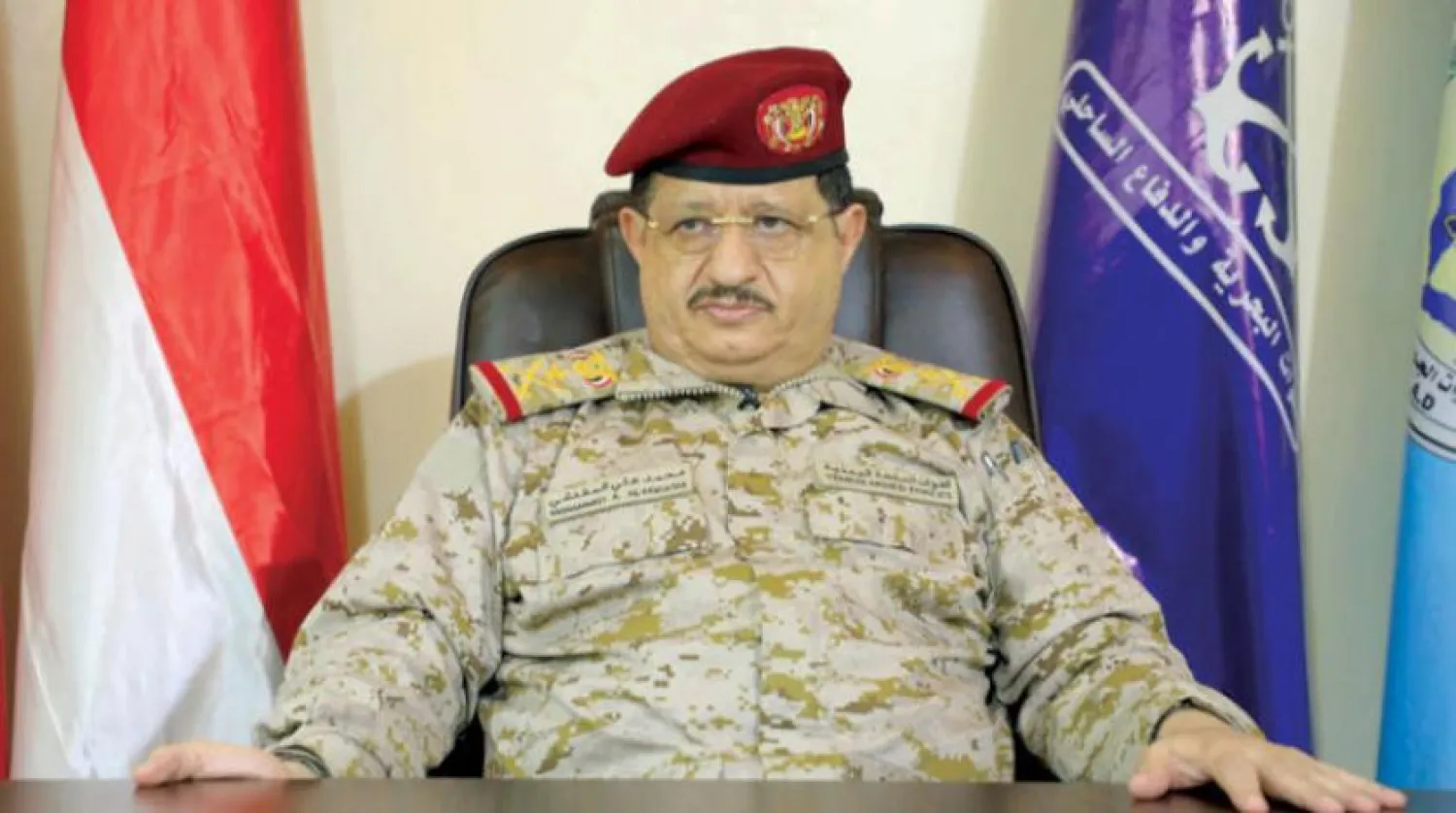
Yemeni Defense Minister Lt. Gen. Mohammed Ali Al-Maqdashi, Asharq Al-Awsat
TT

Yemeni Defense Minister: ‘Excellent’ Coordination with Giants Brigades, Houthis Amassed 15 Brigades for Marib, Al Jawf

Yemeni Defense Minister Lt. Gen. Mohammed Ali Al-Maqdashi, Asharq Al-Awsat

The Yemeni army, backed by the Saudi-led Arab Coalition, was able to defeat Houthis in the governorates of Shabwah and Marib, affirmed Yemeni Defense Minister Lt. Gen. Mohammed Ali Al-Maqdashi.

While the minister described coordination with the Giants Brigades as “excellent,” he explained that the Yemeni army is still in the process of liberating districts in Marib.

According to Maqdashi, the Yemeni army advanced more than 27 km in the direction of Safer and international lines.

“Our forces are around the corner from Umm al-Rish and Mala’a and have bypassed the eastern Balaq,” affirmed Maqdashi, adding that Yemeni Army forces were fighting defensive battles everywhere.

Speaking to Asharq Al-Awsat, Maqdashi revealed that special forces had been deployed around 56 km away from Hajjah governorate’s Harad district.

“The Yemeni Army has not stopped working towards battlefield gains. The Giants Brigades forces have stopped, but they might have future plans,” said Maqdashi.

“Army forces are continuing on all fronts, whether in Marib, Taiz, Al-Jawf, or Harad,” he asserted.

He said that coming days would witness several victories, just like those established with the help of the Giants Brigades on the coast and in the southern governorate of Taiz.

“Our forces are still in Harad and Midi, which are close to Abs. Victory will be achieved with the continuation of the battles, especially if all fronts are opened,” said Maqdashi.

Currently, Yemeni Army forces are stationed 56 km away from Harad and are preparing to fight the battle for freeing the district.

As for future plans to settle battles, Maqdashi pointed out that Yemen is part of the Saudi-led Arab Coalition, which had played a significant role in destroying the Houthi enemy.

“We are confident that we will liberate our country, as we are part of the Arab coalition forces led by the Kingdom of Saudi Arabia,” said Maqdashi.

The minister also talked about the Happy Yemen Brigades, the participation of the first military zone in battles next to Hodeidah, and the challenges facing the Yemeni army.

“The biggest challenge facing us is having capabilities in all fields. Houthis took control of everything, and we started building the state again, and the Kingdom of Saudi Arabia bore a large part in this matter,” said Maqdashi.

Maqdashi also revealed that when the Yemeni army was approaching Sanaa, Houthis were able to gather 15 brigades to attack the army’s positions in Marib and al-Jawf.


Main Suspect in Syria's Tadamon Massacre Arrested, Ministry Says

Amjad Yousef - Syria's Interior Ministry
TT

Main Suspect in Syria's Tadamon Massacre Arrested, Ministry Says

Amjad Yousef - Syria's Interior Ministry

Syria's Interior Ministry said on Friday it had arrested the main suspect in the 2013 Tadamon massacre, one of the worst acts of violence attributed to the former government of Bashar al-Assad, in which 288 civilians were killed.

The ministry released footage of Amjad Yousef’s arrest in the Al-Ghab Plain area of Hama province in western Syria, near his hometown. Yousef had been hiding there since the overthrow of Assad at the end of 2024, a security source told Reuters.

Yousef, 40, a former member of military intelligence under Assad, was thrust into the spotlight in April 2022 when the UK's Guardian newspaper published videos provided by two academics that they said showed him forcing blindfolded civilians to run towards a pit in the Tadamon neighborhood of southern Damascus before shooting them.

Annsar Shahoud, a researcher at the University of Amsterdam Holocaust and Genocide Center and one of the academics, spent four years documenting the massacre.

Posing as an online fangirl, Shahoud gained Yousef's trust and ultimately obtained his confessions both on video and audio recording.

Reuters was unable to reach Yousef for comment as he has been taken into custody.

The massacre is one of the most egregious documented incidents of violence attributed to the Assad government during the 14-year bloody war that began in 2011.

After Assad's fall at the end of 2024, civilians, media outlets and international organizations went to the site of the massacre to inspect it and interview witnesses. Locals refer to the site as "Amjad Yousef's Pit". It has been marked on Google Maps as "The Site of the Tadamon Massacre".

Ahmed Adra, a Tadamon resident and a member of the neighborhood committee, said victims' families had been celebrating in the streets since morning.

"We will take white roses and plant them at the site of the massacre and tell the victims that their memory is alive and that justice is being served," he told Reuters.

Shahoud said she now felt safe with Yousef in custody, but added the path to justice in Syria was unclear and did not include all perpetrators.

"I feel safe now, despite the distance, because I always felt for years that this person was after me," she told Reuters.


US Puts $10 Million Bounty on Iraq’s Kataib Sayyid al-Shuhada Leader

Members of Iraq's pro-Iran Hezbollah Brigades (Kataib Hezbollah) gather in a mourning procession for one of their comrades who was killed the previous day in a strike in Basra, during the funeral in Baghdad on April 8, 2026. (Photo by AHMAD AL-RUBAYE / AFP)
TT

US Puts $10 Million Bounty on Iraq’s Kataib Sayyid al-Shuhada Leader

Members of Iraq's pro-Iran Hezbollah Brigades (Kataib Hezbollah) gather in a mourning procession for one of their comrades who was killed the previous day in a strike in Basra, during the funeral in Baghdad on April 8, 2026. (Photo by AHMAD AL-RUBAYE / AFP)

The United States has placed a $10 million bounty on the leader of an Iranian-backed Shiite group in Iraq.

The US State Department’s Rewards for Justice program issued a notice it sought the leader of Kataib Sayyid al-Shuhada.

It said Hashim Finyan Rahim al-Saraji led the group, whose members “killed
Iraqi civilians and attacked US diplomatic facilities in Iraq.”

It also said Kataib Sayyid al-Shuhada attacked US military bases and personnel in Iraq and Syria.

Iraq has several Shiite groups backed by Iran that are part of the country’s Popular Mobilization Forces.


Lebanon-Israel Ceasefire Extended by 3 Weeks after White House Meeting

US President Donald Trump speaks to the media in the Oval Office of the White House in Washington, DC, USA, 23 April 2026. President Trump met with Lebanese and Israeli envoys at the White House for a new round of peace talks.  EPA/WILL OLIVER / POOL
US President Donald Trump speaks to the media in the Oval Office of the White House in Washington, DC, USA, 23 April 2026. President Trump met with Lebanese and Israeli envoys at the White House for a new round of peace talks. EPA/WILL OLIVER / POOL
TT

Lebanon-Israel Ceasefire Extended by 3 Weeks after White House Meeting

US President Donald Trump speaks to the media in the Oval Office of the White House in Washington, DC, USA, 23 April 2026. President Trump met with Lebanese and Israeli envoys at the White House for a new round of peace talks.  EPA/WILL OLIVER / POOL
US President Donald Trump speaks to the media in the Oval Office of the White House in Washington, DC, USA, 23 April 2026. President Trump met with Lebanese and Israeli envoys at the White House for a new round of peace talks. EPA/WILL OLIVER / POOL

Lebanon and Israel extended their ceasefire for three weeks after a high-level meeting at the White House, US President Donald Trump said on Thursday.

Trump hosted Israel's ambassador to Washington Yechiel Leiter and Lebanese ambassador to the US Nada Moawad in the Oval Office for a second round of US-facilitated talks.

"The Meeting went very well! The United States is going to work with Lebanon in order to help it protect itself from Hezbollah," Trump wrote on Truth Social.

Trump added that he looked forward to hosting Israeli Prime Minister Benjamin Netanyahu and Lebanese President Joseph Aoun in the near future.

Trump also spoke to reporters in the Oval Office alongside the participants in the meeting, saying he hoped the leaders would meet during the three-week cessation of hostilities. He said there was "a great chance" the two countries would reach a peace agreement this year.

Vice President JD Vance, Secretary of State Marco Rubio, US Ambassador to Israel Mike Huckabee and U.S. Ambassador to Lebanon Michel Issa also attended the meeting.

The ceasefire, reached after talks between the two nations' ambassadors ⁠to Washington ⁠last week, was set to expire on Sunday. It has yielded a significant reduction in violence, but attacks have continued in southern Lebanon, where Israeli troops have seized a self-declared buffer zone.

The Lebanese president said a day earlier that during the talks Moawad would ask for an end to Israeli home demolitions in villages and towns occupied by Israel after the latest war broke out on March 2.

Moawad thanked Trump for hosting the talks. "I think with your help, with your support, we can make Lebanon great again," she said.

Asked how the US would help Lebanon to fight Hezbollah, Trump did not provide details but said Washington had "a great relationship with Lebanon."

Trump said Israel had to be able to defend itself against attacks from Hezbollah.

He also called for Lebanon to abolish laws against engagement with Israel.

"Well, I'm pretty sure that that will be ended very quickly. I'll make sure of that," Trump said.
