


Milan Fashion Week Goes on under Shadow of Russian Attack

Gigi Hadid wears a creation as part of the Moschino Fall/Winter 2022-2023 fashion collection, unveiled during the Fashion Week in Milan, Italy, Thursday, Feb. 24, 2022. (AP)
TT

Milan Fashion Week Goes on under Shadow of Russian Attack

Gigi Hadid wears a creation as part of the Moschino Fall/Winter 2022-2023 fashion collection, unveiled during the Fashion Week in Milan, Italy, Thursday, Feb. 24, 2022. (AP)

Milan Fashion Week continued Thursday under the shadow of the Russian invasion of Ukraine and the possible economic repercussions as the West moves toward tighter sanctions.

The head of the Italian fashion council said more than 1 billion euros worth of luxury exports to Russia could be at risk, even as Russian buyers return to Milan for the first time since the pandemic thanks to a deal brokered with the government to recognize the Sputnik V for business travelers.

“If things continue like this, there will be damage,’’ Carlo Capasa, president of the Italian National Fashion Chamber, told The Associated Press. “But it is not even the moment to think about the economic damage, but instead the damage that man does to himself.”

Even if the runways didn't reflect it, the invasion was running in the background as the fashion world made their rounds, and the realization that once again, the world can change in a flash. It was exactly two years ago during the February fashion week previews that the first case in the West of locally transmitted virus was detected near Milan.

"We're coming out of the pandemic. I don't want to think about a European war. I think we have had enough,'' said Arianna Casadei, the third generation of a shoe-making family from Italy's Emilia Romagna coast.

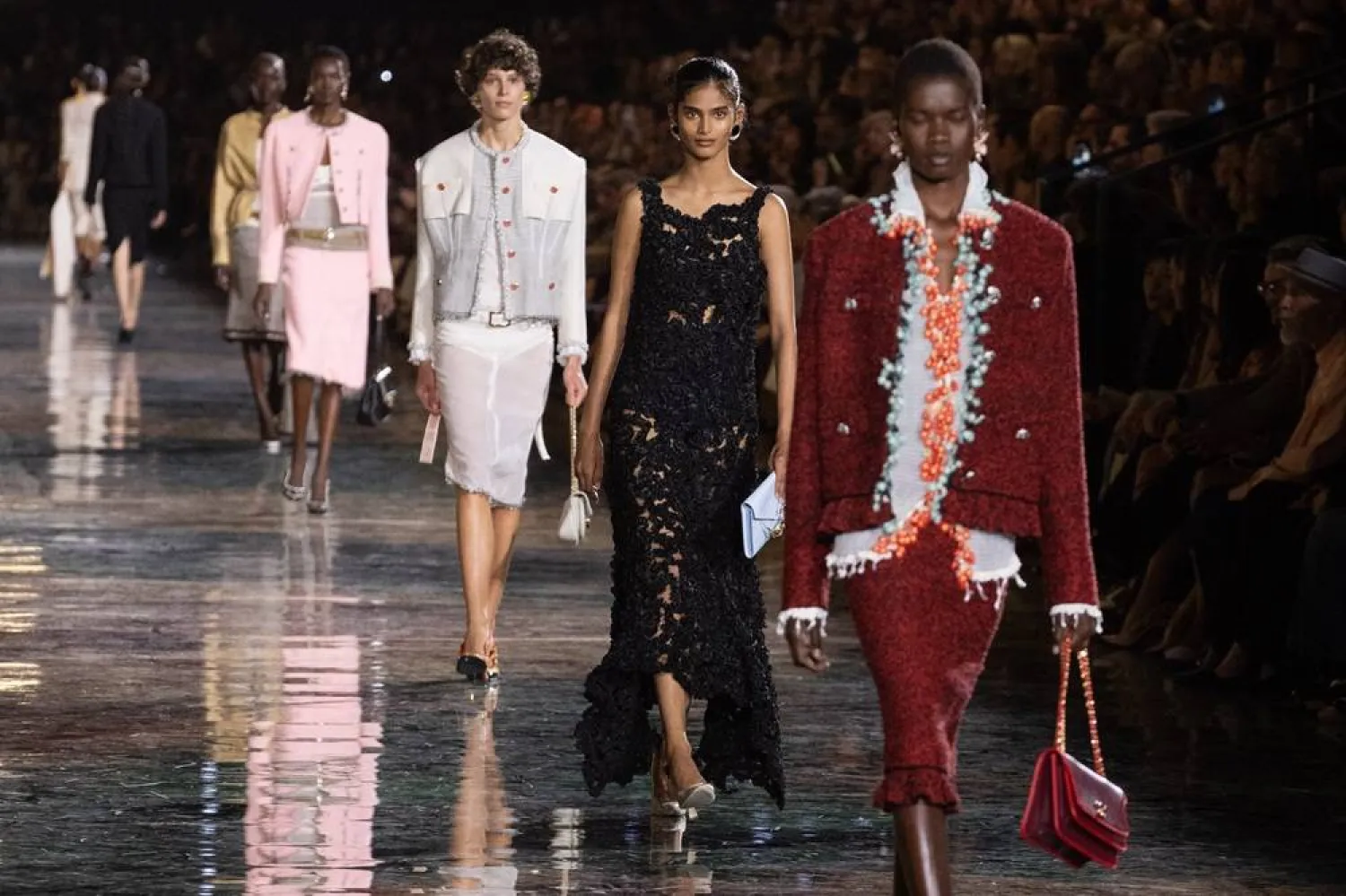
Highlights from Thursday’s preview shows of mostly womenswear for next fall and winter:

Prada’s pragmatism
Make way for the Prada tank top as the new staple for next winter as Miuccia Prada and Raf Simons mark the second year of their creative collaboration.

The simple white branded tank grounds a collection that employs the sheers from eveningwear as durable daytime looks layered with practical tanks and panties, enveloped in masculine overcoats made pretty with wispy faux fur and feathers applied like arm bands.

The skirt of the season is made in three tiers, like confections, mixing up leather, knits, velvet and sheers, sometimes adorned with sequins and rhinestones. It all has the air of upcycling and easily personalized looks.

Jackets also had feminine cutouts, and were adorned with thick ornamental chains that drape, without enclosing. They were worn with sturdy pleated wool skirts with a 1950s flair.

Simons said the collection echoes “revolutionary moments in Prada’s history.”

“The collection is about the history of women, the history of people, not the history of fashion,’’ Prada said in notes.

Moschino’s girls without guilt
Nothing quite says “Let Them Eat Cake” more than a runway show that features looks crafted to resemble furnishings in a European palace of some bygone century. So was Jeremy Scott’s brocade- and velvet-rich collection for Moschino.

Scott had his fun, sending out one model with the motto: “Gilt without Guilt,” and he had multiple jokes about breasts, at one point serving them up pointedly on a silver platter. But beneath the lamp-shade, candelabra and bird cage hats and beyond the grandfather clock dress, the collection featured day suits in bright patterns mimicking Oriental rugs, as well as an array of smart office dresses with pretty piping and button details.

There was also black eveningwear, like the elegant gown with sculpted details around the bare neck worn with opera gloves by Bella Hadid.

In a final flourish, Gigi Hadid twirled off the runway in a gold lame’ gown with a tulle mermaid finish, golden ivy running up her arms as if a statuette.

Scott took a final bow dressed as an astronaut, a nod to the opening music from a “Space Odyssey” but otherwise a head-scratcher.

Emporio Armani’s color play
In a sign that the pandemic is at last easing, Emporio Armani opened up hundreds of seats in its two shows to employees after officials gave the OK to allow full seating.

Giorgio Armani’s line for youthful dressers combined menswear with womenswear after the house postponed the January men’s show due to a virus surge. The merging provided a perfect complement, with geometric motifs running through both collections — in shades of gray for men contrasting with the pink, coral, seafoam green, red and blues for women.

For her, there were flouncy skirts with structured jackets, soft velvety pants with bold silken blouses. Men wore soft jackets tied at the waist, with off-kilter hats and easy-fitting trousers.

Sunnei’s sprint
Loris Messina and Simone Rizzo literally had models sprinting down an outdoor runway for their Sunnei, and in a tongue-in-cheek comment on how fast the fashion world moves, asked guests to film them only in slow motion.

A faux bossy female voice warned that they would be checking all Instagram posts for scofflaws. ”We like to create a moment, to have people enter in our world,'' Rizzo said.

Rizzo said the pair had always envisioned a fast-moving runway, and came up with a collection that reflected that, including wide-legged trousers and leggings, but also thick fuzzy knitwear and rubberized accessories that gave tell-tale signs of motion.

“We were thinking about the kind of girl living right now, who is always running,'' Rizzo said. But he also saw ties to the greater global situation. “We were thinking about how we all run around without thinking of what is going on around. Even what is happening right now in the world makes us understand we really need to calm down.”

Max Mara volumes
Max Mara offered cold weather wear for next winter that envelopes with dramatic silhouettes. Tight bodices give way to teddy bear fuzzy big skirts. Trousers are wide-legged and cuffed, worn with fanny packs that double as hand muffs.

A geometrical motif ran through the collection, from raised patterns on sock booties to square quilting on puffer jackets that provided a studied contrast to ribbing on knitwear. The house’s monochromes ran from basic camel and black and white to flashes of red and yellow.



French Parliament Adopts Bill to Regulate Fast Fashion

This photograph shows the logo of Asian e-commerce giant Shein in its stall at the Bazar de l'Hotel de Ville (BHV) department store in Paris on November 4, 2025, on the eve of the opening of its first physical store at BHV in Paris. (AFP)
TT

French Parliament Adopts Bill to Regulate Fast Fashion

This photograph shows the logo of Asian e-commerce giant Shein in its stall at the Bazar de l'Hotel de Ville (BHV) department store in Paris on November 4, 2025, on the eve of the opening of its first physical store at BHV in Paris. (AFP)

The French parliament on Monday passed a bill aimed at curbing the rise of fast fashion, targeting major Asian e-commerce platforms, such as Shein and Temu.

The legislation, first tabled two-and-a-half years ago, seeks to regulate so-called "ultra-fast fashion" companies, known for selling large volumes of lower quality clothing at rock-bottom price.

Easy to order and replace, fast fashion items contribute to pollution from the textile industry, which accounts for nearly 10 percent of global greenhouse gas emissions.

The Senate passed the bill Monday after the lower house National Assembly did last week.

It imposes a per-item fee for producing textile en masse that will increase over time, and a ban on advertising for ultra-fast fashion brands, including by social media influencers.

Lawmakers hope to rein in Asian e-commerce companies that have exploded in popularity in France in recent years.

Trade Minister Serge Papin last week said the bill would target the main players, including three companies, which he said are driving the surge in ultra-fast fashion.

"Their names, which were still unknown three years ago... are now on everyone's lips in France: Temu, Shein and AliExpress," he said at the time.

But some have criticized the legislation for sparing European and French companies, such as Zara and Kiabi, with some leftist lawmakers in both chambers abstaining during the vote.

Green Party lawmaker Charles Fournier said last week the original bill had been "considerably scaled back", arguing that brands, such as Zara and H&M "have not become models of sustainable fashion".

Stop Fast Fashion, a coalition of organizations, also criticized what it called as a "greatly watered-down" version compared to the one originally put forward.

- Advertising ban doubts -

Anne-Cecile Violland, the center-right member of parliament who proposed the bill, said they needed legislation that could be passed "very quickly and be operational".

"We're coming down very hard on Shein, and that's the first step," she told AFP, adding she understood the disappointment.

The legislation targets ultra-fast fashion based on two criteria: the volume of clothing placed on the market and the cost of repairing garments relative to their purchase price.

The per-item fee will vary on a set scale according to how each brand scores on both these standards.

The levy could reach up to 20 euros ($23) per item by 2030, though the cap remains at 50 percent of the product's pre-tax price.

Part of these penalties will go towards collection and recycling infrastructure.

The legislation also requires ultra-fast fashion companies to display messages on their websites promoting more moderate consumption, including reusing and repairing clothing.

A ban on advertising, including by influencers, is a central plank of the bill, though questions remain over how it could be enforced.


Osaka Makes Spectacular Wimbledon Arrival in Kimono-Inspired Dress

Japan's Naomi Osaka arrives to play against France's Elsa Jacquemot during their women's singles first round tennis match on the first day of the 2026 Wimbledon Championships at The All England Lawn Tennis and Croquet Club in Wimbledon, southwest London, on June 29, 2026. (AFP)
TT

Osaka Makes Spectacular Wimbledon Arrival in Kimono-Inspired Dress

Japan's Naomi Osaka arrives to play against France's Elsa Jacquemot during their women's singles first round tennis match on the first day of the 2026 Wimbledon Championships at The All England Lawn Tennis and Croquet Club in Wimbledon, southwest London, on June 29, 2026. (AFP)

Japan's Naomi Osaka made a spectacular entrance at Wimbledon on Monday as she arrived on court in a kimono-inspired dress.

Osaka has become known for wearing flamboyant outfits before starting her matches and the four-time Grand Slam champion's Wimbledon costume was eagerly-awaited.

With fans and photographers crowded around Court Three prior to her Wimbledon first-round match against France's Elsa Jacquemot, Osaka didn't disappoint.

To match the All England Club's strict all-white dress code, the 28-year-old wore a kimono-style ceremonial dress decorated with embroidered cranes and cherry blossom.

She paired the white outfit with a traditional kanzashi hair ornament featuring white flowers before removing both to reveal a white Nike dress.

While much more conventional, the dress is inspired by kirigami, the Japanese art of paper cutting.

Osaka has worked with a range of fashion designers on her outfits, going for a jellyfish-modelled look at the Australian Open dedicated to her daughter Shai and a gold dress inspired by the Eiffel Tower at the French Open.

For Wimbledon, the former world number one collaborated with Japanese designer Hana Yagi, posting a video accompanied by the caption: "Culture".

Speaking to British Vogue, Osaka said: "I like to use fashion as a medium for storytelling.

"Every walk-out is an opportunity to bring people into my creative world. The fact that people care about it and are excited to see what's next is also pretty cool.

"Obviously, the outfit has to be white, but, aside from that, you can play with a lot of different design elements. In some ways, not having to think about the color allows you to highlight other cool features like fabrics and textures."

Osaka's longtime creative director Marty Harper said Wimbledon's traditions played a key role in the design of the outfit.

"It's one of the few places in sport where ceremony still feels inseparable from competition. We wanted to acknowledge that while creating a dialogue with Japanese ceremonial dress," he said.

"The starting point was the idea of evolving ceremony. The garment is constructed from vintage shiromuku, ceremonial garments originally created to mark important moments in people's lives."


Heat Catches Europe’s Fashion Industry Unprepared as Models Face the Sun in Fur and Wool

 A model presents a creation for Dior for the Menswear Spring/Summer 2027 collection fashion show as part of the Paris Fashion Week, in Paris on June 24, 2026. (AFP)
A model presents a creation for Dior for the Menswear Spring/Summer 2027 collection fashion show as part of the Paris Fashion Week, in Paris on June 24, 2026. (AFP)
TT

Heat Catches Europe’s Fashion Industry Unprepared as Models Face the Sun in Fur and Wool

 A model presents a creation for Dior for the Menswear Spring/Summer 2027 collection fashion show as part of the Paris Fashion Week, in Paris on June 24, 2026. (AFP)
A model presents a creation for Dior for the Menswear Spring/Summer 2027 collection fashion show as part of the Paris Fashion Week, in Paris on June 24, 2026. (AFP)

The most coveted accessory at the Paris Fashion Week shows this week was not a bag, a sneaker or a watch. It was an ice pack.

As a historic heat wave gripped the French capital, fashion houses fought to keep guests cool with mist machines, chilled towels, parasols and iced Evian on silver platters.

It wasn’t enough. Historic venues sweltered, guests were packed in tight, air conditioning was absent or inadequate and water ran short — at one house, organizers weighed serving none at all, having found only plastic bottles to hand out.

That mattered because Paris Fashion Week is not a minor cultural event.

It is one of France’s most visible export machines: six fashion seasons a year, global luxury houses, celebrities, editors, buyers and clients moving through an industry worth billions, often inside aging venues built for a cooler age.

This week raised a harder question: whether Paris should keep staging menswear and haute couture in the height of summer at all if climate change keeps bringing more frequent and intense heat waves.

“I honestly thought I was going to pass out,” said Ben Freeman, a London-based fashion critic from Australia.

Paris neared 41 degrees Celsius (106 Fahrenheit) during a heat wave that pushed France into emergency mode. Large parts of the country were under red alert, and hospitals were told to prepare for more heat-related cases.

Like the dusty Louvre, which cut hours and said its historic building “remains vulnerable and is not sufficiently adapted to climate change,” fashion week exposed a Paris problem as much as a fashion one: how to keep prestige institutions running when the weather no longer fits the building, the calendar or the crowd.

“Paris Fashion Week is the canary in the mine,” Freeman said.

The deeper contradiction was on the runway. At a Paris Fashion Week Men’s where the industry paid to imagine next summer could barely survive this one, houses cooled the people watching the shows, then dressed their models in unseasonable leather, neoprene, wool and fur.

“The calendar does not make any sense,” acknowledged Dior’s Jonathan Anderson, blaming fractured delivery cycles and a business that bears no relation to the season outside.

Some in the front row suggested that fashion week in the hottest months be scrapped.

“In Paris we don’t have AC everywhere, it’s quite rare,” said Thomas Levy, 24, a fashion student outside one show. “I don’t know how the models did it this week in some of the leather and knit coats."

The venues couldn’t cope

Pascal Morand, who heads France’s fashion federation, said organizers were following the government’s heat-wave plan.

“We are conscious of the challenges and very attentive to preserving the Fashion Week experience in this context of structural change,” he told The Associated Press.

The cause ran deeper — an industry whose fixed parts, from the buildings to the clothes, were designed for a cooler world and a customer who lives somewhere else.

The response included earlier shows, more water, more mist, more shade.

Fashion had already been warned about heat management. In March, Celine built an okoumé-wood pavilion in the courtyard of the Institut de France for a winter show, packed guests inside and still saw some leave because of the temperature.

Dior shifted its show to 9 a.m. from mid-afternoon, and Rick Owens moved his forward too. Yet inside Dior’s half-renovated mansion, water was scarce, there was no air conditioning, and some guests looked ready to pass out.

The strain had already shown at Milan Fashion Week last week. At Thom Browne’s first show there, giant misting fans ran and black umbrellas went out as guests waited out the midday sun.

Runways out of season

The clothes were made not for summer in Paris but for global markets and customers who pass the hottest months in refrigerated air. For them, a wool coat in June is not a contradiction. It is just a purchase.

Louis Vuitton presented wetsuits in neoprene, as well as coats in cashmere and fur.

At Saint Laurent, Anthony Vaccarello sent models through cooling clouds of vapor from a Fujiko Nakaya fog sculpture, then ran hot and cold at once: featherweight, unlined tailoring stripped down for the heat, against leather briefs, choker scarves and transparent shoes fogging with the wearer’s sweat.

Issey Miyake’s IM Men gave the clearest practical answer, handing out ice packs at the door, then bamboo-thread fabrics and shadowy prints that moved with the air rather than against it.

Rick Owens made the anxiety literal, sending models through mist in garments with fans whirring inside. One critic called it metaphor for climate catastrophe.

France’s uneasy cooling debate

Air conditioning remains culturally suspect in France — blamed for sore throats, dismissed as wasteful or bad for the planet — even as heat waves turn cooling into a question of public safety.

President Emmanuel Macron’s government leans toward shade, insulation and trees; environmentalists warn that mass cooling would only deepen the emissions driving the heat.

Europe is the fastest-warming continent, but its old cities are short on the cooling a hotter climate demands. From sport to tourism to construction, industries built around fixed calendars and outdoor crowds are being forced to adapt to heat that comes earlier, lasts longer and climbs higher.

The question is how much longer an aging 19th century Paris can host a summer spectacle where guests need ice packs to reach the finale.