


Biden and Europe Waiting on One Key Sanction against Russia

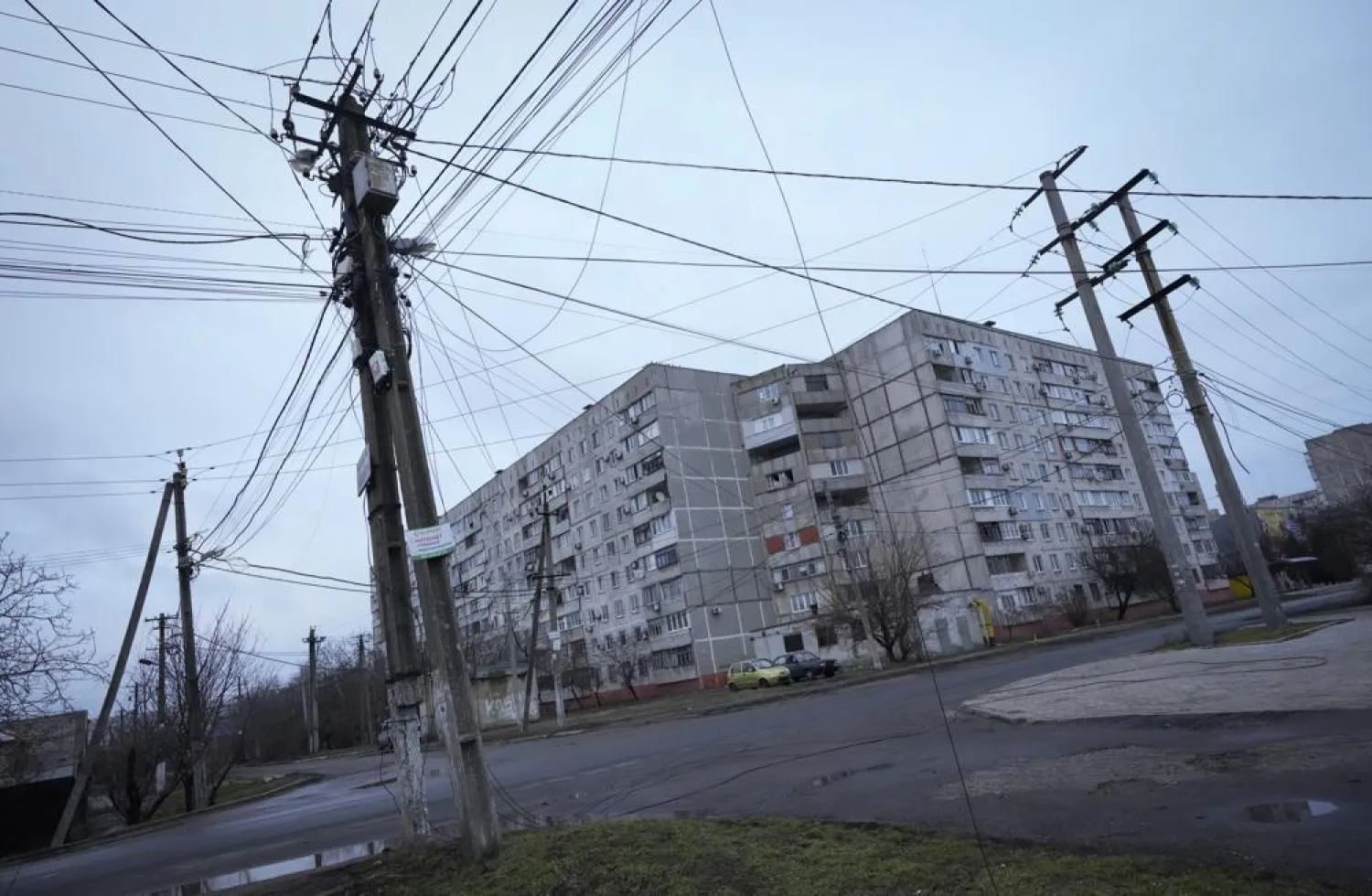
Empty streets seen following Russian shelling in Mariupol, Ukraine, Thursday, Feb. 24, 2022. (AP)
TT

Biden and Europe Waiting on One Key Sanction against Russia

Empty streets seen following Russian shelling in Mariupol, Ukraine, Thursday, Feb. 24, 2022. (AP)

US and European officials are holding one key financial sanction against Russia in reserve, choosing not to boot Russia off SWIFT, the dominant system for global financial transactions.

The Russian invasion of Ukraine caused a barrage of new financial sanctions Thursday. The sanctions are meant to isolate, punish and impoverish Russia in the long term. President Joe Biden announced restrictions on exports to Russia and sanctions against Russian banks and state-controlled companies.

But Biden pointedly played down the need to block Russia from SWIFT, saying that while it's “always” still an option, “right now that's not the position that the rest of Europe wishes to take.” He also suggested the sanctions being put in place would have more teeth.

“The sanctions we’ve imposed exceed SWIFT,” Biden said in response to a question Thursday. “Let’s have a conversation in another month or so to see if they’re working.”

Still, some European leaders, including in the United Kingdom, favor taking the additional step of blocking Russia from SWIFT, the Belgium-headquartered consortium used by banks and other financial institutions that serves as a key communications line for commerce worldwide. The SWIFT system averaged 42 million messages daily last year to enable payments. The name is an acronym for the Society for Worldwide Interbank Financial Telecommunications, and about half of all high-value payments that cross national borders go through its platform.

Ukraine has sought for Russia to be excluded from SWIFT, but several European leaders would prefer to stay patient because a ban could make international trade more difficult and hurt their economies.

“A number of countries are hesitant since it has serious consequences for themselves,” said Dutch Prime Minister Mark Rutte, who believes a ban should be a last resort.

The British government says Prime Minister Boris Johnson pushed at a virtual meeting of the Group of Seven world leaders Thursday for Russia to be kicked out of SWIFT. It said there was “no pushback” but it was agreed that more discussion was needed. UK officials would not confirm Germany was resisting.

US lawmakers have called on Biden to deploy every available financial sanction, with Senate Republican Leader Mitch McConnell saying Thursday that America should “ratchet the sanctions all the way up. Don’t hold any back. Every single available tough sanction should be employed and should be employed now.”

But Sen. Jim Risch of Idaho, the top Republican on the Senate Foreign Relations Committee, said the SWIFT ban would be complicated and time-consuming in part because the US doesn't have control over the decision.

The problem is that banning Russia from SWIFT might not cut it off from the global economy as cleanly as proponents think. Also, there could be blowback in the form of slower international growth. And rival messaging systems could gain users in ways that erode the power of the US dollar — all of which has left SWIFT as a sanction waiting to be deployed.

“It’s a communications platform, not a financial payments system," said Adam Smith, a lawyer who worked in the Obama administration. "If you remove Russia from SWIFT, you’re removing them from a key artery of finance, but they can use pre-SWIFT tools like telephone, telex or email to engage in bank-to-bank transactions.”

The other risk is that countries could migrate their institutions to platforms other than SWIFT, such as a system developed by China. This would increase the friction in global commerce — hurting growth — and make it harder to monitor the finances of terrorist groups.

“By politicizing SWIFT you give incentive for others to develop alternatives,” said Brian O'Toole, a senior fellow at the Atlantic Council and former Treasury official. “SWIFT also is an important partner in US-European counterterrorism efforts. It shares data with US Treasury related to counterterrorism issues that has proven to be enormously valuable.”

The sanctions announced Thursday would still accomplish much of what would happen if Russia lost access to SWIFT, said Clay Lowery of the Institute of International Finance.

“Cutting off these financial institutions from utilizing the dollar, euro, pound sterling is still a pretty significant step," Lowery said. “You’re really having the same impact on certain subsections of the Russian economy through sanctions.”

Iran was blocked from the SWIFT system in 2014 because of its nuclear program. In 2019, then-Russian Prime Minister Dmitry Medvedev said losing access to SWIFT would be akin to a declaration of war against Russia. The statement by Medvedev is a sign that Russia viewed the platform as a vulnerability and developed workarounds to limit any economic damage.

"I think it will be harmful in the immediate term and psychological as well, but I’m not sure it’ll impact the economy in ways that make it worthwhile,” Smith said.

Russia has already prepared for ways to evade sanctions, including those imposed this week, experts say.

Ari Redbord, a former Treasury senior adviser, said he expects Russia’s leadership to bypass financial penalties that limit its ability to engage in the global financial system through the increased use of cryptocurrency.

He said this is a risk “especially when there are actors like Iran, China and North Korea” that will continue to trade with Russia outside of the formal financial system, Redbord said.

“If Russian banks are entirely cut off from the US and European financial system, that will be very debilitating to those banks and the Russian economy,” he said. But the Russian government will use alternative means to trade with countries “even if there are debilitating" sanctions from the European Union and US.



Nigeria's President to Make a Sate Visit to the UK in March

Nigeria’s President Bola Tinubu gives a joint statement with Brazil’s President Luiz Inacio Lula da Silva, at the Planalto presidential palace, in Brasilia, Brazil, Aug. 25, 2025. (AP Photo/Eraldo Peres, File)
TT

Nigeria's President to Make a Sate Visit to the UK in March

Nigeria’s President Bola Tinubu gives a joint statement with Brazil’s President Luiz Inacio Lula da Silva, at the Planalto presidential palace, in Brasilia, Brazil, Aug. 25, 2025. (AP Photo/Eraldo Peres, File)

Nigeria’s president is set to make a state visit to the UK in March, the first such trip by a Nigerian leader in almost four decades, Britain’s Buckingham Palace said Sunday.

Officials said President Bola Tinubu and first lady Oluremi Tinubu will travel to the UK on March 18 and 19, The AP news reported.

King Charles III and Queen Camilla will host them at Windsor Castle. Full details of the visit are expected at a later date.

Charles visited Nigeria, a Commonwealth country, four times from 1990 to 2018 before he became king. He previously received Tinubu at Buckingham Palace in September 2024.m

Previous state visits by a Nigerian leader took place in 1973, 1981 and 1989.

A state visit usually starts with an official reception hosted by the king and includes a carriage procession and a state banquet.

Last year Charles hosted state visits for world leaders including US President Donald Trump, French President Emmanuel Macron and German President Frank-Walter Steinmeier.


Iran Strikes Hard Line on US Talks, Saying Tehran's Power Comes From Saying 'No'

Traffic moves through a street in Tehran on February 7, 2026. (Photo by ATTA KENARE / AFP)
TT

Iran Strikes Hard Line on US Talks, Saying Tehran's Power Comes From Saying 'No'

Traffic moves through a street in Tehran on February 7, 2026. (Photo by ATTA KENARE / AFP)

Iran's top diplomat insisted Sunday that Tehran's strength came from its ability to “say no to the great powers," striking a maximalist position just after negotiations with the United States over its nuclear program and in the wake of nationwide protests.

Foreign Minister Abbas Araghchi, speaking to diplomats at a summit in Tehran, signaled that Iran would stick to its position that it must be able to enrich uranium — a major point of contention with President Donald Trump, who bombed Iranian atomic sites in June during the 12-day Iran-Israel war.

Iran will never surrender the right to enrich uranium, even if war "is imposed on us,” he noted.

"Iran has paid a very heavy price for its peaceful nuclear program and for uranium enrichment." 

Israeli Prime Minister Benjamin Netanyahu is expected to travel to Washington this week, with Iran expected to be the major subject of discussion, his office said.

While Iranian President Masoud Pezeshkian praised the talks Friday in Oman with the Americans as “a step forward,” Araghchi's remarks show the challenge ahead. Already, the US moved the aircraft carrier USS Abraham Lincoln, ships and warplanes to the Middle East to pressure Iran into an agreement and have the firepower necessary to strike the Islamic Republic should Trump choose to do so, according to The AP news.

“I believe the secret of the Islamic Republic of Iran’s power lies in its ability to stand against bullying, domination and pressures from others," Araghchi said.

"They fear our atomic bomb, while we are not pursuing an atomic bomb. Our atomic bomb is the power to say no to the great powers. The secret of the Islamic Republic’s power is in the power to say no to the powers.”

‘Atomic bomb’ as rhetorical device Araghchi's choice to explicitly use an “atomic bomb” as a rhetorical device likely wasn't accidental. While Iran has long maintained its nuclear program is peaceful, the West and the International Atomic Energy Agency say Tehran had an organized military program to seek the bomb up until 2003.

Iran had been enriching uranium up to 60% purity, a short, technical step to weapons-grade levels of 90%, the only non-weapons state to do so. Iranian officials in recent years had also been increasingly threatening that Tehran could seek the bomb, even while its diplomats have pointed to Iranian Supreme Leader Ali Khamenei’s preachings as a binding fatwa, or religious edict, that Iran wouldn’t build one.

Pezeshkian, who ordered Araghchi to pursue talks with the Americans after likely getting Khamenei's blessing, also wrote on X on Sunday about the talks.

“The Iran-US talks, held through the follow-up efforts of friendly governments in the region, were a step forward,” the president wrote. “Dialogue has always been our strategy for peaceful resolution. ... The Iranian nation has always responded to respect with respect, but it does not tolerate the language of force.”

It remains unclear when and where, or if, there will be a second round of talks. Trump, after the talks Friday, offered few details but said: “Iran looks like they want to make a deal very badly — as they should.”

Aircraft carrier in the Arabian Sea During Friday's talks, US Navy Adm. Brad Cooper, the head of the American military's Central Command, was in Oman. Cooper's presence was apparently an intentional reminder to Iran about US military power in the region. Cooper later accompanied US special envoy Steve Witkoff and Jared Kushner, Trump's son-in-law, to the Lincoln out in the Arabian Sea after the indirect negotiations.

Araghchi appeared to be taking the threat of an American military strike seriously, as many worried Iranians have in recent weeks. He noted that after multiple rounds of talks last year, the US “attacked us in the midst of negotiations."

“If you take a step back (in negotiations), it is not clear up to where it will go,” Araghchi said.


Russia: Man Suspected of Shooting Top General Detained in Dubai

An investigator works outside a residential building where the assassination attempt on Russian Lieutenant General Vladimir Alexeyev took place in Moscow, Russia February 6, 2026. REUTERS/Anastasia Barashkova
TT

Russia: Man Suspected of Shooting Top General Detained in Dubai

An investigator works outside a residential building where the assassination attempt on Russian Lieutenant General Vladimir Alexeyev took place in Moscow, Russia February 6, 2026. REUTERS/Anastasia Barashkova

Russia's Federal Security Service (FSB) said on Sunday that the man suspected of shooting top Russian military intelligence officer Vladimir Alexeyev in Moscow has been detained in Dubai and handed over to Russia.

Lieutenant General Vladimir Alexeyev, deputy head of the GRU, ⁠Russia's military intelligence arm, was shot several times in an apartment block in Moscow on Friday, investigators said. He underwent surgery after the shooting, Russian media ⁠said.

The FSB said a Russian citizen named Lyubomir Korba was detained in Dubai on suspicion of carrying out the shooting.

Russian Foreign Minister Sergei Lavrov accused Ukraine of being behind the assassination attempt, which he said was designed to sabotage peace talks. ⁠Ukraine said it had nothing to do with the shooting.

Alexeyev's boss, Admiral Igor Kostyukov, the head of the GRU, has been leading Russia's delegation in negotiations with Ukraine in Abu Dhabi on security-related aspects of a potential peace deal.