Yemeni Chief of Staff: Houthis Pose Direct Threat to Global Economy

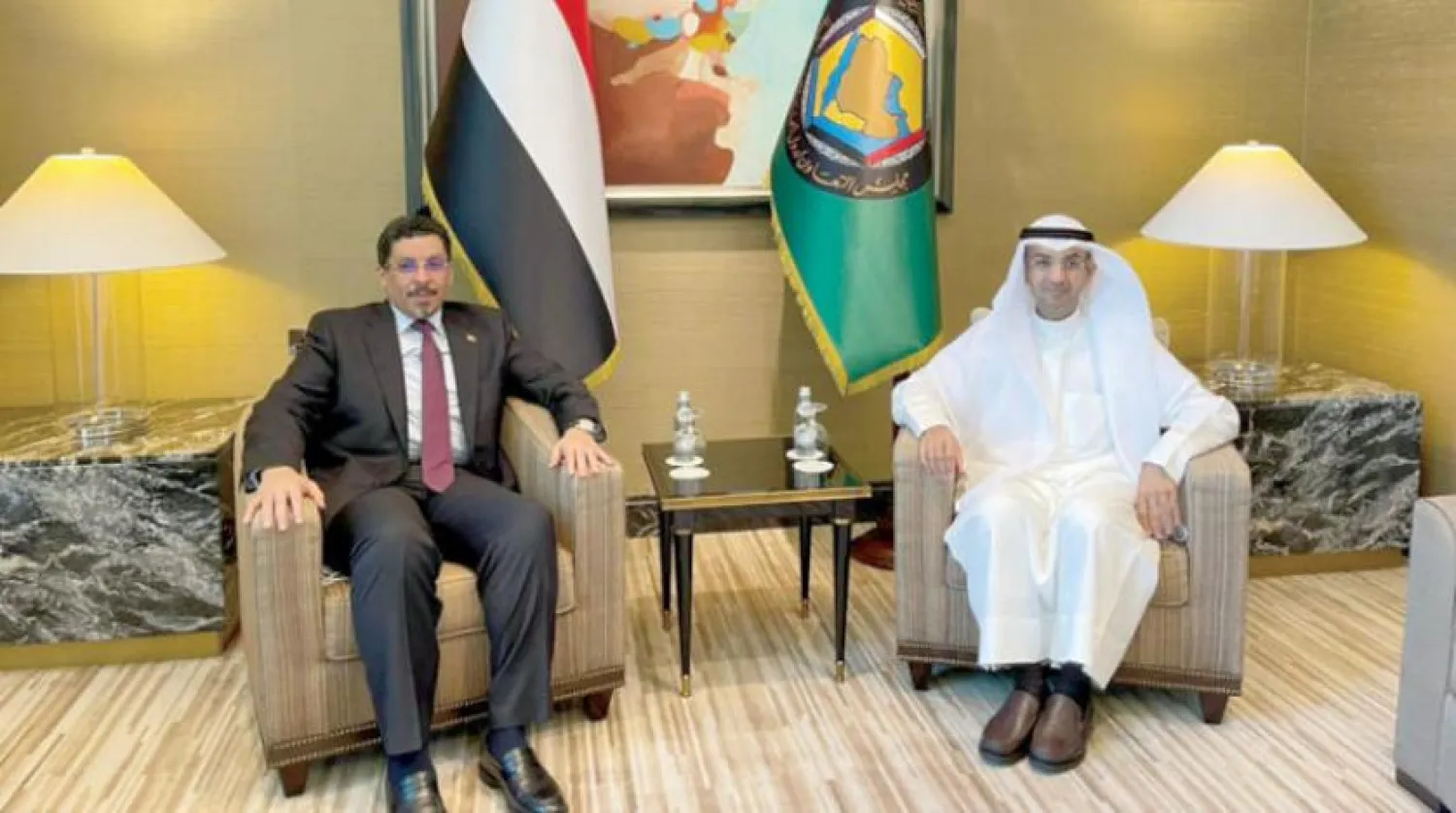
GCC Secretary General Dr. Nayef Al-Hajraf met on Sunday with Yemen’s Minister of Foreign Affairs and Expatriates Ahmed Awad bin Mubarak in Riyadh (SPA)
TT

Yemeni Chief of Staff: Houthis Pose Direct Threat to Global Economy

GCC Secretary General Dr. Nayef Al-Hajraf met on Sunday with Yemen’s Minister of Foreign Affairs and Expatriates Ahmed Awad bin Mubarak in Riyadh (SPA)

Yemen’s Chief of Staff Lieutenant General Sagheer bin Aziz stressed on Sunday that the Iranian-backed Houthi terrorist group poses a direct threat to the global economy, urging international players to support the Yemeni army, which is fighting a fierce war against the militias.

“We call on the international community and the Security Council to enable our legitimate institutions to confront the most dangerous terrorist group in the world: Iran’s Houthi militia,” he wrote on his Facebook page.

The Chief of Staff added that the danger of Houthi terrorism “poses a direct thereat to the global economy. It is time to provide all aspects of support to our national army, which is currently fighting a fierce war against the group on various fronts.”

Meanwhile, Secretary General of the Gulf Cooperation Council for Arab States Dr. Nayef Al-Hajraf reiterated on Sunday GCC’s firm position on finding a political solution to the Yemeni crisis to achieve peace, security and stability in Yemen.

He made his remarks during talks with Yemeni Minister of Foreign Affairs and Expatriates Ahmed Awad bin Mubarak in Riyadh.

Al-Hajraf and the Yemeni minister discussed the developments in Yemen.

Al-Hajraf stressed the GCC states’ keenness on supporting everything that achieves the interests of the Yemeni people, in addition to backing regional and international efforts to achieve security and stability.


Saudi Crown Prince Receives Written Message from Prime Minister of Japan

Saudi Minister of Foreign Affairs Prince Faisal bin Farhan bin Abdullah and Minister of Economy, Trade and Industry of Japan Akazawa Ryosei meet on Wednesday. (SPA)
TT

Saudi Crown Prince Receives Written Message from Prime Minister of Japan

Saudi Minister of Foreign Affairs Prince Faisal bin Farhan bin Abdullah and Minister of Economy, Trade and Industry of Japan Akazawa Ryosei meet on Wednesday. (SPA)

Prince Mohammed bin Salman bin Abdulaziz Al Saud, Saudi Crown Prince and Prime Minister, received a written message from Prime Minister of Japan Sanae Takaichi.

The message was received by Minister of Foreign Affairs Prince Faisal bin Farhan bin Abdullah during a meeting with Minister of Economy, Trade and Industry of Japan Akazawa Ryosei.

During the meeting, the officials reviewed the strategic relations between their countries and discussed ways to boost joint cooperation, particularly in the fields of economy and energy resources.

They also addressed regional developments and joint efforts regarding the situation in the Strait of Hormuz, emphasizing the vital importance of the freedom and safety of international waterways to preserve regional and global security and stability, and to ensure the continued smooth flow of global energy supplies.


Saudi FM, Iranian Counterpart Discuss Regional Developments

Saudi Minister of Foreign Affairs Prince Faisal bin Farhan bin Abdullah
TT

Saudi FM, Iranian Counterpart Discuss Regional Developments

Saudi Minister of Foreign Affairs Prince Faisal bin Farhan bin Abdullah

Saudi Minister of Foreign Affairs Prince Faisal bin Farhan bin Abdullah held a phone call with his Iranian counterpart, Abbas Araghchi, the Saudi Press Agency (SPA) reported on Wednesday.

During the call, they discussed the latest regional developments and the efforts to maintain the region's security and stability, SPA said.


US-Gulf Draft UN Resolution to Hold Iran Accountable over Hormuz Closure

A UN Security Council session held on March 12 (Reuters)
TT

US-Gulf Draft UN Resolution to Hold Iran Accountable over Hormuz Closure

A UN Security Council session held on March 12 (Reuters)

The United States and Bahrain have begun drafting a UN Security Council resolution aimed at holding Iran accountable for closing the Strait of Hormuz and advancing international efforts to reopen it to commercial shipping.

US Ambassador to the UN Mike Waltz, speaking during a phone press conference on Monday, said the draft states that the Security Council strongly condemns repeated attacks and threats by Iran against commercial vessels, as well as actions aimed at obstructing lawful transit through the Strait of Hormuz. These include the laying of naval mines and the imposition of illegal fees on ships.

The proposal determines that such actions constitute a threat to international peace and security, opening the possibility of placing the resolution under Chapter VII of the UN Charter and, consequently, the potential adoption of enforcement measures at a later stage.

It affirms the right of all ships and aircraft to transit the Strait of Hormuz without unlawful interference, in accordance with international law, including the UN Convention on the Law of the Sea.

It further calls on Iran to immediately cease all attacks or threats directed against commercial shipping, as well as any attempts to obstruct or impede freedom of navigation.

A key provision stipulates that Iran must disclose the number of mines it has laid and their precise locations in and around the Strait of Hormuz, and work toward their removal. The draft also calls on Tehran to refrain from interfering in international demining efforts.

Humanitarian corridor

Another clause asks Iran to cooperate with the United Nations in establishing a humanitarian corridor in the Strait of Hormuz, aimed at facilitating the flow of essential goods, including food and fertilizers, which the text says have been disrupted by recent developments in the region.

It also includes a prohibition on any UN member state assisting Iran in closing the strait or restricting transit through it. At the same time, it affirms the right of states to defend their vessels against attacks, in accordance with international law.

This is the latest diplomatic effort by Washington and Manama after China and Russia vetoed a similar resolution hours before a temporary ceasefire was announced in early April.

Waltz said negotiations on the draft would take place this week, adding that it remains unclear whether the resolution will include an enforcement mechanism to secure navigation in the strait.

He revealed that Bahrain is contributing to drafting the text, with input from Saudi Arabia, Kuwait, Qatar and the United Arab Emirates, in a way that would require Iran to halt attacks on commercial vessels and attempts to impose transit fees, as well as to stop laying naval mines and disclose their locations.

Waltz underlined that the draft is narrower in scope than the previous unsuccessful proposal and comes amid a ceasefire with Iran.

The United States and Gulf countries are continuing negotiations this week and are seeking swift adoption of the resolution, provided consensus among the countries concerned is maintained.

Waltz framed the issue not only as part of a confrontation with Iran but also as a matter related to international law and the freedom of global trade, stressing that no country has the right to blackmail global trade.

A previous draft resolution blocked by Russia and China had sought authorization for the use of defensive force to protect navigation in the Strait of Hormuz and free it from Iranian attacks. It also would have allowed states, individually or through voluntary multinational maritime partnerships, to use all necessary and proportionate defensive means, applying to the strait and adjacent waters to secure passage and deter attempts to close, obstruct or otherwise interfere in any way with international navigation through the Strait of Hormuz, through which about one-fifth of the world’s oil passes.