


Beijing Expands Mass Testing as Lockdown Fears Grow

Beijing has launched mass coronavirus testing for nearly all its 21 million residents as fears grow that the Chinese capital might be placed under a strict lockdown like Shanghai Noel Celis AFP/File
TT

Beijing Expands Mass Testing as Lockdown Fears Grow

Beijing has launched mass coronavirus testing for nearly all its 21 million residents as fears grow that the Chinese capital might be placed under a strict lockdown like Shanghai Noel Celis AFP/File

Beijing on Tuesday launched mass coronavirus testing for nearly all its 21 million residents, as fears grew that the Chinese capital may be placed under a strict lockdown like Shanghai.

China is trying to contain a wave of infections in Shanghai -- its biggest city -- which has been almost entirely locked down for weeks and reported 52 new Covid deaths on Tuesday, AFP said.

Beijing authorities have ordered people in 12 central districts that account for most of its population to undergo three rounds of PCR testing after the detection of dozens of cases in the city in recent days.

The capital's most populous downtown district, Chaoyang, was the first to order mass testing from Monday, with people waiting in long lines to be swabbed by health workers in protective gear.

Eleven more districts began testing on Tuesday.

The testing order for Chaoyang sparked panic buying from Sunday night, with residents lining up at supermarkets with full carts and bulging shopping bags as state media tried to reassure the public that there were plentiful supplies.

Beijing residents told AFP they feared a repeat of the sudden lockdown in Shanghai, where people have struggled to obtain food and medical care for non-Covid conditions.

City health official Xu Hejian said Monday that the spread of the virus in Beijing was still "within the scope of control".

- Economic pressure -
The capital reported 33 new cases on Tuesday, a fraction of Shanghai's daily tally of 16,000.

But Beijing officials are anxious to avoid a spiraling outbreak.

They have urged companies to allow employees to work from home, sealed off multiple residential areas and suspended local group tourism ahead of the long May 1 national holiday.

Authorities on Monday urged Beijing residents not to leave the city for these holidays unless necessary.

Beijing's measures are mild, however, compared with actions taken elsewhere, Pinpoint Asset Management chief economist Zhiwei Zhang said in a note.

"I am surprised that the government did not impose restrictive policies in Beijing as harshly and quickly as in other cities that experienced similar outbreaks in recent weeks," he wrote.

Under its zero-Covid policy, China has used strict lockdowns, mass testing and severe travel restrictions to stamp out infections.

But authorities are increasingly struggling with the impact of these protocols on the economy and business morale, especially when outbreaks appear in the country's most important cities.

Concerns have grown around the world about how the outbreaks in China and its government's anti-Covid policies could impact the global economy, especially supply chains.

The city of Baotou in the country's Inner Mongolia region -- a major supplier of rare earths -- said Monday that after the detection of two virus cases, all residents must stay home, with each household only sending one member out to buy necessities once a day.

That order came as Shanghai's lockdown dragged on, with social media users and local news outlets sharing images of green metal fences put up across the city to keep residents confined to their buildings.

One viral image appeared to show fences along the deserted pavements of a once-bustling street where restaurant patrons used to dine al fresco.

Iran President Calls on People to Save Energy

Iranians shop in the Tajrish bazaar in Tehran, Iran, 25 April 2026. (EPA)
TT

Iran President Calls on People to Save Energy

Iranians shop in the Tajrish bazaar in Tehran, Iran, 25 April 2026. (EPA)

Iranian President Masoud Pezeshkian called on his people Saturday to conserve electricity, warning that while there were no shortages at present, the US and Israel aimed to sow "dissatisfaction" among the Iranian people.

"We have asked our dear people, who are now ready and present on the ground, a simple request. And that is to reduce their own electricity and energy consumption," the president said on state TV.

"We do not need people to sacrifice for the time being, but we do need to control consumption. Instead of 10 lights, two lights should be turned on in the house -- what is wrong with that?" he added.

Despite the US-Israeli bombing campaign against Iran, there have been no reported power cuts in Tehran in recent days.

Pezeshkian accused Iran's enemies of hitting infrastructure and imposing a blockade "so that the current satisfaction turns into dissatisfaction".

US President Donald Trump has repeatedly threatened to wipe out Iran's power infrastructure, but has so far not followed through.

Even before the current war with the United States and Israel, however, Iran suffered frequent power outages during the winter and summer peaks in demand.

According to the International Energy Agency, Iran generates nearly four-fifths of its electricity from burning natural gas, a resource in which it is self-sufficient thanks to vast gas fields.

It supplements this with low-quality heavy fuel oil, known as mazout, used at older power stations.

Nevertheless, ageing infrastructure, a lack of investment and the impact of fierce international sanctions that cut off access to technology and investment have left the electricity grid unable to cope with demand.

Pezeshkian has previously launched several public awareness campaigns to reduce energy use.


Türkiye Dismisses Deputy Education Minister After School Shootings

Flowers are hung on the fence of a school where a shooting took place, in the southeastern province of Kahramanmaras, Türkiye, April 16, 2026. (Reuters)
TT

Türkiye Dismisses Deputy Education Minister After School Shootings

Flowers are hung on the fence of a school where a shooting took place, in the southeastern province of Kahramanmaras, Türkiye, April 16, 2026. (Reuters)

President Recep Tayyip Erdogan has dismissed Türkiye’s deputy education minister after two school shootings that left nine people dead, according to the official gazette published late Friday.

Eight students aged 10 and 11 and a teacher were killed this month when a 14-year-old opened fire at a school in the southern province of Kahramanmaras.

Authorities said the attacker, who died at the scene, brought five firearms and was the son of a former police inspector, who has since been arrested.

A separate attack in southeastern Sanliurfa province involved a former student who opened fire at his old high school before taking his own life when confronted by police.

Under a decree signed by Erdogan, deputy education minister Nazif Yilmaz was dismissed and replaced by Cihad Demirli.

The measures also targeted the leadership of state institutions responsible for education, according to the decree.

The incidents have sparked public outcry and Erdogan has said the government will introduce measures, including restrictions on gun ownership.


Macron Reaffirms Efforts to Reopen Strait of Hormuz, as TotalEnergies Warns of Energy Shortages

 French President Emmanuel Macron attends a Greece–France Economic Forum at the Stavros Niarchos Foundation Cultural Center in Athens, Greece, April 25, 2026. (Reuters)
French President Emmanuel Macron attends a Greece–France Economic Forum at the Stavros Niarchos Foundation Cultural Center in Athens, Greece, April 25, 2026. (Reuters)
TT

Macron Reaffirms Efforts to Reopen Strait of Hormuz, as TotalEnergies Warns of Energy Shortages

 French President Emmanuel Macron attends a Greece–France Economic Forum at the Stavros Niarchos Foundation Cultural Center in Athens, Greece, April 25, 2026. (Reuters)
French President Emmanuel Macron attends a Greece–France Economic Forum at the Stavros Niarchos Foundation Cultural Center in Athens, Greece, April 25, 2026. (Reuters)

French President Emmanuel Macron reiterated ‌on Saturday that he was focused on efforts to reopen the Strait of Hormuz, a day after the head of TotalEnergies warned of global energy shortages if the Iran war continues for months.

Macron, speaking at a news conference in Athens alongside Greek Prime Minister Kyriakos Mitsotakis, said panic caused by geopolitical uncertainty can in itself lead to shortages.

"Our goal is to achieve a full reopening in the coming days and weeks, in accordance with ‌international law, ‌guaranteeing freedom of navigation without tolls on ‌the ⁠Strait of Hormuz. Then ⁠things can gradually return to normal," Macron said.

TotalEnergies CEO Patrick Pouyanne pressed on Friday for the reopening of the strait, through which about a fifth of the globe's oil and gas supply normally flows.

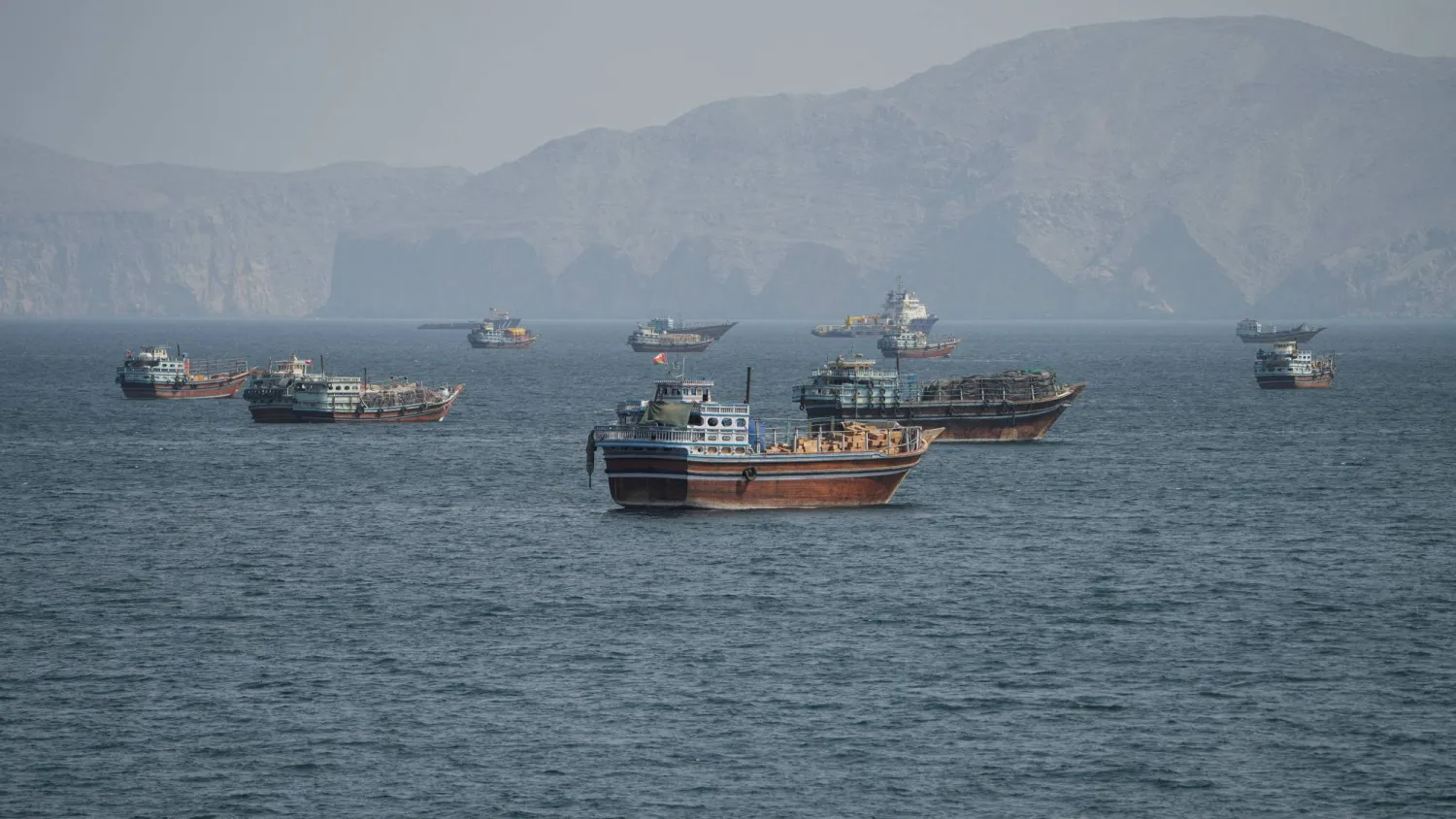
Movement through the strait, which is also a key transport route for ⁠goods including fertilizers and pharmaceuticals, has been choked ‌due to the US-Israeli ‌war with Iran, as Iran has seized container ships and ‌the United States has mounted a blockade on Iranian ‌ports.

"If it lasts two, three months more, we are entering in a world of scarcity of energy, which Asian countries have already suffered," Pouyanne told the World Policy Conference in Chantilly, ‌outside Paris. "You cannot have 20% of the oil and gas of the planet being ⁠stranded and ⁠not accessible without major consequences."

More than a dozen countries have said they are willing to join an international mission led by France and Britain to protect shipping in the strait when conditions permit, even as US President Donald Trump has said he does not need allies' help.

"We're all in the same boat, and it's not a boat we chose, if I may say. We're victims of geopolitics and we're victims of this war that started several months ago," Macron said on Saturday.