


Gulf States Underline Unified Stance on Russian-Ukrainian Crisis

The Gulf-Russian ministerial meeting in Riyadh on Wednesday (AFP)
TT

Gulf States Underline Unified Stance on Russian-Ukrainian Crisis

The Gulf-Russian ministerial meeting in Riyadh on Wednesday (AFP)

Saudi Minister of Foreign Affairs Prince Faisal bin Farhan said that the unity of the stances of the Gulf States towards international issues and crises has consolidated the Cooperation Council as one of the effective and influential international forces.

He pointed to two separate Gulf meetings on Wednesday; the first held in the presence of Russian Foreign Minister Sergei Lavrov, and the second with Ukrainian Foreign Minister Dmytro Kuleba, via videoconference.

“Through these two meetings, we voiced our unified position towards the Russian-Ukrainian crisis and its negative repercussions, especially with regard to food security in the affected countries and the world,” the Saudi foreign minister said.

Meanwhile, the Russian foreign minister stressed that the Gulf countries would not participate in Western sanctions against Moscow, Russian media reported.

At the conclusion of the joint ministerial meeting of the strategic dialogue between Russia and the Gulf Cooperation Council countries, Lavrov said that Russia did not stand against NATO or the European Union, adding that the international community should support the implementation of the UN Security Council resolutions unanimously agreed by its permanent members.

The GCC is facing many challenges, mainly “Iran’s nuclear and missile program, its arming of militias, its support for terrorism, and its destabilizing behavior in the region,” according to the Saudi foreign minister, who added: “Our dialogue and communication with Iran must be based on a unified Gulf position through which we call for calm, cooperation and commitment to the principles of international legitimacy and good neighborliness, so that we can work together to achieve our development plans within a stable regional environment.”

His statements came on the sidelines of the 152nd Gulf Ministerial Meeting, which was held at the headquarters of the GCC Secretariat in Riyadh, in the presence of Lavrov.

The meeting affirmed that the GCC position on the Russian-Ukrainian crisis was based on the principles of international law and the Charter of the United Nations, and the preservation of the international system based on respect for the sovereignty, territorial integrity and political independence of states, non-interference in their internal affairs, and non-use or threat of force.

In their final statement, the GCC ministers reiterated their support for mediation efforts to resolve the crisis between Russia and Ukraine through dialogue and negotiations.

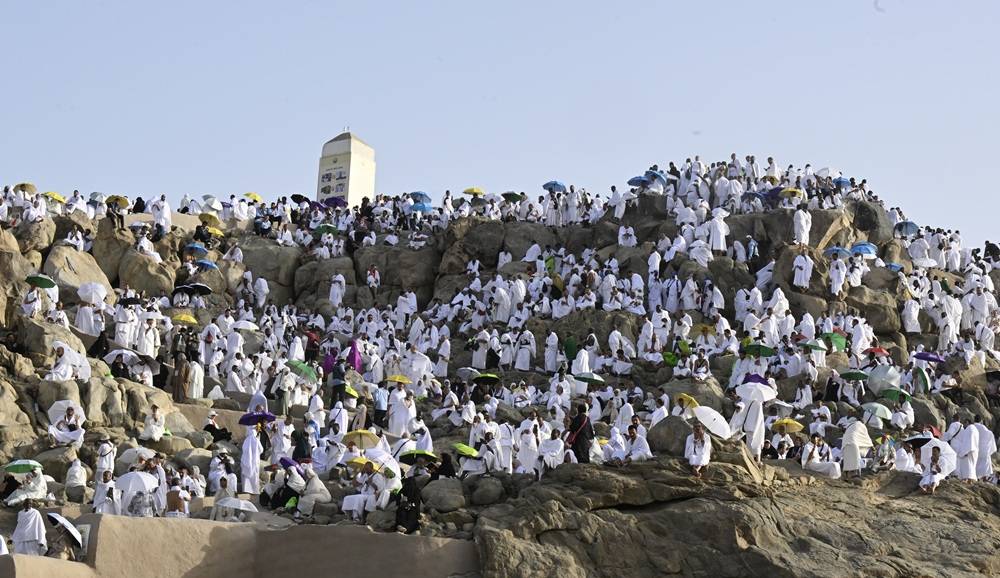
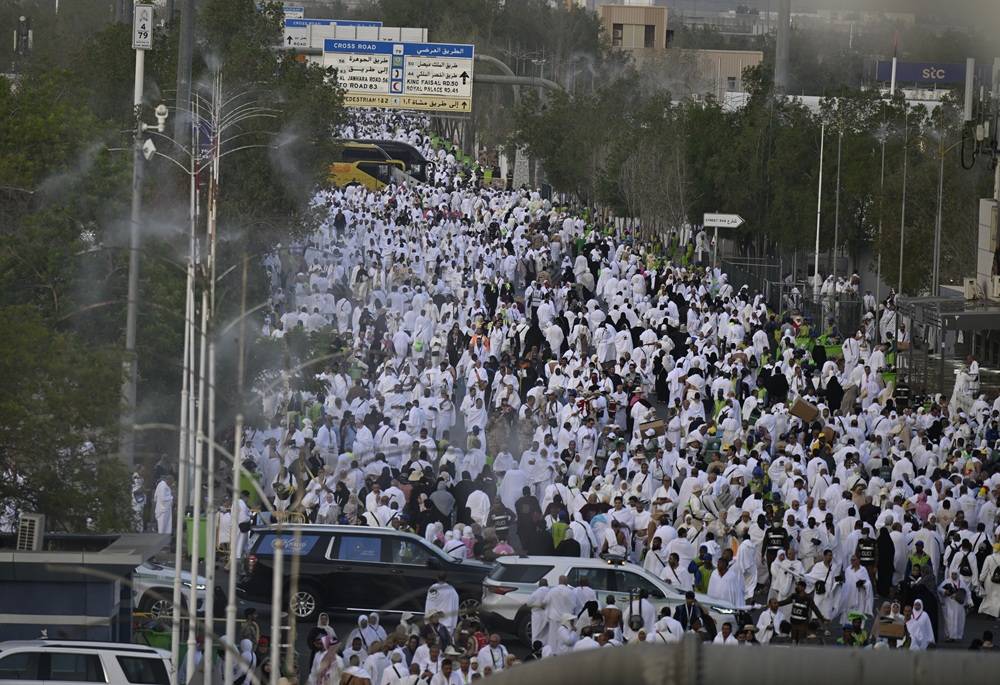
Hajj Pilgrims Head to Muzdalifah after Arafat, as Mina Prepares for Their Return

Muslim pilgrims pray on Saudi Arabia's Mount Arafat, also known as Jabal al-Rahma or Mount of Mercy, during the climax of the Hajj pilgrimage early on May 26, 2026. (AFP)
TT

Hajj Pilgrims Head to Muzdalifah after Arafat, as Mina Prepares for Their Return

Muslim pilgrims pray on Saudi Arabia's Mount Arafat, also known as Jabal al-Rahma or Mount of Mercy, during the climax of the Hajj pilgrimage early on May 26, 2026. (AFP)

Hajj pilgrims began heading to Muzdalifah at sunset on Tuesday, the ninth day of Dhu al-Hijjah, to spend the night there after standing on the plain of Arafat and completing the greatest pillar of the Hajj.

The move came after pilgrims spent the Day of Tarwiyah in Mina, following the Sunnah of the Prophet Mohammed.

Saudi security and service teams were deployed across the holy sites to manage the movement from Arafat to Muzdalifah, where pilgrims will remain until dawn on Wednesday, the first day of Eid al-Adha.

They will then head to Mina to stone Jamarat al-Aqaba, sacrifice their animals, shave or shorten their hair, and stay there for the remaining days of the pilgrimage.

In a solemn scene, about 1.7 million pilgrims, according to the General Authority for Statistics, poured into Arafat from the early morning hours of the ninth day of Dhu al-Hijjah to perform Hajj’s central rite.

Dressed in white, they chanted the talbiyah and prayed for forgiveness and mercy on one of the most solemn days of the Hajj.

Muslim pilgrims gather at Jabal al-Rahmah (Mount of Mercy) in the Arafat region near Makkah, Saudi Arabia, 26 May 2026. (EPA)

Their hearts were united by one purpose, seeking pardon, forgiveness, and spiritual renewal. Their colors, nationalities, and languages differed, but their prayers rose as one, pleading for mercy and deliverance from hellfire.

The pilgrims performed the noon and afternoon prayers combined and shortened, with one call to prayer and two iqamahs, at Al-Namirah Mosque in Arafat, in keeping with the Sunnah of the Prophet.

They listened to the Arafat sermon, delivered this year by Sheikh Dr. Ali Al-Hudhaifi, imam and preacher.

Prince Saud bin Mishal bin Abdulaziz, deputy governor of the Makkah Region and deputy chairman of Saudi Arabia’s Permanent Committee for Hajj and Umrah, said at Arafat that the Kingdom’s leadership gives great attention to serving pilgrims and harnessing all technical and human resources so they can perform their rituals safely and smoothly from arrival to departure.

He said Saudi Arabia had been honored with the responsibility of serving the Grand Mosque and its visitors, and had made serving pilgrims a deeply rooted mission passed down through generations and supported by the care of its leadership.

Speaking on behalf of Custodian of the Two Holy Mosques King Salman bin Abdulaziz and Prince Mohammed bin Salman, Crown Prince and Prime Minister, Prince Saud welcomed the pilgrims and said the Day of Arafat embodies the highest meanings of unity and equality.

Saudi Arabia had mobilized all its capabilities and resources to develop projects, prepare facilities, deploy modern technologies, and harness national talent and human expertise to help pilgrims perform their rituals with ease, he stressed.

He said the Kingdom would continue developing the Hajj system and improving services for pilgrims, guided by its noble mission toward Islam and Muslims.

Prince Saud praised pilgrims for their cooperation and adherence to instructions, urging them to maintain awareness and discipline to help ensure the best services and complete their spiritual journey in comfort and calm.

He also commended workers from various sectors serving pilgrims, saying their sincere efforts reflect the noble values and humanitarian principles of Saudi citizens, as well as the honor of serving pilgrims in pursuit of divine reward.

Muslim pilgrims make their way to Jabal al-Rahmah (Mount of Mercy) in the Arafat region near Makkah, Saudi Arabia, 26 May 2026. (EPA)

Carefully planned security operation

The movement of pilgrims from Arafat to Muzdalifah was smooth and flexible, with convoys monitored directly by security teams to organize them according to movement and grouping plans, guide them, and ensure their safety.

The security plan was designed to ease the flow of crowds through the Al-Mashaaer Al-Mugaddassah Metro line, buses, and pedestrian routes, as part of an integrated service system for pilgrims.

Saudi Arabia’s Interior Ministry is tracking pilgrim movements across the holy sites through an advanced digital system that has improved field decision-making, crowd management, service efficiency, and pilgrim safety.

The system uses advanced technologies and smart operating systems to monitor crowd density, pedestrian movement, and transport in key locations. It analyzes live operational indicators using artificial intelligence to improve movement and respond to field developments.

Security operations and control centers linked to the digital system strengthen coordination among security, service, and health agencies at the holy sites through real-time monitoring.

They also help improve performance, maintain services during the Hajj season, forecast crowd density, and manage pilgrim movement.


Saudi Arabia Says over 1.7 Million Pilgrims Performed this Year’s Hajj

Muslim pilgrims gather at Jabal al-Rahmah (Mount of Mercy) in the Arafat region near Makkah, Saudi Arabia, 26 May 2026. (EPA)
TT

Saudi Arabia Says over 1.7 Million Pilgrims Performed this Year’s Hajj

Muslim pilgrims gather at Jabal al-Rahmah (Mount of Mercy) in the Arafat region near Makkah, Saudi Arabia, 26 May 2026. (EPA)

Saudi Arabia's General Authority for Statistics (GASTAT) announced on Tuesday that 1,707,301 pilgrims were preset at this year’s Hajj.

International pilgrims totaled 1,546,655, while domestic pilgrims, comprising citizens and residents, reached 160,646.

A total of 893,396 male and 813,905 female pilgrims were tallied.

Regarding international pilgrims, GASTAT said that 1,485,729 arrived through air entry points, 54,429 arrived through land crossings, and 6,497 arrived through sea entry points.

GASTAT relied on the Ministry of Interior's administrative records as its primary source for this year's Hajj, utilizing a unified, register-based model adopted over the past six years to ensure highly accurate and reliable statistical data.


Saudi, Qatari FMs Discuss Latest Regional Developments

 13 February 2026, Bavaria, Munich: Saudi Minister of Foreign Affairs Prince Faisal bin Farhan bin Abdullah speaks during a panel session at the Munich Security Conference. (dpa)
13 February 2026, Bavaria, Munich: Saudi Minister of Foreign Affairs Prince Faisal bin Farhan bin Abdullah speaks during a panel session at the Munich Security Conference. (dpa)
TT

Saudi, Qatari FMs Discuss Latest Regional Developments

 13 February 2026, Bavaria, Munich: Saudi Minister of Foreign Affairs Prince Faisal bin Farhan bin Abdullah speaks during a panel session at the Munich Security Conference. (dpa)
13 February 2026, Bavaria, Munich: Saudi Minister of Foreign Affairs Prince Faisal bin Farhan bin Abdullah speaks during a panel session at the Munich Security Conference. (dpa)

Saudi Minister of Foreign Affairs Prince Faisal bin Farhan bin Abdullah received on Tuesday a telephone call from Qatari Prime Minister and FM Sheikh Mohammed bin Abdulrahman bin Jassim Al Thani.

They discussed the latest developments in the region and bilateral coordination and consultation over them.
