


Aftershock in Afghanistan as Quake Toll Rises to 1,150 Dead

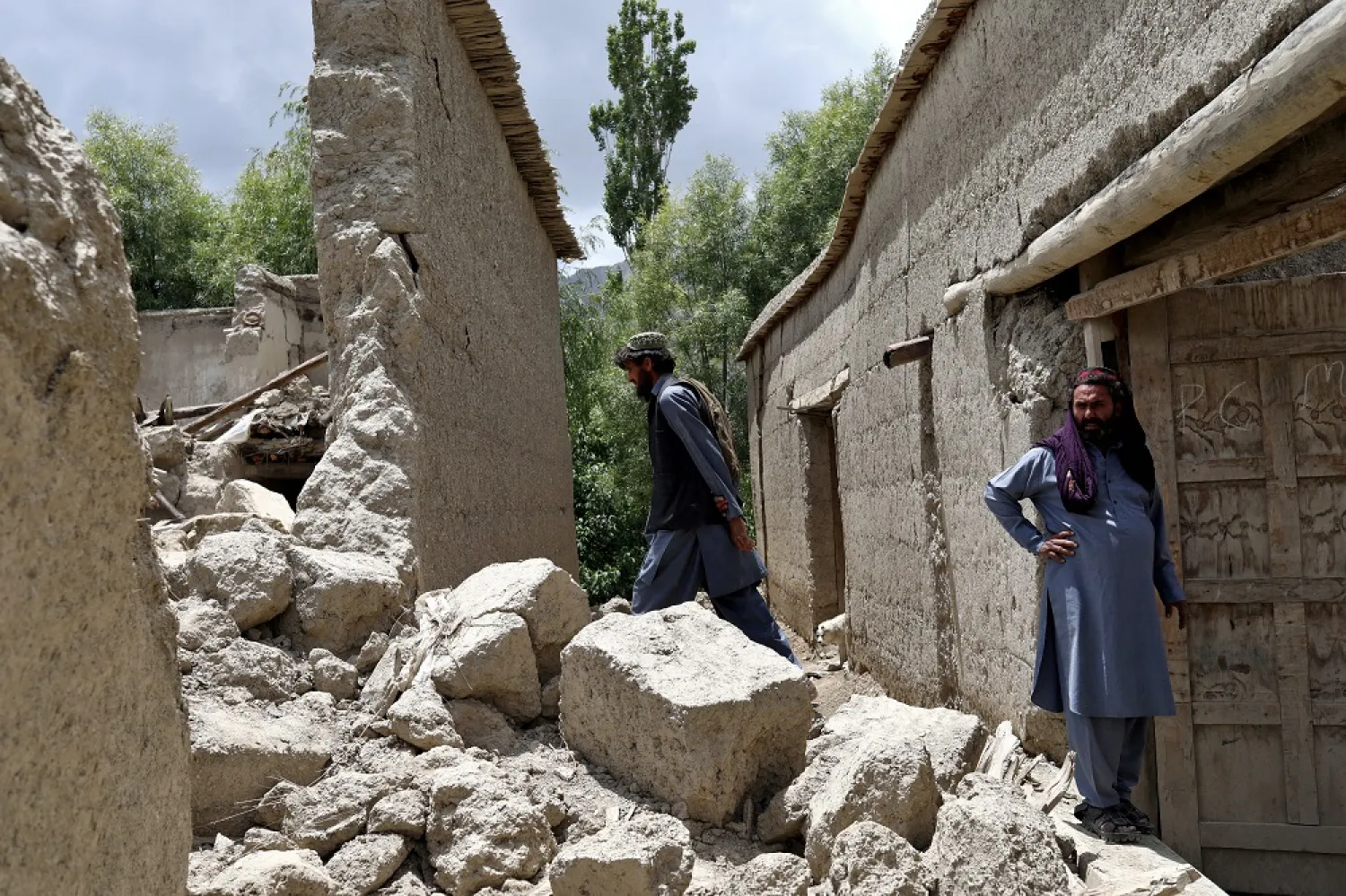
Afghan men stand on the debris of their house that was damaged by an earthquake in Gayan, Afghanistan, June 23, 2022. (Reuters)
TT

Aftershock in Afghanistan as Quake Toll Rises to 1,150 Dead

Afghan men stand on the debris of their house that was damaged by an earthquake in Gayan, Afghanistan, June 23, 2022. (Reuters)

An aftershock shook a hard-hit area of eastern Afghanistan on Friday, two days after a quake rattled the region, razing hundreds of mud-brick homes and killing 1,150 people, according to state media.

Pakistan’s Meteorological Department reported a 4.2 magnitude quake in southeastern Afghanistan that state-run Bakhtar News Agency reported took five more lives in hard-hit Gayan District and injured 11 people.

The country of 38 million people was already in the midst of a spiraling economic crisis that had plunged millions deep into poverty with over a million children at risk of severe malnutrition.

The magnitude 6 quake on Wednesday that struck in the night as people were sleeping left thousands without shelter and brought into sharp focus the compounding needs of the country. Afghanistan remains cut off from the international monetary system, and aid groups lament having to pay local staff with bags of cash delivered by hand as nations refuse to deal directly with the Taliban.

Aid organizations like the local Red Crescent and World Food Program have stepped in to assist the most vulnerable families with food and other emergency needs like tents and sleeping mats in Paktika province, the epicenter of the earthquake, and neighboring Khost province.

Still, residents appeared to be largely on their own to deal with the aftermath as their new Taliban-led government and the international aid community struggle to bring in help. The shoddy mountain roads leading to the affected areas were made worse by damage and rain. Villagers have been burying their dead and digging through the rubble by hand in search of survivors.

The Taliban director of the Bakhtar agency said Friday the death toll had risen to 1,150 people from previous reports of 1,000 killed. Abdul Wahid Rayan said at least 1,600 people were injured.

The United Nations Office for the Coordination of Humanitarian Affairs has put the death toll at 770 people.

It’s not clear how death toll counts are being reached, given the difficulties of accessing and communicating with the impacted villages. Either grim toll would make the quake Afghanistan’s deadliest in two decades.

State media reported that close to 3,000 homes were destroyed or badly damaged. In the district of Gayan, at least 1,000 homes were damaged by the earthquake. Another 800 homes in the Spera district of Khost province were also damaged.

While modern buildings withstand magnitude 6 earthquakes elsewhere, Afghanistan’s mud-brick homes and landslide-prone mountains make such quakes more dangerous.

Roads in the area are so poorly paved and difficult to navigate that some villages in Gayan District take a full day to reach from Kabul, though it is only 175 kilometers (110 miles away.)

In villages across Gayan district, toured by Associated Press journalists for hours Thursday, families who had spent the previous rainy night out in the open lifted pieces of timber of collapsed roofs and pulled away stones by hand, looking for missing loved ones. Taliban fighters circulated in vehicles in the area, but only a few were seen helping dig through the rubble.

There was little sign of heavy equipment - only one bulldozer was spotted being transported. Ambulances circulated, but little other help to the living was evident. One 6-year-old boy in Gayan wept as he said his parents, two sisters and a brother were all dead. He had fled the ruins of his own home and took refuge with the neighbors.

Many international aid agencies withdrew from Afghanistan when the Taliban seized power last August. Those that remain are scrambling to get medical supplies, food and tents to the remote quake-struck area. UN agencies are also facing a $3 billion funding shortfall for Afghanistan this year.

Germany, Norway and several other countries announced they were sending aid for the quake, but underscored that they would work only through UN agencies, not with the Taliban, which no government has officially recognized as of yet. Nations have called on the Taliban to first address human rights concerns, chief among them the rights and freedoms of Afghan women and girls.

The International Rescue Committee has emergency health teams in the two provinces to deliver essential first aid and said it is providing cash support to families who have lost their homes and livelihoods in the earthquake. The organization, which has been operating in Afghanistan since 1988, is calling for an international roadmap to ultimately release Afghanistan’s foreign exchange reserves.

The Taliban's takeover of the country last year as the US was preparing to withdraw its troops prompted the Biden administration to freeze around $9.5 billion that the Afghan central bank has in US banks, hampering the new rulers' efforts to pay civil servants and import goods.

Trucks of food and other necessities arrived from Pakistan, and planes full of humanitarian aid landed from Iran and Qatar. India humanitarian relief and a technical team to the capital, Kabul, to coordinate the delivery of humanitarian assistance. India says its aid will be handed over to a UN agency on the ground and the Afghan Red Crescent Society.

In Paktika province, the quake shook a region of deep poverty, where residents scrape out in a living in the few fertile areas among the rough mountains.

There are projections, quoted by the UN and others, that poverty rates may climb as high as 97% of the population and unemployment to 40% this year.




Netanyahu Skeptical of an Iran Breakthrough

Israel's Prime Minister Benjamin Netanyahu leaves after a meeting with US President Donald Trump at the White House February 11, 2026, in Washington, DC. (Photo by Brendan Smialowski / AFP)
TT

Netanyahu Skeptical of an Iran Breakthrough

Israel's Prime Minister Benjamin Netanyahu leaves after a meeting with US President Donald Trump at the White House February 11, 2026, in Washington, DC. (Photo by Brendan Smialowski / AFP)

Israeli Prime Minister Benjamin Netanyahu said he was skeptical that US nuclear talks with Iran will lead to a breakthrough but described his meeting with US President Donald Trump at the White House as “excellent.”

Speaking to reporters Thursday in Washington before boarding a plane to return to Israel, Netanyahu said Trump’s terms and Iran’s “understanding that they made a mistake the last time when they did not reach an agreement, may lead them to agree to conditions that will enable a good agreement to be reached.”

While he said he did “not hide my general skepticism” about any deal, he stressed that any agreement must include concessions about Iran’s ballistic missiles program and support for militant proxies.

He added that the conversation Wednesday with Trump, which lasted more than two hours, included a number of other subjects, including Gaza and regional developments but focused on the negotiations with Iran.


German Court Rejects Palestinian's Claim over Weapons Exports

A view shows the front of the Reichstag building, the seat of the German parliament, the Bundestag, in Berlin, Germany March 5, 2025. REUTERS/Annegret Hilse/File Photo
TT

German Court Rejects Palestinian's Claim over Weapons Exports

A view shows the front of the Reichstag building, the seat of the German parliament, the Bundestag, in Berlin, Germany March 5, 2025. REUTERS/Annegret Hilse/File Photo

Germany's highest court on Thursday threw out a case brought by a Palestinian civilian from Gaza seeking to sue the German government over its weapons exports to Israel.

The complainant, supported by the European Center for Constitutional and Human Rights (ECCHR), had been seeking to challenge export licences for German parts used in Israeli tanks deployed in Gaza.

After his case was rejected by lower courts in 2024 and 2025, he had appealed to the Federal Constitutional Court.

But the court in Karlsruhe dismissed the case, stating that "the complainant has not sufficiently substantiated that the specialized courts misjudged or arbitrarily denied a possible duty to protect him", AFP reported.

While Germany is obliged to protect human rights and respect international humanitarian law, this does not mean the state is necessarily obliged to take specific action on behalf of individuals, the court said.

"It is fundamentally the responsibility of the state authorities themselves to decide how they fulfil their general duty of protection," it added.

The ECCHR called the decision "a setback for civilian access to justice".

"The court acknowledges the duty to protect but only in the abstract and refuses to ensure its practical enforcement," said Alexander Schwarz, co-director of the NGO's International Crimes and Legal Accountability program.

"For people whose lives are endangered by the consequences of German arms exports, access to justice remains effectively closed," he said.

The ECCHR had been hoping for a successful appeal after the Constitutional Court ruled last year that Germany had "a general duty to protect fundamental human rights and the core norms of international humanitarian law, even in cases involving foreign countries".

In that case, two Yemenis had been seeking to sue Berlin over the role of the US Ramstein airbase in a 2012 drone attack.

The complainant was one of five Palestinians who initially brought their case against the German government in 2024.


2 Israelis Charged with Using Classified Military Information to Place Bets

The Israeli Iron Dome air defense system intercepts missiles during an Iranian attack on Tel Aviv, Israel, June 18, 2025. (AP Photo/Leo Correa, File)
TT

2 Israelis Charged with Using Classified Military Information to Place Bets

The Israeli Iron Dome air defense system intercepts missiles during an Iranian attack on Tel Aviv, Israel, June 18, 2025. (AP Photo/Leo Correa, File)

Two Israelis have been charged with using classified military information to place bets on how future events will unfold, Israeli authorities said Thursday, accusing the individuals of “serious security offenses.”

A joint statement by the Israeli Ministry of Defense, domestic security service Shin Bet and police said that a civilian and a reservist are suspected of placing bets on the US-based prediction market Polymarket on future military operations based on information that the reservist had access to, The AP news reported.

Israel’s Attorney General’s Office decided to prosecute the two individuals following a joint investigation by police, military intelligence and other security agencies that resulted in several arrests. The two face charges including bribery and obstruction of justice.

Authorities offered no details on the identity of the two individuals or the reservist's rank or position in the Israeli military but warned that such actions posed a “real security risk” for the military and the Israeli state.

Israel’s public broadcaster Kan had reported earlier that the bets were placed in June ahead of Israel’s war with Iran and that the winnings were roughly $150,000.

Israel's military and security services “view the acts attributed to the defendants very seriously and will act resolutely to thwart and bring to justice any person involved in the activity of using classified information illegally,” the statement said.

The accused will remain in custody until the end of legal proceedings against them, the Prosecutor's Office said.

Prediction markets are comprised of typically yes-or-no questions called event contracts, with the prices connected to what traders are willing to pay, which theoretically indicates the perceived probability of an event occurring.

Their use has skyrocketed in recent years, but despite some eye-catching windfalls, traders still lose money everyday. In the US, the trades are categorized differently than traditional forms of gambling, raising questions about transparency and risk.