


Paris Seeks to Build Strategic Partnership with Riyadh in Energy, Aviation

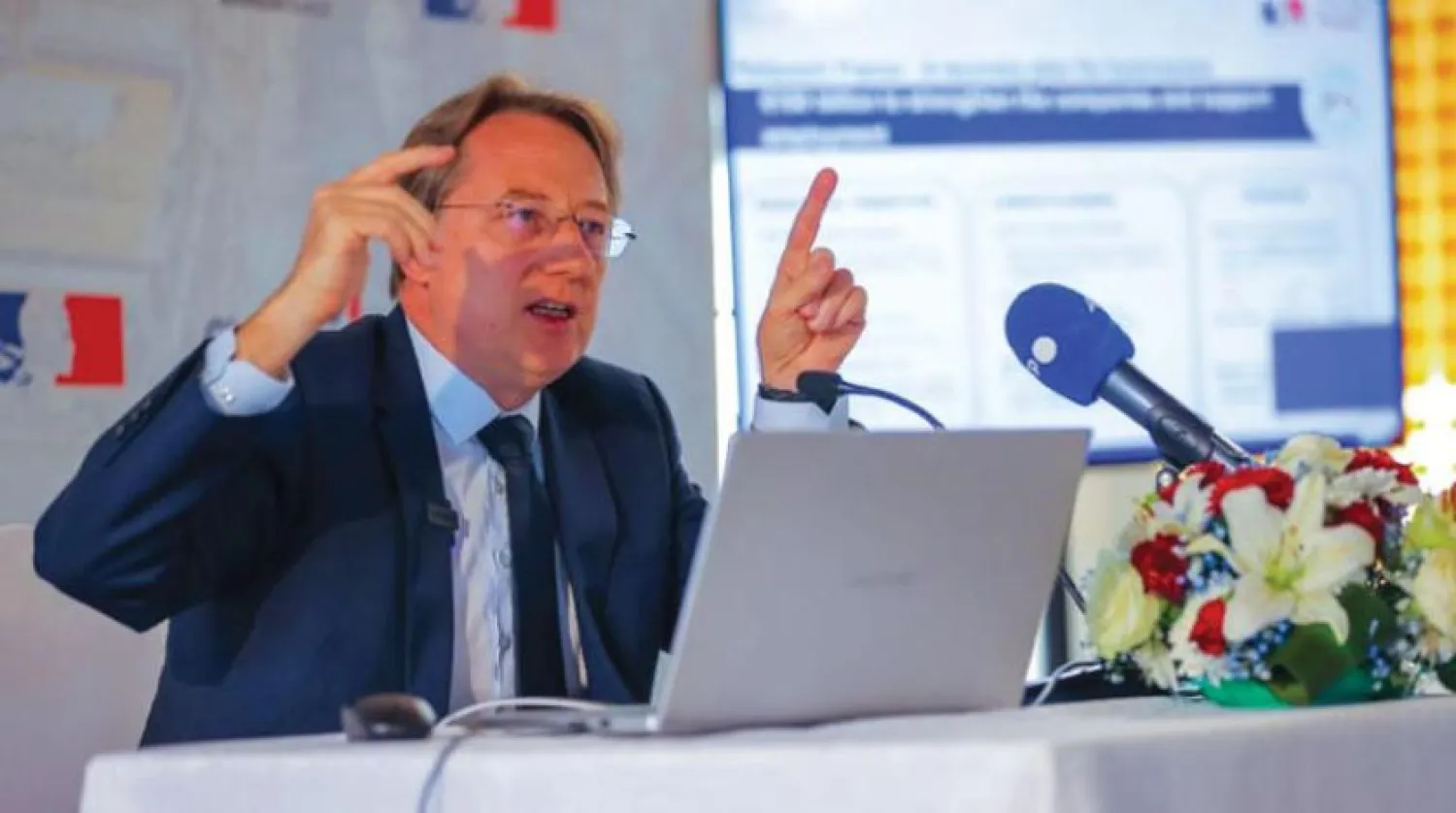
 French Ambassador to Saudi Arabia Ludovic Pouille (Saad al-Dossary)
French Ambassador to Saudi Arabia Ludovic Pouille (Saad al-Dossary)
TT

Paris Seeks to Build Strategic Partnership with Riyadh in Energy, Aviation

 French Ambassador to Saudi Arabia Ludovic Pouille (Saad al-Dossary)
French Ambassador to Saudi Arabia Ludovic Pouille (Saad al-Dossary)

French Ambassador to Saudi Arabia Ludovic Pouille said that his country was seeking to build a strategic partnership with the Kingdom that includes several vital sectors, including aviation and energy.

“The strategic partnership that we intend to build with the Kingdom is twofold, as our ambition is not only to increase the presence of French companies in the Saudi market, but we also want our Saudi partners, whether public institutions or private companies, to explore the richness and plurality of investment opportunities in the French economy,” Pouille told Asharq Al-Awsat.

Referring to figures published by Eurostat – a dissemination database that provides official statistics on the European Union, EU member states and sub-state regions – Pouille said that the Kingdom owned 25 percent of French companies in the Middle East.

He added that the number of subsidiaries in the Kingdom controlled by French companies was 135, equivalent to 40% of the subsidiaries controlled by European companies. Those employ more than 13,300 workers and generate nearly 4 billion euros.

Pouille explained that French companies were implementing important and large projects in the Kingdom, especially in the sectors of energy, water, waste treatment, transportation, aviation and construction, noting that large French groups enjoy a particularly good position in the field of renewable energies and the water sector.

With regards to large projects such as NEOM, the Red Sea, Qiddiya and AlUla, the French ambassador noted that French companies would work on basic infrastructure, airports, roads, bridges and roads leading to different sites, with funding from the Public Investment Fund.

He added that public-private partnerships were proposed through tenders to develop income-generating facilities in terms of electricity, water, waste and communications.

According to Pouille, many French companies, whether large groups or small and medium-sized companies, are participating in the construction and operation of future accommodation and catering facilities, leisure and entertainment amenities, cultural spaces and commercial areas.

Pointing to figures released by the Bank of France, the diplomat said that the balance of French direct investment in Saudi Arabia amounted to nearly 3 billion euros, according to data in early 2021, mainly concentrated in the energy sector.

This represents 25 percent of French foreign direct investment in the Middle East, he underlined.

Meanwhile, Pouille said that the balance of Saudi foreign direct investment in France amounts to only 600 million euros, which is equivalent to 4.5 percent of FDI by Middle Eastern countries in France. Qatar accounts for 53 percent and the UAE 19 percent, with investments mainly focusing on real estate and the hotel sector.

“We believe that these mutual investment volumes are below their capacity, and that they should grow in the coming years, especially in the context of the strategic partnership between our two countries,” he stated.



Eurozone Manufacturing Growth Reaches 4-Year High

Production lines at German car manufacturer Mercedes-Benz at its factory in Rastatt (Reuters)
TT

Eurozone Manufacturing Growth Reaches 4-Year High

Production lines at German car manufacturer Mercedes-Benz at its factory in Rastatt (Reuters)

Euro zone manufacturers faced soaring input costs and supply chain disruptions in March due to the Iran war, even as underlying tepid demand threatened to undermine the sector's fragile recovery, a survey showed.

The conflict in the Middle East has disrupted global logistics networks, causing delivery delays and pushing input price inflation to its highest levels since October 2022, distorting headline growth measures.

A jump in the cost of manufacturing, driven by higher oil and energy prices, led manufacturers to respond by raising selling prices at the fastest pace ⁠in just over ⁠three years.

"It's exactly the same as during the pandemic - this is a supply shock - normally longer delivery times are associated with too much demand in a really healthy environment but in a supply shock it falsely elevates the PMI," said Chris Williamson, chief business economist at S&P Global.

"It ⁠does falsely elevate the PMI so conditions would be worse than the headline PMI indicates," he also said.

The S&P Global euro zone Manufacturing Purchasing Managers' Index rose to 51.6 in March from 50.8 in February, higher than a preliminary estimate of 51.4.

A reading above 50.0 indicates growth in activity.

The new orders sub-index - a key gauge of demand - matched February's 46-month high but growth remained modest.

Production rose for a third consecutive month, with the output sub-index edging up ⁠to 52.0 ⁠from 51.9 in February, marking a seven-month high.

New export orders stabilized after contracting for eight straight months, providing some relief to manufacturers.

Backlogs of work increased for the first time since mid-2022, signaling capacity pressures, yet companies cut jobs at a faster rate in March.

Business confidence slipped to a five-month low and remained below its long-term average as the conflict weighed on sentiment.

Germany and Italy recorded their strongest readings in 46 and 37 months respectively, while Spain was the only country in contraction territory. Greece posted the highest reading, followed by Ireland, while France's manufacturing sector stagnated.


Turkish Manufacturing Contracts at Fastest Pace in Five Months in March, PMI Shows

 People walk past displayed items in a clothes shop at Eminonu commercial area, in Istanbul, Türkiye, Thursday, March 26, 2026. (AP)
People walk past displayed items in a clothes shop at Eminonu commercial area, in Istanbul, Türkiye, Thursday, March 26, 2026. (AP)
TT

Turkish Manufacturing Contracts at Fastest Pace in Five Months in March, PMI Shows

 People walk past displayed items in a clothes shop at Eminonu commercial area, in Istanbul, Türkiye, Thursday, March 26, 2026. (AP)
People walk past displayed items in a clothes shop at Eminonu commercial area, in Istanbul, Türkiye, Thursday, March 26, 2026. (AP)

Turkish manufacturing activity contracted ‌at its fastest pace in five months in March as the war in the Middle East lifted costs, disrupted supply chains and weakened demand, a business survey showed on Wednesday.

The Istanbul Chamber of Industry Turkish Manufacturing Purchasing Managers' Index (PMI), compiled by S&P Global, fell to 47.9 in March from 49.3 in February, the survey showed.

The 50-mark separates ‌growth from contraction.

"The ‌Turkish manufacturing sector suffered ‌something ⁠of a setback in ⁠March, after conditions had looked to be on the path to becoming more favorable in February," said Andrew Harker, economics director at S&P Global Market Intelligence.

New orders fell for a 33rd straight month and ⁠at the sharpest pace since last ‌November, while export ‌demand also weakened more quickly. Output was scaled back ‌to the greatest extent since last November, ‌S&P Global said.

Price pressures intensified as firms linked higher freight, fuel, oil and raw material costs to the Middle East conflict. Input costs rose ‌at the fastest rate since April 2024, while output price inflation ⁠hit ⁠a 25-month high.

Supply-chain strains also worsened. Suppliers' delivery times lengthened to the largest extent since August 2024, while manufacturers cut employment at the sharpest pace in six months and reduced purchasing activity and inventories.

The survey said manufacturing conditions have now weakened in every month over the past two years. Business confidence fell to a five-month low in March, although firms still expected output to rise over the coming year.


Japan, France Agree Rare Earths Deal to Cut China Reliance

French President Emmanuel Macron shakes hands with Japanese Prime Minister Sanae Takaichi during a welcoming ceremony at the Akasaka palace in Tokyo, Japan on April 1, 2026. PHILIP FONG/Pool via REUTERS
TT

Japan, France Agree Rare Earths Deal to Cut China Reliance

French President Emmanuel Macron shakes hands with Japanese Prime Minister Sanae Takaichi during a welcoming ceremony at the Akasaka palace in Tokyo, Japan on April 1, 2026. PHILIP FONG/Pool via REUTERS

Japan and France agreed to strengthen support for rare earths supply chains on Wednesday, Japan's public broadcaster NHK reported, in the latest moves by both countries to lessen dependence on the world's dominant supplier, China.

During French President Emmanuel Macron's three-day visit to Japan for talks with Prime Minister Sanae Takaichi, officials signed a roadmap to cooperate on critical minerals supply chains, NHK said.

"We cannot rely solely on specific countries, especially China," French Finance Minister Roland Lescure was quoted as saying by NHK.

The two sides also agreed to secure raw material supplies for a rare earths refining project in southern France, called Caremag, the broadcaster said.

The state-owned Japan Organization for Metals and Energy Security and gas ⁠firm Iwatani, along ⁠with the French government, are investors in Caremag, which is due to start operations in late 2026.

Japan plans to get about 20% of its future demand for dysprosium and terbium from the refining plant, heavy rare earth oxides used in magnets for EV motors, offshore wind turbines and electronic components.

Takaichi and Macron are due to issue a joint statement calling for diversifying supplies of rare earths and other critical minerals during their summit on Wednesday, the Nikkei newspaper reported separately.

The deal ⁠comes at a critical moment, with Japan and Western governments and manufacturers scrambling to secure supplies of rare earths minerals to reduce their dependency on China, the world's dominant rare earths producer and supplier.

In February, China prohibited exports of so-called dual-use items to 20 Japanese entities, which it said supply Japan's military.

That was after Takaichi angered Beijing with comments about Taiwan in November.

The rules cover seven rare earths and associated materials currently on China's dual-use control list, including dysprosium and yttrium, along with a swathe of other controlled critical minerals.

"China is pursuing a strategy of using rare earths as a diplomatic card, and if US-China and Japan–China relations improve, exports could recover quickly," said Kotaro Shimizu, principal analyst at Mitsubishi UFJ Research and Consulting.

Japan has reduced its reliance on ⁠China to 60% ⁠from 90% following a 2010 diplomatic incident which saw Beijing restricting rare earths supply to Tokyo.

Japan has been boosting investments in overseas projects like trading house Sojitz's tie-up with Australia's Lynas Rare Earths, and promoting rare earths recycling and manufacturing processes.

In the latest set of steps, Japan's Mitsubishi Materials this week agreed to acquire a stake in US ReElement, a company involved in rare earth element recycling, as both countries have set up an action plan for China alternatives.

Japan and the US are also considering joint development of rare-earth-rich mud deposits, near the remote Minamitori Island, and Japan is in talks with India to jointly explore rare earths in the desert state of Rajasthan.

Japan and France will also seek cooperation in space, with companies from the two countries expected to sign memorandums of understanding on 12 joint projects, including space debris removal and rocket launches, the Nikkei said.