Sweden: Iranian Gets Life in Prison for 1980s War Crimes

This file courtroom sketch made on November 23, 2021 by Anders Humlebo shows former Iranian prison official Hamid Noury (L) and attorney Thomas Soderqvist during the war crime trial against Noury who is being questioned in Stockholm District Court, Stockholm. (Photo by Anders HUMLEBO / TT NEWS AGENCY / AFP)
TT

Sweden: Iranian Gets Life in Prison for 1980s War Crimes

This file courtroom sketch made on November 23, 2021 by Anders Humlebo shows former Iranian prison official Hamid Noury (L) and attorney Thomas Soderqvist during the war crime trial against Noury who is being questioned in Stockholm District Court, Stockholm. (Photo by Anders HUMLEBO / TT NEWS AGENCY / AFP)

An Iranian citizen was Thursday sentenced to life imprisonment by a Swedish court after being convicted of committing grave war crimes and murder in the 1980s.

The Stockholm District Court said that Hamid Noury, 61, took part in severe atrocities in July-August 1988 while working as an assistant to the deputy prosecutor at the Gohardasht prison outside the Iranian city of Karaj.

A life sentence in Sweden generally means a minimum of 20 to 25 years in prison, but it could be extended. If he is eventually released, Noury will be expelled from Sweden. Noury can appeal the verdict.

The court said Noury participated “in the executions of many political prisoners in Iran in the summer of 1988" and had “the role of assistant to the deputy prosecutor” at the prison "jointly and in collusion with others been involved in the executions."

The acts were deemed as a serious crime against international law, the court said. A second wave of executions was directed at left-wing sympathizers who were deemed to have renounced their Islamic faith, the court statement said, adding “these acts have been deemed as murder.”

They said Iran’s supreme leader at the time, Ayatollah Khomeini, had issued an execution order for all prisoners in the country who sympathized and remained loyal with the Iranian opposition group Mujahedeen-e-Khalq, known as MEK.

Due to that order, a large number of prisoners were executed in the Gohardasht prison between July 30 and Aug. 16, 1988, the Swedish prosecutors said.

Amnesty International has put the number executed on government orders at around 5,000, saying in a 2018 report that "the real number could be higher". Iran has never acknowledged the killings.

During the trial proceedings that ended May 4, Noury has denied wrongdoing.

Judge Tomas Zander said that Noury had claimed that the evidence against him had (been) fabricated” by the Mujahedin.

“However, nothing substantial has emerged which gives the court reason to question the investigation’s reliability and robustness,” Zander said.

“We are of course disappointed,” defense lawyers Thomas Söderqvist and Daniel Marcus told the Swedish news agency TT. They said they would appeal the verdict.

Balkees Jarrah, interim international justice director at Human Rights Watch, called it “a meaningful moment" for survivors and the family of the victims.

“The ruling sends a message to the most senior Iranian officials implicated in these crimes that they can’t remain beyond the reach of justice forever," she said in a statement.
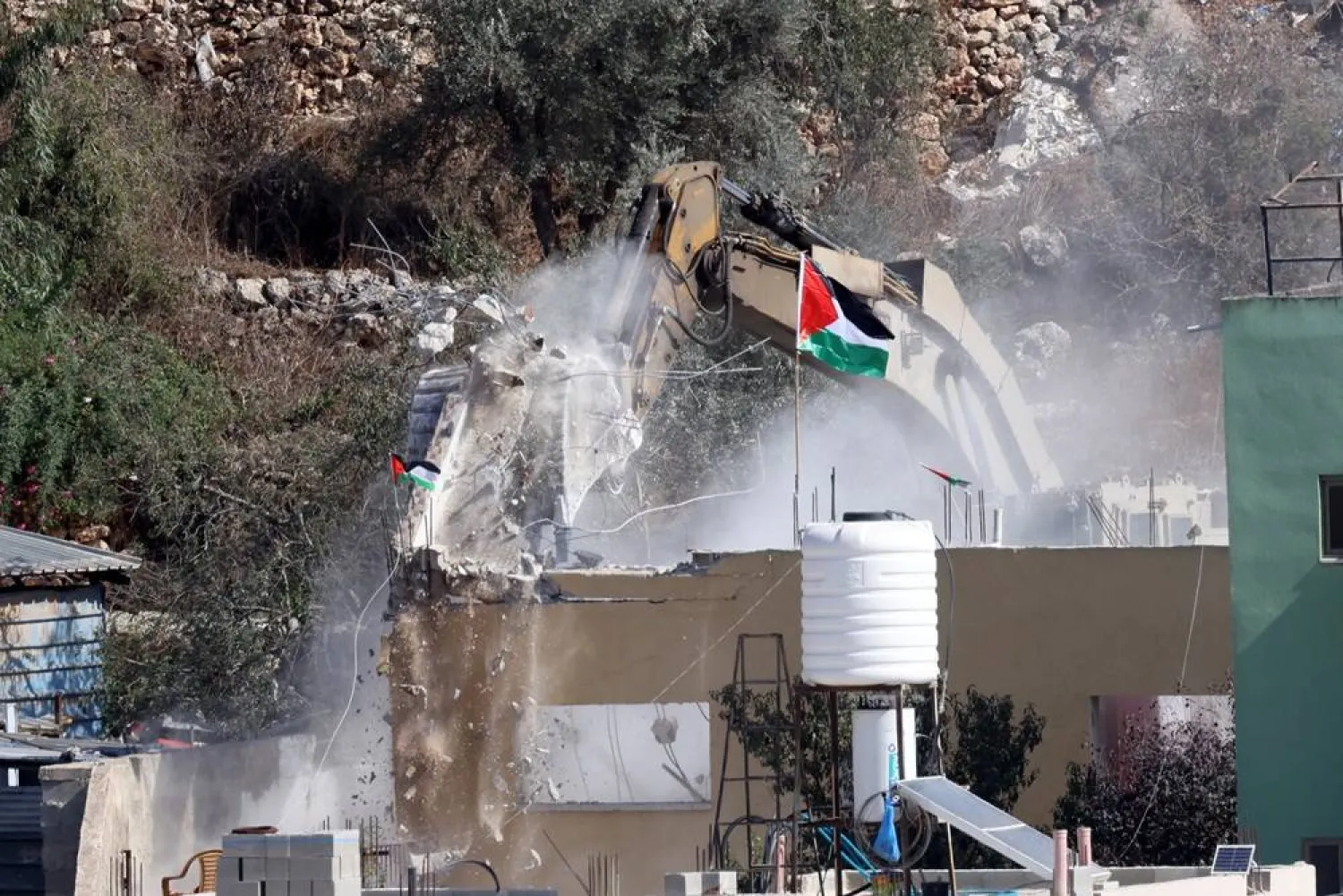


UN Rights Chief Wants Next Israeli Govt to 'Change Course Massively'

n Israeli bulldozer demolishes the house of Palestinian prisoner Ibrahim Abdul Karim Daoud at the West Bank village of Beita, 28 October 2026. (EPA)
TT

UN Rights Chief Wants Next Israeli Govt to 'Change Course Massively'

n Israeli bulldozer demolishes the house of Palestinian prisoner Ibrahim Abdul Karim Daoud at the West Bank village of Beita, 28 October 2026. (EPA)

UN rights chief Volker Turk said Wednesday he hopes a new Israeli government will "change course massively" and respect international law, as the country's political future hung in the balance after hard-fought elections.

"The message is: don't continue the current course of warfare where you think you are above international law, because I think that's what we have frankly seen in the current environment," he told reporters in New York.

"Israel has its obligations under international law, international humanitarian law, international human rights law, and they need to respect them, and I hope that the next government will do precisely that and change course massively," the Austrian diplomat added.

Earlier this week, Turk warned that Israel's military occupation in the occupied West Bank city of Hebron, launched after a deadly attack by Palestinian gunmen, raised serious concerns of "ethnic cleansing."

"Collective punishment is a grave violation of international law," he said in a statement Monday.

With more than 85 percent of ballots counted in Israel's election, Prime Minister Benjamin Netanyahu's right-wing bloc was slightly ahead but still short of a majority, making Israeli Arab parties possible kingmakers.

The Tuesday vote was the first election since the October 7, 2023 attack that led Israel to wage war in Gaza and across the region.


Israel Defense Minister Slams Eisenkot’s Call for Military to Resist PM Pressure

Israeli Prime Minister Benjamin Netanyahu and Defense Minister Israel Katz attend a graduation ceremony of new Israeli army officers at a base near Mitzpe Ramon, Israel, October 21, 2026. (Reuters)
TT

Israel Defense Minister Slams Eisenkot’s Call for Military to Resist PM Pressure

Israeli Prime Minister Benjamin Netanyahu and Defense Minister Israel Katz attend a graduation ceremony of new Israeli army officers at a base near Mitzpe Ramon, Israel, October 21, 2026. (Reuters)

Israel's defense minister on Wednesday denounced opposition candidate Gadi Eisenkot for urging the military to resist post-election pressure from Prime Minister Benjamin Netanyahu, who has threatened new strikes on Iran.

"His call to senior military officials not to obey the directives of the prime minister or me or of other relevant security authorities, on the grounds that 'they have his support', is an anti-democratic statement detached from reality," Israel Katz wrote on X.

Eisenkot, a former military chief, in a speech to supporters after Tuesday's election said that Netanyahu was a caretaker prime minister lacking a mandate and that the military should serve the state rather than the premier.

"Stand firm in the face of any attempt to challenge you. You have my unequivocal backing. Netanyahu, do not dare use Israel's security for your political needs," Eisenkot said.

Netanyahu has repeatedly threatened renewed war on Iran, after bombing campaigns backed by the United States last year and again this year.

Media reports, denied by Netanyahu, said that military chief Lieutenant General Eyal Zamir pushed back immediately before the election on the prime minister's new plans on Iran.

Katz said that Eisenkot's comments were the latest in "a campaign of lies" about tensions between Netanyahu and the military over Iran.


Caretaker Role Could Limit Netanyahu but Not Rule Out War with Iran

Israel's Prime Minister Benjamin Netanyahu addresses his supporters at the election night rally after the first exit polls were announced, in Jerusalem on early October 28, 2026, during Israel's legislative elections. (AFP)
TT

Caretaker Role Could Limit Netanyahu but Not Rule Out War with Iran

Israel's Prime Minister Benjamin Netanyahu addresses his supporters at the election night rally after the first exit polls were announced, in Jerusalem on early October 28, 2026, during Israel's legislative elections. (AFP)

Benjamin Netanyahu is expected to face more constraints as Israel's caretaker prime minister after Tuesday's election, but experts say his government could still retain significant powers including when it comes to waging war on Iran.

Neither Netanyahu’s right-wing coalition nor an opposition bloc led by former military chief Gadi Eisenkot is projected by Israeli media ‌to win ‌a majority in the country’s 120-seat legislature. Eisenkot has ‌acknowledged ⁠the prime minister ⁠was still in office as a caretaker but issued a warning that Netanyahu might use security for political ends.

Netanyahu's office has previously rejected accusations he is using the Iran conflict for political gain. His office did not immediately return a request for comment on Wednesday.

“If you look at the letter of the law, a caretaker government has the ⁠same authority, has the same powers as a regular ‌government,” said Guy Lurie, a research ‌fellow at the Israel Democracy Institute, adding however that a caretaker government “has a duty ‌of restraint” and more limited discretion to act in some areas.

A ‌caretaker government faces limitations when it comes to issues such as appointments, but has leeway to act in matters where there is a public interest, analysts say.

“In general, security issues are the clearest exception to this duty of ‌restraint,” said Or Asher, a researcher at the Tel Aviv-based Tachlith Institute, noting that Israel's supreme court has ⁠previously held ⁠that a caretaker government must avoid far-reaching decisions unless they are justified by a pressing necessity.

“The Supreme Court has historically avoided intervening in decisions to go to war, and parliamentary oversight is at its thinnest in the weeks after the new Knesset convenes and before its committees are formed,” Asher said, adding that “a caretaker prime minister can legally take Israel to war, including against Iran”.

After the final tally is in, Israel’s President Isaac Herzog is expected to consult party leaders and then tap the candidate he believes has the best chance of forming a government, with the nominee then getting up to 42 days to establish a government.