

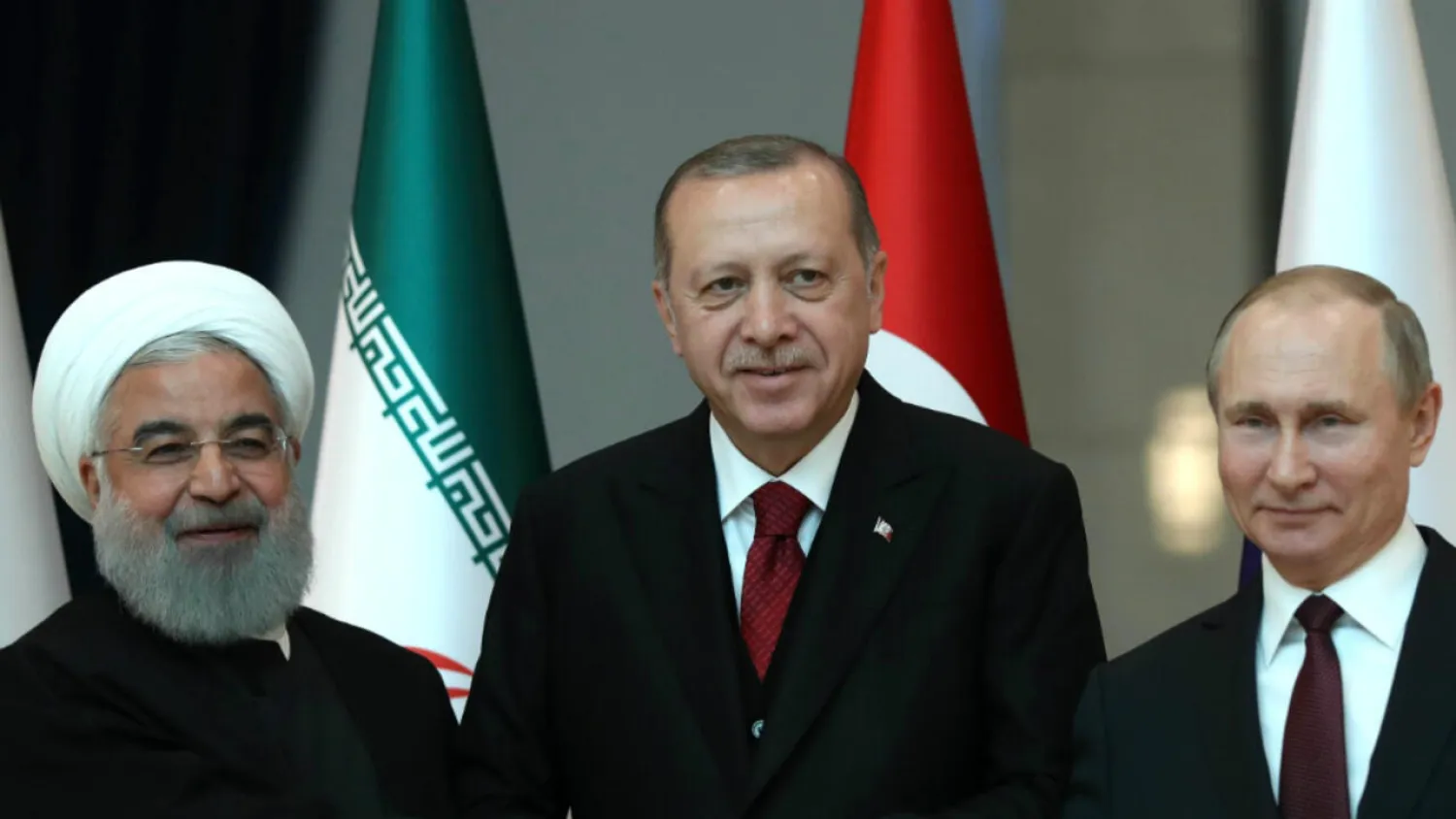

Iran, Russia, Turkey Presidents to Talk Syria War in Tehran

Tolga Bozoglu, AFP archive | Iran's Hassan Rouhani, Turkish President Recep Tayyip Erdogan, Russian President Vladimir Putin and at a tripartite summit in Ankara, Turkey in April 2018.
TT

Iran, Russia, Turkey Presidents to Talk Syria War in Tehran

Tolga Bozoglu, AFP archive | Iran's Hassan Rouhani, Turkish President Recep Tayyip Erdogan, Russian President Vladimir Putin and at a tripartite summit in Ankara, Turkey in April 2018.

With the war in Ukraine still raging, Russian President Vladimir Putin travels Tuesday to Tehran for talks with his Iranian and Turkish counterparts on the Syria conflict.

Russia, Turkey and Iran have in recent years met to discuss Syria as part of the so-called "Astana peace process" to end more than 11 years of conflict in the Arab country.

All three are involved in Syria, with Russia and Iran supporting the Damascus regime against its opponents, and Turkey backing rebels.

Tuesday's summit comes as Turkish President Recep Tayyip Erdogan has threatened to launch a new offensive in northern Syria against Kurdish militants.

Iran, whose President Ebrahim Raisi is hosting the meeting, has already warned that any Turkish military action in Syria could "destabilize the region".

The Tehran summit will also enable Erdogan to hold his first meeting with Putin since Russia invaded Ukraine in February.

The Turkish president has for months been offering to meet the Russian leader in a bid to help resolve heightened global tensions since the war began.

"The timing of this summit is not a coincidence," Russian analyst Vladimir Sotnikov told AFP.

"Turkey wants to conduct a 'special operation' in Syria just as Russia is implementing a 'special operation' in Ukraine," he said.

Turkey has launched waves of attacks on Syria since 2016, targeting Kurdish militias as well as ISIS group extremists and forces loyal to Syrian President Bashar al-Assad.

- Green light? -
Erdogan's planned military offensive targets Kurdish fighters which Ankara regards as "terrorists".

They include the US-backed Kurdish People's Protection Units (YPG), which formed a crucial part of an international coalition against the ISIS group in Syria.

Ankara fears a strong Kurdish presence along its border with Syria will embolden the banned Kurdistan Workers' Party, which for decades has been waging an insurgency against the Turkish state that has claimed tens of thousands of lives.

Syria's government has repeatedly condemned Turkish threats to mount a new incursion.

Sinan Ulgen, a visiting scholar at Carnegie Europe who specializes in Turkish foreign policy, said Ankara wants the blessing of Moscow and Iran before launching its operation.

"It's particularly important because the two potential target regions are under the control of Russia, and Turkey wants to be able to use the airspace... so as to minimize the risks," he said.

Iran "also has an indirect presence in the region through Shiite militias that it controls", said Ulgen.

Ultimately, Erdogan is hoping to get "the green light" from Putin and Raisi, he added.

Russia has already expressed the hope that Turkey would "refrain" from launching an attack on Syria.

Iran, whose foreign minister Hossein Amir-Abdollahian visited both Ankara and Damascus in recent weeks, has also urged caution.

- 'Destabilizing' -
Late last month, Iran's top diplomat said in Ankara that "we understand that... maybe a special operation might be needed".

"Turkey's security concerns must be tackled fully and permanently."

Days later, Amir-Abdollahian said in Damascus that Turkish military action in Syria "would be a destabilizing element in the region".

Mazloum Abdi, chief commander of the YPG-linked Syrian Democratic Forces, has urged Russia and Iran to restrain Turkey.

"We hope (the attacks) will not take place and that the Kurds... will not be forsaken during the talks between the big powers," he said.

The SDF has warned that an invasion by Ankara would undermine efforts to combat ISIS group jihadists in Syria's northeast.

Nicholas Heras of the Newlines Institute said Iran and Russia "want to prevent another Turkish military campaign in Syria".

"Iran is building a presence in and around Aleppo that concerns Turkey, and Russia is for all intents and purposes ceding ground to Iran throughout Syria," he added.

For Iranian political analyst Ahmad Zeidabadi, "new differences" have emerged between Russia, Iran and Turkey following the Ukraine war.

This and an "uncertain future", he said, means the three leaders will try to "coordinate" their views on Syria to avoid further tensions.



Surging Terrorism by Israeli Settlers in West Bank Condemned but Unpunished

While so-called "Jewish terrorism" has drawn widespread condemnation both in Israel and abroad, little has been done to curb it. JAAFAR ASHTIYEH / AFP
TT

Surging Terrorism by Israeli Settlers in West Bank Condemned but Unpunished

While so-called "Jewish terrorism" has drawn widespread condemnation both in Israel and abroad, little has been done to curb it. JAAFAR ASHTIYEH / AFP

Violence by extremist Israeli settlers against Palestinians in the occupied West Bank has reached unprecedented levels since the start of the war with Iran, with NGOs and opposition figures denouncing an environment of impunity.

While so-called "Jewish terrorism" has drawn widespread condemnation both in Israel and abroad, little has been done to curb it, said AFP.

Assaults by violent settlers against Palestinians have been carried out for years, often to the indifference of mainstream Israeli society.

But the recent surge has prompted criticism from influential rabbis, settler leaders and even military chief Lieutenant General Eyal Zamir, who described the attacks as "morally and ethically unacceptable".

According to Reem Cohen, a researcher at the Tel Aviv-based Institute for National Security Studies (INSS), "there has been an increase in acts of Jewish terrorism since the start of the war with Iran", along with a rise in "the severity of the acts".

In an interview with AFP, Cohen, who authored a report on the issue in January, denounced the impunity enjoyed by the perpetrators.

"The Israeli government and security forces... have not responded with determination," Cohen wrote in his report.

One of the first measures taken by Defense Minister Israel Katz upon assuming office in 2024 was to cancel administrative detention -- a form of virtually unlimited custody -- for Israeli suspects of violent crimes in the West Bank. It was maintained for Palestinians.

At least six Palestinians have been killed in the West Bank since the beginning of March in violence attributed to extremist settlers.

That figure for the whole of 2024 stood at five, according to UN data.

"Jewish terrorism against Palestinians in the West Bank has evolved from marginal, local incidents into a widespread phenomenon that occurs as part of a fight for control of the territory and an increasing effort to uproot Palestinian presence," Cohen wrote.

- 'Ideological support' -

Israel has occupied the West Bank since 1967. Excluding east Jerusalem, more than 500,000 Israelis now live there in settlements considered illegal by the UN, among some three million Palestinians.

Settlement building in the territory has continued under every Israeli government since the occupation began.

But it has accelerated significantly under the current coalition of Prime Minister Benjamin Netanyahu, which contains far-right parties and is considered one of the most right-wing in Israeli history.

It has surged even more since the October 7, 2023 attack by the Palestinian movement Hamas that triggered the Gaza war.

After the outbreak of the second intifada, the Palestinian uprising in the early 2000s, groups of radicalized settlers living outside formal settlements, known as the "hilltop youth", pursued what they called a "price tag" policy, carrying out random revenge attacks on Palestinians after every anti-Israeli assault.

Since October 7, such violence has become a daily occurrence, "with the ideological support of certain members of the government", Cohen said, in a reference to far-right ministers Itamar Ben Gvir and Bezalel Smotrich.

During the ongoing war with Iran, the head of the left-wing Democrats party, Yair Golan, accused the government of "supporting Jewish terrorism" and harming Israel's security by forcing the army to "put out fires (the government had) lit" in the West Bank.

Videos posted on social media, sometimes by the perpetrators themselves, show hundreds of young men -- often masked and armed with sticks or automatic weapons -- entering Palestinian villages to sow terror.

- 'Hilltop barbarians' -

Violent settlers have with increased frequency torched Palestinians' homes, uprooted their olive trees and killed their cattle.

In a recent investigation into these groups, which operate mainly in rural areas near the cities of Nablus in the northern West Bank and Hebron in the south, the Israeli daily Yedioth Ahronoth called them "hilltop barbarians".

Since October 7, settlers have established more than 175 farms and outposts in the West Bank with the tacit consent of Israeli authorities.

Though illegal under Israeli law, these outposts are meant to create facts on the ground and receive protection from the army, according to the NGO Peace Now.

The hardcore "hilltop youth" reject all authority and espouse a theocratic and anti-democratic vision of Jewish sovereignty over the West Bank -- with any means to achieve it deemed legitimate.

According to several Israeli media outlets, Netanyahu recently requested that the army take action against the extremists, whom he publicly condemned in November, saying they were not representative of the settler movement.

According to the INSS, "90 percent of settler violence cases in the West Bank are closed without indictments", and Israeli soldiers, instead of arresting the culprits, at times take part in the assaults.


Lebanon's Hezbollah Claims Drone, Rocket Attacks on Northern Israel

Smoke billows from an area targeted by an Israeli airstrike on the southern Lebanese village of Khiam on August 25, 2024, amid escalations in the ongoing cross-border tensions as fighting continues between Israel and Hamas militants in the Gaza Strip. (Photo by Rabih DAHER / AFP) AFP - RABIH DAHER
TT

Lebanon's Hezbollah Claims Drone, Rocket Attacks on Northern Israel

Smoke billows from an area targeted by an Israeli airstrike on the southern Lebanese village of Khiam on August 25, 2024, amid escalations in the ongoing cross-border tensions as fighting continues between Israel and Hamas militants in the Gaza Strip. (Photo by Rabih DAHER / AFP) AFP - RABIH DAHER

Lebanese militant group Hezbollah said its fighters launched drones and rockets at northern Israel on Thursday, with the Israeli military's Home Front Command saying air raid sirens were activated across the border.

In separate statements, the Iran-backed group claimed rocket fire targeting Israeli troops in border areas and a drone attack targeting a village, reported AFP.

Sirens were activated in those areas, according to the Israeli Home Front Command, with no reports of any casualties or damage.


Houthi Schools in Yemen Turned into Early Recruitment Camps

Yemeni students attend morning assembly at a school in Sanaa (EPA)
TT

Houthi Schools in Yemen Turned into Early Recruitment Camps

Yemeni students attend morning assembly at a school in Sanaa (EPA)

Since rising to power in 2014, Yemen’s Houthi movement, Ansar Allah, has systematically entrenched itself within the education system, rewriting curricula, renaming schools, and embedding ideological programs.

Classrooms have become a frontline in a broader struggle over identity and influence, and a pipeline for recruiting young people.

As public schools were sidelined and weakened, the group built a parallel model, recasting education as a controlled, camp-like environment. At its core is a network branded “Martyr of the Quran Schools,” positioned as an alternative system.

Seizure and spread

The shift has been enforced on the ground. Public school buildings have been taken over and rebranded. Kamran School in Ibb, for example, was renamed under the new label. Other schools have been given the names of Houthi figures, a move educators say aims to replace the state’s education identity.

The expansion has also reached mosques, including the Grand Mosque in Dhamar, Al-Shamsiya School, and Al-Firdous Mosque in Sanaa’s Sawaan district, which have been repurposed into centers under the same banner.

Within three years, the model has spread across Houthi-held areas, moving beyond major cities into districts.

The schools operate as closed boarding schools, providing housing, food, and supplies while imposing a tightly controlled ideological framework. The name itself invokes the group’s founder, Hussein Badr al-Din al-Houthi.

From headline to pattern

On March 3, 2024, Houthi authorities said 3,000 students had graduated from the network.

The figure appears routine. But it reflects just two years of intensive, closed education, from a project that only began to take shape in 2022, underscoring the speed of expansion.

Houthi media say the model started with one school in Sanaa, then one per province, before spreading rapidly, especially in the capital.

Accounts suggest similarities with the system used by Hezbollah in Lebanon. Houthi officials frame the schools as part of the founder’s vision to produce generations “aware of the Quran” and able to confront cultural challenges.

Blurred structures

The schools carry the formal name “Martyr of the Quran Secondary Schools for Sharia Sciences,” but key details, including their legal basis and oversight, remain unclear.

References to a “republican decree” establishing them have surfaced, but no confirmed evidence exists. Reports also refer to boards of directors and links to education officials, yet the structure remains opaque.

An entity described as the General Administration of Secondary Schools for Sharia Sciences, reportedly led by Houthi figure Mohammed al-Tawqi within the education ministry, appears to be connected, though its exact role is unclear.

The group’s “General Mobilization” apparatus, tasked with recruitment and ideological training, is a constant presence. It operates directly under Houthi leadership and coordinates with religious bodies, mirroring models used by Hezbollah and Iran-aligned groups elsewhere.

No oversight

A teacher in Sanaa province, speaking anonymously, said the schools operate outside formal educational supervision. Curricula and programs are not published, leaving their content difficult to assess.

Management, he said, is tied to Ansar Allah’s cultural and educational offices, not standard education authorities.

Funding is similarly opaque. The schools are backed by the group’s resources, including levies and compulsory contributions, with Houthi media pointing to the Zakat Authority and the General Mobilization body as sources.

Recruitment and incentives

Each academic year, aligned with the Islamic calendar adopted by the group, enrollment opens to students aged 15 to 17 who have completed basic education.

Admission requires interviews and tests that assess ideological commitment and readiness for a full two-year residential program.

The incentives are clear: full accommodation, meals, clothing, and free tuition, alongside intensive daily programs described as faith-based.

The schools currently focus on secondary education, but expansion is underway. Graduates receive certification from an affiliated religious academy and can pursue further study or join institutions, including the group's military colleges.

A controlled day

Details of the curriculum remain scarce, but officials describe a rigid schedule. According to a school supervisor in Sanaa, the day starts at 4 a.m. with prayers and Quran study, followed by classes, then extended ideological sessions in the afternoon and evening.

Students study the writings of Hussein al-Houthi, attend lectures, and watch group-produced content as part of sustained indoctrination.

The program runs for two years in a closed setting, largely cut off from families.

Teachers are also drawn in. With public sector salaries disrupted, many join these schools, where pay is available, but they must first undergo ideological training.

Beyond the classroom

Activities extend beyond formal lessons. Students visit sites linked to Houthi leaders, including the grave of Hussein al-Houthi and that of Saleh al-Sammad, framed as “faith-building” experiences.

Annual events, including “Martyr’s Day,” feature speeches, marches, and staged combat scenes, reinforcing themes of jihad and allegiance.

A former teacher said the activities follow a structured program designed to build loyalty before academic learning. Students are trained in public speaking, media presence, and simulated combat, and take part in security-style exercises.

Militarization of school life

Military elements are integrated into daily life, with exposure to weapons and organized student parades, such as one held in Raymah province in February 2025.

School environments reinforce the messaging, with classrooms filled with images, slogans, and ideological language tied to the group.

“It is not an educational institution,” one teacher said. “It is a place to shape students.”

Pressure and withdrawal

A student in Sanaa province, identified as Sadiq, said he left after his father learned of the school’s ideological focus.

He described a reduced academic schedule, with only three classes a day, while the rest of the time is devoted to lectures.

“After the lecture, if a student cannot answer questions, he is beaten,” he said, adding that many stopped attending under the pressure.

Parallel system, uncertain future

The rise of these schools has created a parallel education track alongside the recognized system, leaving students exposed if conditions shift.

Houthi media promote student statements dismissing other schools as lacking real knowledge, reflecting a broader effort to discredit formal education.

Graduates emerge shaped by a strong ideological framework, raising questions about their academic and professional prospects and the long-term impact on Yemen.

Education, once a space for critical thinking and opportunity, is being recast as a tool of mobilization, reshaping a generation in line with a narrow ideological project.