

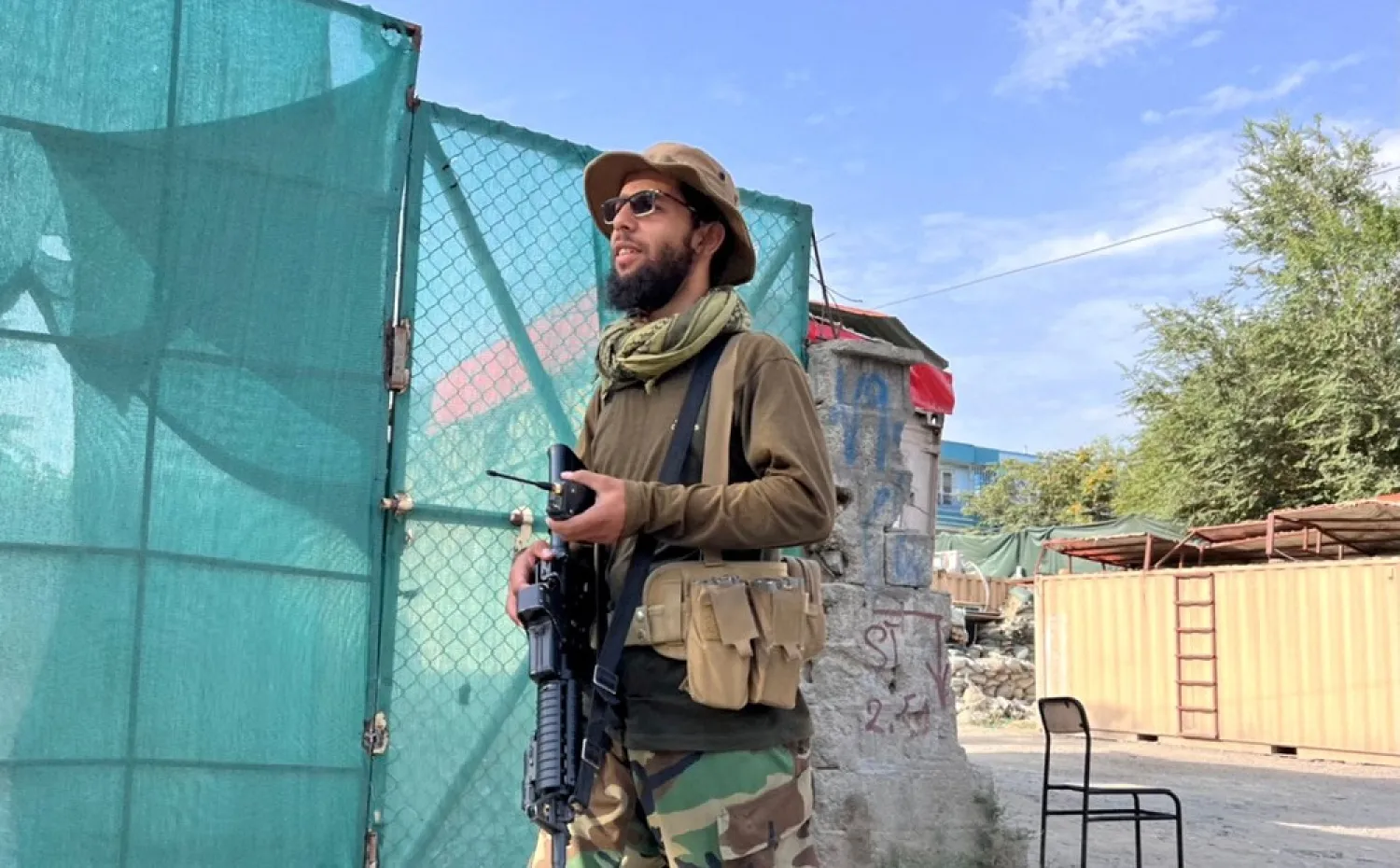

Watching Al-Qaeda Chief’s ‘Pattern of Life’ Key to His Death

A Taliban fighter stands guard near the site where al-Qaeda leader Ayman al-Zawahiri was killed in a US strike over the weekend, in Kabul, Afghanistan, August 2, 2022. (Reuters)
TT

Watching Al-Qaeda Chief’s ‘Pattern of Life’ Key to His Death

A Taliban fighter stands guard near the site where al-Qaeda leader Ayman al-Zawahiri was killed in a US strike over the weekend, in Kabul, Afghanistan, August 2, 2022. (Reuters)

As the sun was rising in Kabul on Sunday, two Hellfire missiles fired by a US drone ended Ayman al-Zawahiri's decade-long reign as the leader of al-Qaeda. The seeds of the audacious counterterrorism operation had been planted over many months.

US officials had built a scale model of the safe house where Zawahiri had been located, and brought it into the White House Situation Room to show President Joe Biden. They knew Zawahiri was partial to sitting on the home's balcony.

They had painstakingly constructed “a pattern of life," as one official put it. They were confident he was on the balcony when the missiles flew, officials said.

Years of efforts by US intelligence operatives under four presidents to track Zawahiri and his associates paid dividends earlier this year, Biden said, when they located Osama bin Laden’s longtime No. 2 — a co-planner of the Sept. 11, 2001, terrorist attacks on the US — and ultimate successor at the house in Kabul.

Bin Laden's death came in May 2011, face to face with a US assault team led by Navy SEALs. Zawahiri's death came from afar, at 6:18 a.m. in Kabul.

His family, supported by the Haqqani Taliban network, had taken up residence in the home after the Taliban regained control of the country last year, following the withdrawal of US forces after nearly 20 years of combat that had been intended, in part, to keep al-Qaeda from regaining a base of operations in Afghanistan.

But the lead on his whereabouts was only the first step. Confirming Zawahiri's identity, devising a strike in a crowded city that wouldn’t recklessly endanger civilians, and ensuring the operation wouldn’t set back other US priorities took months to fall into place.

That effort involved independent teams of analysts reaching similar conclusions about the probability of Zawahiri's presence, the scale mock-up and engineering studies of the building to evaluate the risk to people nearby, and the unanimous recommendation of Biden’s advisers to go ahead with the strike.

“Clear and convincing,” Biden called the evidence. "I authorized the precision strike that would remove him from the battlefield once and for all. This measure was carefully planned, rigorously, to minimize the risk of harm to other civilians.”

The consequences of getting it wrong on this type of judgment call were devastating a year ago this month, when a US drone strike during the chaotic withdrawal of American forces killed 10 innocent family members, seven of them children.

Biden ordered what officials called a “tailored airstrike,” designed so that the two missiles would destroy only the balcony of the safe house where the terrorist leader was holed up for months, sparing occupants elsewhere in the building.

A senior US administration official, speaking on the condition of anonymity to discuss the strike planning, said Zawahiri was identified on “multiple occasions, for sustained periods of time” on the balcony where he died.

The official said “multiple streams of intelligence” convinced US analysts of his presence, having eliminated “all reasonable options” other than his being there.

Two senior national security officials were first briefed on the intelligence in early April, with the president being briefed by national security adviser Jake Sullivan shortly thereafter. Through May and June, a small circle of officials across the government worked to vet the intelligence and devise options for Biden.

On July 1 in the White House Situation Room, after returning from a five-day trip to Europe, Biden was briefed on the proposed strike by his national security aides. It was at that meeting, the official said, that Biden viewed the model of the safe house and peppered advisers, including CIA Director William Burns, Director of National Intelligence Avril Haines and National Counterterrorism Center director Christy Abizaid, with questions about their conclusion that Zawahiri was hiding there.

Biden, the official said, also pressed officials to consider the risks the strike could pose to American Mark Frerichs, who has been in Taliban captivity for more than two years, and to Afghans who aided the US war efforts who remain in the country. US lawyers also considered the legality of the strike, concluding that Zawahiri's continued leadership of the terrorist group and support for al-Qaeda attacks made him a lawful target.

The official said Zawahiri had built an organizational model that allowed him to lead the global network even from relative isolation. That included filming videos from the house, and the US believes some may be released after his death.

On July 25, as Biden was isolated in the White House residence with COVID-19, he received a final briefing from his team.

Each of the officials participating strongly recommended the operation’s approval, the official said, and Biden gave the sign-off for the strike as soon as an opportunity was available.

That unanimity was lacking a decade earlier when Biden, as vice president, gave President Barack Obama advice he did not take — to hold off on the bin Laden strike, according Obama's memoirs.

The opportunity came early Sunday — late Saturday in Washington — hours after Biden again found himself in isolation with a rebound case of the coronavirus. He was informed when the operation began and when it concluded, the official said.

A further 36 hours of intelligence analysis would follow before US officials began sharing that Zawahiri was killed, as they watched the Haqqani Taliban network restrict access to the safe house and relocate the dead al-Qaeda leader’s family. US officials interpreted that as the Taliban trying to conceal the fact they had harbored Zawahiri.

After last year’s troop withdrawal, the US was left with fewer bases in the region to collect intelligence and carry out strikes on terrorist targets. It was not clear from where the drone carrying the missiles was launched or whether countries it flew over were aware of its presence.

The US official said no American personnel were on the ground in Kabul supporting the strike and the Taliban was provided with no forewarning of the attack.

In remarks 11 month ago, Biden had said the US would keep up the fight against terrorism in Afghanistan and other countries, despite pulling out troops. “We just don’t need to fight a ground war to do it.”

“We have what’s called over-the-horizon capabilities,” he said.

On Sunday, the missiles came over the horizon.


Nigeria's President to Make a Sate Visit to the UK in March

Nigeria’s President Bola Tinubu gives a joint statement with Brazil’s President Luiz Inacio Lula da Silva, at the Planalto presidential palace, in Brasilia, Brazil, Aug. 25, 2025. (AP Photo/Eraldo Peres, File)
TT

Nigeria's President to Make a Sate Visit to the UK in March

Nigeria’s President Bola Tinubu gives a joint statement with Brazil’s President Luiz Inacio Lula da Silva, at the Planalto presidential palace, in Brasilia, Brazil, Aug. 25, 2025. (AP Photo/Eraldo Peres, File)

Nigeria’s president is set to make a state visit to the UK in March, the first such trip by a Nigerian leader in almost four decades, Britain’s Buckingham Palace said Sunday.

Officials said President Bola Tinubu and first lady Oluremi Tinubu will travel to the UK on March 18 and 19, The AP news reported.

King Charles III and Queen Camilla will host them at Windsor Castle. Full details of the visit are expected at a later date.

Charles visited Nigeria, a Commonwealth country, four times from 1990 to 2018 before he became king. He previously received Tinubu at Buckingham Palace in September 2024.m

Previous state visits by a Nigerian leader took place in 1973, 1981 and 1989.

A state visit usually starts with an official reception hosted by the king and includes a carriage procession and a state banquet.

Last year Charles hosted state visits for world leaders including US President Donald Trump, French President Emmanuel Macron and German President Frank-Walter Steinmeier.


Iran Strikes Hard Line on US Talks, Saying Tehran's Power Comes From Saying 'No'

Traffic moves through a street in Tehran on February 7, 2026. (Photo by ATTA KENARE / AFP)
TT

Iran Strikes Hard Line on US Talks, Saying Tehran's Power Comes From Saying 'No'

Traffic moves through a street in Tehran on February 7, 2026. (Photo by ATTA KENARE / AFP)

Iran's top diplomat insisted Sunday that Tehran's strength came from its ability to “say no to the great powers," striking a maximalist position just after negotiations with the United States over its nuclear program and in the wake of nationwide protests.

Foreign Minister Abbas Araghchi, speaking to diplomats at a summit in Tehran, signaled that Iran would stick to its position that it must be able to enrich uranium — a major point of contention with President Donald Trump, who bombed Iranian atomic sites in June during the 12-day Iran-Israel war.

Iran will never surrender the right to enrich uranium, even if war "is imposed on us,” he noted.

"Iran has paid a very heavy price for its peaceful nuclear program and for uranium enrichment." 

Israeli Prime Minister Benjamin Netanyahu is expected to travel to Washington this week, with Iran expected to be the major subject of discussion, his office said.

While Iranian President Masoud Pezeshkian praised the talks Friday in Oman with the Americans as “a step forward,” Araghchi's remarks show the challenge ahead. Already, the US moved the aircraft carrier USS Abraham Lincoln, ships and warplanes to the Middle East to pressure Iran into an agreement and have the firepower necessary to strike the Islamic Republic should Trump choose to do so, according to The AP news.

“I believe the secret of the Islamic Republic of Iran’s power lies in its ability to stand against bullying, domination and pressures from others," Araghchi said.

"They fear our atomic bomb, while we are not pursuing an atomic bomb. Our atomic bomb is the power to say no to the great powers. The secret of the Islamic Republic’s power is in the power to say no to the powers.”

‘Atomic bomb’ as rhetorical device Araghchi's choice to explicitly use an “atomic bomb” as a rhetorical device likely wasn't accidental. While Iran has long maintained its nuclear program is peaceful, the West and the International Atomic Energy Agency say Tehran had an organized military program to seek the bomb up until 2003.

Iran had been enriching uranium up to 60% purity, a short, technical step to weapons-grade levels of 90%, the only non-weapons state to do so. Iranian officials in recent years had also been increasingly threatening that Tehran could seek the bomb, even while its diplomats have pointed to Iranian Supreme Leader Ali Khamenei’s preachings as a binding fatwa, or religious edict, that Iran wouldn’t build one.

Pezeshkian, who ordered Araghchi to pursue talks with the Americans after likely getting Khamenei's blessing, also wrote on X on Sunday about the talks.

“The Iran-US talks, held through the follow-up efforts of friendly governments in the region, were a step forward,” the president wrote. “Dialogue has always been our strategy for peaceful resolution. ... The Iranian nation has always responded to respect with respect, but it does not tolerate the language of force.”

It remains unclear when and where, or if, there will be a second round of talks. Trump, after the talks Friday, offered few details but said: “Iran looks like they want to make a deal very badly — as they should.”

Aircraft carrier in the Arabian Sea During Friday's talks, US Navy Adm. Brad Cooper, the head of the American military's Central Command, was in Oman. Cooper's presence was apparently an intentional reminder to Iran about US military power in the region. Cooper later accompanied US special envoy Steve Witkoff and Jared Kushner, Trump's son-in-law, to the Lincoln out in the Arabian Sea after the indirect negotiations.

Araghchi appeared to be taking the threat of an American military strike seriously, as many worried Iranians have in recent weeks. He noted that after multiple rounds of talks last year, the US “attacked us in the midst of negotiations."

“If you take a step back (in negotiations), it is not clear up to where it will go,” Araghchi said.


Russia: Man Suspected of Shooting Top General Detained in Dubai

An investigator works outside a residential building where the assassination attempt on Russian Lieutenant General Vladimir Alexeyev took place in Moscow, Russia February 6, 2026. REUTERS/Anastasia Barashkova
TT

Russia: Man Suspected of Shooting Top General Detained in Dubai

An investigator works outside a residential building where the assassination attempt on Russian Lieutenant General Vladimir Alexeyev took place in Moscow, Russia February 6, 2026. REUTERS/Anastasia Barashkova

Russia's Federal Security Service (FSB) said on Sunday that the man suspected of shooting top Russian military intelligence officer Vladimir Alexeyev in Moscow has been detained in Dubai and handed over to Russia.

Lieutenant General Vladimir Alexeyev, deputy head of the GRU, ⁠Russia's military intelligence arm, was shot several times in an apartment block in Moscow on Friday, investigators said. He underwent surgery after the shooting, Russian media ⁠said.

The FSB said a Russian citizen named Lyubomir Korba was detained in Dubai on suspicion of carrying out the shooting.

Russian Foreign Minister Sergei Lavrov accused Ukraine of being behind the assassination attempt, which he said was designed to sabotage peace talks. ⁠Ukraine said it had nothing to do with the shooting.

Alexeyev's boss, Admiral Igor Kostyukov, the head of the GRU, has been leading Russia's delegation in negotiations with Ukraine in Abu Dhabi on security-related aspects of a potential peace deal.
