
Iraq’s Sadrists Told to Quit Parliament but Keep Protesting

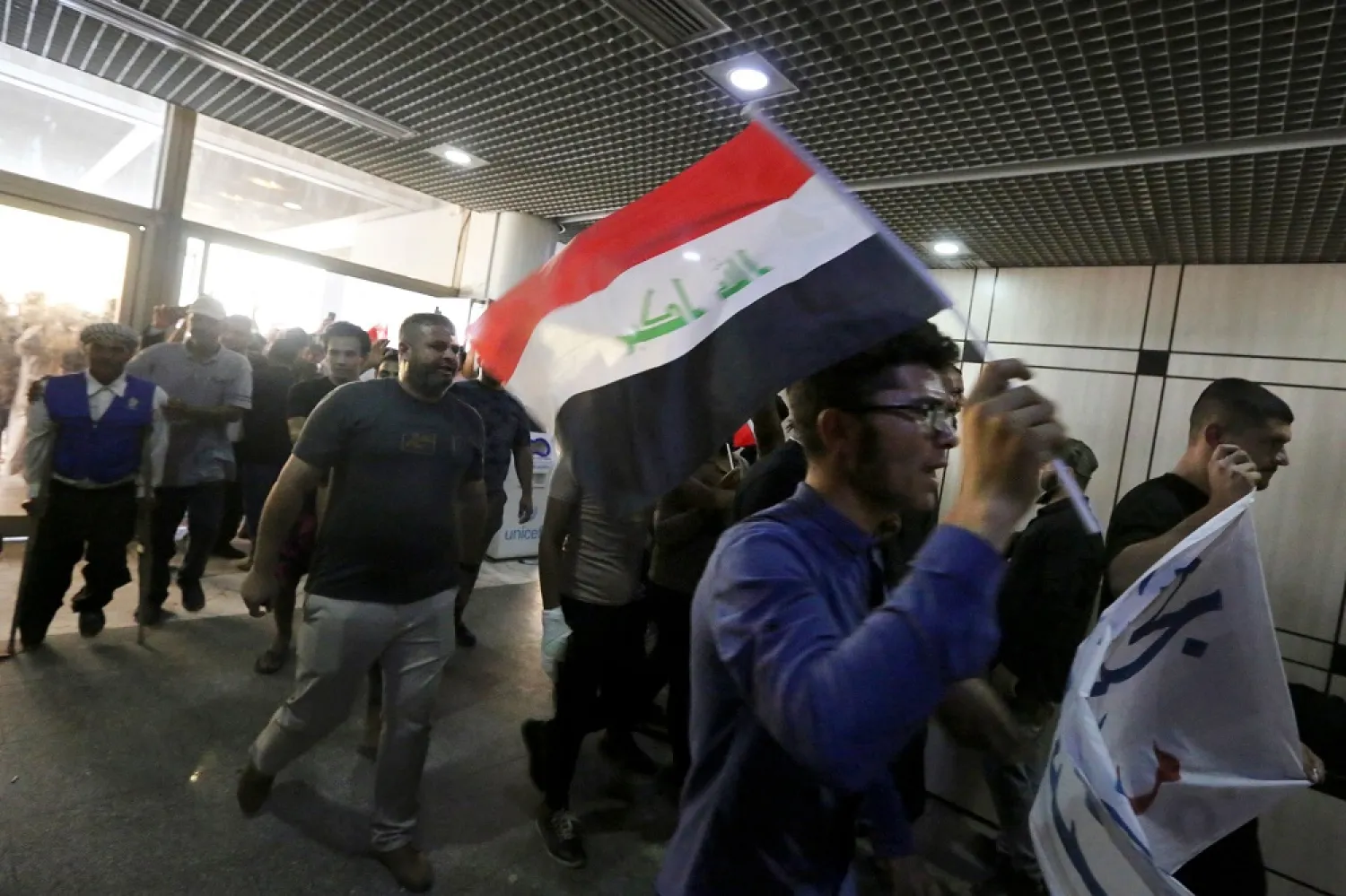
Supporters of Iraqi cleric Moqtada al-Sadr chant slogans during their sit-in at Iraq's parliament to protest a rival bloc's nomination for prime minister, in the capital Baghdad's high-security Green Zone, on August 2, 2022. (AFP)
TT

Iraq’s Sadrists Told to Quit Parliament but Keep Protesting

Supporters of Iraqi cleric Moqtada al-Sadr chant slogans during their sit-in at Iraq's parliament to protest a rival bloc's nomination for prime minister, in the capital Baghdad's high-security Green Zone, on August 2, 2022. (AFP)

A top official from Iraq's Sadrist movement called Tuesday on followers who have occupied parliament for four days to move their protest outside, as calls mount for dialogue between political rivals.

Supporters of powerful cleric Moqtada al-Sadr -- whose political bloc in October won the largest share of seats in elections -- stormed parliament on Saturday to protest against a rival Shiite faction's pick for prime minister.

Nearly 10 months on from the elections, the oil-rich country still has no government and no new prime minister or president.

A standoff pits the two key factions of the Shiite political scene, between the populist Sadr with a devoted following of millions, and the pro-Iran Coordination Framework.

While Sadr's bloc resigned in June ostensibly in a bid to unblock the impasse, the situation has only deteriorated since then.

Mohammed Salih al-Iraqi, a senior Sadr loyalist, called on protesters to "leave parliamentary headquarters" and join fellow Sadrists at an "encampment in front of and around the building".

The announcement caused confusion in parliament, where some officials said the instructions were to only leave the main chamber and another meeting room, but that protesters could stay on in the large entrance hall.

On Tuesday afternoon, hundreds of protesters continued to lounge in armchairs and on carpets in parliament, an AFP journalist said.

Protest encampment
In the surrounding gardens, protesters have erected tents, while mobile food stalls have sprung up to serve food and drinks. Cows were tied up to a post and a butcher manned a sand.

Protesters should leave the inside of parliament within 72 hours, Sadr ally Iraqi added, in a message on Twitter.

"The pursuit of the sit-in is very significant because it will solidify your demands," he said, recommending that protesters rotate their presence at the site.

He also announced that a major prayer rally would take place on Friday in the Green Zone, home to parliament, other Iraqi institutions and foreign embassies.

The Sadrist camp was outraged by the Coordination Framework faction last week nominating former minister Mohammed Shia al-Sudani as prime minister.

The Coordination Framework is a grouping that includes former prime minister Nouri al-Maliki, a long-standing foe of Sadr, and the Popular Mobilization Forces, a former paramilitary network now integrated into the security forces.

Thousands of Coordination Framework supporters have held counter-protests in Baghdad against the occupation of parliament, decrying what they call an attempted coup.

Outgoing prime minister Mustafa al-Kadhimi late Monday called for a "national dialogue", a proposal endorsed by the Sunni speaker of parliament Mohamed al-Halbussi and by Ammar al-Hakim, a senior Coordination Framework official.


Can Libyan Lawmakers Force a Change in Parliament’s Leadership?

A still from the Libyan House of Representatives’ latest session on Sept. 15 (video posted by the House on its Facebook page)
TT

Can Libyan Lawmakers Force a Change in Parliament’s Leadership?

A still from the Libyan House of Representatives’ latest session on Sept. 15 (video posted by the House on its Facebook page)

A push to change the rules of Libya’s parliament and rotate its leadership has put a question to the Benghazi-based chamber: Can lawmakers unseat Speaker Aguila Saleh after nearly 12 years at its helm?

The effort has also raised questions about why a bloc opposed to Saleh’s “unilateral decision-making” is acting now, whether its campaign is tied to the “4+4” agreement, and whether that deal can be carried out.

The agreement is seen as a possible route out of Libya’s political divide through a unified executive authority that would lead the country to elections within two years.

The lawmakers opposing Saleh say they will press on with efforts to “reform parliament and change its leadership.”

They say they were blocked from holding a session on the issue in the middle of last week when the chamber’s Benghazi headquarters was closed on its leadership’s orders.

Issam al-Jehani, a prominent member of the bloc, said its 86 lawmakers could meet in any Libyan city where they could carry out their duties.

Their aim was “neither a conspiracy nor an attempt to take Saleh’s seat,” he said, but reform in response to Saleh’s unilateral decisions and determination to stay in office.

Other political figures say the campaign could splinter and fade. Its momentum, they argue, depends on the balance of power in eastern Libya and on regional pressure.

Lawmaker Ali al-Takbali expects it to lose steam. He told Asharq Al-Awsat that a similar call in March for a session to change parliament’s rules came to nothing.

He also questioned whether Saleh’s opponents could keep enough lawmakers together to hold a session to remove him. They may unite over a grievance, al-Takbali said, but become harder to assemble once they return home, particularly if some reconsider their position because of personal interests or tribal ties.

Fellow lawmaker Montaser al-Hassi warned that some members’ actions could split parliament. Lawmakers have the right to amend its rules, he said, but must do so through legal channels.

Libya has long been divided between two governments: the interim Government of National Unity led by Abdulhamid al-Dbeibah in Tripoli, and Osama Hammad’s parliament-appointed government, which runs the east and some southern cities and is backed by Libyan National Army commander Field Marshal Khalifa Haftar.

Under the “4+4” agreement reached late last month by representatives of the Government of National Unity and the Libyan National Army under UN auspices, a new presidential council and unified government would prepare the country for general elections within two years.

Some observers and political figures say regional countries regard Saleh’s continued leadership as a safeguard against a split in the legislature, which they describe as the only institution to have remained intact through Libya’s institutional divisions.

Analyst Hossam Fnish linked the turmoil in parliament to the “4+4” deal. He said the reform bloc’s insistence on changing the rules before holding sessions would delay incorporating the agreement into Libya’s constitutional declaration, hindering a deal that could lead to elections and end the divide.

The UN mission, he said, prefers to incorporate the agreement through a constitutional amendment before seeking Security Council endorsement.

Fathi al-Shibli, head of the Voice of the People party, questioned the reform bloc’s motives. Complaints about Saleh making decisions alone and sessions going ahead without a quorum had circulated for years without drawing objections from lawmakers, he said.

That, in his view, lent weight to suspicions that the dispute was a struggle between blocs backed by powerful interests, rather than a drive for reform.

Al-Shibli expects Saleh to remain in office until the UN mission calls for a constituent council to replace parliament and the High Council of State to implement the “4+4” agreement. He said both bodies oppose a change to Libya’s political landscape.

Political analyst Mohammed Mahfouz likewise described the parliamentary dispute as a contest between powerful groups in eastern and western Libya, each seeking to show the international community that it can control the political scene.

Saleh’s hold on his position rests on two factors, Mahfouz told Asharq Al-Awsat: whether he and his allies can absorb the current anger, and whether regional and Western countries support him.

Saleh’s two deputies may help him contain the challenge, Mahfouz said, because they too could face replacement.


Iraq’s PM Tells UN The State Alone Will Decide War, Peace

Iraqi Prime Minister Ali al-Zaidi speaks during the 81st session of the United Nations General Assembly on Sept. 25, 2026. (AP)
TT

Iraq’s PM Tells UN The State Alone Will Decide War, Peace

Iraqi Prime Minister Ali al-Zaidi speaks during the 81st session of the United Nations General Assembly on Sept. 25, 2026. (AP)

Iraqi Prime Minister Ali al-Zaidi said on Friday that one of his government’s priorities was to ensure the state alone decides matters of war and peace, stressing that weapons must remain in the hands of constitutional institutions.

“The practical measures to bring weapons and decisions on war and peace under state control are moving in the right direction,” al-Zaidi told the UN General Assembly.

He called them essential to building state institutions, protecting sovereignty and securing stability.

He said the end of the international coalition’s mission in Iraq would mark a new phase in relations with strategic partners, shifting from military cooperation to economic and development cooperation. Iraq would continue to strengthen its security and military capabilities, he added.

Al-Zaidi called for tighter border controls, the closing of security gaps and continued vigilance against conditions that could fuel extremism.

He reiterated Iraq’s support for dialogue, diplomacy, respect for sovereignty, noninterference and good neighborly relations, and urged countries to resolve conflicts through negotiations and prevent renewed wars.

He urged the world to engage more closely with Iraq, saying the country could contribute to security and stability.

He also highlighted the Development Road project as a “strategic corridor for trade, investment and energy” linking Iraq’s Grand Faw Port to Türkiye and, from there, Europe.

“Iraq has never been on the margins. It is at the heart of history and the pulse of the present, and it deserves a partnership for the future,” he said.

US Secretary of State Marco Rubio had warned Baghdad that militias must be disarmed to avoid the “Balkanization of Iraq,” amid growing pressure on the Iraqi government to bring weapons under state control.

Rubio expressed US support for al-Zaidi’s efforts to strengthen state authority and called for armed factions to be dismantled. He warned that competing centers of power could fragment Iraq and weaken its institutions.

Al-Zaidi had proposed a plan beginning with a 90-day period during which armed factions would cease attacks, with the transfer of weapons to the state to be completed by June 30, 2027.


UN Identifies 214 Firms Linked to Israeli Settlements

Palestinians protest against Israeli settlements near Nablus in the occupied West Bank (Reuters)
TT

UN Identifies 214 Firms Linked to Israeli Settlements

Palestinians protest against Israeli settlements near Nablus in the occupied West Bank (Reuters)

The United Nations on Friday released a fresh update of its database of companies with activities in Israeli settlements in Palestinian territories, listing 214 firms from 11 countries.

Since last year's update, the UN rights office added an additional 61 companies to the database and had removed five companies.

But major firms like Airbnb, Booking.com, Motorola Solutions and TripAdviser remained on the list.

The report, which was harshly criticized by Israel, served as a "reminder to companies that they have human rights responsibilities", UN rights chief Volker Turk said in a statement.

Firms, he said, "are expected to conduct due diligence to ensure that they do not become involved in human rights violations or abuses".

While most of the companies were based in Israel, others were based in Canada, China, France, Germany, Luxembourg, the Netherlands, Portugal, Spain, Britain and the United States.

There were two Spanish companies removed from the database since last year, along with one each from Canada, Israel and Portugal.

The list was first produced in 2020 after a UN Human Rights Council resolution called for a database of firms that profited from business in illegally occupied Palestinian territory.

The UN rights office was asked to list companies found to be taking part in any of 10 activities, including construction, surveillance, demolitions and destruction of agricultural land in Israeli settlements in the West Bank, including East Jerusalem.

Despite a requirement for the database to be updated annually, it has been revised just twice before, in 2023 and 2025.

The list is not exhaustive.

It only reviews companies about which it received submissions during set timeframes, the last of which closed in June 2024.

In all, it has received submissions about 596 companies, of which it has so far reviewed 381.

Israel, which has been harshly critical of the database from the start, slammed it again Friday as "a distorted mechanism... established solely to persecute the Jewish state".

The country's mission to the UN in Geneva charged that it was "a political tool" used by the rights office "to advance a smear campaign against business enterprises that committed no wrongdoing".

Israel has controlled the West Bank since 1967 in an occupation considered illegal under international law.