


Asian Markets Track Wall St Plunge on Growing Rate Fears

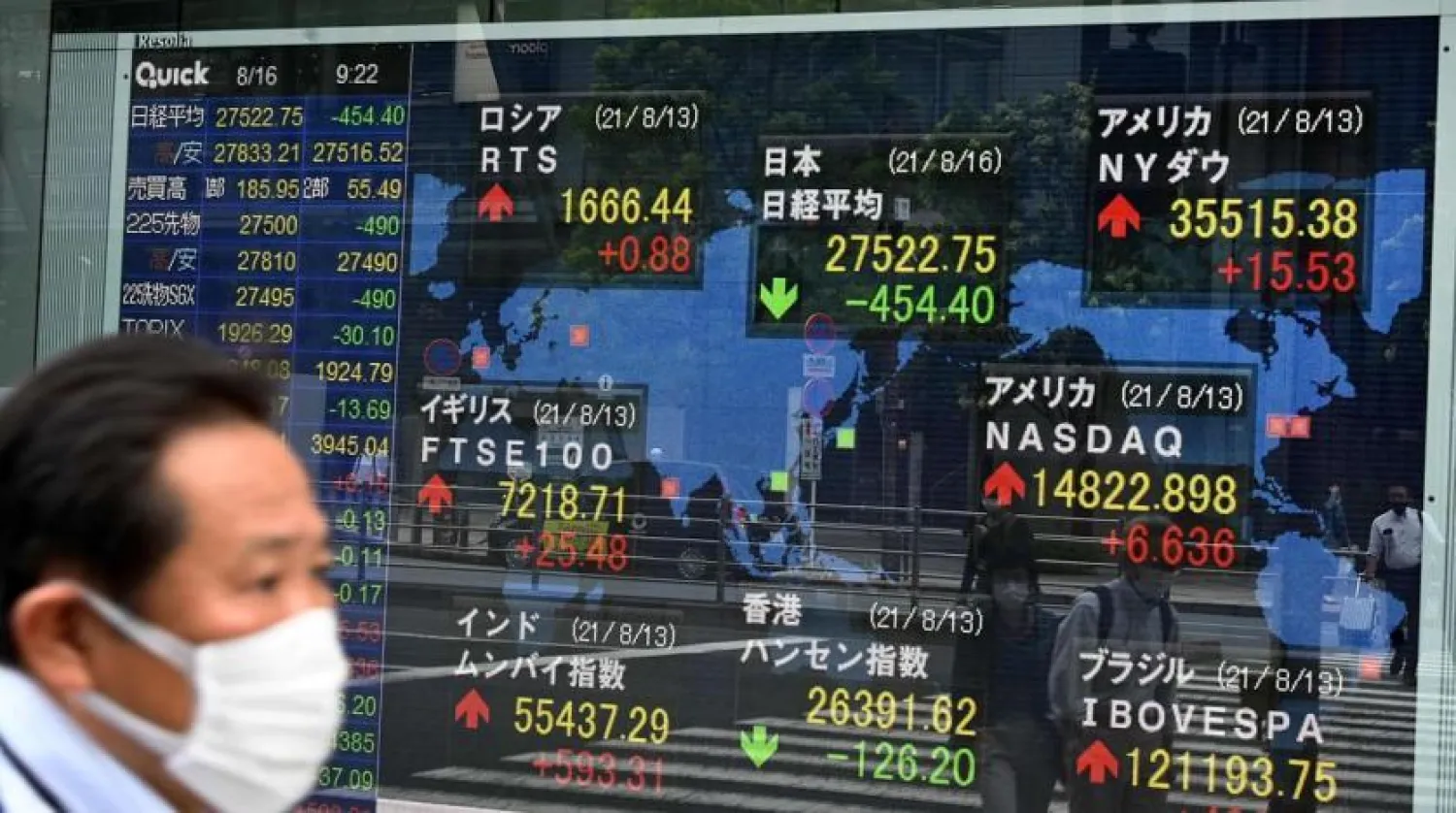
A pedestrian walks past a stock indicator displaying the Nikkei 225 of the Tokyo Stock Exchange (C, top) and other world stock markets in Tokyo on 16 August 2021. AFP
TT

Asian Markets Track Wall St Plunge on Growing Rate Fears

A pedestrian walks past a stock indicator displaying the Nikkei 225 of the Tokyo Stock Exchange (C, top) and other world stock markets in Tokyo on 16 August 2021. AFP

Asian markets fell again Tuesday and the dollar held gains as traders grow increasingly worried that the Federal Reserve will continue to ramp up interest rates to fight inflation.

With the Jackson Hole symposium of central bankers and finance chiefs taking place this week, the focus is on what Fed chief Jerome Powell says about its plans to tackle prices, with many fearing officials could send the economy into recession, AFP said.

The equities' losses appear to mark the end of a near-two-month rally from June lows, which was powered by signs of economic weakness that observers hoped would allow the bank to be less hawkish.

"Investors are becoming increasingly concerned that Jerome Powell will deliver a hawkish speech at Jackson hole, whilst warning that the coming months will be hard to navigate (and fan fears of a recession)," said Matthew Simpson at SoneX Financial.

"Public comments from various Fed members have become increasingly hawkish as they seemingly read from the same script ahead of Jackson Hole – which is an event typically associated with important Fed announcements."

Bets that the central bank will keep lifting rates for some time have sent 10-year Treasury yields higher and ramped up fears of a contraction in the world's number one economy.

But the United States is not the only economy under pressure, with governments and banks around the world facing an uphill battle against inflation, which is at multi-decade highs owing to spiking energy costs and supply chain snarls.

That comes as uncertainty rules owing to the ongoing war in Ukraine and a sharp slowdown in China caused by lockdowns put in place as part of the country's zero-Covid strategy.

Wall Street fell deep into the red with the S&P 500 and Nasdaq off more than two percent each.

And Asia followed suit.

Hong Kong and Shanghai dropped as investors brushed off a loan rate cut by the People's Bank of China, which also called for banks to lend more to help the battered property market.

Tokyo, Sydney, Seoul, Singapore, Taipei, Manila and Wellington were also down.

The dollar held its strength on rate hike expectations, with 24-year highs against the yen and two-decade highs against the euro, having broken parity with the single currency.

The euro has been hammered for months by recession expectations as it is hit by an energy crisis caused by sanctions on Russia for its invasion of Ukraine.

Fears have increased after Russia's Gazprom said Friday that the Nord Stream pipeline would be closed for maintenance at the end of the month, cutting Europe's crucial gas deliveries.

- Key figures at around 0230 GMT -
Tokyo - Nikkei 225: DOWN 1.2 percent at 28,456.92 (break)

Hong Kong - Hang Seng Index: DOWN 0.5 percent at 19,552.76

Shanghai - Composite: DOWN 0.2 percent at 3,270.21

Euro/dollar: UP at $0.9942 from $0.9941 Monday

Pound/dollar: UP at $1.1772 from $1.1763

Euro/pound: DOWN at 84.45 pence from 84.51 pence

Dollar/yen: DOWN at 137.13 yen from 137.48 yen

West Texas Intermediate: UP 0.8 percent at $91.11 per barrel

Brent North Sea crude: UP 0.8 percent at $97.26

New York - Dow: DOWN 1.9 percent at 33,063.61 (close)

London - FTSE 100: DOWN 0.2 percent at 7,533.79 (close)


OPEC Further Lowers 2026 Global Oil Demand Growth Forecast

FILE PHOTO: People walk past an installation depicting barrel of oil with the logo of Organization of the Petroleum Exporting Countries (OPEC)  in Baku, Azerbaijan November 19, 2024. REUTERS/Maxim Shemetov/File Photo
FILE PHOTO: People walk past an installation depicting barrel of oil with the logo of Organization of the Petroleum Exporting Countries (OPEC) in Baku, Azerbaijan November 19, 2024. REUTERS/Maxim Shemetov/File Photo
TT

OPEC Further Lowers 2026 Global Oil Demand Growth Forecast

FILE PHOTO: People walk past an installation depicting barrel of oil with the logo of Organization of the Petroleum Exporting Countries (OPEC)  in Baku, Azerbaijan November 19, 2024. REUTERS/Maxim Shemetov/File Photo
FILE PHOTO: People walk past an installation depicting barrel of oil with the logo of Organization of the Petroleum Exporting Countries (OPEC) in Baku, Azerbaijan November 19, 2024. REUTERS/Maxim Shemetov/File Photo

OPEC on Wednesday lowered its forecast for world oil demand growth in 2026 to 580,000 barrels per day, a copy of its monthly report showed, marking the fourth straight downward revision.

The producer group continues to see a smaller impact on consumption since the Iran war started than other forecasters such as the International Energy Agency, which expects demand to decline in 2026, Reuters reported.

The Organization of the Petroleum Exporting Countries also raised its forecast for 2027 oil demand growth, according to the report on OPEC's website.


Bank of America Pledges $250 Billion for US Infrastructure Financing

Signage is seen at the Bank of America Tower in Manhattan, New York City, New York, US, November 2, 2022. (Reuters)
TT

Bank of America Pledges $250 Billion for US Infrastructure Financing

Signage is seen at the Bank of America Tower in Manhattan, New York City, New York, US, November 2, 2022. (Reuters)

Bank of America said on Wednesday it plans to deploy $250 billion by July 2027 to support US digital and infrastructure projects, a move it says will boost the country's economic growth and help create tens of thousands of jobs.

The Wall Street bank said its "Critical Infrastructure Finance Initiative," launched on the heels of the nation's 250th anniversary celebrations, will provide primary market lending, investments, ‌capital markets services, ‌and banking and advisory offerings.

The announcement underscores how ‌major ⁠US financial institutions are seeking ⁠to capitalize on rising demand for AI data centers, critical minerals and energy infrastructure upgrades.

It comes days after Morgan Stanley said it would facilitate roughly $1.5 trillion over the next decade to finance technology and infrastructure projects.

Last year JPMorgan Chase launched a $1.5 trillion plan to facilitate, finance and invest in industries deemed critical to the US national security and economic resilience, including defense, ⁠energy and advanced manufacturing.

BOOSTING GROWTH, CREATING JOBS

Bank of ‌America's financing will target three areas: ‌digital infrastructure, including data centers and computing; energy and power infrastructure, including renewable generation ‌and energy storage; and core infrastructure such as transportation and natural gas.

"Meeting ‌America's growing infrastructure needs requires mobilizing capital at scale across increasingly interconnected sectors," said Karen Fang, global head of infrastructure and sustainable finance at Bank of America.

"Delivering these projects requires integrated financing solutions spanning corporate and project-level capital in both public ‌and private markets."

The $250 billion target will be measured over an 18-month period from January 1, 2026, to July ⁠4, 2027, ⁠the bank said.

"If we all do our job right, we should be deploying more capital," said Fang, who is also co-head of global capital solutions at BofA, when asked about potential deployment of more capital after July 2027.

Many projects require new infrastructure to be built before becoming operational, she said.

In the United States, infrastructure construction loans typically have terms of five to seven years. Once projects are completed and operating, they are often refinanced with longer-term debt lasting 10, 15 or 20 years, Fang said.

She said greater infrastructure investment would help drive economic growth and create long-term jobs.

"Infrastructure spending will lead to economic growth and prosperity," she said.


IEA Cuts 2026 Oil Demand Forecast Again as Hormuz Remains Shut

Boats and a vessel in the Strait of Hormuz, as seen from Musandam, Oman, August 3, 2026. (Reuters)
TT

IEA Cuts 2026 Oil Demand Forecast Again as Hormuz Remains Shut

Boats and a vessel in the Strait of Hormuz, as seen from Musandam, Oman, August 3, 2026. (Reuters)

The International Energy Agency on Wednesday sharply reduced its forecast for global oil demand this year, as supplies remain crimped by the closure of the Strait of Hormuz and high prices deter buyers.

Demand is expected to slump by 1.6 million barrels per day (mb/d), compared with its forecast slump of one million barrels in its previous monthly report in July.

Crude prices have remained well above levels seen before the US and Israeli attacks on Iran in late February, sparking a war that has seen Iran launch attacks at several Gulf countries.

Tehran also responded by effectively shutting down tanker and cargo traffic in the Strait of Hormuz, through which around one-fifth of global oil supplies usually transit.

"The ongoing closure of the Strait of Hormuz and elevated fuel prices continue to weigh on oil consumption," the Paris-based IEA said.

Despite a purported ceasefire and repeated claims that a deal to open the strait was imminent -- what the IEA referred to as "sudden diplomatic pivots" -- only a handful of ships are being let through, leading to volatile pricing on global oil markets.

The IEA said global supplies rose by 2.4 million barrels per day in July, to reach 101.5 mb/d, but that was still 6.3 mb/d lower than a year ago.

But "renewed hostilities and maritime disruptions in July and early August undermined the recovery efforts," the agency said.

It now expects global supply to fall by 4.3 mb/d on average this year, before recovering next year.

On the demand side, the IEA is projecting a return to growth in the fourth quarter of this year.
