


Ukraine Says Nuclear Plant Offline after Russian Shelling

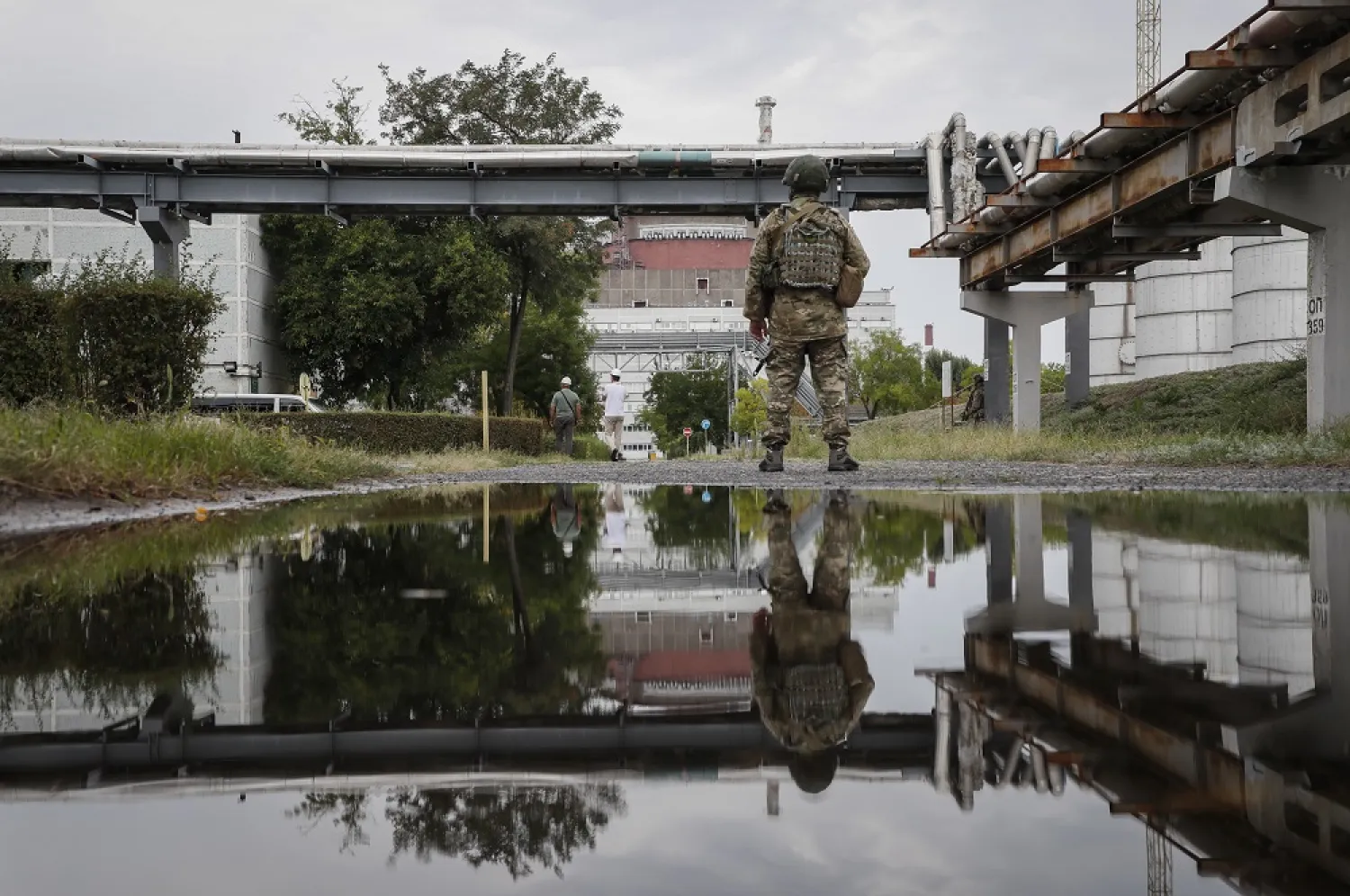
A picture taken during a visit organized by the Russian military shows Russian servicemen guard on the territory of the Zaporizhzhia Nuclear Power Plant in Enerhodar, southeastern Ukraine, 01 September 2022. (EPA)
TT

Ukraine Says Nuclear Plant Offline after Russian Shelling

A picture taken during a visit organized by the Russian military shows Russian servicemen guard on the territory of the Zaporizhzhia Nuclear Power Plant in Enerhodar, southeastern Ukraine, 01 September 2022. (EPA)

Europe’s largest nuclear plant was knocked off Ukraine's electricity grid Monday after its last transmission line was disconnected as a result of a fire caused by Russian shelling, the facility’s operator and the UN atomic watchdog said.

The International Atomic Energy Agency said it was informed Monday by Ukrainian authorities that the reserve line “was deliberately disconnected in order to extinguish a fire.”

“The line itself is not damaged, and it will be reconnected once the fire is extinguished,” the IAEA said.

In the meantime, the plant’s only remaining operational reactor would “generate the power the plant needs for its safety and other functions,” the agency said.

The incident fueled fears of a potential nuclear disaster at Zaporizhzhia, which is one of the 10 biggest nuclear plants in the world. Experts say its reactors are designed to protect against natural disasters and incidents such as aircraft crashes, but leaders around the world have appealed for it to be spared in the fighting because of the huge risk of a catastrophe.

Plant operator Energoatom said in a statement that Russian forces have kept up “intensive shelling” of the area around Zaporizhzhia in recent days despite the warnings.

The IAEA, which still has two experts at the plant after a perilous inspection last week that required six inspectors to travel through the fighting, said last Saturday that the plant had lost its last main line to the grid, but was still sending power to the grid through a reserve line.

The developments at Zaporizhzhia came on the eve of a report to the UN Security Council by the IAEA inspectors about what they found on their visit.

Russia and Ukraine have traded accusations about endangering the plant, which the Kremlin’s forces have held since early March. The plant’s Ukrainian staff continue to operate it.

The Russian military had earlier Monday accused Ukrainian forces of staging “provocations” at the plant, which lies within a Russian-installed administrative area.

Russia’s Defense Ministry claimed that Kyiv’s forces on Sunday targeted the territory of the plant with a drone, which it said Russian troops were able to shoot down.

The ministry said Ukrainian troops also shelled the adjacent city of Enerhodar twice overnight.

Ukrainian Energy Minister Herman Halushchenko said on Facebook on Monday that fighting around the power station made it impossible to repair damaged power lines, putting the world “once again on the brink of a nuclear disaster.”

Ukraine’s presidential adviser, Mykhailo Podolyak, applauded the IAEA’s decision to leave some experts at the plant.

“There are Russian troops now who don’t understand what’s happening, don’t assess the risks correctly,” Podolyak said.

“There is a number of our workers there, who need some kind of protection, people from the international community standing by their side and telling (Russian troops): ‘Don’t touch these people, let them work,’” he added.

Meanwhile, a senior Kremlin official blamed Western sanctions on Russia over its war in Ukraine for stoppages in Moscow’s supply of natural gas to Europe.

In some of the bluntest comments yet on the standoff between Moscow and Western Europe over energy supplies, Kremlin spokesman Dmitry Peskov said problems with pumping the gas occurred “because of the sanctions.”

“Other reasons that would cause problems with the pumping don’t exist,” Peskov claimed.

The sanctions on Moscow and Russian companies have created problems with equipment maintenance, he said, though that claim has been refuted by Western governments and engineers.

Russian energy company Gazprom announced Friday that a suspension of gas supplies heading westwards through the Nord Stream 1 pipeline would be extended indefinitely because oil leaks in turbines need fixing.

That move brought a surge in European natural gas prices and walloped global stock markets.

High energy prices and possible shortages this winter in Western Europe have set alarm bells ringing among governments, notably those in the European Union.

French President Emmanuel Macron on Monday called for a 10% cut in his country’s energy use in coming weeks and months to avoid the risk of rationing and cuts this winter.

Peskov laid the blame for the disruption firmly at the door of the sanctions, which he claimed have prevented machinery from working properly, even though experts say that isn’t true.

German officials have rejected those explanations, saying they are merely a political power play. Germany’s Siemens Energy, which manufactured turbines the Nord Stream 1 pipeline uses, said turbine leaks can be fixed while gas continues to flow through the pipeline.

Elsewhere, the fighting raged on for a seventh month, with Ukraine’s presidential office saying Monday at least four civilians were killed and seven others were wounded by new Russian shelling across several regions of Ukraine.

In the eastern city of Sloviansk, personnel at the Ukrainian Red Cross Society swept up debris Monday from a second rocket attack on its premises in a week.

Nobody was hurt in either attack, said Taras Logginov, head of the agency’s rapid response unit. He blamed Russia forces and accused them of war crimes for the attacks.

In a row of apartment buildings across the road, the few residents who haven't evacuated sawed sheets of plywood to board up their shattered windows.

Henadii Sydorenko sat on the porch of his apartment building for a break. He said he’s not sure whether to stay or leave, torn between his responsibility of taking care of three apartments whose owners have already evacuated and the increasing fear because of the now frequent shelling of Sloviansk.

“It’s frightening,” the 57-year-old said of the shelling. “I’m losing my mind, little by little.”

Ukrainian President Volodymyr Zelenskyy said Kyiv’s forces had liberated three settlements — two in the south and one in the east, in the Donetsk region. He didn’t provide names of the settlements in his comments on Sunday night.

Amid increased Ukrainian strikes on the occupied Kherson region, Russian-installed authorities there said early Monday that for security reasons they were putting on hold their plans for a local referendum on whether the region should formally become part of Russia.

But by the afternoon, officials had a change of heart and said the ballot would go ahead as planned, though no date has been set.



Top Trump Iran Negotiator Says Visits US Aircraft Carrier in Middle East

US Special Envoy Steve Witkoff delivers a press conference upon the signing of the declaration on deploying post-ceasefire force in Ukraine, during the so-called "Coalition of the Willing" summit, at the Elysee Palace in Paris, France, January 6, 2026. (Reuters)
TT

Top Trump Iran Negotiator Says Visits US Aircraft Carrier in Middle East

US Special Envoy Steve Witkoff delivers a press conference upon the signing of the declaration on deploying post-ceasefire force in Ukraine, during the so-called "Coalition of the Willing" summit, at the Elysee Palace in Paris, France, January 6, 2026. (Reuters)

US President Donald Trump's lead Iran negotiator Steve Witkoff on Saturday said he visited the USS Abraham Lincoln aircraft carrier currently in the Arabian Sea, with Washington and Tehran due to hold further talks soon.

"Today, Adm. Brad Cooper, Commander of US Naval Forces Central Command, Jared Kushner, and I met with the brave sailors and Marines aboard the USS Abraham Lincoln, her strike group, and Carrier Air Wing 9 who are keeping us safe and upholding President Trump's message of peace through strength," said Witkoff in a social media post.

Iranian Foreign Minister Abbas Araghchi said on Saturday he hoped talks with the United States would resume soon, while reiterating Tehran's red lines and warning against any American attack.


Israel’s Netanyahu Expected to Meet Trump in US on Wednesday and Discuss Iran

Israeli Prime Minister Benjamin Netanyahu delivers a speech during a special session to mark the 77th anniversary of the Knesset's establishment and the 60th anniversary of the dedication of the current building at the Knesset, the Israeli parliament, in Jerusalem, 02 February 2026. (EPA)
TT

Israel’s Netanyahu Expected to Meet Trump in US on Wednesday and Discuss Iran

Israeli Prime Minister Benjamin Netanyahu delivers a speech during a special session to mark the 77th anniversary of the Knesset's establishment and the 60th anniversary of the dedication of the current building at the Knesset, the Israeli parliament, in Jerusalem, 02 February 2026. (EPA)

Israeli Prime Minister Benjamin Netanyahu is expected to meet US President Donald Trump on Wednesday in Washington, where they will discuss negotiations with Iran, Netanyahu's office said on Saturday.

Iranian and US officials held indirect nuclear ‌talks in the ‌Omani capital ‌Muscat ⁠on Friday. ‌Both sides said more talks were expected to be held again soon.

A regional diplomat briefed by Tehran on the talks told Reuters Iran insisted ⁠on its "right to enrich uranium" ‌during the negotiations with ‍the US, ‍and that Tehran's missile capabilities ‍were not raised in the discussions.

Iranian officials have ruled out putting Iran's missiles - one of the largest such arsenals in the region - up ⁠for discussion, and have said Tehran wants recognition of its right to enrich uranium.

"The Prime Minister believes that any negotiations must include limiting ballistic missiles and halting support for the Iranian axis," Netanyahu's office said in a ‌statement.


Italy FM Rules Out Joining Trump’s ‘Board of Peace’

Italy's Minister for Foreign Affairs Antonio Tajani speaks to the press during the EPP Leaders’ meeting, in Zagreb, Croatia, 30 January 2026. (EPA)
TT

Italy FM Rules Out Joining Trump’s ‘Board of Peace’

Italy's Minister for Foreign Affairs Antonio Tajani speaks to the press during the EPP Leaders’ meeting, in Zagreb, Croatia, 30 January 2026. (EPA)

Italy will not take part in US President Donald Trump's "Board of Peace", Italian Foreign Minister Antonio Tajani said Saturday, citing "insurmountable" constitutional issues.

Trump launched his "Board of Peace" at the World Economic Forum in Davos in January and some 19 countries have signed its founding charter.

But Italy's constitution bars the country from joining an organization led by a single foreign leader.

Prime Minister Giorgia Meloni, a Trump ally, last month noted "constitutional problems" with joining, but suggested Trump could perhaps reopen the framework "to meet the needs not only of Italy, but also of other European countries".

Tajani appeared Saturday to rule that out.

"We cannot participate in the Board of Peace because there is a constitutional limit," he told the ANSA news agency.

"This is insurmountable from a legal standpoint," he said, the day after meeting US Secretary of State Marco Rubio and US Vice President JD Vance at the Olympics in Milan.

Although originally meant to oversee Gaza's rebuilding, the board's charter does not limit its role to the Palestinian territory and appears to want to rival the United Nations.