

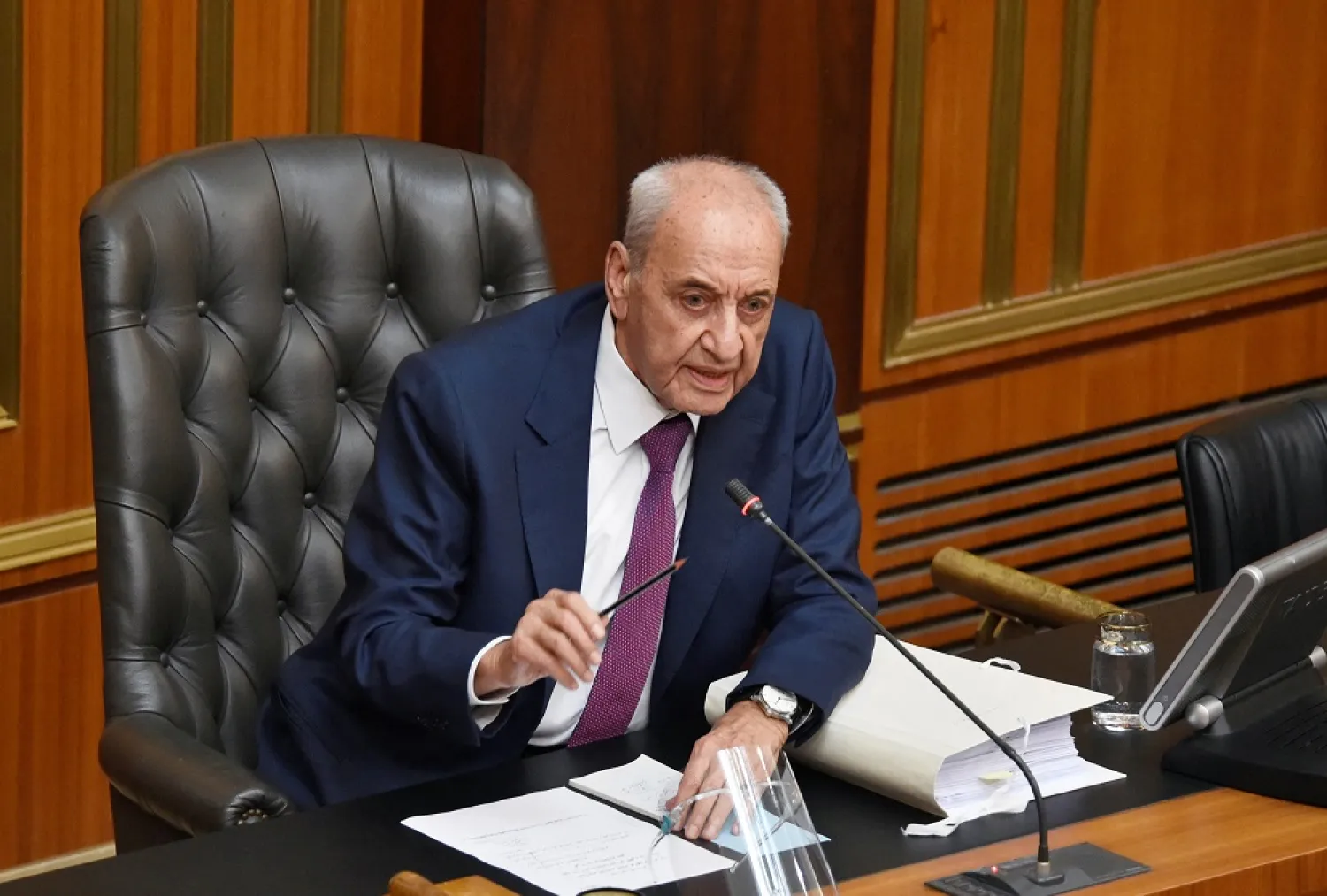

Lebanon's Berri to Asharq Al-Awsat: Election of President More than Necessary

Lebanese parliament Speaker Nabih Berri speaks during a parliament session to discuss and approve budget in Beirut, Lebanon September 16, 2022. (Lebanese Parliament/Handout via Reuters)
TT

Lebanon's Berri to Asharq Al-Awsat: Election of President More than Necessary

Lebanese parliament Speaker Nabih Berri speaks during a parliament session to discuss and approve budget in Beirut, Lebanon September 16, 2022. (Lebanese Parliament/Handout via Reuters)

Lebanon’s parliament Speaker Nabih Berri stressed the need to elect a new president to succeed Michel Aoun, whose term ends on October 31.

In remarks to Asharq Al-Awsat, he said: “The election of a president is more than necessary.”

He also underscored the need to form a new government to avoid “constitutional chaos.”

Moreover, Berri praised the speech delivered by Grand Mufti Sheikh Abdullatif Derian before Sunni MPs on Saturday.

“His speech was more than good. It was binding. We are concerned with holding the presidential elections within the constitutional deadline,” added the speaker.

The elections are a priority at the moment to counter the aims of parties seeking vacuum, he went on to say.

On efforts to form a new government, he said he is awaiting the outcome of the upcoming meeting between Aoun and caretaker Prime Minister Najib Mikati upon his return from New York where he took part in the United Nations General Assembly.

The formation of a cabinet will dash the goals of some sides that were hoping for “constitutional chaos.”

“I don’t think it’s in anyone’s interest, given the difficult situation in the country, for us to be led towards directions everyone wants to avoid,” Berri said.

Derian had on Saturday called for the election of a president who is “ethical and responsible.”

The president must be “wise, have a sense of national responsibility, integrity and ability to bring together all Lebanese,” he told a delegation of Sunnis MPs.

Derian warned that Lebanon was moving rapidly towards becoming a “non-state” and Arabs and world are “ignoring it because of its poor political management on all levels.”

He called on the MPs to help in ushering in change by “reclaiming the presidency of the republic and restoring respect to it and its role on the internal and external scenes.”

Furthermore, he highlighted the “extreme” importance of the position of president in Lebanon in specific because the “Christian president is a symbol of coexistence on which the system is founded.”

In a statement after closed-door talks with Derian meeting, the lawmakers pledged to preserve Lebanon’s sovereignty, unity and freedoms.

They pledged to elect a president within the constitutional deadline and reiterated their commitment to the Taif Accord that outlines Lebanon’s Arab identity and on which its national unity and harmony between religions is based.



Aoun Rejects Any Settlement at Lebanon’s Expense as Salam Rallies Int’l Support

Lebanese President Joseph Aoun speaks during an interview with AFP at the Presidential Palace in Baabda on September 15, 2026. (Photo by JOSEPH EID / AFP)
TT

Aoun Rejects Any Settlement at Lebanon’s Expense as Salam Rallies Int’l Support

Lebanese President Joseph Aoun speaks during an interview with AFP at the Presidential Palace in Baabda on September 15, 2026. (Photo by JOSEPH EID / AFP)

Lebanese President Joseph Aoun has stressed the need to strengthen national unity in the face of the challenges confronting Lebanon, saying any political settlement must not come at the expense of the country and its national interests.

Aoun warned on Tuesday against “seeking support from abroad against one another at home in ways that serve Lebanon’s enemies.”

“Let us instead draw strength from one another in dealing with the outside world,” he said.

Aoun stressed that Lebanon cannot be built by a single group, sect, or political party, calling for efforts to overcome divisions and enhance dialogue and communication among Lebanese citizens as the gateway to building trust and ensuring stability.

He said Lebanon can recover whenever its people place the national interest above all other considerations, urging greater engagement between generations and a move away from grudges and divisions.

Salam Mobilizes Support in New York

In New York, Prime Minister Nawaf Salam held a series of meetings on the sidelines of the United Nations General Assembly, stressing Lebanon’s priorities in discussions with UN Secretary-General Antonio Guterres, Jordan’s King Abdullah II, Turkish President Recep Tayyip Erdogan, Finnish President Alexander Stubb, Qatari Prime Minister and Foreign Minister Sheikh Mohammed bin Abdulrahman Al Thani, Iraqi Prime Minister Ali al-Zaidi, Bahraini Foreign Minister Abdullatif bin Rashid Al-Zayani, and US Senator Jeanne Shaheen.

During these meetings, Salam stressed the need for Israel to fully withdraw from Lebanese territory and cease its attacks, strengthen the capabilities of the Lebanese Army, and ensure a continued international presence in southern Lebanon following the end of UNIFIL’s mandate.
He also emphasized extending state authority across the country and ensuring that weapons remain solely under state control.

Salam sought support for Lebanon’s recovery, reconstruction, and rehabilitation efforts, as well as for the continuation of government reforms and the expansion of cooperation and investment, particularly in energy, transportation, and regional connectivity.

Meeting with the UN Secretary-General

In his meeting with Guterres, Salam stressed the importance of maintaining a UN-backed international presence in southern Lebanon after the conclusion of UNIFIL’s mission, arguing that such a presence would support stability and help extend state authority.

He also discussed the humanitarian situation, noting that approximately 329,000 people remain displaced, and highlighted the need to shift from emergency response measures toward supporting returns, recovery efforts, and the restoration of essential services.

Regional Consultations

With King Abdullah II of Jordan, discussions focused on supporting Lebanon and its institutions, particularly the Lebanese Army, continuing coordination to reduce tensions, and mobilizing international support for arrangements that would prevent a security vacuum in the south.

In talks with Erdogan, Salam discussed strengthening Lebanese-Turkish relations and expanding cooperation in trade, investment, energy, and infrastructure, in addition to electricity and railway connectivity projects and support for recovery and reconstruction in southern Lebanon.

Salam to the Lebanese Diaspora: Difficult Decisions and Reforms

Addressing members of the Lebanese community in New York, Salam said that despite the difficult circumstances, the government had not abandoned its course. Instead, it had taken “difficult decisions” and launched a serious reform agenda aimed at changing the country's trajectory and building a state in which Lebanese citizens can regain confidence.

On the issue of weapons, Salam stressed that the government remains committed to implementing its decisions so that the state alone exercises authority across Lebanon, holds exclusive control over decisions of war and peace, and entrusts responsibility for citizens’ security to the Lebanese Army and legitimate security institutions.

He linked these efforts to achieving an Israeli withdrawal, securing the return of residents to southern Lebanon, and launching a broader recovery and reconstruction process, emphasizing that stability is an essential prerequisite for economic revival and investment.


Iraqi-American Understanding on ‘Disarmament’ by Mid-2027

Iraqi Prime Minister Ali al-Zaidi during his meeting on Monday with US Secretary of State Marco Rubio in New York (government media)
TT

Iraqi-American Understanding on ‘Disarmament’ by Mid-2027

Iraqi Prime Minister Ali al-Zaidi during his meeting on Monday with US Secretary of State Marco Rubio in New York (government media)

Iraqi Prime Minister Ali al-Zaidi renewed his government's commitment to restricting the possession of weapons to state institutions, a policy that has become known as the "disarmament of armed factions.”

The statement came during al-Zaidi's meeting with US Secretary of State Marco Rubio in New York on Monday, on the sidelines of the 81st session of the United Nations General Assembly.

According to a statement from the Iraqi Prime Minister's Office, al-Zaidi told Rubio that his government is working to strengthen Iraqi-American relations and elevate the level of strategic partnership between the two countries through constructive economic cooperation that expands areas of joint work and enhances mutual interests.

Al-Zaidi also reaffirmed the government's determination to complete its sovereign obligations and move forward with measures to ensure that arms remain exclusively in the hands of the state, in accordance with constitutional and legal principles.

The government statement quoted Rubio as expressing US support for Iraq in consolidating and sustaining internal stability, meeting the aspirations of Iraqis for economic development and greater engagement with the world, and supporting government measures aimed at strengthening state institutions and promoting stability and economic growth.

Following the meeting between al-Zaidi and Rubio, Tom Barrack, the US Presidential Special Envoy for Iraq, told reporters on Tuesday that an agreement had been reached to place all weapons under the control of the Iraqi state and to fully resolve the issue by the end of June 2027. This partially aligns with remarks al-Zaidi made to The New York Times.

Al-Zaidi outlined his government's plan to disarm armed factions and integrate their members, beginning with a 90-day preliminary phase during which the factions would halt their attacks in exchange for not being targeted by US strikes.

This may indicate that al-Zaidi succeeded in persuading Washington to grant additional time to settle the issue of disarming armed factions.

Previously, his government had adhered to a September 30 deadline, which coincides with the withdrawal of the US-led international coalition forces from Iraq.

Barrack has been quoted by the media as saying that the weapons of all armed groups in Iraq would be brought under control by 2027, with the state becoming the country’s sole armed authority.


Türkiye’s Erdogan Urges World to ‘Immediately’ Start Rebuilding Gaza

Türkiye’s President Recep Tayyip Erdogan addresses the 81st United Nations General Assembly at UN headquarters in New York City, US, September 22, 2026. (Reuters)
TT

Türkiye’s Erdogan Urges World to ‘Immediately’ Start Rebuilding Gaza

Türkiye’s President Recep Tayyip Erdogan addresses the 81st United Nations General Assembly at UN headquarters in New York City, US, September 22, 2026. (Reuters)

The world must immediately start the reconstruction of the devastated Gaza Strip, Turkish President Recep Tayyip Erdogan said on Tuesday.

"We must begin the reconstruction of Gaza immediately," he told the United Nations General Assembly, urging world leaders to "exert greater pressure on Israel."

Since Hamas fighters launched their October 7, 2023 attack on Israel, triggering a massive response, the tiny Palestinian territory has been devastated by countless Israeli airstrikes, which by October 2025 had left 84 percent of all structures damaged or destroyed, UN figures show.

Despite a US-brokered ceasefire in October 2025, Israel has continued its airstrikes and restricted entry of equipment that international NGOs say is needed for the territory's reconstruction, which has yet to begin.

According to a joint assessment published by the United Nations, the World Bank and the European Union in April, Gaza will require $71.4 billion in recovery and reconstruction spending over the next decade.

Erdogan also urged all nations that have yet to recognize Palestine as an independent state to "reconsider," with his words prompting the Israeli delegation to walk out of the hall.

"I would like to call upon all those countries who have yet not recognized the state of Palestine to reconsider their decisions," he said.

A year ago, France led a special UN summit to recognize a Palestinian state at which 10 countries formally made the move, among them Britain, Canada and Australia, bringing the number of UN member states to do so to around 157, more than four-fifths of the UN membership.

The move has been roundly rejected by Israel.