


Tracing Uncertainty: Google Harnesses Quantum Mechanics at California Lab

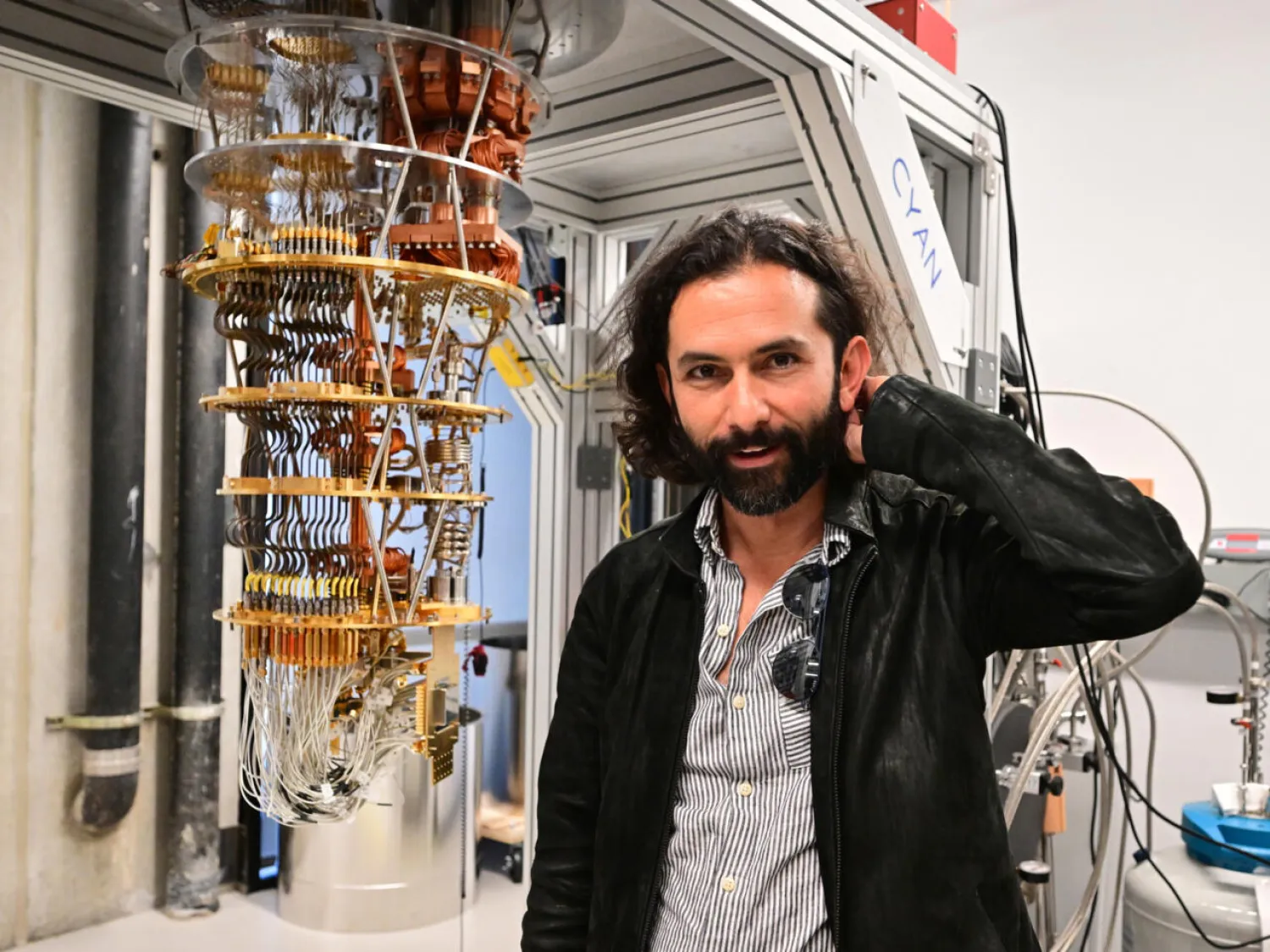
Google has around 20 quantum computers at its lab in Santa Barbara, where Dr Erik Lucero and his team are trying to forge the future of computing Frederic J. BROWN AFP
TT

Tracing Uncertainty: Google Harnesses Quantum Mechanics at California Lab

Google has around 20 quantum computers at its lab in Santa Barbara, where Dr Erik Lucero and his team are trying to forge the future of computing Frederic J. BROWN AFP

Outside, balmy September sunshine warms an idyllic coast, as California basks in yet another perfect day.

Inside, it's minus 460 Fahrenheit (-273 Celsius) in some spots, pockets of cold that bristle with the impossible physics of quantum mechanics -- a science in which things can simultaneously exist, not exist and also be something in between, AFP said.

This is Google's Quantum AI laboratory, where dozens of super-smart people labor in an office kitted out with climbing walls and electric bikes to shape the next generation of computers -- a generation that will be unlike anything users currently have in their pockets or offices.

"It is a new type of computer that uses quantum mechanics to do computations and allows us... to solve problems that would otherwise be impossible," explains Erik Lucero, lead engineer at the campus near Santa Barbara.

"It's not going to replace your mobile phone, your desktop; it's going to be working in parallel with those things."

Quantum mechanics is a field of research that scientists say could be used one day to help limit global warming, design city traffic systems or develop powerful new drugs.

The promises are so great that governments, tech giants and start-ups around the world are investing billions of dollars in it, employing some of the biggest brains around.

- Schrodinger's cat -
Old fashioned computing is built on the idea of binary certainty: tens of thousands of "bits" of data that are each definitely either "on" or "off," represented by either a one or a zero.

Quantum computing uses uncertainty: its "qubits" can exist in a state of both one-ness and zero-ness in what is called a superposition.

The most famous illustration of a quantum superposition is Schrodinger's cat -- a hypothetical animal locked in a box with a flask of poison which may or may not shatter.

While the box is shut, the cat is simultaneously alive and dead. But once you interfere with the quantum state and open the box, the question of the cat's life or death is resolved.

Quantum computers use this uncertainty to perform lots of seemingly contradictory calculations at the same time -- a bit like being able to go down every possible route in a maze all at once, instead of trying each one in series until you find the right path.

The difficulty for quantum computer designers is getting these qubits to maintain their superposition long enough to make a calculation.

As soon as something interferes with them -- noise, muck, the wrong temperature -- the superposition collapses, and you're left with a random and likely nonsensical answer.

The quantum computer Google showed off to journalists resembles a steampunk wedding cake hung upside-down from a support structure.

Each layer of metal and curved wires gets progressively colder, down to the final stage, where the palm-sized processor is cooled to just 10 Millikelvin, or about -460 Fahrenheit (-273 Celsius).

That temperature -- only a shade above absolute zero, the lowest temperature possible in the universe -- is vital for the superconductivity Google's design relies on.

While the layer-cake computer is not huge -- about half a person high -- a decent amount of lab space is taken up with the equipment to cool it -- pipes whoosh overhead with helium dilutions compressing and expanding, using the same process that keeps your refrigerator cold.

- Future -But... what does it all actually do?

Well, says Daniel Lidar, an expert in quantum systems at the University of Southern California, it's a field that promises much when it matures, but which is still a toddler.

"We've learned how to crawl but we've certainly not yet learned how to how to walk or jump or run," he told AFP.

The key to its growth will be solving the problem of the superpositional collapses -- the opening of the cat's box -- to allow for meaningful calculations.

As this process of error correction improves, problems such as city traffic optimization, which is fiendishly hard on a classical computer because of the number of independent variables involved -- the cars themselves -- could come within reach, said Lidar.

"On (an error-corrected) quantum computer, you could solve that problem," he said.

For Lucero and his colleagues, these future possibilities are worth the brain ache.

"Quantum mechanics is one of the best theories that we have today to experience nature. This is a computer that speaks the language of nature.

"And if we want to go out and figure out these really challenging problems, to help save our planet, and things like climate change, than having a computer that can do exactly that, I'd want that."


China Approves First Two Level-3 Autonomous Driving Cars from State-owned Automakers

People pass by the entrance to Volkswagen (China) Technology Company, a 3 billion euros ($3.5 billion) R&D center in Hefei in eastern China's Anhui province, on Feb. 25, 2025. (AP Photo/Ken Moritsugu)
TT

China Approves First Two Level-3 Autonomous Driving Cars from State-owned Automakers

People pass by the entrance to Volkswagen (China) Technology Company, a 3 billion euros ($3.5 billion) R&D center in Hefei in eastern China's Anhui province, on Feb. 25, 2025. (AP Photo/Ken Moritsugu)

China's industry regulator on Monday approved two Chinese cars with level-3 autonomous driving capabilities, marking the first time such vehicles have been cleared by the national regulator as legitimate products ready for mass adoption.

The Ministry of Industry and Information Technology approved the two electric sedans from state-owned automakers Changan Auto and BAIC Motor in its latest automobile product entry category, said Reuters.

The two models are allowed to activate conditional autonomous driving in designated areas of Chongqing and Beijing with speed limits of 50km/h and 80km/h, respectively, the ministry said in a statement. The automakers will conduct trial operation with the cars on the specific roads via their ride-hailing units, it added.

The auto industry has defined five levels of autonomous driving, from cruise control at level one to fully self-driving cars at level five, and level three allows drivers to take their eyes and hands off the road in certain situations.

The move underscored China's ambition to lead the development and adoption of autonomous driving, a technology poised to disrupt the auto industry globally. Last year, China lined up nine automakers for public tests to advance the adoption of self-driving cars.

Chinese regulators earlier this year had sharpened scrutiny of the assisted driving technologies following an accident involving a Xiaomi SU7 sedan in March. That incident killed three occupants when their car crashed seconds after the driver took control from the assisted-driving system.

But government officials are pressing Chinese automakers to rapidly deploy even more advanced systems. In their level-3 push, Chinese regulators also are upping the regulatory ante by holding automakers and parts suppliers liable if their systems fail and cause an accident.

Autonomous driving developers such as Pony AI and WeRide have been testing their level-4 cars with licenses granted by local governments across China.

Tesla's Full Self-Driving, a level-2 driver assistance system, has been partially approved in China since February and falls short of its capabilities in the United States.


Elm Company Named Strategic Partner for International Data and AI Conference

Elm Company Named Strategic Partner for International Data and AI Conference
TT

Elm Company Named Strategic Partner for International Data and AI Conference

Elm Company Named Strategic Partner for International Data and AI Conference

The Saudi Data and Artificial Intelligence Authority (SDAIA) announced a strategic partnership with Elm Company for the International Conference on Data and AI Capacity Building (ICAN 2026), enhancing collaboration to empower the data and artificial intelligence ecosystem and promote innovation in education and human capacity development.

This partnership comes as part of preparations for ICAN 2026, organized by SDAIA from January 28 to 29 at King Saud University in Riyadh, with the participation of a select group of specialists and experts from around the world, SPA reported.

The step represents a qualitative addition that contributes to enriching the conference’s knowledge content and expanding partnerships with leading national entities.

Elm Company brings extensive experience in designing digital solutions and building technical capabilities, reinforcing its role as a strategic partner in supporting the conference. It contributes by developing training tracks and digital empowerment programs, participating in the technology exhibition, and presenting qualitative initiatives that help empower national competencies in the fields of data and artificial intelligence.


Foxconn to Invest $510 Million in Kaohsiung Headquarters in Taiwan

Construction is scheduled to start in 2027, with completion targeted for 2033. Reuters
TT

Foxconn to Invest $510 Million in Kaohsiung Headquarters in Taiwan

Construction is scheduled to start in 2027, with completion targeted for 2033. Reuters

Foxconn, the world’s largest contract electronics maker, said on Friday it will invest T$15.9 billion ($509.94 million) to build its Kaohsiung headquarters in southern Taiwan.

That would include a mixed-use commercial and office building and a residential tower, it said. Construction is scheduled to start in 2027, with completion targeted for 2033.

Foxconn said the headquarters will serve as an important hub linking its operations across southern Taiwan, and once completed will house its smart-city team, software R&D teams, battery-cell R&D teams, EV technology development center and AI application software teams.

The Kaohsiung city government said Foxconn’s investments in the city have totaled T$25 billion ($801.8 million) over the past three years.