

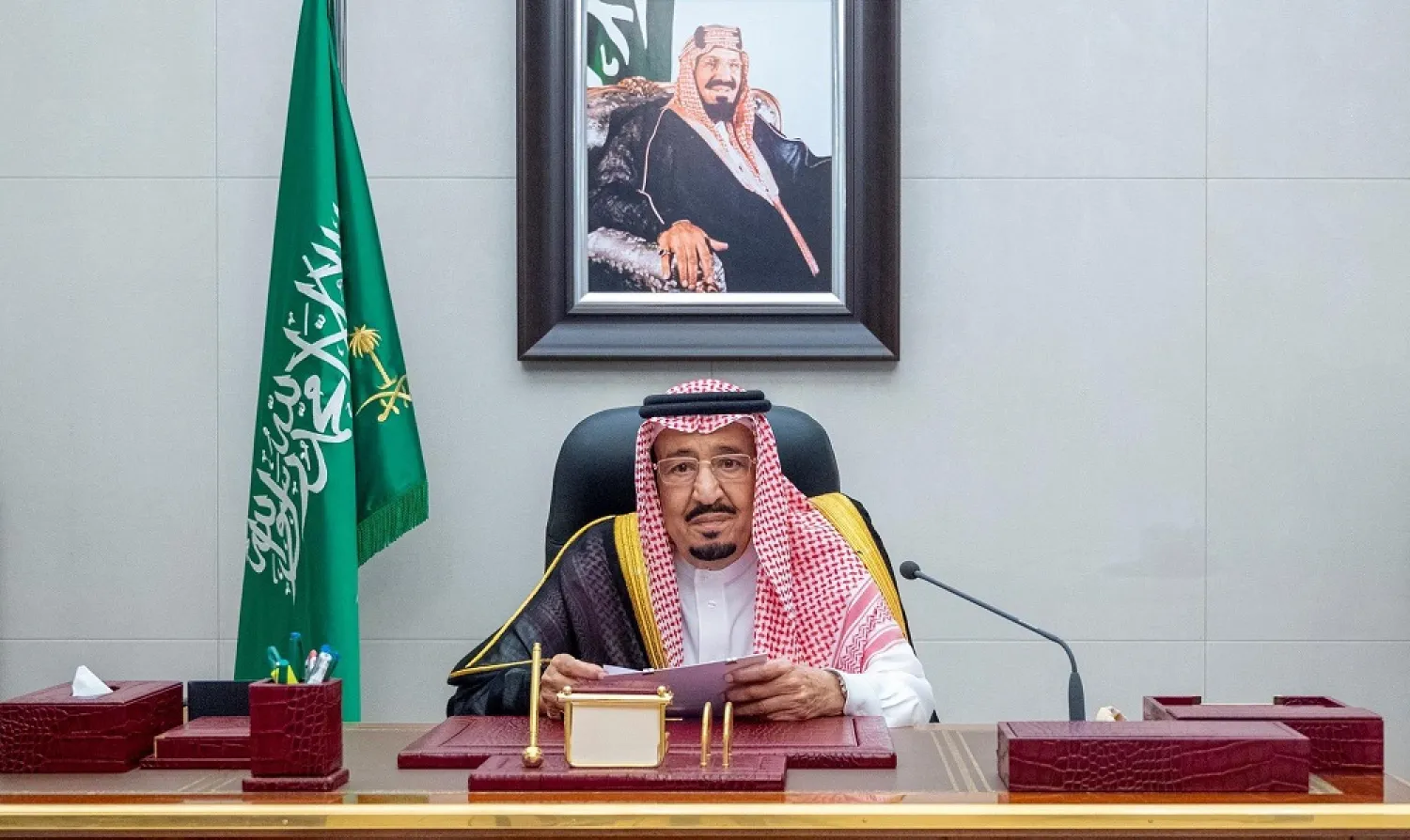

King Salman Urges Peaceful Solutions, Backs Int’l Efforts to Resolve Russia-Ukraine Crisis

Custodian of the Two Holy Mosques King Salman bin Abdulaziz delivers his speech before the Shura Council. (SPA)
TT

King Salman Urges Peaceful Solutions, Backs Int’l Efforts to Resolve Russia-Ukraine Crisis

Custodian of the Two Holy Mosques King Salman bin Abdulaziz delivers his speech before the Shura Council. (SPA)

Custodian of the Two Holy Mosques King Salman bin Abdulaziz stressed on Sunday the importance of dialogue, negotiations and peaceful solutions in ending fighting, protecting civilians and establishing peace, security and development for all.

He underlined the Kingdom’s support to international efforts aimed at reaching a political solution to the Russia-Ukraine crisis and ending the fighting.

King Salman inaugurated on Sunday the proceedings of the third year of the eighth session of the Shura Council. Prince Mohammed bin Salman, Crown Prince and Prime Minister, was also at the inauguration.

King Salman added that the Kingdom “was and still is a mediator of peace and beacon of humanity given its high standing among nations and pivotal role in international politics.”

He also cited its pioneering role in supporting all that is good for mankind, highlighting Crown Prince Mohammed’s humanitarian initiatives towards resolving the crisis in Ukraine.

He underlined the success of his recent mediation to release prisoners from several countries, their transfer to Russia to the Kingdom and eventual return to their homes.

“The Kingdom is committed to helping countries most in need and affected from natural disasters and man-made crises,” he added, stressing that it is the greatest humanitarian donor in the Arab and Islamic world and among the top three on the international level.

Moreover, King Salman said Saudi Arabia was working with international partners to ease the impact of armed conflicts on food security. He said Riyadh stresses the importance of easing the export of grain and food goods because the continuous rise in food prices will push several communities on the verge of famine.

He noted that the Kingdom has contributed around 2.8 billion dollars towards improving food security.

Int'l contributions

On the economic level, King Salman stated that the Kingdom continues to achieve high levels of growth in spite of the rise in global inflation. He credited this success to its monetary, financial and economic policies.

He remarked that unemployment was also dropping in the Kingdom. As of the second quarter of 2022, unemployment stood at 9.7 percent. The Kingdom is aiming to reach 7 percent in line with its Vision 2030.

King Salman highlighted the Jeddah Security and Development Summit that was held with the participation of the United States and leaders of nine Arab countries in July. The gatherers stressed the importance of collective work in building a better future for the region and its people.

King Salman underlined Saudi Arabia’s standing and central role on the political and economic levels. “This standing constantly places it at the center of the world as it remains abreast of its developments, helps in confronting its challenges and invests in its opportunities to achieve its interests and that of its brothers and friends in service of humanity,” he declared.

In line with the Kingdom’s efforts to bolster relations with countries around the world, Crown Prince Mohammed bin Salman carried out several visits to a number of friendly and fraternal countries. The Kingdom has also hosted a number of world leaders and senior officials.

These visits have led to the signing of significant agreements that aim to achieve joint interests.

King Salman said the Kingdom is looking forward to elevating joint Gulf work to boost the Gulf Cooperation Council on all levels. He stressed the importance of continuing efforts towards achieving a prosperous economic bloc and joint defense and security system.

Stances and crises

King Salman remarked that the security of the Middle East demands swift efforts to reach a just and comprehensive solution to the Palestinian-Israeli conflict in line with international resolutions and the 2002 Arab peace initiative. The solution must lead to the establishment of an independent Palestinian state according to the 1967 borders with East Jerusalem as its capital.

He added that Riyadh condemns all unilateral measures that undermine the two-state solution, demanding their immediate halt.

On Yemen, King Salman hoped that the United Nations-sponsored truce would lead to a settlement to the conflict and a comprehensive political solution that would establish sustainable peace among the Yemeni people.

He underscored Saudi Arabia’s support to the Presidential Leadership Council and its efforts to restore security and stability in Yemen.

On Iraq, King Salman said its security is integral to that of the region. “Saudi Arabia support its security, stability, territorial integrity, Arab identity and social fabric,” he added. He stated that the Kingdom backs Iraq in its fight against terrorist groups and armed militias.

On Sudan, he declared that the Kingdom supports and encourages dialogue between political forces. It supports efforts aimed at maintaining the unity of the state and its institutions and backs Sudan as it confronts economic challenges.

Turning to Syria, King Salman urged respect to UN Security Council resolutions that preserve its sovereignty, stability and Arab identity. He stressed the need to prevent a renewal of fighting, maintain ceasefire agreements and ensure the delivery of humanitarian aid to those in need.

On Lebanon, he emphasized the need for political and economic reforms to be carried out that will help it overcome its crisis. Moreover, he stressed the need for its government to impose its authority throughout Lebanese territories.

Authorities must maintain security and confront attempts to smuggle drugs abroad and crack down on terrorist activities that are a threat to the security and stability of the region.

On Libya, King Salman said the Kingdom supports the comprehensive ceasefire and Libyan calls for the withdrawal of all foreign forces, fighters and mercenaries from its territories in line with Security Council resolution 2570.

King Salman also stressed the need to maintain humanitarian support to Afghanistan and continue efforts to prevent it from turning into a launchpad for terrorist attacks or haven for terrorists.

On global security and peace, the monarch said they cannot be achieved through an arms race or the possession of weapons of mass destruction. Rather, they are achieved through cooperation between countries to achieve development and progress.

“We urge the international community to intensify efforts to prevent the proliferation of weapons of mass destruction and ensure that the Middle East is devoid of them,” he demanded.

He called on Iran to “immediately respect its nuclear commitments and cooperate fully with the International Atomic Energy Agency and take serious steps to build trust between it and its neighbors and international community.”



Saudi Arabia Condemns RSF Attacks on Civilians and Aid Convoys in Sudan

 An elderly man picks up his food aid ration at the Umdulu Camp, in Engpung County, Sudan, January 30, 2026. (Karl Schembri/Norweigan Refugee Council/Handout via Reuters)
An elderly man picks up his food aid ration at the Umdulu Camp, in Engpung County, Sudan, January 30, 2026. (Karl Schembri/Norweigan Refugee Council/Handout via Reuters)
TT

Saudi Arabia Condemns RSF Attacks on Civilians and Aid Convoys in Sudan

 An elderly man picks up his food aid ration at the Umdulu Camp, in Engpung County, Sudan, January 30, 2026. (Karl Schembri/Norweigan Refugee Council/Handout via Reuters)
An elderly man picks up his food aid ration at the Umdulu Camp, in Engpung County, Sudan, January 30, 2026. (Karl Schembri/Norweigan Refugee Council/Handout via Reuters)

Saudi Arabia strongly condemned on Saturday the Rapid Support Forces’ attack against a humanitarian aid convoy in Sudan’s Kordofan.

A Foreign Ministry statement said the Kingdom expressed its strong condemnation of the attack against Al-Kuweik Military Hospital, a humanitarian aid convoy affiliated with the World Food Program, and a vehicle transporting displaced civilians.

“These acts are unjustifiable under any circumstances and are flagrant violations of all humanitarian norms and relevant international agreements,” it stressed.

“The Kingdom called on the RSF to immediately cease these violations and to fulfill their moral and humanitarian obligations by ensuring the safe and unhindered delivery of humanitarian assistance to those in need, in accordance with international humanitarian law and the Jeddah Declaration signed on May 11, 2023,” it added.

The Kingdom reiterated its firm position in support of Sudan’s unity, security, and stability, the need to preserve its legitimate institutions.

It voiced its rejection of “foreign interference and the continued actions of certain parties in supplying illicit weapons, mercenaries, and foreign fighters, despite their stated support for a political solution,” saying such “conduct is a primary factor in prolonging the conflict and exacerbating the suffering of the Sudanese people.”

A drone attack by the RSF hit a vehicle carrying displaced families in central Sudan Saturday, killing at least 24 people, including eight children, a doctors’ group said, a day after a World Food Program aid convoy was targeted.

The attack occurred close to the city of Rahad in North Kordofan province, said the Sudan Doctors Network, which tracks the country’s ongoing war. The vehicle was transporting displaced people who fled fighting in the Dubeiker area, the group said in a statement. Among the dead children were two infants.


OIC Condemns Terrorist Bombing of Mosque in Islamabad

A Pakistani man reacts as people attend a protest against the suicide bomb blast that killed dozens of people, in Peshawar, Pakistan, 07 February 2026. (EPA)
TT

OIC Condemns Terrorist Bombing of Mosque in Islamabad

A Pakistani man reacts as people attend a protest against the suicide bomb blast that killed dozens of people, in Peshawar, Pakistan, 07 February 2026. (EPA)

The Organization of Islamic Cooperation (OIC) General Secretariat strongly condemned on Saturday the terrorist bombing that targeted a mosque in Islamabad.

The secretariat stressed its categorical rejection of terrorism in all its forms, especially those targeting places of worship.

It underlined its firm stance in condemning these criminal acts, which are contrary to human values and religious principles.

The OIC offered its sincere condolences to the government and people of Pakistan and to the families of the victims.

It also reiterated its full solidarity with Pakistan in its efforts to combat terrorism and boost its security and stability.

At least 30 people killed in a suicide bombing at a Muslim mosque during Friday prayers.


Bahrain, France Sign Defense Cooperation Agreement

Sheikh Nasser bin Hamad Isa Al Khalifa, Bahrain's King Hamad bin Isa Al Khalifa, France's President Emmanuel Macron and Junior Minister at the Ministry of Defense, Alice Rufo, pose after signing a bilateral agreement at the Elysee Palace in Paris, France, February 6, 2026. (Thibault Camus/Pool via Reuter)
TT

Bahrain, France Sign Defense Cooperation Agreement

Sheikh Nasser bin Hamad Isa Al Khalifa, Bahrain's King Hamad bin Isa Al Khalifa, France's President Emmanuel Macron and Junior Minister at the Ministry of Defense, Alice Rufo, pose after signing a bilateral agreement at the Elysee Palace in Paris, France, February 6, 2026. (Thibault Camus/Pool via Reuter)

Bahrain and France signed on Friday a joint defense cooperation agreement during talks between King Hamad bin Isa Al Khalifa met with President Emmanuel Macron in Paris.

The French presidency said the agreement consolidates cooperation in the field of defense, training and exchange of strategic information.

“This agreement will ⁠also open ‌up ‍new ‍opportunities for industrial ‍cooperation in defense, and strengthen solidarity between our two countries in a ⁠global and regional geopolitical context marked by increasing tensions,” it added.

The agreement was signed by Bahrain’s National Security Adviser and Secretary General of the Supreme Defense Council Sheikh Nasser bin Hamad Al Khalifa and France’s Minister Delegate to the Minister of the Armed Forces and Veterans Alice Rufo.

Macron highlighted the depth of the historical relations between Bahrain and France, as well as the progress achieved across various domains in support of common interests, reported Bahrain’s state news agency (BNA).

For his part, King Hamad commended the French president’s keenness to strengthen relations between the two countries.

The talks also addressed means to bolster bilateral relations across all sectors to achieve shared interests.

Both sides commended the efforts of the Joint Bahraini-French High Committee. They highlighted the positive outcomes achieved in advancing cooperation and underlined the importance of continuing the committee’s work to expand cooperation across various domains.

The talks addressed regional and international developments, and efforts aimed at resolving conflicts through dialogue and diplomatic solutions and reducing tensions.