

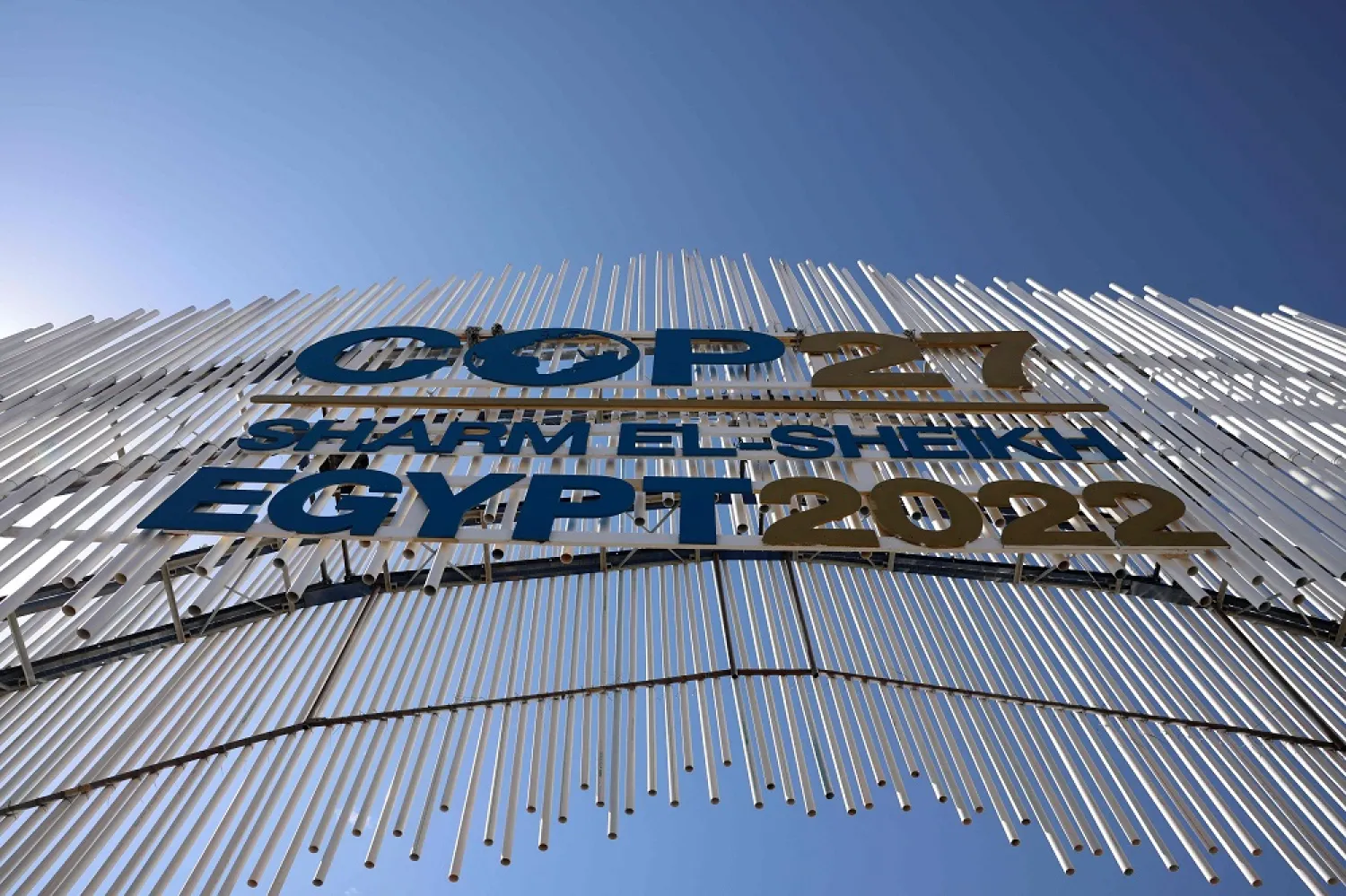

COP27 Summit to Kick off in Egypt

his picture shows the main entrance of the Sharm el-Sheikh International Convention Center where the COP27 climate summit will take place, in Egypt's Red Sea resort city of Sharm el-Sheikh, on November 5, 2022 (AFP)
TT

COP27 Summit to Kick off in Egypt

his picture shows the main entrance of the Sharm el-Sheikh International Convention Center where the COP27 climate summit will take place, in Egypt's Red Sea resort city of Sharm el-Sheikh, on November 5, 2022 (AFP)

The COP27 summit kicks off Sunday in Egypt with nearly 200 countries struggling to outpace increasingly dire climate impacts in a world upended by war and economic turmoil.

Just in the last few months, a cascade of climate-addled weather disasters has killed thousands, displaced millions and caused billions in damages: massive flooding in Pakistan and Nigeria, deepening droughts in Africa and the western US, cyclones in the Caribbean, and unprecedented heat waves across three continents.

"Report after report has painted a clear and bleak picture," said UN chief Antonio Guterres in the run-up to the 13-day conference in the Red Sea resort of Sharm el-Sheik.

"COP27 must lay the foundations for much faster, bolder climate action now and in this crucial decade, when the global climate fight will be won or lost."

Concretely, that means slashing greenhouse emissions 45 percent by 2030 to cap global warming at 1.5 degrees Celsius above late-19th-century levels.

Warming beyond that threshold, scientists warn, could push Earth toward an unlivable hothouse state.

But current trends would see carbon pollution increase 10 percent by the end of the decade and Earth's surface heat up 2.8C, according to findings unveiled last week.

Promises made under the Paris Agreement would, if kept, only shave off a few tenths of a degree.

"Our planet is on course for reaching tipping points that will make climate chaos irreversible and forever bake in catastrophic temperature rise," Guterres said recently.

"We need to move from tipping points to turning points for hope."

Heads of state and government will attend the Sharm el-Sheikh Climate Implementation Summit on November 7 and 8. The high-level segment primarily attended by ministers will take place from November 15 to 18.

Negotiations to implementation

For the UN climate forum, that means transitioning from negotiations to implementation.

It also means a shift from politics to the economy, with government investments in China, the US and the European Union leveraging hundreds of billions of yuan, dollars and euros into trillions.

The already daunting task of decarbonizing the global economy in a few years has been made even harder by a global energy crunch and rapid inflation, along with debt and food crises across much of the developing world.

"There have been fraught moments before," said E3G think tank senior analyst Alden Meyer, recalling other wars, the near collapse of the UN-led process in 2009, and Donald Trump yanking the United States out of the Paris Agreement in 2016.

"But this is a perfect storm," dubbed by some a "polycrisis", said the 30-year veteran of the climate arena.

After front-line negotiators set COP27 in motion on Sunday, more than 120 world leaders will put in appearances on Monday and Tuesday.

Saudi Arabia will dispatch six ministers to the summit, including Energy Minister Prince Abdulaziz bin Salman and Envoy for Climate Affairs Adel Al Jubeir.

The most conspicuous no-show will be China's Xi Jinping, whose leadership was renewed last month at a Communist Party Congress.

US President Joe Biden has said he will come, but only after legislative elections on Tuesday that could see either or both houses of Congress fall into the hands of Republicans hostile to international action on climate change. He will visit Sharm el-Sheikh on November 11.

Cooperation between the United States and China -- the world's two largest economies and carbon polluters -- has been crucial to rare breakthroughs in the nearly 30-year saga of UN climate talks, including the 2015 Paris Agreement.

‘Genuine commitment’

In a welcome message ahead of the summit, COP27 President and Foreign Minister Sameh Shoukri said: "Climate change is no doubt the challenge of our times, and the international community is hence called upon to deal with this challenge collectively, effectively and rapidly."

"In Glasgow we succeeded in concluding for the most part the extensive negotiations to operationalize the Paris Agreement, we must now set our attentions on the full implementation of the Agreement and on the delivery of the various commitments and pledges made," he added.

"The most reliable science available in the form of the recently published IPCC reports paints a sobering picture, and highlights the urgent need to significantly raise our ambition with regard to emissions reduction, in tandem with the need to effectively adapt to the negative impacts of Climate change," he continued.

"The reports also reminded us of the need to provide and mobilize necessary financial support from public and private sources, along with other means of implementation in the form of technology and capacity building if we are to ensure that developing countries are in a position to make the necessary contribution to this global effort."

"We in Egypt truly believe that the political will demonstrated in Glasgow allowed us to successfully complete our work on the Paris Agreement Work Program, and to announce a broad range of commitments and pledges," he stressed.

"We trust that this political will and genuine commitment will once again be on display in Sharm el-Sheikh and will facilitate making the progress we all aspire to."

"And while many governments have stepped up their action and others will hopefully follow suit in the near future, the fact remains that this global effort requires contributions from and collaboration with all non-party stakeholders across the board," said Shoukri.

"We commit to all parties to exert all efforts to create an environment conducive to reaching consensus on negotiating texts," he added.

"This in our view requires a less adversarial and more empathetic approach in dealing with issues at hand, and we trust that all parties will appreciate that our chances of success, collectively, are greatly enhanced when every country, group and community feels that their interests and concerns are taken on board."



Israeli Leaks Test Prospects for Gaza Deal’s Second Phase

A young girl stands in front of tents that burned after candles were lit for lighting at a displacement camp in Gaza City on Friday (AFP)
TT

Israeli Leaks Test Prospects for Gaza Deal’s Second Phase

A young girl stands in front of tents that burned after candles were lit for lighting at a displacement camp in Gaza City on Friday (AFP)

A stream of Israeli leaks has highlighted moves toward alternative scenarios in Gaza if the disarmament of Hamas is not carried out soon.

The options being floated range from freezing reconstruction across the enclave and limiting rebuilding to areas under Israeli control to the prospect of renewed military operations.

Experts who spoke to Asharq Al-Awsat described the leaks about alternative plans to confront Hamas as pressure tactics and contingency plans, saying they reflect expectations that the main plan to disarm the resistance will not be implemented immediately.

They said such measures further complicate the path of the second phase, making it, even if launched, a lengthy process due to Israeli obstacles.

Israel’s Yedioth Ahronoth newspaper reported on Friday, citing sources, that the army is preparing alternative plans to carry out a new military operation in Gaza to dismantle Hamas infrastructure if an international force fails in its mission.

This followed earlier Israeli talk of starting partial reconstruction in the southern city of Rafah before Hamas is disarmed, according to Israel’s Channel 12. That proposal contradicts efforts by Arab states to pursue a comprehensive reconstruction of Gaza.

The leaks came after a meeting last week between US President Donald Trump and Israeli Prime Minister Benjamin Netanyahu.

Israel Hayom reported at the time that the two had agreed on Jan. 15 as the date to begin the second phase of Trump’s Gaza plan, with a two-month deadline to dismantle Hamas’ weapons, amid presidential threats against the Palestinian movement if it fails to comply.

Mokhtar Ghobashy, Secretary General of the Al-Farabi Center for Strategic Studies, stated that the second phase of the Gaza agreement is inherently complex and that Israel does not want to enter it except on terms that serve its interests.

He said this became clear after the Trump-Netanyahu meeting, noting that there appears to be an agreed path allowing the launch of the second phase, but at a slow pace. Any acceleration, he said, would depend on the interests achieved by both sides, not just the Palestinians.

Barakat Al-Farra, a former Palestinian ambassador to Egypt, said that the repeated Israeli leaks since last week’s Trump-Netanyahu meeting indicate attempts and contingency plans aimed at complicating the second phase, even if it begins, and that its implementation would be delayed due to Israeli obstacles.

Amid the Israeli leaks, the foreign ministers of Saudi Arabia, Egypt, Jordan, the United Arab Emirates, Indonesia, Pakistan, Türkiye and Qatar issued a joint statement on Friday calling for the implementation of Trump’s Gaza agreement.

They stressed the need for the immediate, full and unhindered entry of humanitarian aid into Gaza through the United Nations and its agencies, as well as the rehabilitation of infrastructure and hospitals and the opening of the Rafah crossing in both directions.

The eight ministers emphasized the urgent need to immediately launch and expand early recovery efforts, including providing permanent and dignified shelter to protect residents from harsh winter conditions.

The statement also renewed the eight countries’ full support for UN Security Council Resolution 2803 and for the comprehensive plan presented by Trump.

The ministers said they are committed to contributing to its successful implementation in a way that ensures the sustainability of the ceasefire, ends the war in Gaza, secures a dignified life for Palestinians, and leads to a credible path toward Palestinian self-determination and statehood.

Resolution 2803 was adopted by the Security Council in November and welcomed Trump’s 20-point plan to end the Gaza conflict, which was issued on September 29, 2025.

Despite the end of the war after the ceasefire agreement entered into force on Oct. 10, 2025, living conditions have not improved significantly due to Israel’s failure to meet its commitments under the deal.

These include allowing the agreed-upon quantities of food, relief, and medical supplies, as well as mobile homes, and opening border crossings.

Ghobashy said the joint statement by the eight Arab and Islamic countries extends pressure efforts to accelerate the move toward the second phase and to enforce Israel’s delayed commitments from the first phase, particularly those related to opening the Rafah crossing in both directions and increasing the flow of aid.

Al-Farra, meanwhile, said mediators have no option but to continue applying pressure to prevent any further complications for the second phase, predicting that 2026 will not differ from previous periods since the Gaza agreement began in October.


Hadhramaut Official Says National Shield Advances, STC Withdrawal Leaves Security Gap

Residents of Al Mahrah governorate voiced support for Yemen’s presidential decisions (Saba News Agency)
TT

Hadhramaut Official Says National Shield Advances, STC Withdrawal Leaves Security Gap

Residents of Al Mahrah governorate voiced support for Yemen’s presidential decisions (Saba News Agency)

A Yemeni local authority official confirmed that the National Shield forces had taken full control of the 37th Brigade camp in al-Khasha and pushed on to the city of al-Qatn, moving toward the strategic city of Seiyun in Hadhramaut.

Abdulhadi al-Tamimi, assistant undersecretary of Hadhramaut governorate for valley and desert affairs, told Asharq Al-Awsat that withdrawing forces loyal to the Southern Transitional Council had left a security vacuum at several military sites, saying local authorities, in coordination with residents, were working to address and fill the gap.

Al-Tamimi, who is in Hadhramaut, stated that forces from the Hadhramaut Tribes Alliance and the Hadhramaut Protection Forces are preparing to move toward the coastal area, specifically Mukalla, to support the Hadhrami Elite Forces in maintaining security and preventing clashes with withdrawing STC forces.

The Hadhramaut official thanked Saudi Arabia for its support of Yemen, and Hadhramaut in particular, which he said had endured difficult times.

“We welcome our brothers in the National Shield forces and salute the support of our elder sister, the Kingdom of Saudi Arabia, under the leadership of the Custodian of the Two Holy Mosques and the Crown Prince and Minister of Defense, for supporting Yemen and backing Hadhramaut, which lived through difficult days due to the invasion of hordes of STC militias into the Hadhramaut Valley and Desert,” he said.

“Those areas had been far from the conflicts Yemen went through and were spared thanks to the wisdom of their people, but this time they came treacherously, seized control of the First Military Region and wreaked havoc there.”

Al-Tamimi stated that the National Shield forces moved at dawn on Friday, following the failure of all de-escalation efforts and attempts to persuade STC leaders to withdraw.

“Unfortunately, many of the STC forces present did not comply with the request to withdraw, leave their weapons and return from where they came, so clashes occurred with support from Saudi air power, and control was taken of the major base, the 37th Armored Brigade camp,” he said.

He added that the forces then advanced to al-Qatn and were heading toward Seiyun, noting that several areas where STC forces had been present were hit by airstrikes, forcing them to flee, most notably the First Military Region.

Al-Tamimi said the rapid withdrawal of STC forces left a security vacuum at camps such as al-Suwayri.

He added that there was also a separate movement on the Hadhramaut, Plateau by the Hadhramaut, Tribes Alliance, led by Sheikh Amr bin Habrish, and the Hadhramaut, Protection Forces, which were joined by many Hadhrami officers and commanders after they took control of the Ghayl bin Yamin camp.

“We are preparing to head to the Hadhramaut, coast to reinforce the Hadhrami Elite Forces there so they are not attacked by the withdrawing force,” he said.

Al-Tamimi stated that the local authority had instructed all districts to form emergency committees to address the situation and secure vital areas until the National Shield forces arrive.

Meanwhile, hospitals in Seiyun received eight wounded people and one fatality as a result of the military developments in Hadhramaut, on Friday, according to local sources.

The Second Military Region issued a statement saying that camps and military sites under its command would remain fully under its responsibility, describing itself as part of the military institution.

The commander of the Second Military Region had previously declared loyalty to the STC, while the statement suggested a shift in position.

The Second Military Region said the Hadhrami Elite Forces “have carried out their national and security duties since their establishment, pledging full commitment to protecting the Hadhramaut coast and its people, maintaining security and social peace, and safeguarding public and private property.


Sudan: How One Hospital Saved Thousands of Lives Amid War

Al Nao Hospital Director Dr. Jamal Eltaeb (Asharq Al-Awsat)
TT

Sudan: How One Hospital Saved Thousands of Lives Amid War

Al Nao Hospital Director Dr. Jamal Eltaeb (Asharq Al-Awsat)

As Sudan’s war dragged on and fighting engulfed the capital Khartoum, the health system collapsed almost entirely. Hospitals shut their doors one after another, until only a single facility remained in operation in the city of Omdurman.

Al Nao Hospital, perched west of the city on the front line of fierce military confrontations, became the capital’s last functioning emergency hospital, receiving the wounded, responding to urgent cases, and saving thousands of lives under relentless fire.

Despite severe security and psychological pressure, a small group of doctors, health workers, volunteers, and technicians held out to keep the hospital running amid indiscriminate shelling, falling rockets and artillery rounds, severe shortages of supplies, power and water outages, the collapse of communications, and an ever-increasing flow of emergency cases.

Throughout the siege and restrictions imposed on the hospital, doctors, medical staff, and volunteers treated the wounded using just three worn-out ambulances.

Their meals were limited to beans and lentils for breakfast and dinner, as no restaurants were operating in the surrounding area, which was saturated with the smell of blood and gunpowder.

Their efforts earned them the Aurora Prize for Awakening Humanity, which is awarded to individuals who risk their lives, freedom, or health to save others.

Harsh days

The field hospital demonstrated its ability to function in the darkest of times.

“I was deeply affected by the deaths of children, and they were in large numbers,” hospital director Dr. Jamal Eltaeb told Asharq Al-Awsat.

“We were receiving more than 100 cases a day, sometimes within a single hour, around 4,000 a month, with injuries ranging from severe to minor, and we treated large numbers of wounded.”

Eltaeb said the hospital began operating on April 17, 2023, just days after the outbreak of the war, through an initiative launched by young volunteers and with extremely limited capabilities to treat the wounded.

“The injuries caused by indiscriminate shelling shook me deeply, especially among children and women,” he said.

“The deaths of young children were the most painful. Even if you are a doctor, you never get used to seeing children with amputated limbs or their abdomens torn open.”

Drowning in chaos

While the streets of Omdurman sank into chaos, the hospital remained alive with activity.

“We worked with the medical staff available and the limited medicines we had,” Eltaeb said. “The Dutch organization Doctors Without Borders provided us with major support.”

He added that after the war began, he moved from Khartoum to Omdurman as a volunteer, before Khartoum State’s health ministry personally asked him to formally manage the hospital in July 2023.

Alongside colleagues Dr. Amir Mohammed Al-Hassan, a specialist in internal medicine and cardiology, and Dr. Yasser Shamboul, a specialist in internal medicine, he began work with limited resources.

“Ministries and institutions were absent,” Eltaeb said.

“The wounded, the sick, the elderly, and children accept no excuses. They just want someone to treat them.”

Painful scenes

In February 2025, a powerful explosion rocked a popular market in Omdurman, quickly flooding the hospital’s emergency room with bodies and injured victims. “That was one of the most difficult days,” Eltaeb said.

“Sabreen Market was crowded with shoppers. We received around 170 injured people in less than two hours, transported by trucks because there was no ambulance service.”

Those who attempted to help were not doctors or health workers, he said, leading to chaotic transport that mixed the dead with the wounded.

Hospital staff sorted the bodies from the living inside the trucks and confirmed 48 deaths, alongside patients with varying injuries, some of whom lost limbs or were left with permanent disabilities.

“But thank God, we saved the lives of the rest,” he said.

The hospital itself came under indiscriminate shelling, yet doctors and medical staff insisted on continuing their work.

Eltaeb said several hospital workers were killed by shelling and rockets, one volunteer died inside the adjacent mosque, two security guards were killed, and a soldier was wounded by a sniper’s bullet inside the hospital.

Aurora humanitarian prize

The Aurora Foundation for Awakening Humanity awarded its 2025 prize, worth $1 million, to Dr. Jamal Eltaeb in recognition of his efforts managing a hospital that served as a final medical line of defense in Khartoum during the armed conflict.

The prize is one of the world’s leading humanitarian awards, honoring those who risk their lives, freedom, or health to save others and alleviate suffering in situations of conflict, crimes against humanity, or human rights violations.

“I do not know who nominated me for this prize,” Eltaeb said. “I was selected from among 880 nominees without my knowledge. When the shortlist was reduced to 25 people, I learned that I had been nominated.”

He said the prize committee searched for him by sending inquiries to hospitals across Europe, looking for a doctor named Jamal Eltaeb. A colleague in anesthesia in London emailed a message to a fellow doctor at Al Nao Hospital, who forwarded it to him.

“When I read the message, I thought it was some kind of joke and did not reply,” he said. After being encouraged to respond, he shared his contact details and received a call the following day, as the shortlist narrowed to 15, then four, before he was named the final winner.

“The prize does not represent me personally,” Eltaeb said. “It represents the hospital family, the doctors, administrators, and workers. I was only leading them. I am no more deserving of this prize than they are.”