

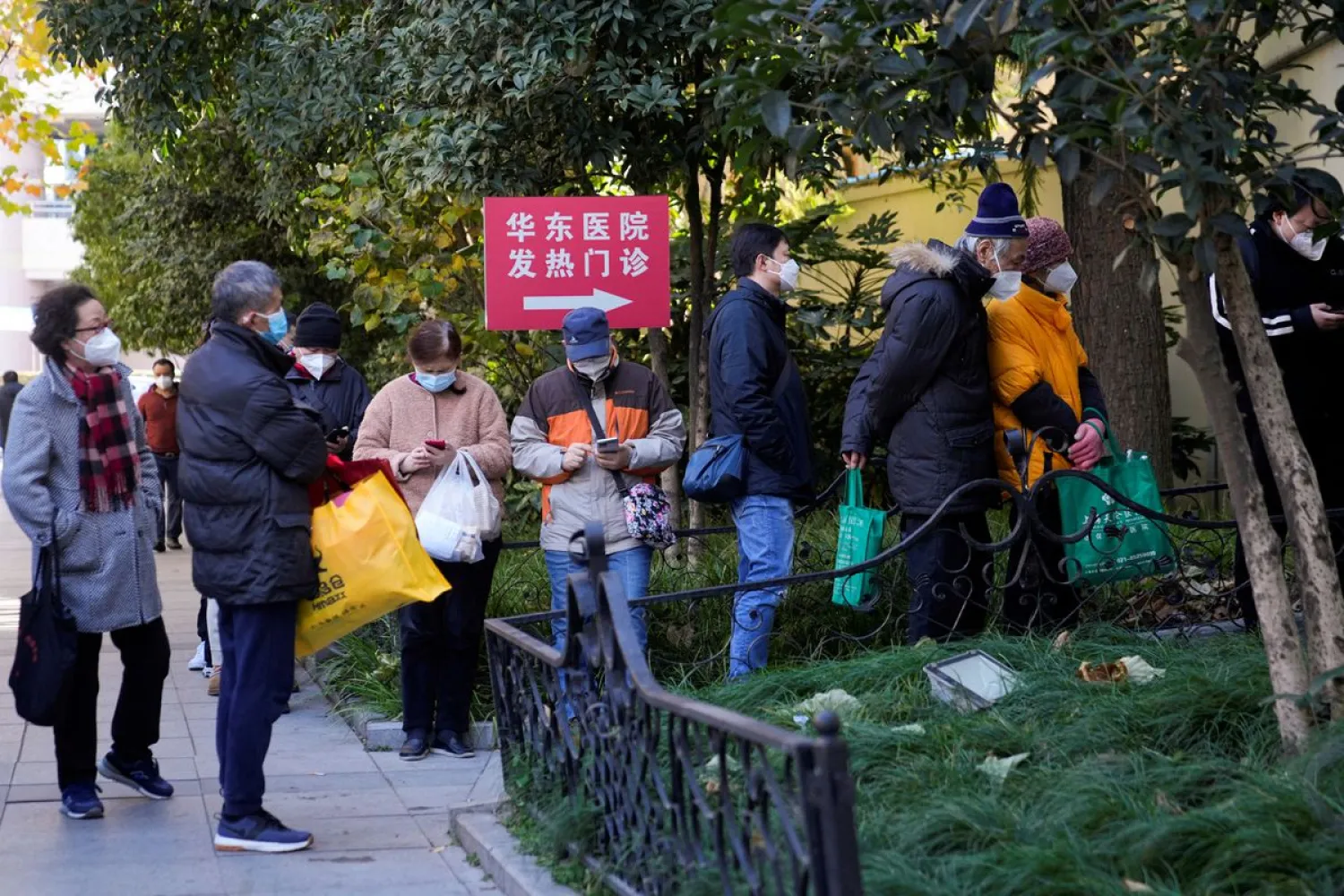

China to Scrap COVID Quarantine Rule for Inbound Travelers

People wearing protective masks line up outside a fever clinic of a hospital, as coronavirus disease (COVID-19) outbreaks continue in Shanghai, China, December 20, 2022. REUTERS/Aly Song
TT

China to Scrap COVID Quarantine Rule for Inbound Travelers

People wearing protective masks line up outside a fever clinic of a hospital, as coronavirus disease (COVID-19) outbreaks continue in Shanghai, China, December 20, 2022. REUTERS/Aly Song

China will stop requiring inbound travelers to go into quarantine starting from Jan. 8, the National Health Commission said on Monday in a major step towards easing curbs on its borders, which have been largely shut since 2020.

China's management of COVID-19 will also be downgraded to the less strict Category B from the current top-level Category A, the health authority said in a statement, as the disease has become less virulent and will gradually evolve into a common respiratory infection.

Three years of zero-tolerance measures, from shuttered borders to frequent lockdowns, have battered China's economy, fueling last month the mainland's biggest show of public discontent since President Xi Jinping took power in 2012.

But China made an abrupt policy U-turn this month, dropping nearly all of its domestic COVID curbs in a move that has left hospitals across the country scrambling to cope with a nationwide wave of infections.

Strict requirements on inbound travelers had remained in place, including five days of mandatory quarantine at a government-supervised facility and three more of isolation at home.

That restriction and one on the number of passengers on international flights will be removed from Jan. 8, Reuters reported. Travelers entering China will still have to undergo PCR testing 48 hours before departure, however, the health authority said.

Arrangements for foreigners to come to China, such as for work and business will be improved and the necessary visas will also be facilitated, the authority said.

But passenger entry and exit at sea and land ports will gradually resume, while the outbound travel of Chinese nationals will be restored "in an orderly manner", it added.

Since January 2020, China had classified COVID-19 as a Category B infectious disease but managed it under Category A protocols that cover diseases such as bubonic plague and cholera, giving local authorities the power to quarantine patients and their close contacts and lock down regions.

While China downgrades its management of the new coronavirus, the National Health Commission said epidemic prevention and control protocols at key institutions such as elderly care institutions will be strengthened.



Greek PM Announces New Mideast War Fallout Relief Measures

Greek Prime Minister Kyriakos Mitsotakis speaks during a joint press conference with Cyprus' and France's presidents at Paphos military airport, in Paphos, Cyprus, 09 March 2026, (EPA)
TT

Greek PM Announces New Mideast War Fallout Relief Measures

Greek Prime Minister Kyriakos Mitsotakis speaks during a joint press conference with Cyprus' and France's presidents at Paphos military airport, in Paphos, Cyprus, 09 March 2026, (EPA)

Greek Prime Minister Kyriakos Mitsotakis on Monday announced a raft of additional measures to mitigate the energy cost of the Middle East war.

In a televised address, Mitsotakis said the government had earmarked 300 million euros ($346 million) in relief for households and farmers in April and May, said AFP.

The subsidies are targeted at reducing the cost of diesel fuel, petrol and fertilizer. Part of the initiative is aimed at holding back price hikes in ferry fares to the islands, Mitsotakis said.

Oil prices rose on Monday after the United States and Israel warned at the weekend that the war against Iran -- which has disrupted oil deliveries through the Strait of Hormuz -- would continue for several more weeks.

Greece had already announced a first batch of measures on March 11, capping profit margins on gasoline and foodstuffs for three months.

Mitsotakis on Monday said the government was keeping additional funds on tap.

"Since no one knows how long this war will last, we are obviously keeping reserves in case the global economic situation deteriorates significantly," the conservative leader said.


Russia Opposes Hormuz Blockade, Interfax Reports

The reactor building of Iran's nuclear power plant and electricity poles are seen, at Bushehr, Iran, 750 miles (1,245 kilometers) south of the capital Tehran, Iran, Feb. 27, 2005. (AP Photo/Vahid Salemi, File)
TT

Russia Opposes Hormuz Blockade, Interfax Reports

The reactor building of Iran's nuclear power plant and electricity poles are seen, at Bushehr, Iran, 750 miles (1,245 kilometers) south of the capital Tehran, Iran, Feb. 27, 2005. (AP Photo/Vahid Salemi, File)

Russia opposes any blockade of the Strait ‌of ‌Hormuz but ‌says ⁠such issues must ⁠be viewed in ⁠the context ‌of ‌the broader ‌global ‌situation, Interfax reported ‌on Monday, citing the ⁠Russian Foreign ⁠Ministry.

In a statement the Ministry said: “We hope the United States acts wisely and not threaten Bushehr nuclear power plant”.

US President Donald Trump and Iranian leaders traded threats over the key Strait of Hormuz Monday, amid threats that the US-Israel war on Iran could last several more weeks.

With the conflict now in its fourth week and showing no sign of ending, the head of the International Energy Agency warned of the worst global energy crisis in decades and said the world economy was under "major threat" from it.

Observers, meanwhile, have also raised the prospect of a surge in inflation that could force central banks to hike interest rates, while the choking off of fertilizer shipments has also fanned concerns about global food security.

The US president on Saturday gave Iran 48 hours to reopen the Strait of Hormuz to shipping or face the destruction of its energy infrastructure.

The ultimatum, made just a day after the US leader said he was considering "winding down" military operations, came as the waterway -- through which a fifth of global oil and gas flows -- remained effectively closed.


Japanese National Returns Home After Monthslong Detention in Iran

 Japan's Minister of Foreign Affairs Toshimitsu Motegi delivers his opening remarks at the 28th ASEAN Plus Three Summit in Kuala Lumpur, Malaysia, Monday, Oct. 27, 2025. (Reuters)
Japan's Minister of Foreign Affairs Toshimitsu Motegi delivers his opening remarks at the 28th ASEAN Plus Three Summit in Kuala Lumpur, Malaysia, Monday, Oct. 27, 2025. (Reuters)
TT

Japanese National Returns Home After Monthslong Detention in Iran

 Japan's Minister of Foreign Affairs Toshimitsu Motegi delivers his opening remarks at the 28th ASEAN Plus Three Summit in Kuala Lumpur, Malaysia, Monday, Oct. 27, 2025. (Reuters)
Japan's Minister of Foreign Affairs Toshimitsu Motegi delivers his opening remarks at the 28th ASEAN Plus Three Summit in Kuala Lumpur, Malaysia, Monday, Oct. 27, 2025. (Reuters)

Japan's top government spokesperson said Monday that one of two Japanese nationals detained in Iran has safely returned home in good health.

Chief Cabinet Secretary Minoru Kihara's confirmation came one day after Foreign Minister Toshimitsu Motegi announced the person's release.

Motegi, speaking on a Fuji Television talk show Sunday, said the person had been detained since last year and was released on Wednesday. He said the person took a flight from Azerbaijan.

Kihara, at a regular news conference Monday, confirmed that the former detainee returned to Japan on Sunday in good health.

Kihara said another Japanese national who was arrested earlier this year is still in custody but “we have confirmed that there is no problem with the safety and health" of the person and that Japan is continuing to press Iran for a release as soon as possible.

Motegi said the release came after his repeated demands to Iranian Foreign Minister Abbas Araghchi and that he is “working to win an early release” of the other detainee while communicating with his family and other concerned parties.

The Committee to Protect Journalists has named the person detained in Iran in January as a journalist at Japan’s public broadcaster NHK. The CPJ said the NHK journalist was arrested Jan. 20 by the Iranian Revolutionary Guard Corps and was transferred Feb. 23 to Evin Prison, quoting unidentified sources citing fear of persecution.

Motegi did not identify either of the people detained but said the released Japanese national was detained in 2025.

The Foreign Ministry said earlier this month the detainees were safe and in good health, but only acknowledged that one was detained last year and the other one in January.

The ministry has given no further details and did not say whether the two cases were related.