


Minister: Ukraine Aims to Develop Air-to-air Combat Drones

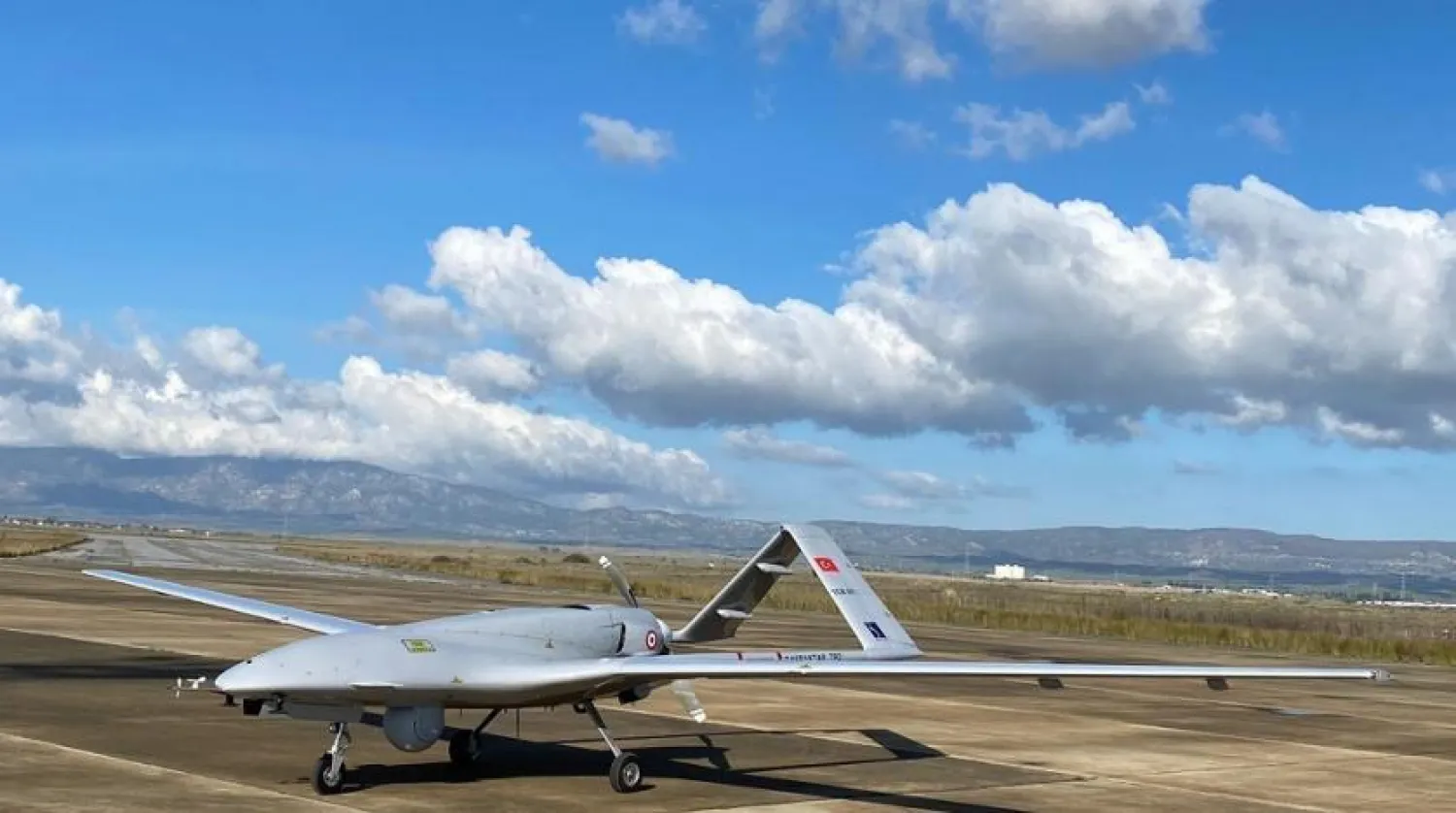
File photo: A Turkish-made Bayraktar TB2 drone is seen shortly after its landing at an airport in Gecitkala, known as Lefkoniko in Greek, in Cyprus, Monday, Dec. 16, 2019. (AP)
TT

Minister: Ukraine Aims to Develop Air-to-air Combat Drones

File photo: A Turkish-made Bayraktar TB2 drone is seen shortly after its landing at an airport in Gecitkala, known as Lefkoniko in Greek, in Cyprus, Monday, Dec. 16, 2019. (AP)

Ukraine has bought some 1,400 drones, mostly for reconnaissance, and plans to develop combat models that can attack the exploding drones Russia has used during its invasion of the country, according to the Ukrainian government minister in charge of technology.

In a recent interview with The Associated Press, Minister of Digital Transformation Mykhailo Fedorov described Russia’s war in Ukraine as the first major war of the internet age. He credited drones and satellite internet systems like Elon Musk’s Starlink with having transformed the conflict.

Ukraine has purchased drones like the Fly Eye, a small used for intelligence, battlefield surveillance and reconnaissance.

“And the next stage, now that we are more or less equipped with reconnaissance drones, is strike drones,” Federov said. “These are both exploding drones and drones that fly up to three to 10 kilometers and hit targets.”

He predicted “more missions with strike drones” in the future, but would not elaborate. “We are talking there about drones, UAVs, UAVs that we are developing in Ukraine. Well, anyway, it will be the next step in the development of technologies,” he said.

Russian authorities have alleged several Ukrainian drone strikes on its military bases in recent weeks, including one on Monday in which they said Russian forces shot down a drone approaching the Engels airbase located more than 600 kilometers (over 370 miles) from the Ukrainian border.

Russia's military said debris killed three service members but no aircraft were damaged. The base houses Tu-95 and Tu-160 nuclear-capable strategic bombers that have been involved in launching strikes on Ukraine.

Ukrainian authorities have never formally acknowledged carrying out such drone strikes, but they have made cryptic allusions to how Russia might expect retaliation for its war in Ukraine, including within Russian territory.

Ukraine is carrying out research and development on drones that could fight and down other drones, Federov said. Russia has used Iranian-made Shahed drones for its airstrikes in Ukrainian territory in recent weeks, in addition to rocket, cruise missile and artillery attacks.

“I can say already that the situation regarding drones will change drastically in February or March,” he said.

Federov sat for an interview in his bright and modern office. Located inside a staid ministry building, the room contained a vinyl record player, history books stacked on shelves and a treadmill.

The minister highlighted the importance of mobile communications for both civilian and military purposes during the war and said the most challenging places to maintain service have been in the Donetsk, Zaporizhzhia, Odesa and Kyiv regions in the center and east of the country.

He said there are times when fewer than half of mobile phone towers are functioning in the capital, Kyiv, because Russian airstrikes have destroyed or damaged the infrastructure that power them.

Ukraine has some 30,000 mobile-phone towers, and the government is now trying to link them to generators so they can keep working when airstrikes damage the power grid.

The only alternative, for now, is satellite systems like Starlink, which Ukrainians may rely on more if blackouts start lasting longer.

“We should understand that in this case, the Starlinks and the towers, connected to the generators, will be the basic internet infrastructure,” Federov said.

Many cities and towns are facing power cuts lasting up to 10 hours. Fedorov said Ukrainian President Volodymyr Zelenskyy signed a decree that instructs mobile phone companies to ensure they can provide signals without electricity for at least three days.

Meanwhile, with support from its European Union partners, his ministry is working to bring 10,000 more Starlink stations to Ukraine, with internet service made available to the public through hundreds of “Points of Invincibility” that offer warm drinks, heated spaces, electricity and shelter for people displaced by fighting or power outages.

Roughly 24,000 Starlink stations already are in operation in Ukraine. Musk’s company, SpaceX, began providing them during the early days of the war after Fedorov tweeted a request to the billionaire.

“I just stood there on my knees, begging them to start working in Ukraine, and promised that we would make a world record," he recalled.

Federov compared Space X's donation of the satellite terminals to the US-supplied multiple rocket launchers in terms of significance for Ukraine's ability to mount a defense to Russia's invasion.
“Thousands of lives were saved,” he said.

As well as the civilian applications, Starlink has helped front-line reconnaissance drone operators target artillery strikes on Russian assets and positions. Federov said his team is now dedicating 70% of its time to military technologies. The ministry was created only three years ago.

Providing the army with drones is among its main tasks.

“We need to do more than what is expected of us, and progress does not wait,” Federov said, scoffing at Russian skill in the domain of drones. “I don’t believe in their technological potential at all.”



Taiwan Says China Deploys Warships in ‘Military Operations’

A Chinese PLA navy ship monitors an area during a maritime cooperative activity between the Philippines, Australia and Canadian navy near Scarborough Shoal in the disputed South China Sea on Sep 3, 2025. (AFP)
TT

Taiwan Says China Deploys Warships in ‘Military Operations’

A Chinese PLA navy ship monitors an area during a maritime cooperative activity between the Philippines, Australia and Canadian navy near Scarborough Shoal in the disputed South China Sea on Sep 3, 2025. (AFP)

Taiwan said Friday that China had deployed warships for “military operations” stretching hundreds of kilometers from the Yellow Sea to the South China Sea, posing a “threat” to the region.

Beijing, which claims self-ruled Taiwan as part of its territory, neither confirmed nor denied the maneuvers.

Taiwan’s defense ministry and other security agencies were monitoring China’s activities and had a “complete grasp of the situation,” presidential office spokeswoman Karen Kuo told reporters.

She did not say how many Chinese ships were involved in the deployment, but a security source told AFP the number was “significant.” The source spoke on condition of anonymity because they were not authorized to speak to the media.

The operations were not limited to the Taiwan Strait, but extended from the southern Yellow Sea, to the East China Sea near the disputed Diaoyu Islands and on into the South China Sea and even the Western Pacific, Kuo said.

“This indeed poses a threat and impact on the Indo-Pacific and the entire region,” she said.

Taiwan urged China to “exercise restraint,” Kuo said, adding: “We are also confident that we can handle this matter well.”

Neither China’s armed forces nor state media have announced any increased military activity in the region where Taiwan said Chinese ships had been detected.

Beijing’s defense ministry spokesman Jiang Bin said Friday that the navy’s training on the high seas complies with international law and “is not directed at any specific country or target.”

He was responding to a question about a Chinese naval flotilla that reportedly may be heading toward Australia.

A spokesman for China’s foreign ministry said Beijing “has consistently followed a defensive policy” and urged “relevant parties” not to “overreact or... engage in groundless hype.”

China has refused to rule out using force to take Taiwan, and also contentiously claims sovereignty over nearly all of the South China Sea.

Taiwan’s intelligence chief Tsai Ming-yen said Wednesday that October to December was the “peak season” for China’s “annual evaluation exercises.”

There was a possibility that China’s ruling Communist Party could turn seemingly routine military activities into drills targeting Taiwan, Tsai warned.

Last December, Taiwan said about 90 Chinese warships and coast guard vessels took part in vast exercises including simulating attacks on foreign ships and practicing blockading sea routes in Beijing’s biggest maritime drills in years.

Beijing did not confirm the drills at that time.

The United States has historically been Taiwan’s main security backer.

But President Donald Trump’s administration signaled a potential shift in that policy on Friday, saying in a strategy document that its Asian allies Japan and South Korea should take on more of the burden of defending the region.


France Investigates Reports of Drones Over Nuclear Sub Base

A picture taken on December 5, 2016 shows a nuclear submarine at the naval base in Ile Longue, western of France. (AFP)
TT

France Investigates Reports of Drones Over Nuclear Sub Base

A picture taken on December 5, 2016 shows a nuclear submarine at the naval base in Ile Longue, western of France. (AFP)

French prosecutors are investigating after drones were suspected to have flown over a nuclear submarine base on the Atlantic coast late on Thursday, a prosecutor in charge of military affairs in the city of Rennes said on Friday.

Jean-Marie Blin said overflights had been reported from around 7 p.m. (1800 GMT) on Thursday until 1 a.m. (midnight GMT) on Friday morning, with the bulk of the sightings occurring during the first couple of hours.

He denied press reports that gendarmes had fired at the suspected drones, but said they had taken "precautionary measures".

Drone flights, mostly of unknown origin, have been disrupting Europe's airspace in the past few months. European Commission President Ursula von der Leyen has called the incursions "hybrid warfare". Russia regularly denies accusations that it is responsible.

The Ile Longue base in northwest France houses nuclear-powered submarines, according to the navy's website. Each is equipped with 16 ballistic missiles carrying several nuclear warheads.

Blin said the investigation was for now focused on verifying whether there really had been drones in the sky. "Some of the reports may be completely fanciful, others are much more serious."

He said the reports had come from different people on site, including gendarmes and military officers.


Putin, Modi Agree to Expand and Widen India-Russia Trade, Strengthen Friendship

05 December 2025, India, New Delhi: Russian President Vladimir Putin is welcomed by Indian President Droupadhi Murmu, and Indian Prime Minister Narendra Modi. (Konstantin Zavrazhin/Kremlin/dpa)
TT

Putin, Modi Agree to Expand and Widen India-Russia Trade, Strengthen Friendship

05 December 2025, India, New Delhi: Russian President Vladimir Putin is welcomed by Indian President Droupadhi Murmu, and Indian Prime Minister Narendra Modi. (Konstantin Zavrazhin/Kremlin/dpa)

Russian President Vladimir Putin offered India uninterrupted fuel supplies on Friday, eliciting a cautious response even as he and Indian Prime Minister Narendra Modi agreed to expand trade and defense ties between countries with decades-old ties.

India, the world's top buyer of Russian arms and seaborne oil, has rolled out the red carpet for Putin during his two-day state visit, his first to New Delhi since Russia's invasion of Ukraine in 2022. But New Delhi is also in talks with the US on a trade deal to cut punitive tariffs imposed by President Donald Trump on its goods over India's purchases of Russian oil.

India's energy imports are expected to fall to a three-year-low this month following US tariffs and sanctions. Russia has said it wants to import more Indian goods in an effort to grow trade to $100 billion by 2030.

INDIA CAUTIOUS ON OIL IMPORTS

Putin said Moscow was ready to continue ensuring "uninterrupted fuel supplies" to India, following up on comments on Thursday questioning US pressure on India to curb oil purchases from Russia.

India appeared cautious about the offer.

Asked about the future of energy trade between the two countries, India's foreign secretary said Indian energy companies take decisions based on "evolving market dynamics" and "commercial issues that they confront while sourcing their supplies", indicating the pressures of sanctions and prices.

Energy cooperation between the two countries continues within this framework, Vikram Misri told a media briefing. Underlining this caution, Indian state refiners Indian Oil Corp and Bharat Petroleum Corp have placed January orders for the loading of Russian oil from non-sanctioned suppliers due to widening discounts, Reuters reported on Friday.

TIES HAVE 'STOOD TEST OF TIME', SAYS MODI

Describing India's enduring partnership with Russia as "a guiding star", Modi said: "Based on mutual respect and deep trust, these relations have always stood the test of time."

"We have agreed on an economic cooperation program for the period up to 2030. This will make our trade and investment more diversified, balanced, and sustainable," he told reporters, with Putin by his side.

Modi, who warmly embraced Putin on the airport tarmac when he arrived on Thursday, also reiterated India's support for a peaceful resolution to the war in Ukraine.

A joint statement issued following the summit said: "The leaders emphasized that in the current complex, tense, and uncertain geopolitical situation, Russian-Indian ties remain resilient to external pressure."

21-GUN SALUTE

Putin received a ceremonial welcome on Friday on the forecourt of Rashtrapati Bhavan, the colonial-era presidential palace, with a 21-gun salute as his convoy drove in.

A large business and government delegation has accompanied Putin.

Among the deals signed, the two countries agreed to help Indians move to Russia for work, to set up a joint venture fertilizer plant in Russia, and boost cooperation in agriculture, healthcare and shipping.

They also agreed to reshape their defense ties to take account of New Delhi's push for self-reliance through joint research and development, as well as the production of advanced defense platforms. This would include joint production in India of spare parts, components, assemblies, and other products for servicing Russian weapons and military equipment.

PUTIN QUESTIONS WASHINGTON

In an interview with broadcaster India Today aired on Thursday, Putin challenged US pressure on India not to buy Russian fuel.

"If the US has the right to buy our (nuclear) fuel, why shouldn't India have the same privilege?" he said, adding that he was ready to discuss the matter with Trump.

India has said Trump's tariffs are unjustified and unreasonable, noting continued US trade with Moscow.

The US and European Union still import billions of dollars worth of Russian energy and commodities, ranging from liquefied natural gas to enriched uranium, despite economic sanctions.