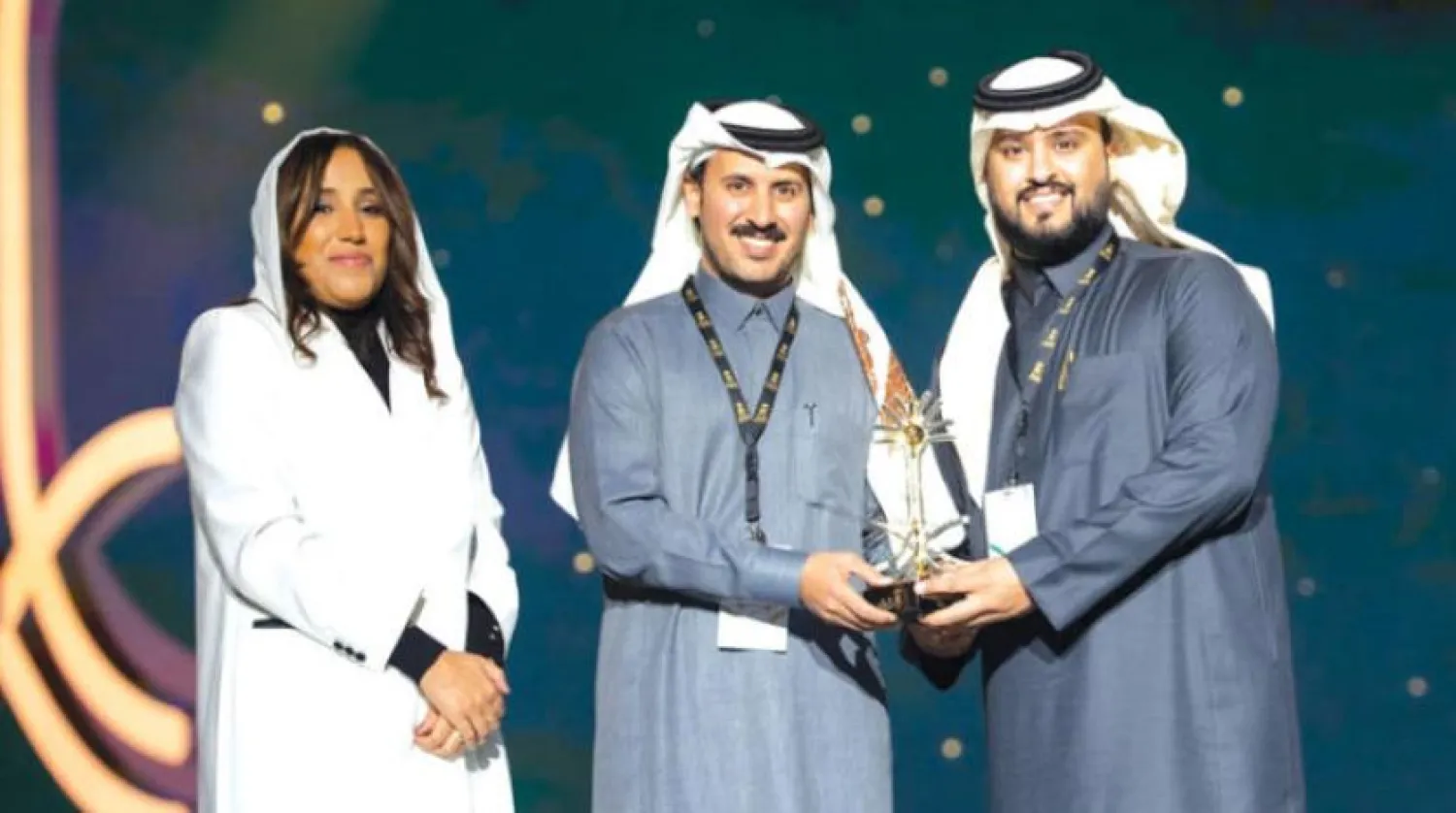
Saudi Arabia Honors Best National Media Productions

Saudi Research & Marketing Group (SRMG) CEO Joumana Alrashid honors social media influencer Thawab Alsubaie with his prize. (Asharq Al-Awsat) 
TT

Saudi Arabia Honors Best National Media Productions

Saudi Research & Marketing Group (SRMG) CEO Joumana Alrashid honors social media influencer Thawab Alsubaie with his prize. (Asharq Al-Awsat) 

In partnership with the Saudi Tourism Commission, the Saudi Ministry of Media, represented by the Government Communication Center, celebrated the winners at the 3rd edition of the Media Excellence Award for national day 2022.   

Acting Minister of Media Dr. Majid Al-Qasabi announced the expansion of the forthcoming edition of the award, which will become an annual event known as the “Media Excellence Award”. It will celebrate the national creative works throughout the year, and allow the participation of more creators from across Saudi Arabia.  

This year’s event saw 30 finalists out of 1,000 participants compete for prizes in nine media categories. 

The best media campaign prize was awarded to the Local Content and Government Procurement Authority; the best photograph prize went to photographer Hamad al-Okaili for his photo “Falcon and the Falcons”; and the best video from the private sector prize went to the Half Million company.  

The Prince Mohammed bin Salman bin Abdulaziz Foundation (MiSK) won the best video from the non-profit sector prize for its production “Watan Hader Lak”.  

Social media influencer Thawab Alsubaie won the best creative work in the social media for individuals prize.  

The Riyadh Newspaper bagged the best media coverage prize for its production “Riyadh Capital of the Universe…History was Made Here.” 

The Saudi Broadcasting Authority won the best TV production for its documentary “The Saudi Ardah”. The best broadcast and podcast prize went to the “Qafilah Podcast” for its episode “Flag…Symbol of Pride and Honor”.  

Aramco’s “Ithra” initiative won the best national song prize for its song “We Sing for our Home Country”. 

The tourism film prize went to the Tourism Development Fund for its production “People of Tourism”. 

This year’s edition of the Media Excellence Award for national day dedicated a special tribute to figures who had major contributions in media and culture in Saudi Arabia. The honored personalities are composer of the national anthem, late poet Ibrahim Khafaji; singer Mohammed Abdu; photographer Bandar Al-Jaloud; and French photographer Tchékof Minosa. 


Next Artemis Mission on Track for 2027, but Anything Can Happen, Astronaut Says

A banner of the Artemis program is seen outside of the Vehicle Assembly Building (VAB) at Kennedy Space Center, in Cape Canaveral, Florida, on September 30, 2026. (AFP)
TT

Next Artemis Mission on Track for 2027, but Anything Can Happen, Astronaut Says

A banner of the Artemis program is seen outside of the Vehicle Assembly Building (VAB) at Kennedy Space Center, in Cape Canaveral, Florida, on September 30, 2026. (AFP)

The next mission under NASA's Artemis moon program could still launch next summer as planned, but "anything can happen" given the remaining development work for the two lunar landers needed for the mission, one of the Artemis III astronauts told Reuters.

NASA's third Artemis mission will be the first to involve the program's moon landers — SpaceX's Starship and Blue Origin's Blue Moon.

Unlike Artemis II, the spacecraft will stay in Earth's orbit to perform crewed docking demonstrations with Orion, a capsule whose job is to transfer the astronaut crew to the landers after getting them into space.

"The biggest thing is having faith in the team to pull together, with the same ‌rationale that anything ‌can happen," Artemis III mission specialist Andre Douglas said in an interview ‌on ⁠Monday, when asked ⁠if Artemis III is still on track for launch next year.

Douglas, 40, fellow NASA astronauts Randy Bresnik and Frank Rubio, as well as Italian astronaut Luca Parmitano, were tapped this year as the crew for Artemis III, seen as a key rehearsal before NASA attempts to put astronauts on the lunar surface in 2028 in Artemis IV.

Both companies' lunar landers have had schedule delays while facing an unchecked list of complex development tasks, such as demonstrating the ability to store and delicately transfer super-cooled propellants in ⁠space and dock with another object in orbit.

"Those are the major ones," ‌Douglas said of the milestones the contractors need to ‌achieve before the mission.

While some industry sources doubt the landers will be ready in time for a 2027 ‌mission, NASA has been optimistic, with administrator Jared Isaacman citing good progress for "the parts that ‌are in NASA's greatest control," referring to the NASA-owned Orion and its Space Launch System rocket.

Starship and Blue Moon have received billions of dollars in NASA funding while their development remains privately managed, a commercial-focused contracting model that has given NASA relatively little control over the manner and speed with which the companies build their ‌landers.

"We just have to keep putting our heads down, leaning forward, and trying to meet the ideal timeline, which would be June of ⁠next year," said ⁠Douglas, who works with both SpaceX and Blue Origin on their lander development.

He added that he and other NASA officials plan to meet with SpaceX and Blue Origin over the next few months to determine their spacecraft's readiness.

The Artemis III mission had originally been planned as the program's first moon landing until February, when Isaacman imposed sweeping program changes that turned Artemis III into an extra practice mission. The agency is pressed to return to the moon quickly as it races China, which is targeting 2030 for its own first moon landing.

Artemis III will be the first trip to space for Douglas, who spent years shadowing the Artemis II crew as a backup. A systems engineering scholar and naval architect, Douglas has a background in the US Coast Guard that taught him how to be adaptable to rapid change, he said.

"I learned in the military that the plan only lasts for 10 minutes," he said. "You have expectations, but then you're also ready in the background for change."


Nobel Medicine Prize Goes to 3 Scientists for Research into Brain Activity

Nobel Medicine Prize Goes to 3 Scientists for Research into Brain Activity
TT

Nobel Medicine Prize Goes to 3 Scientists for Research into Brain Activity

Nobel Medicine Prize Goes to 3 Scientists for Research into Brain Activity

The Nobel Prize in medicine was awarded Monday to three scientists whose work led to a tool that uses light to help unravel how the brain works.

Karl Deisseroth, Peter Hegemann and Georg Nagel have carried out research into light-gated ion channels and optogenetics. The Nobel Assembly lauded their work and said their tool is now being used in laboratories around the world to reveal the brain’s mysteries.

Deisseroth, 54, is a Howard Hughes Medical Institute investigator and Stanford University professor in California. Hegemann, 71, is at Humboldt University in Berlin, and Nagel, 73, most recently worked at the University of Würzburg, also in Germany, the assembly said.

The work that won the 2026 Nobel Prize in medicine Optogenetics opened what the Nobel assembly called a new era in neuroscience following the discovery of a light-controlled switch to turn on and off nerve cells and circuits in the brain to better learn how it works. The research has started unraveling the pathways that lead to behavior and disease.

The breakthrough began when Hegemann explored how a single-celled type of green algae can swim toward light. He and Nagel discovered a particular protein that, when illuminated by blue light, opens a channel to create an electrical impulse. Putting that protein into other cells makes them light-sensitive.

Deisseroth then worked with the gene that controls that protein to create a light-controlled switch for nerve cells in the brains of living mice.

“People usually think about light as a way of collecting information to observe things,” he said. “But this is the opposite of that. This is using light to control things, to make things happen, and to do it in a very precise way.”

Deisseroth first developed tiny fibers to deliver light to cells modified with the light-sensitive gene and said there now are other techniques to switch on or off neurons being studied.

Optogenetics is mostly a research technique to learn how specific neurons and neural circuits work, which can then lead to development of treatments, including regimens for autism and schizophrenia that other scientists are pursuing, he said. A technique he called direct optogenetics is being used to test a treatment for a genetic form of vision loss called retinitis pigmentosa.

Why the research is important Brain cells communicate in milliseconds, and optogenetics for the first time offered scientists a way to control them at the same speed in a laboratory, said Patrick Forcelli, the chairman of the pharmacology and physiology department at Georgetown University, whose lab uses optogenetics.

Now a mainstay in neuroscience labs, the field has moved from using fixed maps of brain activity to building functional wiring diagrams. It has also jump-started additional techniques to explore neural complexity.

“It has let us go from a ‘Rand McNally’ road atlas of the brain to something more akin to ‘Google Earth,’” Forcelli said in an email.

The University of Pittsburgh’s Jeremy Berg was at the U.S. National Institutes of Health in the early 2000s when it awarded Deisseroth major funding for “this vision of optogenetics that was pretty much spot-on the way it played out.”

“It’s a very precise set of tools for doing experiments about how the brain works that are pretty hard to do any other way,” Berg said.

Abdel El Manira, a member of Nobel Assembly, said the impact of optogenetics goes beyond the understanding of a healthy brain.

“It has also helped reveal how specific brain circuits are disrupted, with implications for conditions such as blindness, depression, addiction and dementia," El Manira said. "Yet despite these extraordinary advances, the brain still holds countless mysteries, with much more left to learn and discover. And optogenetics has given us a powerful means to take on these challenges.”

Deisseroth had just gone to bed when he learned of the award Deisseroth, a self-described night owl, said he was up late in his Northern California home working on papers and emailing students. He had just gone to lie down when he got the call from the Nobel Assembly.

“No real sleep was achieved,” he told The Associated Press in a phone call an hour after the announcement.

He said the next task on his to-do list was to pack school lunches for his children, who were still sound asleep.

“That’s my one obligation I have in the next few hours, to make sure I make their sandwiches,” he said.

Thomas Perlmann, the secretary of the medicine committee, said he was able to reach all three winners Monday. The AP could not immediately reach Hegemann and Nagel.

Medicine prize kicks off Nobels week The prize was announced at the Karolinska Institute in Stockholm, kicking off Nobels week. The prize money this year is 12 million Swedish kronor (about $1.2 million), whether for an individual, small group of laureates or organization.

Last year, the prize went to three scientists researching the immune system.

Monday's medicine prize is followed by the physics prize on Tuesday, chemistry on Wednesday and literature on Thursday.

After Friday’s peace prize is awarded, the Nobel Memorial Prize in Economic Sciences will be announced on Oct. 12.



AI Camp Kicks Off in Madinah with 120 Participants

AI Camp kicks off in Madinah with 120 participants. (SPA)
TT

AI Camp Kicks Off in Madinah with 120 Participants

AI Camp kicks off in Madinah with 120 participants. (SPA)

The AI Camp kicked off at the Madinah Chamber of Commerce and Industry on Sunday as part of the MED AI Forum, bringing together 120 participants and nine speakers over five days, the Saudi Press Agency said on Monday.

The camp aims to develop innovative solutions to real-world challenges through three tracks: sports, agriculture, and tourism, enabling participants to progress from identifying challenges and generating ideas to building prototypes and preparing for the hackathon.