
Iraq’s Kurdish Region Warns against ‘Unlawful’ Stop to Funds

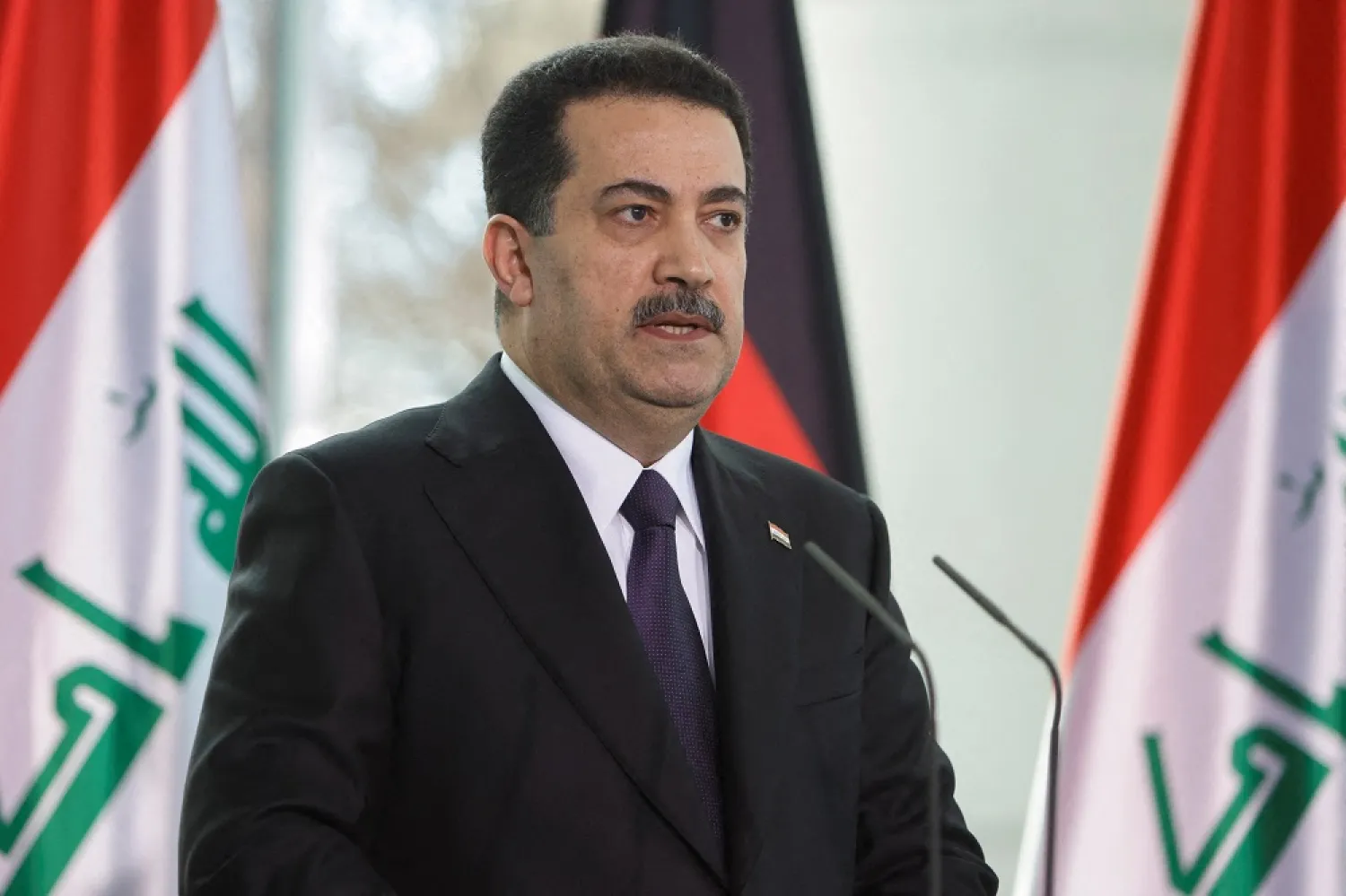
Iraqi Prime Minister Mohammed Shia al-Sudani during a news conference at the Federal Chancellery in Berlin, Germany January 13, 2023. (Reuters)
TT

Iraq’s Kurdish Region Warns against ‘Unlawful’ Stop to Funds

Iraqi Prime Minister Mohammed Shia al-Sudani during a news conference at the Federal Chancellery in Berlin, Germany January 13, 2023. (Reuters)

Iraqi Kurdish authorities on Thursday pushed back against a decision by Iraq's top court that blocked payments from state coffers funding the semi-autonomous region.

Jutiar Adel, a spokesperson for Iraq's Kurdistan Regional Government said in a statement that the “unlawful decision from an illegitimate court will impact (the) mutual understanding” between Kurdish authorities in northeastern Iraq and the central government in Baghdad.

The Iraqi Federal Supreme Court issued a ruling Wednesday that invalidates a series of decisions by the government in Baghdad to transfer funds to the KRG to pay salaries in 2021 and 2022, arguing that the transfers violated Iraq’s 2021 budget law and were unconstitutional.

The ruling came in response to a lawsuit filed by Mustafa Sanad — an independent lawmaker who is allied with Iraq's ruling coalition composed of largely Shiite parties backed by Iran — and by the governor of the Wasit province in eastern Iraq. Sanad praised the decision, saying it had “stopped the financial bleeding.”

The decision cannot be appealed. It places in doubt both the future payment of salaries and the fragile relationship between the Kurdish regional government and Baghdad.

Nechirvan Barzani, president of the Kurdistan Region, said in a statement that the decision “targets not only the public employees and the people of Kurdistan who are Iraqi citizens, but also the entire political process and stability.”

A KRG official who spoke on condition of anonymity because he was not authorized to discuss the case publicly, said the “KRG will be in talks with the federal government to find a way to bring back normality to the ground.”

Should those talks fail, he said, “the people of Kurdistan region will be the victims.”


UN: Syria's President and 2 Top Ministers Were Targets of 5 Foiled Assassination Attempts

Syrian President Ahmed al-Sharaa gestures speaking with Russian President Vladimir Putin during their meeting at the Kremlin in Moscow, Russia, 28 January 2026. MAXIM SHIPENKOV/Pool via REUTERS
TT

UN: Syria's President and 2 Top Ministers Were Targets of 5 Foiled Assassination Attempts

Syrian President Ahmed al-Sharaa gestures speaking with Russian President Vladimir Putin during their meeting at the Kremlin in Moscow, Russia, 28 January 2026. MAXIM SHIPENKOV/Pool via REUTERS

Syria’s president, interior minister and foreign minister were the targets of five foiled assassination attempts last year, the UN chief said in a report on threats posed by ISIS militants released Wednesday.

The report said President Ahmad al-Sharaa was targeted in northern Aleppo, the country’s most populous province, and southern Daraa by a group assessed to be a front for the ISIS group.

The report, issued by Secretary-General António Guterres and prepared by the UN Office of Counter-Terrorism, gave no dates or details of the attempts against al-Sharaa or Syrian Interior Minister Anas Hasan Khattab and Foreign Minister Asaad al-Shibani.

The assassination attempts are more evidence that the militant group remains intent on undermining the new Syrian government and “actively exploiting security vacuums and uncertainty” in Syria, the report said.

It said al-Sharaa was “assessed to be a primary target” of the ISIS. And it said the front group provided ISIS with plausible deniability and "improved operational capacity.”

Al-Sharaa has led Syria since his opposition forces ousted longtime Syrian President Bashar Assad in December 2024, ending a 14-year civil war.

In November, his government joined the international coalition formed to counter the ISIS group, which once controlled a large part of Syria.

The UN counter-terrorism experts said the militant group still operates across the country, primarily attacking security forces, particularly in the north and northeast.

In one ambush attack on Dec. 13 on US and Syrian forces near Palmyra, two US servicemen and an American civilian were killed and three Americans and three members of Syria's security forces were wounded. President Donald Trump retaliated, launching military operations to eliminate ISIS fighters.

According to the UN counter-terrorism experts, the ISIS group maintains an estimated 3,000 fighters across Iraq and Syria, the majority of them based in Syria.

The US military in late January began transferring ISIS detainees who were held in northeastern Syria to Iraq to ensure they remain in secure facilities. Iraq has said it will prosecute the militants.

Syrian government forces had taken control of a sprawling camp housing thousands of ISIS detainees following the withdrawal of the US-backed Syrian Democratic Forces as part of a ceasefire with the Kurdish fighters.

The report released Wednesday to the UN Security Council said as of December, before the ceasefire deal, more than 25,740 people remained in the al-Hol and Roj camps in the northeast, more than 60% of them children, with thousands more in other detention centers.


Lebanon to Decide on Plan to Control Arms North of Litani Next Week, Minister Says

FILE PHOTO: Lebanese army members stand on a military vehicle during a Lebanese army media tour, to review the army's operations in the southern Litani sector, in Alma Al-Shaab, near the border with Israel, southern Lebanon, November 28, 2025. REUTERS/Aziz Taher/File Photo
TT

Lebanon to Decide on Plan to Control Arms North of Litani Next Week, Minister Says

FILE PHOTO: Lebanese army members stand on a military vehicle during a Lebanese army media tour, to review the army's operations in the southern Litani sector, in Alma Al-Shaab, near the border with Israel, southern Lebanon, November 28, 2025. REUTERS/Aziz Taher/File Photo

Lebanon’s ‌government will decide next week how to move to the second phase of a plan to extend its authority and place all arms under state control in areas north of the Litani River, its information minister said on Wednesday.

The decision will be based on a presentation by the army outlining its needs and capabilities, the minister, Paul Morcos, told reporters during a visit to Kuwait, where he was attending an ‌Arab meeting.

The ‌Lebanese army said in January that ‌it ⁠had taken operational control ⁠in the area between the Litani River and the border with Israel. The cabinet asked the army to brief it in early February on how to pursue disarmament in other parts of the country, Reuters reported.

"We have completed the first phase, south of the ⁠Litani River. Next week the government will ‌take a decision regarding the ‌second phase considering what the army commander sets out ‌in terms of needs and capabilities, so that ‌we can decide accordingly, based on that explanation," Morcos said.

Lebanon has been seeking to place all arms under state control, in line with a November 2024 US-brokered ceasefire that ended ‌a war between Israel and the Iran-backed Hezbollah group.

Morcos ruled out ⁠the ⁠possibility of any confrontation between the Lebanese army and Hezbollah, saying the objective was "to extend state authority and achieve stability, and insofar as these goals can be achieved together, we will proceed".

Israel has carried out regular strikes in Lebanon since the end of the war with Hezbollah, killing around 400 people since the ceasefire, according to a toll from Lebanese security sources.

Israel has accused Hezbollah of seeking to rearm in violation of the ceasefire agreement with Lebanon. Hezbollah says it has respected the ceasefire in southern Lebanon.


Israel Has Joined Trump's 'Board of Peace,' Netanyahu Says

Israeli Prime Minister Benjamin Netanyahu during a joint press conference with US President Donald Trump in the State Dining Room at the White House on September 29, 2025 (Reuters)
TT

Israel Has Joined Trump's 'Board of Peace,' Netanyahu Says

Israeli Prime Minister Benjamin Netanyahu during a joint press conference with US President Donald Trump in the State Dining Room at the White House on September 29, 2025 (Reuters)

Israel has joined US President Donald Trump's "Board of Peace" initiative, Prime Minister Benjamin Netanyahu said on Wednesday during his visit to Washington where he met Trump and Secretary of State Marco Rubio.

Visuals released earlier on Wednesday after the Netanyahu-Rubio meeting showed them holding a document with Netanyahu's signature on Israel joining the board. Netanyahu said on X he "signed Israel's accession ‌as a member ‌of the "Board of Peace.

He later discussed Iran with ‌Trump.

A ⁠UN Security Council ⁠resolution, adopted in mid-November, authorized the board and countries working with it to establish an international stabilization force in Gaza, where a fragile ceasefire began in October under a Trump plan on which Israel and Palestinian militant group Hamas signed off.

Under Trump's Gaza plan, the board was meant to supervise Gaza's temporary governance. Trump thereafter said the board, with him as chair, ⁠would be expanded to tackle global conflicts.

The board ‌will hold its first meeting on ‌February 19 in Washington to discuss Gaza's reconstruction.

Many rights experts say that Trump ‌overseeing a board to supervise a foreign territory's affairs resembled a ‌colonial structure. Israel's presence on the board is expected to bring further criticism as the board does not include a Palestinian.

Countries have reacted cautiously to Trump's invitation to join the board launched in late January. Many experts are concerned the board ‌could undermine the United Nations.

While some of Washington's Middle Eastern allies have joined, many of its traditional ⁠Western allies have ⁠stayed away.

The ceasefire in Gaza has been repeatedly violated, with at least 580 Palestinians and four Israeli soldiers reported killed since it began in October, according to Palestinian and Israeli tallies, respectively.

The next phase of Trump's Gaza plan calls for resolving complex issues like Hamas' disarmament, which the group has long rejected, further Israeli withdrawal from Gaza and the deployment of an international peacekeeping force.

Israel's assault on Gaza has killed over 72,000, according to Gaza's health ministry, caused a hunger crisis and internally displaced Gaza's entire population.

Multiple rights experts, scholars and a UN inquiry say it amounts to genocide. Israel calls its actions self-defense after Hamas-led militants killed 1,200 people and took over 250 hostages in a late 2023 attack.