


US, S. Korea Hold Air Drills as N. Korea Warns of 'All-out Showdown'

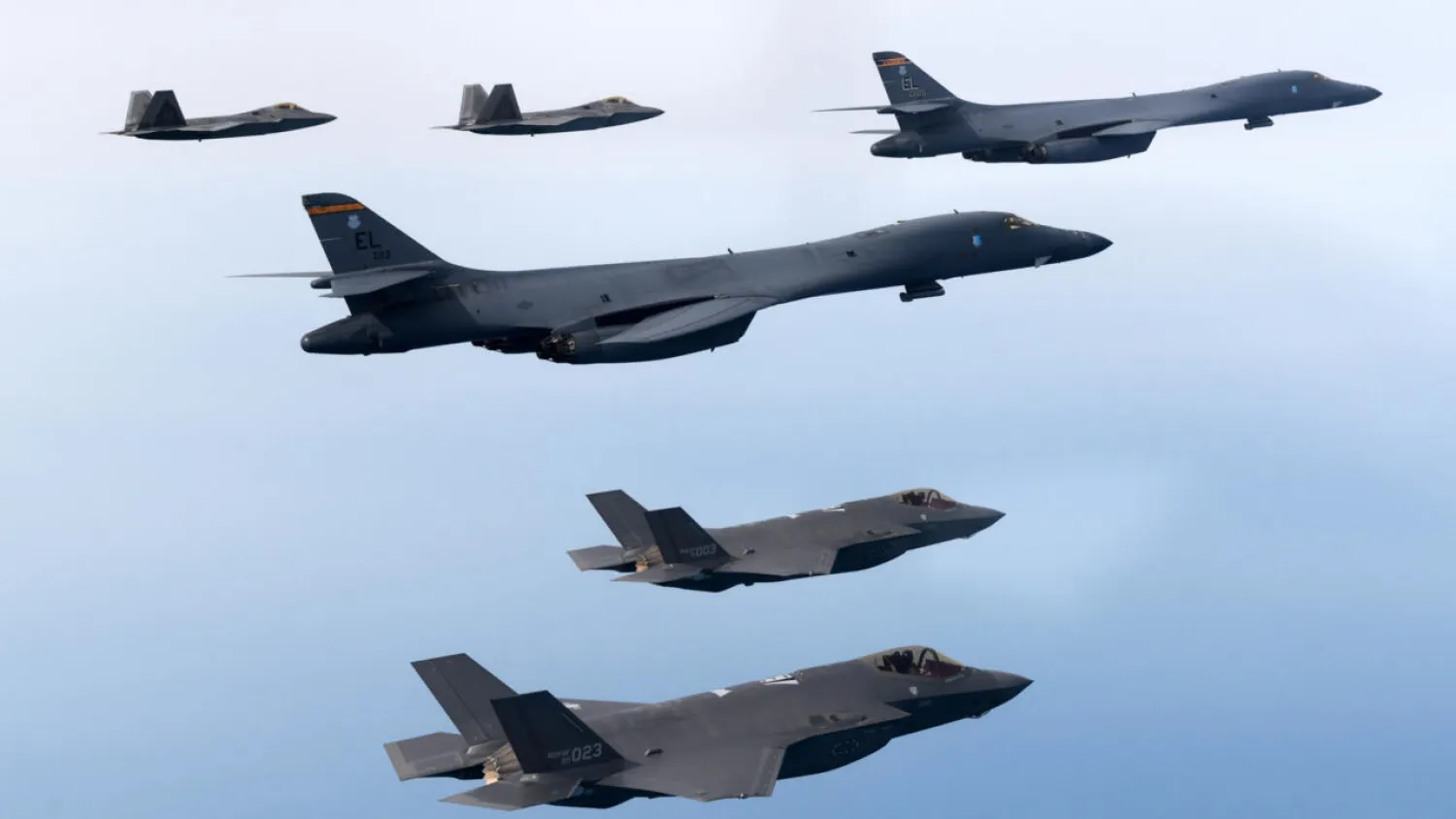
The United States and South Korea conducted a joint air exercise featuring long-range bombers and stealth fighters. Handout / South Korean Defense Ministry/AFP
TT

US, S. Korea Hold Air Drills as N. Korea Warns of 'All-out Showdown'

The United States and South Korea conducted a joint air exercise featuring long-range bombers and stealth fighters. Handout / South Korean Defense Ministry/AFP

South Korea said Thursday it had staged joint air drills with the United States featuring strategic bombers and stealth fighters, prompting Pyongyang to warn that such exercises could "ignite an all-out showdown".

The exercises, the first by the security allies this year, came a day after US Defense Secretary Lloyd Austin and his South Korean counterpart vowed to boost security cooperation to counter an increasingly belligerent nuclear-armed North Korea, AFP said.

The drills on Wednesday showed "the US's will and capabilities to provide strong and credible extended deterrence against North Korea's nuclear and missile threats," the South Korean defense ministry said.

They involved American B-1B long-range heavy bombers and stealth fighters -- US Air Force F-22s and South Korean F-35s -- flying over the Yellow Sea, the ministry added.

A North Korean foreign ministry spokesman warned the exercises could "ignite an all-out showdown", the state news agency KCNA reported.

Seoul and Washington's moves to ramp up joint drills crossed "an extreme red-line".

South Korea is eager to convince its increasingly nervous public of America's robust defense commitment, after a year in which North Korea declared itself an "irreversible" nuclear power and conducted a weapons test almost every month in defiance of international sanctions.

Austin and South Korean Defense Minister Lee Jong-sup agreed this week to "expand and bolster the level and scale" of joint military exercises in light of "continued provocations" from Pyongyang, including a recent drone incursion into the South.

- 'Nuke for nuke' -
Bolstering US-South Korean military drills and deploying strategic weapons to the region was akin to "talking about the use of nuclear weapons against the DPRK", the North Korean statement on KCNA said, using the country's official name.

It warned that North Korea would follow the "principle of 'nuke for nuke and an all-out confrontation for an all-out confrontation!'"

"The DPRK is not interested in any contact or dialogue with the US as long as it pursues its hostile policy and confrontational line," it added.

US-South Korean joint military exercises infuriate Pyongyang, which views them as rehearsals for an invasion and has often responded with threats and drills of its own.

"By emphasizing that the United States is entirely responsible for the deterioration of the situation on the Korean peninsula, (North Korea) is accumulating legitimacy for the development of its missile and nuclear weapons programs," said Yang Moo-jin, a professor at the University of North Korean Studies in Seoul.

He added that a large North Korean military parade and its planned launch of a spy satellite could further raise tensions with Seoul and Washington.

Commercial satellite imagery has suggested that "extensive parade preparations" are under way in Pyongyang ahead of one of the biggest state holidays, according to the 38 North website.

The parade could be held on the "Day of the Shining Star" on February 16, the birthday of Kim Jong Il, the son of North Korea's founder Kim Il Sung and the father and predecessor of current leader Kim Jong Un, it added.



Trump Hints at Land Strike as Venezuela Pressure Mounts

A US Air Force C-130J Super Hercules aircraft approaches for landing at Rafael Hernandez Airport, amid tensions between US President Donald Trump's administration and the government of Venezuelan President Nicolas Maduro, in Aguadilla, Puerto Rico, December 28, 2025. (Reuters)
TT

Trump Hints at Land Strike as Venezuela Pressure Mounts

A US Air Force C-130J Super Hercules aircraft approaches for landing at Rafael Hernandez Airport, amid tensions between US President Donald Trump's administration and the government of Venezuelan President Nicolas Maduro, in Aguadilla, Puerto Rico, December 28, 2025. (Reuters)

A throwaway remark last week by President Donald Trump has raised questions about whether US forces may have carried their first land strike against drug cartels in Venezuela.

Trump said the US knocked out a "big facility" for producing trafficking boats, as he was discussing his pressure campaign against Venezuelan President Nicolas Maduro in an interview broadcast Friday.

"They have a big plant or a big facility where they send, you know, where the ships come from," Trump said in an interview with billionaire supporter John Catsimatidis on the WABC radio station in New York.

"Two nights ago we knocked that out. So we hit them very hard."

Trump did not say where the facility was located or give any other details. US forces have carried out numerous strikes in both the Caribbean Sea and eastern Pacific Ocean since September, killing more than 100 people.

The Pentagon referred questions about Trump's remarks to the White House. The White House did not respond to requests for comment from AFP.

There has been no official comment from the Venezuelan government.

Trump has been saying for weeks that the United States will "soon" start carrying out land strikes targeting drug cartels in Latin America, but there have been no confirmed attacks to date.

The Trump administration has been ramping up pressure on Maduro, accusing the Venezuelan leader of running a drug cartel himself and imposing an oil tanker blockade.

Maduro has accused Washington of attempting regime change.


UN Chief Says ‘Get Serious’ in Grim New Year Message

 UN Secretary-General Antonio Guterres. (AFP)
UN Secretary-General Antonio Guterres. (AFP)
TT

UN Chief Says ‘Get Serious’ in Grim New Year Message

 UN Secretary-General Antonio Guterres. (AFP)
UN Secretary-General Antonio Guterres. (AFP)

The United Nations urged global leaders Monday to focus on people and the planet in a New Year's message depicting the world in chaos.

"As we enter the new year, the world stands at a crossroads. Chaos and uncertainty surround us. Division. Violence. Climate breakdown. And systemic violations of international law," UN Secretary-General Antonio Guterres said in a video message.

In 2026, as war rages in Ukraine and elsewhere, world leaders must work to ease human suffering and fight climate change, he added.

"I call on leaders everywhere: Get serious. Choose people and planet over pain," said Guterres, criticizing the global imbalance between military spending and financing for the poorest countries.

Military spending is up nearly 10 percent this year to $2.7 trillion, which is 13 times total world spending on development aid and equivalent to the entire gross domestic product of Africa, he said.

Wars are raging at levels unseen since World War II, he added.

"In this New Year, let's resolve to get our priorities straight. A safer world begins by investing more in fighting poverty and less in fighting wars. Peace must prevail," said Guterres, who will be serving his last year as secretary general.


Türkiye and Armenia Agree to Simplify Visa Procedures to Normalize Ties

Türkiye’s President Recep Tayyip Erdogan, right, and Armenia's Prime Minister Nikol Pashinyan shake hands before a meeting at Prague Castle in Prague, Czech Republic, Thursday, Oct. 6, 2022. (Turkish Presidency via AP, File)
TT

Türkiye and Armenia Agree to Simplify Visa Procedures to Normalize Ties

Türkiye’s President Recep Tayyip Erdogan, right, and Armenia's Prime Minister Nikol Pashinyan shake hands before a meeting at Prague Castle in Prague, Czech Republic, Thursday, Oct. 6, 2022. (Turkish Presidency via AP, File)

Türkiye and Armenia have agreed to simplify visa procedures as part of efforts to normalize ties, Türkiye’s Foreign Ministry announced Monday, making it easier for their citizens to travel between the two countries.

Relations between Türkiye and Armenia have long been strained by historic grievances and Türkiye’s alliance with Azerbaijan. The two neighboring countries have no formal diplomatic ties and their joint border has remained closed since the 1990s.

The two countries, however, agreed to work toward normalization in 2021, appointing special envoys to explore steps toward reconciliation and reopening the frontier. Those talks have progressed in parallel with efforts to ease tensions between Armenia and Azerbaijan.

Türkiye supported Azerbaijan during its 2020 conflict with Armenia for control of the Karabakh region, known internationally as Nagorno-Karabakh, a territorial dispute that had lasted nearly four decades.

The Turkish Foreign Ministry said in a statement posted on social platform X that Ankara and Yerevan agreed that holders of diplomatic, special and service passports from both countries would be able to obtain electronic visas free of charge as of Jan. 1.

“On this occasion, Türkiye and Armenia reaffirm once again their commitment to continue the normalization process between the two countries with the goal of achieving full normalization without any preconditions,” the ministry said.

Türkiye and Armenia also have a more than century-old dispute over the deaths of an estimated 1.5 million Armenians in massacres, deportations and forced marches that began in 1915 in Ottoman Türkiye. Historians widely view the event as genocide.

Türkiye denies the deaths constituted genocide, saying the toll has been inflated and those killed were victims of civil war and unrest. It has lobbied to prevent countries from officially recognizing the massacres as genocide.