


EU Diplomat Demands Accountability Following Israeli Settler Rampage in West Bank

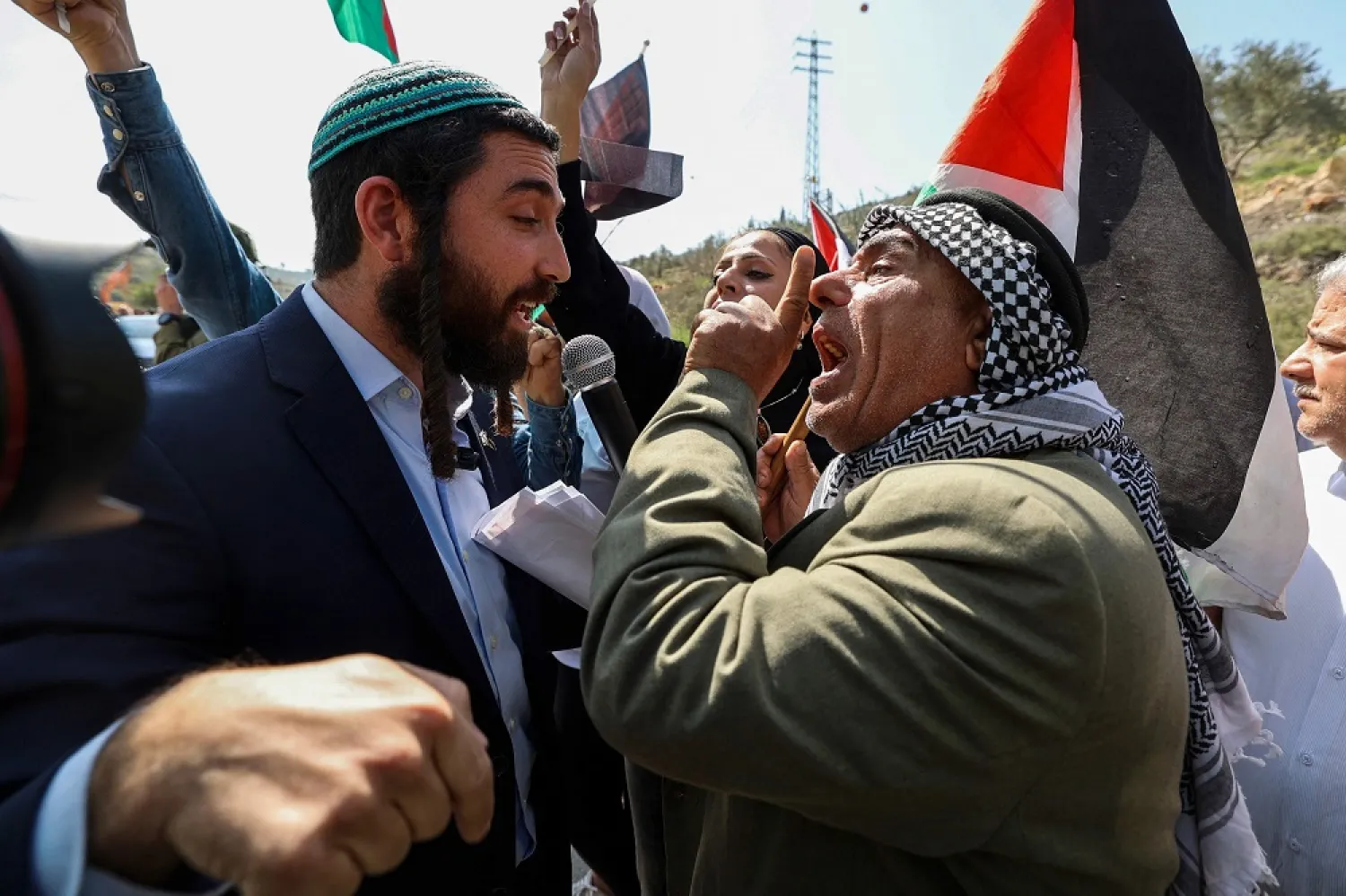
Knesset (Parliament) member for Israel's Religious Zionism party Tzvi Sukkot (L) is confronted as he tries to interrupt a rally by Palestinian and Israeli peace activists protesting at the entrance of Huwara in the occupied West Bank, on March 3, 2023, following deadly violence by Israeli settlers. (AFP)
TT

EU Diplomat Demands Accountability Following Israeli Settler Rampage in West Bank

Knesset (Parliament) member for Israel's Religious Zionism party Tzvi Sukkot (L) is confronted as he tries to interrupt a rally by Palestinian and Israeli peace activists protesting at the entrance of Huwara in the occupied West Bank, on March 3, 2023, following deadly violence by Israeli settlers. (AFP)

The European Union's envoy to the Palestinians called on Friday for accountability and for perpetrators to be brought to justice after a rampage by Israeli settlers this week in the occupied West Bank in which one Palestinian was killed and dozens of houses, shops and cars were torched.

Ambassador Sven Kuhn von Burgsdorff, heading one of the biggest EU delegations to visit the West Bank, said the officials wanted to see with their own eyes the damage left by Sunday's violence in and around the Palestinian village of Huwara. The rampage followed a Palestinian gun attack that killed two Israeli brothers.

"It is absolutely necessary for us that accountability is fully ensured, that the perpetrators be brought to justice, that those who lost property be compensated," Kuhn von Burgsdorff said.

Local media reported that, in a rare move, Israel's Defense Minister Yoav Gallant on Thursday signed administrative detention orders for two suspects over the rampage, after a Jerusalem court ordered police to release all seven people who had been detained in connection with the rampage.

Amnesty International condemned the release of the suspects in a statement on Friday. It also condemned the use of administrative detention, which it said was a practice that violated international law.

Israeli rights group Yesh Din found that 93% of investigations into settler attacks in the West Bank between 2005 and 2022 were closed without indictment.

Israeli Major General Yehuda Fuchs, who commands the Israeli military in the area, said on Tuesday that his forces had prepared for attempted settler retribution over the gun attack but had been surprised by the intensity of the violence, which he said was perpetrated by dozens of people. He called it a "pogrom carried out by outlaws".

Violence in the West Bank has surged over the past year with stepped-up Israeli military raids following a spate of Palestinian attacks. The United States, Jordan and Egypt have appealed for calm, concerned about an escalation ahead of the Muslim holy month of Ramadan and the Jewish Passover festival in late March and early April.

Washington’s call to Netanyahu

The United States has demanded that Israeli Prime Minister Benjamin Netanyahu disavow a call on Wednesday by far-right Finance Minister Bezalel Smotrich for the village of Huwara to be erased.

On the night of the rampage, Netanyahu urged people not to take the law into their own hands, but he has not publicly addressed Smotrich's statement or responded to the unusual criticism by Washington, a close ally.

The UN human rights chief on Friday criticized Smotrich for his remarks, describing them as "an unfathomable statement of incitement to violence and hostility".

Volker Turk was addressing the Geneva-based UN Human Rights Council, where he formally presented a report on the situation in the occupied Palestinian territories.

Late on Thursday, Palestinian officials said Israeli forces shot dead 15-year-old Mohammad Nidal Saleem in the back in the West Bank town of Azzoun.

Ahmad Enaya, the town's mayor, said an Israeli military vehicle drove into town and when teens hurled rocks at the car, soldiers responded with live fire.

The Israeli military said in a statement that soldiers shot at suspects who had hurled explosives at forces while they were conducting a search in the area for people who launched fireworks at Israeli vehicles passing near Azzoun.

It said it was aware of reports of people being wounded but did not confirm any Palestinian fatalities.

A statement by the public hospital in Qalqilya, near Azzoun, said two other people were treated for gunshot wounds.

"The terrorism waged by settlers, in cooperation with the occupation government, is unprecedented," said Walid Assaf, a former Palestinian Authority official who monitored Israeli settlements, speaking at Saleem's funeral in Azzoun on Friday.

At least 62 Palestinians, including gunmen and civilians, have been killed since the start of 2023, the Palestinian health ministry said. Thirteen Israelis and a Ukrainian tourist died in Palestinian attacks in the same period, according to official Israeli figures.

Palestinians seek to establish a state in the West Bank, East Jerusalem and Gaza, areas Israel captured in a 1967 war.

"We Palestinians will remain steadfast and we will defend our existence in the face of this occupation," said Assaf.



US Response Muted on New Israeli West Bank Measures

Israeli machinery levels land ahead of settlement construction near Jenin in the occupied West Bank, Dec. 23, 2025 (EPA)
TT

US Response Muted on New Israeli West Bank Measures

Israeli machinery levels land ahead of settlement construction near Jenin in the occupied West Bank, Dec. 23, 2025 (EPA)

Days ahead of Israeli Prime Minister Benjamin Netanyahu’s visit to Washington, his government moved on measures framed as procedural but laden with far-reaching sovereign implications.

Decisions by Israel’s security cabinet have made it easier for Israelis to purchase land in the West Bank and expanded Israeli enforcement tools in areas formally administered by the Palestinian Authority under the Oslo Accords.

A White House official reiterated President Donald Trump’s opposition to annexing the West Bank, but Washington’s response stopped short of any concrete measures.

The position, attributed to an unnamed official and unaccompanied by deterrent action, prompted speculation that the US stance amounted to tacit acquiescence rather than active opposition.

On the eve of Netanyahu’s arrival, Reuters cited a White House source as saying Trump continues to oppose Israeli annexation of the West Bank and views “stability” there as consistent with the goals of peace and Israel’s security.

The manner in which the position was conveyed, however, left room for interpretation. The issue, analysts say, is less whether Washington rejects annexation in principle than whether it opposes the cumulative steps that could lead to it.

Israeli officials have framed the measures as administrative, but critics view them as part of a broader pattern aimed at gradually altering conditions in the West Bank. Such steps, they argue, create facts on the ground that are later treated as irreversible.

In this reading, formal opposition to annexation does not preclude policies that effectively advance it without an explicit declaration, a process some observers describe as incremental annexation.

Limited US response

Restricting the US reaction to an unattributed statement suggests an effort to balance competing priorities: signaling continuity in Washington’s stated position while avoiding a confrontation with Netanyahu ahead of his visit.

Diplomats note that this approach indicates US objections are being managed through messaging rather than through policy leverage.

Even when the US language is explicit, its impact is limited unless it is accompanied by political cost. Governments typically adjust behavior in response to incentives or penalties, not statements alone.

In this context, the absence of measures reduces the deterrent effect of US opposition, leaving Israel with room to maneuver.

The timing of the Israeli decisions sends parallel messages. Domestically, they signal continued commitment to policies favored by right-wing constituencies and settler groups. Internationally, they suggest that reversing on-the-ground changes is becoming increasingly complex.

The approach reflects a familiar strategy of establishing new realities ahead of any renewed political process.

The moves also highlight the influence of Finance Minister Bezalel Smotrich within the governing coalition and his stated objective of undermining the practical foundations of a Palestinian state, even if the concept remains part of official rhetoric.

Measures described as technical adjustments thus take on broader political significance.

Impact on the two-state framework

The West Bank remains central to any viable Palestinian state. Steps that weaken Palestinian administrative authority or alter control over land are therefore assessed primarily by their effect on the feasibility of statehood.

Critics argue the latest measures move in the opposite direction, further blurring the distinction between Israeli control and Palestinian self-governance.

From Washington’s perspective, the situation underscores a broader contradiction. An administration that has shown limited engagement with the international consensus on a two-state solution is, in practice, also narrowing the range of alternative outcomes.

As prospects for two states diminish, analysts warn that other scenarios become more likely, including prolonged security control or recurring instability, complicating the US's assertions that current policies promote stability.

Reports in the US press citing Arab and Islamic condemnation, as well as concern at the United Nations, indicate that the West Bank remains a sensitive issue for many governments, including those maintaining ties with Israel.

Any perception of US leniency risks weakening those partners’ positions domestically.

At the United Nations, repeated warnings from international bodies have reaffirmed legal frameworks that Israel views as restrictive, but which others consider essential to any settlement.

While this divide is longstanding, critics note that developments on the ground are advancing faster than diplomatic efforts to address them.

As Washington emphasizes the importance of stability in the West Bank, the debate increasingly centers on what that stability entails: a temporary calm sustained by existing realities, or one underpinned by a credible political horizon.

For now, analysts say, each new Israeli step is being viewed less as an isolated decision than as a test of the credibility of the US's stated opposition.


Israel Steps Up Targeted Killings of Senior Hamas, Islamic Jihad Figures

Palestinians mourn victims of Israeli strikes in Gaza City, Tuesday (Reuters)
TT

Israel Steps Up Targeted Killings of Senior Hamas, Islamic Jihad Figures

Palestinians mourn victims of Israeli strikes in Gaza City, Tuesday (Reuters)

Israel has intensified a targeted military campaign in the Gaza Strip, pressing ahead with airstrikes aimed at senior operatives from Hamas and Islamic Jihad, citing what it describes as repeated ceasefire violations linked to armed fighters emerging from tunnels in Rafah.

The strikes have focused on areas west of the so-called “yellow line,” Israeli-designated restricted zones, with Israel again using the Rafah tunnel incident as a security pretext to hit targets it says were previously identified.

Israel says it considers such incidents breaches of the ceasefire agreement and has used them to justify continued attacks on militant targets inside the enclave.

Moreover, Israeli forces are conducting round-the-clock intelligence operations inside Gaza, relying heavily on unmanned aerial vehicles that continuously patrol the enclave and use advanced technology to identify targets.

These efforts are supported by electronic surveillance, including phone monitoring, as well as human intelligence, according to sources.

In the latest strike, carried out around midday on Tuesday, two Palestinians were killed when an Israeli airstrike hit an electric bicycle traveling along Salah al-Din Road near the entrance to the village of al-Masdar in central Gaza.

The two were taken to Al-Aqsa Martyrs Hospital, while a third person at the scene was wounded.

Sources told Asharq Al-Awsat that one of those killed was Asim Abu Holi, commander of the elite unit of Saraya al-Quds, the armed wing of Islamic Jihad, in central Gaza. Another militant accompanying him was critically wounded.

The second fatality was an elderly civilian who happened to be passing through the area.

The developments coincided with the killing of Palestinian woman Abeer Hamdan, who was shot dead by Israeli forces north of Khan Younis in southern Gaza. Later, another young man was killed in the south of the city.

At least seven Palestinians were also wounded in separate shooting incidents involving Israeli vehicles and drones near yellow-line areas in Gaza City and the town of Beit Lahiya in the north.

By midday Tuesday, more than 589 Palestinians had been killed since the ceasefire took effect on October 10, 2025. The total death toll since Oct. 7, 2023, has exceeded 72,000, according to local figures.

On Monday evening, hours after the Rafah incident, an Israeli helicopter struck a residential apartment in the al-Nasr neighborhood of Gaza City, killing three Palestinians, including a child.

Sources said the strike targeted three senior militants from the Beit Hanoun Battalion of Izz al-Din al-Qassam Brigades, the armed wing of Hamas.

Two of them were killed, while a third, the child’s father, was critically wounded.

The sources said the targeted militants had led months-long field operations against Israeli forces in Beit Hanoun in northern Gaza, including bombings and sniper attacks. Al-Qassam Brigades had previously released videos documenting those operations, which it said resulted in Israeli casualties.

Elsewhere on Monday, a Palestinian farmer was shot dead by Israeli forces in Deir al-Balah in central Gaza. At the same time, an older man was killed by Israeli fire near the yellow line northwest of Beit Lahiya.

Hamas spokesman Hazem Qassem said Israel was “escalating its violations of the Gaza ceasefire under false pretexts, disregarding the efforts of mediators and guarantor states seeking to maintain calm,” adding that those parties must act to compel Israel to halt the breaches.

Rafah tunnels

The Israeli military said on Tuesday that its attacks on Hamas operatives were in response to a ceasefire violation in Rafah. It claimed on Monday morning that it had detected an armed group emerging from Rafah tunnels and firing at Israeli troops, prompting forces to kill them.

Some images published later showed that among the dead was Anas Issa al-Nashar, the son of a veteran Hamas leader and one of the movement’s early founders and former political bureau members.

However, videos circulated on social media by unidentified accounts appeared to show armed members of the Yasser Abu Shabab gang killing some of the militants, rather than Israeli forces.

Similar incidents have occurred repeatedly, in which the gang has abducted and killed Palestinians before handing them over to Israeli forces, according to local accounts.

Abu Obeida, spokesman for the Qassam Brigades, said the actions of such gangs reflected “complete alignment with the occupation” and the execution of its agenda, describing them as “a desperate attempt to assert themselves.”

He added that Israel would not be able to protect them, asserting that the fighters killed in the Rafah tunnels were slain by the gang, not by Israeli troops.

Rafah crossing

In a related development, Israeli authorities have kept the Rafah crossing partially open for more than a week, allowing limited passenger movement in both directions.

The Palestinian Red Crescent Society said it facilitated the departure of 50 travelers on Tuesday, including 19 patients, most of the remainder being their companions, as part of ongoing humanitarian efforts to evacuate medical cases for treatment abroad.

Another 50 travelers returned late Monday.

As of Monday evening, a total of 397 travelers had crossed Rafah, out of 1,600 scheduled to travel in both directions, representing a compliance rate of about 25%, according to the government media office.


Lebanon, Jordan Seek Solutions After Damascus Bans Non-Syrian Trucks

Lebanese truck drivers block the road on the Lebanese side of the Masnaa border crossing in protest against Syria's decision to ban non-Syrian trucks from entering its territory, on February 10, 2025. (AFP)
TT

Lebanon, Jordan Seek Solutions After Damascus Bans Non-Syrian Trucks

Lebanese truck drivers block the road on the Lebanese side of the Masnaa border crossing in protest against Syria's decision to ban non-Syrian trucks from entering its territory, on February 10, 2025. (AFP)

Lebanon and Jordan are seeking a solution with Syria after the latter barred foreign trucks from entering its territory, officials from both countries told AFP on Tuesday.

Damascus had issued a decision on Saturday stipulating that "non-Syrian trucks will not be allowed to enter" the country, and that goods being imported by road must be unloaded at specific points at border crossings.

The decision exempts trucks that are only passing through Syria to other countries.

Dozens of trucks unable to enter the country were lined up on the Lebanese side of the Masnaa border crossing on Tuesday, an AFP photographer saw.

Ahmad Tamer, head of land and maritime transportation at the Lebanese transport ministry told AFP that discussions were underway with Damascus over the decision.

He said the issue was not specifically targeting Lebanon -- which is trying to reset ties with Damascus after the fall of Bashar al-Assad -- adding that he hoped to hold a meeting with the Syrian side soon.

Lebanon sends around 500 trucks to Syria per day, according to Tamer.

In Jordan, also affected by the decision, transport ministry spokesperson Mohammed al-Dweiri told AFP that "discussions are currently underway, and we are awaiting a response from the Syrian side regarding allowing foreign trucks to enter and cross".

Dweiri said that Jordanian trucks were continuing to unload their cargo at the free zone at the Nassib border crossing with Syria despite some "confusion".

Around 250 Jordanian trucks travel to Syria daily, according to him.

A source in the Syrian General Authority for Ports and Customs told AFP that the decision aimed to "regulate the movement of cargo through the ports".

Representatives of unions and associations in Lebanon's transport sector denounced the decision on Tuesday and warning of "negative repercussions", according to the state-run National News Agency.

Syria is the only land route Lebanon can use to export merchandise to wealthy Gulf markets.

As part of continued attempts to rekindle ties, the two countries signed an agreement on Friday to hand around 300 Syrian convicts over to Damascus.