Djibouti FM to Asharq Al-Awsat: We Are Seeking Meeting with Representatives of Burhan, Hemedti

Djiboutian Foreign Minister Mahmoud Ali Youssouf. (Asharq Al-Awsat)
TT

Djibouti FM to Asharq Al-Awsat: We Are Seeking Meeting with Representatives of Burhan, Hemedti

Djiboutian Foreign Minister Mahmoud Ali Youssouf. (Asharq Al-Awsat)

Djiboutian Foreign Minister Mahmoud Ali Youssouf revealed that the presidents of Djibouti, South Sudan, and Kenya are anticipating a cessation of hostilities in Sudan.

He also said the heads of states are hoping that “formal and effective” mediation prevails between Sudan’s warring factions.

Clashes between the Sudanese army and the paramilitary Rapid Support Forces (RSF) erupted in mid-April, killing hundreds and injuring thousands more.

Regional African bloc Intergovernmental Authority on Development (IGAD), after a virtual summit in April, said it plans to send the presidents of Kenya, South Sudan, and Djibouti as soon as possible to reconcile conflicting Sudan groups.

“We are currently seeking a meeting between representatives of Abdel Fattah al-Burhan, the head of the Sovereign Council and commander of the Sudanese army, and his deputy, commander of the RSF, Mohamed Hamdan “Hemedti” Daglo, with representatives of the three countries to execute the IGAD mission,” Youssouf told Asharq Al-Awsat.

The top diplomat stated that Burhan and Hemedti have “already agreed in principle to the mediation, but the ceasefire remains a problem.”

A cessation of hostilities is a fundamental requirement for the presidents of South Sudan, Kenya, and Djibouti to arrive in the Sudanese capital, Khartoum.

“We are simply waiting for the ceasefire and the cessation of hostilities to be respected, so that the presidents can travel to Khartoum,” affirmed Youssouf.

“We have decided to hold a meeting between representatives of Burhan and Hemedti with the foreign ministers of the three countries in any of their respective countries, in order to pave the way for the visit,” he added.

According to Youssouf, the current situation in Sudan is a “disaster in every sense of the word.”

Despite challenges and delays, the transitional period had been making progress until recently.

“The disaster was a result of the contradictions within the Sudanese military establishment,” explained Youssouf.

The minister expressed his desire for a more prominent and effective Arab role, stating that the Arab League should take a greater role in the Sudan crisis, given the country's integral role in the Arab world.


Syrian Intelligence Thwarts Terrorist Plot Targeting Homs Refinery

A view of the Homs refinery. (SANA)
TT

Syrian Intelligence Thwarts Terrorist Plot Targeting Homs Refinery

A view of the Homs refinery. (SANA)

A source in Syria’s intelligence revealed to SANA on Sunday that a terrorist plot targeting the Homs refinery in central Syria has been thwarted.

The Homs refinery, along with the Baniyas refinery, plays a crucial role in securing petroleum derivatives for the domestic market. Last October, atmospheric distillation unit "10" was rehabilitated and maintained, with a design capacity of one million tons of crude oil annually. This boosts the refinery's capacity to produce petroleum derivatives and supports the availability of diesel, fuel oil, and kerosene in the local market.

Authorities did not reveal who was behind the plot.

The current refinery comprises four production units based on atmospheric distillation, alongside a naphtha upgrading project to produce high-octane gasoline that meets domestic market needs.

Some units are currently operational, while maintenance and commissioning work are being finalized on two other units in preparation for launch. This will bring the refinery's operational capacity to approximately 60,000 to 70,000 barrels per day of petroleum derivatives.

Established in 1959, the Homs Refinery General Company is one of the oldest oil facilities in Syria, though its efficiency has declined over time. Yousef Qablawi, CEO of the Syrian Petroleum Company, said last year that the company is currently working on constructing a new refinery 51 kilometers away from the city of Homs.


Syria Arrests Two ISIS Militants Involved in Assassinations

A member of the security forces walks through a checkpoint operated by Syria's Interior Ministry on the outskirts of Sawara Sughra, in the northern countryside of Sweida, Syria, September 15, 2026. REUTERS/Khalil Ashawi
TT

Syria Arrests Two ISIS Militants Involved in Assassinations

A member of the security forces walks through a checkpoint operated by Syria's Interior Ministry on the outskirts of Sawara Sughra, in the northern countryside of Sweida, Syria, September 15, 2026. REUTERS/Khalil Ashawi

Syrian authorities said on Sunday they arrested two ISIS members in the east of the country, blaming them for targeted killings including that of a defense ministry official.

In a statement, the internal security forces announced the arrest of "two individuals following close intelligence surveillance" in Deir Ezzor.

They are accused of "carrying out a series of assassinations in the governorate, the latest of which was targeting Ministry of Defense member Ibrahim al-Jassem" in the city of Mayadin.

Syrian authorities blamed the group for a bombing in Damascus while French President Emmanuel Macron was visiting the country in July, and said they had dismantled the cell responsible.

According to a report presented to the United Nations Security Council that same month, the group counts some 3,000 combatants in Syria.


Areas Controlled by Armed Gangs in Gaza Become Safe Havens for Criminals and Killers

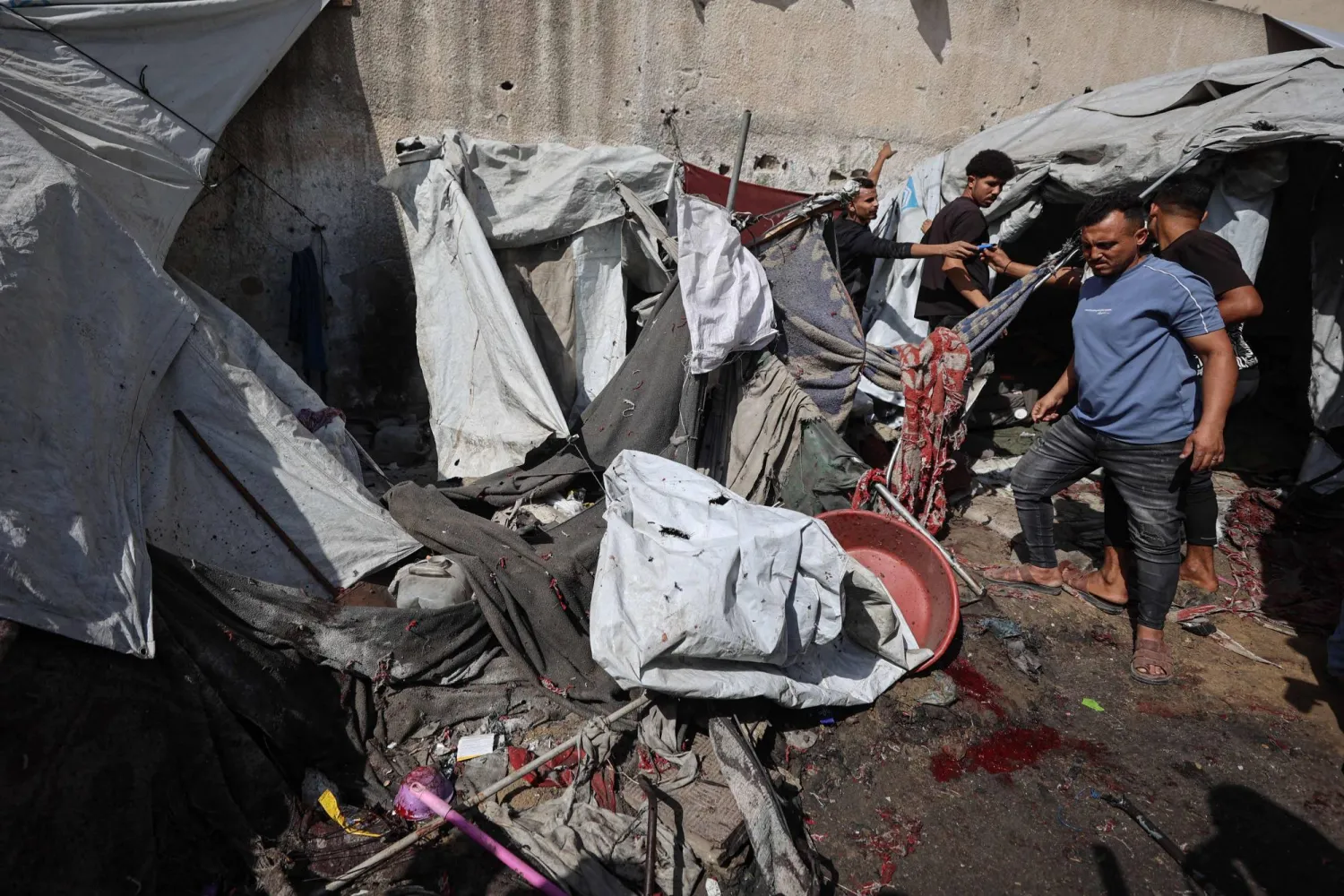
 Palestinians inspect a destroyed tent and traces of blood on the ground following an Israeli strike that killed three people in Gaza City's Al-Remal neighbourhood on November 1, 2026. (Photo by Omar AL-QATTAA / AFP)
Palestinians inspect a destroyed tent and traces of blood on the ground following an Israeli strike that killed three people in Gaza City's Al-Remal neighbourhood on November 1, 2026. (Photo by Omar AL-QATTAA / AFP)
TT

Areas Controlled by Armed Gangs in Gaza Become Safe Havens for Criminals and Killers

 Palestinians inspect a destroyed tent and traces of blood on the ground following an Israeli strike that killed three people in Gaza City's Al-Remal neighbourhood on November 1, 2026. (Photo by Omar AL-QATTAA / AFP)
Palestinians inspect a destroyed tent and traces of blood on the ground following an Israeli strike that killed three people in Gaza City's Al-Remal neighbourhood on November 1, 2026. (Photo by Omar AL-QATTAA / AFP)

About a week ago, gunmen killed two police officers affiliated with the Hamas government and wounded several others during an operation in Deir al-Balah, central Gaza, to arrest a wanted suspect. The attackers subsequently fled in what was not the first incident of its kind.

Field sources told Asharq Al-Awsat that, within hours of the incident, it became clear that the gunmen had headed toward areas where armed gangs operate east of Deir al-Balah.

According to the sources, areas controlled by armed gangs in the Gaza Strip, primarily located in territories under Israeli military control that account for approximately 70% of the enclave, have become safe havens for criminals, particularly those responsible for killing security personnel.

The sources confirmed that all those who fled to areas where armed gangs operate had committed crimes of a purely criminal nature.

Repeated Incidents

One source said that over the past year and a half, similar incidents had been documented involving gunmen who committed murders, wounded individuals, carried out robberies or engaged in drug trafficking before fleeing to areas controlled by armed gangs.

These gangs exploit such incidents to recruit fugitives into their ranks, taking advantage of their personal circumstances, socioeconomic conditions and the fact that they are wanted by police and judicial authorities.

In the October 26 incident, police officers were attempting to ambush a wanted suspect when he opened fire on them. Other gunmen joined the shooting, killing two officers and wounding several others.

Multiple sources confirmed this account, including the Hamas-run Interior Ministry, which said it was pursuing the suspects and continuing its efforts to maintain security and stability in the Gaza Strip and prevent the spread of lawlessness.

However, some of those involved returned the day after the killings, barricaded themselves inside a house and gathered armed relatives around them.

The sources reported mediation attempts aimed at resolving the dispute and persuading the wanted suspects to surrender to Hamas government security forces, but no agreement has been reached so far.

The families of the two slain officers have demanded swift retribution and insisted that neither those directly involved nor their supporters be allowed to escape punishment.

In a joint statement, the families said that carrying out retribution was the only guarantee of "upholding justice and calming tensions."

Their demands came amid fears of renewed violence that could result in deaths on both sides, particularly after some of those involved in the killings returned to Hamas-controlled areas.

Security Concerns

Armed gangs have become a persistent security concern for Hamas security agencies and other Palestinian factions, which continue to pursue their members, particularly in light of the gangs' involvement in serious security incidents, including assassinations of security officials and abductions of faction activists.

The situation comes as Hamas police and security agencies face severe difficulties investigating and pursuing criminal and security-related offenses across the Gaza Strip because of repeated Israeli attacks against their personnel.

In the latest such incident, several police officers were killed on Sunday while deployed in areas south of Al-Mawasi in Khan Younis, when an Israeli drone struck them as they carried out their duties.

Five officers were killed, including Lieutenant Colonel Mohammed Al-Jamal and Major Bassam Miqdad. Six others, including civilians, sustained injuries of varying severity.

Gaza's Interior Ministry described the attacks as "systematic," saying they had killed 75 police officers and personnel since the ceasefire took effect in October 2025.

In a statement, the ministry appealed to the international community to "take urgent action and pressure the occupation to stop its crimes against the police force, which performs civilian duties under the law to preserve citizens' security and safety."

Repeated Attacks

Separately, three Palestinians, including a man and his child, were killed in an airstrike on a crowded street filled with displaced people in the Al-Rimal neighborhood of western Gaza City.

The man's wife and their other child sustained serious injuries.

The strike occurred during a period of heavy movement by residents, displaced people and schoolchildren, leaving several others wounded, some critically.

A Hamas source told Asharq Al-Awsat that Jamal Abu Isaid, a commander in the Al-Qassam Brigades, the movement's military wing, was among those killed in the strike.

Only minutes separated the first airstrike, which targeted police officers in Khan Younis, from the second, which struck a group of civilians in Gaza City.

Around midday Sunday, several Palestinians were also wounded, including a woman in critical condition, when Israeli military vehicles opened fire toward the Halawa displacement camp in Jabalia al-Balad, northern Gaza.

Another Palestinian was reported to have died from critical injuries sustained several days earlier in the village of Al-Masdar in central Gaza.

The latest deaths brought the number of Palestinians killed since the ceasefire came into effect to more than 1,585, with over 5,700 others wounded.

During October, Israeli airstrikes across the Gaza Strip killed more than 143 Palestinians, including 22 children, according to figures from the enclave's Health Ministry.