


Ukrainian Dam Breach: What Is Happening and What’s at Stake 

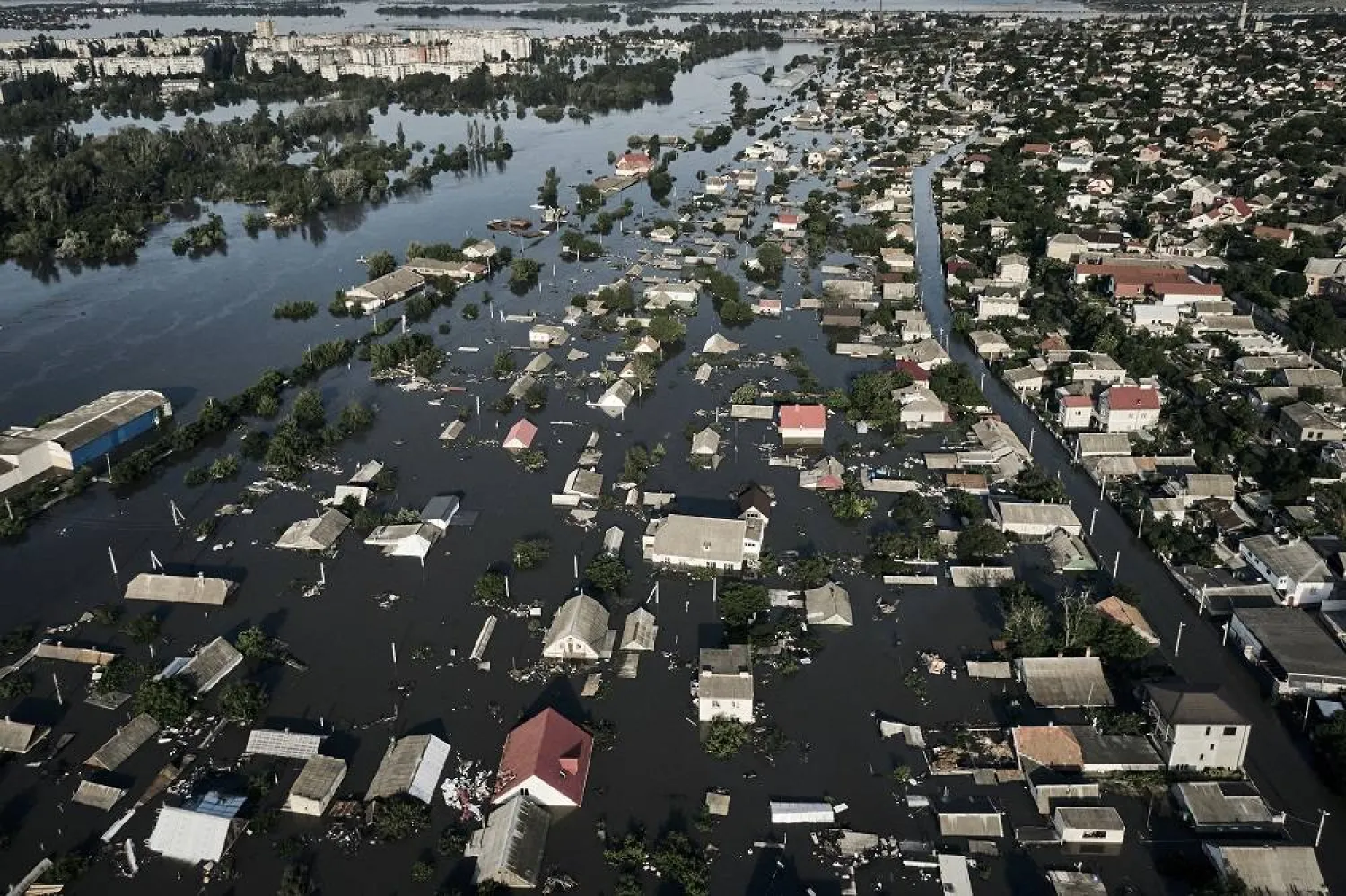
Streets are flooded in Kherson, Ukraine, Wednesday, June 7, 2023 after the walls of the Kakhovka dam collapsed. (AP)
TT

Ukrainian Dam Breach: What Is Happening and What’s at Stake 

Streets are flooded in Kherson, Ukraine, Wednesday, June 7, 2023 after the walls of the Kakhovka dam collapsed. (AP)

The fallout from the breach of a river dam along a frontline of Russia's war in Ukraine continued to wreak havoc on lives, livelihoods and the environment on Wednesday.

The dramatic rupture of the Kakhovka dam that upheld Ukraine's largest reservoir began releasing a torrent of water a day earlier in areas where tens of thousands of people live along the Dnieper River. The river's southernmost portion has become a makeshift dividing line between the fighting sides.

It's not clear what caused the breach on the dam, which was already damaged in the war. Ukraine accused Russian forces of blowing up the facility, while Russian officials blamed Ukrainian military strikes.

What are the latest developments?

Authorities and rescue workers on both sides stepped up efforts Wednesday to pull beleaguered residents to higher and drier ground, a day after torrential flooding from the dam breach inundated their homes, villages and cities.

Ukrainian President Volodymyr Zelenskyy wrote on Telegram that hundreds of thousands of people were without normal access to drinking water.

The Russia-appointed mayor of the occupied city of Nova Kakhovka, Vladimir Leontyev, said seven people were missing. The city sits near the dam.

In Ukrainian-controlled areas on the western side, Oleksandr Prokudin, the head of Kherson Regional Military administration, said water levels were expected to rise by another meter (about 3 feet) over the next 20 hours.

UN Secretary-General Antonio Guterres said Tuesday that at least 16,000 people have already lost their homes, and the UN’s humanitarian aid coordinator said efforts are underway to provide water, money, and legal and emotional support to those affected.

The head of the UN's International Atomic Energy Agency, Rafael Mariano Grossi, tweeted about “concerning developments” in the wake of the dam breach and said he will travel next week to the Zaporizhzhia nuclear power plant, which sits upstream. IAEA said Tuesday there was “no immediate risk" to the safety of the plant,” whose six reactors have been shut down for months but still need water for cooling.

Why is the dam important?

The 30-meter-high (98-foot-high) dam and associated hydroelectric power station are located about 70 kilometers (44 miles) east of the city of Kherson — a flashpoint of the conflict in a region that Russia has claimed to have annexed but does not fully control.

Together with the power station, the dam helps provide electricity, irrigation and drinking water to a wide swath of southern Ukraine, including the Crimean Peninsula, which was illegally annexed by Russia in 2014.

Ukraine's vast agricultural heartland, which is partially fed by the Dnieper river, is crucial to worldwide supplies of grain, sunflower oil and other foodstuffs. Global wheat and corn prices rose Tuesday on concerns that production might be disrupted.

The dam — one of the world's biggest in terms of reservoir capacity — retained a volume of water nearly equivalent to that of the Great Salt Lake in the United States.

What has happened to the dam during the war?

Russia has controlled the dam since the early days of the war, and Moscow and Kyiv have accused each other of shelling it. Ukraine said the troops occupying it detonated explosives last fall that damaged three sluice gates, which help regulate water levels. Signs of damage to the gates were evident in late May.

Even before the devastation wrought by Tuesday’s breach, hydropower generation was at a fraction of peak levels. Ukrainian officials and independent experts say Russian forces have failed to maintain the dam — built in the 1950s — either deliberately or through neglect.

Earlier this year, water levels in the reservoir were so low that many across Ukraine and beyond feared a meltdown at the Russian-occupied Zaporizhzhia nuclear power plant. Since mid-February, the water level has steadily increased, according to data from Theia, a French provider of geospatial analysis.

The Ukrainian company that manages the dam and power plant estimates that it will take about four days for the reservoir to reach equilibrium and stop discharging massive amounts of water.

Who and what is at risk?

As floodwaters swelled, both Russian and Ukrainian authorities ordered evacuations from among at least 80 towns and villages at risk on both sides of the river, though neither side reported any deaths.

Officials said about 22,000 people live in areas at risk of flooding in Russian-controlled areas, while 16,000 live in the most critical zone in Ukrainian-held territory.

Ukraine’s Energy Ministry said there is a risk of flooding at energy facilities in the Kherson region. Nearly 12,000 customers in the city of Kherson have already been left without electricity, and water supplies are also at risk.

Experts warned about the possibility of an environmental disaster for wildlife and ecosystems — in Ukraine and beyond.

The biggest impact of the breach is likely to be upstream, said Mark Mulligan, a professor of physical and environmental geography at King’s College London and co-leader of the Global Dam Watch, a project that monitors dams and reservoirs.

“This huge reservoir is going to drain down and the shallows upstream are going to dry out,” causing ecological damage to aquatic vegetation and wildlife that have relied on the water for seven decades, he said. The rapid flow of freshwater into the Black Sea could also damage fisheries and the wider ecology of the northwest part of the sea.

What does it mean for the war?

Ukrainian officials said the Russians destroyed the dam to prevent Ukraine from launching a counteroffensive in the area, while Russian officials claimed that Ukraine destroyed the dam to prevent a potential Russian attack on the western bank.

Either way, the destruction of the dam severs a key crossing of the country's most important river. The dam served as a bridge, enabling vehicles to pass over; its destruction also unleashed torrents of water, making it harder to cross the river by other means.

Since last fall, the lower portion of the Dnieper has made up an important part of the front line that stretches more than 1,000 kilometers (620 miles).

The crossing repeatedly came under rocket fire as Ukrainian forces led a successful counteroffensive in November that drove Russian forces back across the Dnieper.

Ukraine's military has used groups of scouts to try to gain control of small islands near the Russia-controlled eastern bank and areas in the river’s delta. But experts say a broader offensive would involve major risks and logistical challenges.

Crossing the wide river was always seen as a daunting task for the Ukrainian military. Most observers expected it to launch a counteroffensive elsewhere.

Ukrainian military analyst Oleh Zhdanov said that the flooding would make crossing the river even more difficult, noting that it would impact the minefields on the Russia-controlled eastern bank. “Minefields were flooded, mines will be washed off and no one knows where they will surface,” he said.


AI Tsunami Plunges Millions into Unemployment

“Artificial intelligence in the physical world” is displayed on a screen during a conference showcasing advances in autonomous driving technology in California on Dec. 11, 2025. (Reuters)
TT

AI Tsunami Plunges Millions into Unemployment

“Artificial intelligence in the physical world” is displayed on a screen during a conference showcasing advances in autonomous driving technology in California on Dec. 11, 2025. (Reuters)

The year 2025 brought no respite for Lebanese language editor and proofreader Hamida Al-Shaker. Before the year had run its course, her decades-long professional journey was abruptly cut short.

Nearly 60, Al-Shaker had never used artificial intelligence tools or held a conversation with ChatGPT, as millions now do. She was unaware that the technologies rapidly spreading across mobile phones and computers were already doing her job, faster and more efficiently than any human could.

That quiet technological advance proved devastating. A sweeping transformation in the labor market became a tsunami, pushing Al-Shaker and millions of workers worldwide toward unemployment, sparing no sector and few age groups. The impact has been particularly harsh on employees over 50 who failed to keep pace with the accelerating speed of technological change.

According to the website allaboutai, the adoption of artificial intelligence has already contributed to the loss of around 14 million jobs globally. And the wave is far from over. As many as 92 million jobs could disappear worldwide over the next five years.

At its core, artificial intelligence enables computer systems to mimic human thinking, make decisions, and execute complex tasks, from planning to practical application, particularly in editorial and knowledge-based work.

Shock and an uncertain future

Al-Shaker was unaware of this reality, a fact that led to a shock, followed by another, during 2025, which saw the widest spread yet of AI applications. The first shock came when she received a call from the human resources department informing her that her salary would be cut by 50 percent due to “financial difficulties facing the company.” Less than five months later, a second call informed her that she was being laid off, without explanation.

According to Al-Shaker, citing her department head, she was not alone. Half of the team lost their jobs due to the impact of artificial intelligence on client contracts, as companies increasingly turned to AI to draft their news, statements, and reports, either for free or at minimal monthly subscription costs, compared with the sums they previously paid to public relations and advertising agencies.

In this context, economic analyses published by Reuters indicate that annual subscriptions to advanced AI tools, even at the enterprise level, often do not exceed the cost of paying a single employee’s salary for a limited number of months. From a purely managerial perspective, this makes such decisions easy to justify financially.

As a result, Al-Shaker and her colleagues became just another figure in a cold equation. Companies boost profits and cut production costs, while growing numbers of workers are pushed out of the labor market, not because they lack competence, but because algorithms are cheaper than people.

Most affected sectors

Al-Shaker’s story is not an isolated case. It is part of a growing global phenomenon affecting workers across multiple sectors. Specialized reports indicate that jobs based on routine tasks or repetitive data processing are most vulnerable, as automation and generative AI tools expand. Among the most affected sectors are:

Customer service and call centers, where intelligent chat systems and text and voice analysis tools can now handle user inquiries with high efficiency, according to TechRT.

Data and administrative support tasks, such as data entry, file classification, and secretarial work, are being replaced by advanced automation tools, according to Complete AI Training.

Retail and supply chains, where self-checkout systems, smart warehouses, and inventory automation have reduced the need for cashiers and traditional warehouse workers, according to Pleeq Software and ninjatech.blog.

Manufacturing and production, where the spread of robots and automated control systems has intensified the impact of AI on manual labor jobs, according to All About AI.

Accounting and financial operations, where demand for basic roles has declined due to reliance on intelligent financial software capable of handling bookkeeping and routine processes, according to Complete AI Training.

Content creation and media, which have not been spared, are now threatened as AI is capable of writing, summarizing, and rewriting content, posing a challenge to a range of basic writing tasks.

Many workers who lost their jobs do not realize that they are victims of the so-called Fourth Industrial Revolution, which Klaus Schwab, founder and executive chairman of the World Economic Forum at the time, warned about years earlier.

Speaking at the World Government Summit in Dubai in 2016, Schwab said the world was “on the brink of a technological revolution that will fundamentally alter the way we live, work, and relate to one another.”

He added that the scale, scope, and complexity of the changes would be unprecedented, and that while their exact shape remained unclear, the response would have to be integrated and comprehensive across the public and private sectors, academia, and civil society.

Market demands and human skills

Much of what Schwab predicted has now come to pass, particularly in recent months, as companies worldwide accelerate their adoption of AI tools. Experience alone is no longer enough to remain competitive in the labor market. Traditional jobs are changing rapidly, and the required human skills have become more specialized and complex, with greater emphasis on working alongside intelligent systems and turning information into added value.

Professionals who understand how to integrate AI tools into their daily work without sacrificing quality or analytical depth are increasingly in demand, according to Maziad Hijaz‏, Editor-in-Chief at Hewar Group‏ in Riyadh.

Hijaz told Asharq Al-Awsat that artificial intelligence has become an essential part of daily work in terms of speed and volume, while review, editing, and analysis remain entirely human responsibilities to ensure quality.

He added that the sector now requires new skills, and those who fail to adapt will be left behind. These include utilizing AI tools for writing and analysis, developing data literacy, employing predictive analysis, and transforming information into compelling narratives. Combining human skills with AI tools is what ensures excellence.

Firas Barakat, a strategic communications expert in Saudi Arabia, said AI represents a pivotal turning point in labor markets, enhancing efficiency while reshaping the nature of jobs and required skills.

Speaking to Asharq Al-Awsat, Barakat said AI has undoubtedly caused the loss of traditional roles involving routine tasks, but at the same time, it is a major engine for generating new jobs in advanced fields such as data analysis, cybersecurity, smart systems management, and digital solutions engineering, roles that did not exist just a few years ago.

History repeats itself

Technology expert Hassan Yahya, based in the United States, offered a historical perspective. He said this is not the first time the world has been stunned by technological advances, noting that similar fears over job losses have accompanied every major innovation.

He pointed to 1959, when General Motors introduced the industrial robot Unimate, triggering widespread warnings about threats to employment.

Yahya said that AI is already affecting millions of jobs, with projections from the World Economic Forum indicating that 92 million jobs will disappear over the next five years. However, more than 170 million new jobs are expected to be created, meaning a fundamental transformation of work rather than mass unemployment.

He added that eliminating jobs without replacing them does not serve companies or economies, making the creation of new roles inevitable. However, this requires learning how to work with AI, as ignoring the shift could leave many people outside a rapidly changing labor market.

Cost-cutting and profit maximization

The experiences of employees cannot be separated from a recurring economic equation that is evident in thousands of companies worldwide. Instead of retaining experienced staff with associated salaries, insurance, and end-of-service benefits, many firms are opting to replace them with AI.

A World Economic Forum report found that 41 percent of global companies plan to reduce their workforce by 2030 due to increased reliance on AI and automation.

Hijaz said AI adoption has also reshaped relationships with clients, accelerating work and significantly improving quality. He cited a Deloitte study showing that integrating AI into public relations reduced content production time by 25 to 35 percent while improving accuracy.

A market worth billions

The gains are split between business owners and AI companies, whose financial returns contrast sharply with the reality faced by thousands of displaced workers. In mid-2025, a Reuters report stated that OpenAI, the developer of ChatGPT, had reached annual revenues of around $10 billion by the end of the first half of the year, on track to exceed $12.7 billion by year's end, driven by surging demand for its services.

This growth is not limited to OpenAI. A Forbes report showed that other global technology companies with AI divisions are generating billions of dollars in additional annual revenue, making AI one of the most important profit sources for major tech firms, even as some lay off staff to improve cost efficiency.

Key players

The main players in the sector include OpenAI, best known for ChatGPT and a leader in large language models, with a strategic partnership with Microsoft.

Google DeepMind follows, having developed powerful models such as Gemini and AlphaGo, and leading in scientific, medical, and research-oriented AI.

Microsoft itself has become a global force in AI, investing billions in OpenAI and integrating AI across Windows, Office through Copilot, and Azure AI.

NVIDIA focuses on developing the chips and processors that power AI, while Meta offers open-source models such as LLaMA. Amazon Web Services leads in cloud-based AI, and Anthropic has emerged as a strong competitor in the field of language models.

The global AI market was estimated at around $747.9 billion in 2025 and is projected to grow to $2.74 trillion by 2032, according to AffMaven.

Concerns over consequences

The stark contrast between multibillion-dollar AI revenues and the growing risk facing millions of workers raises a central ethical and economic question. Why do companies benefit from technology to cut costs and boost profits while often postponing or ignoring their social responsibility toward displaced employees?

Economists warn that such savings are frequently achieved without genuine retraining efforts or alternative job creation, deepening global unemployment rather than addressing it.

Islam Al-Shafii, an economist based in New York, cited remarks by US Federal Reserve Chair Jerome Powell on Dec. 20, warning of waves of layoffs linked to AI or companies halting job postings for the same reason.

Al-Shafii said the current fear of AI remains precautionary, as it has not yet fully replaced humans. The real risk, he said, is that work previously requiring five employees can now be done by one person using AI.

He added that while some professions remain relatively safe for now, such as skilled trades, concerns persist over safety and decision-making, with international organizations expressing reservations.

Breaking monopolies

Yahya argued that confronting these changes requires breaking three major monopolies: the monopoly of university degrees in hiring, as companies like Google and Dell focus on skills rather than diplomas; the technological monopoly, as AI empowers individuals to execute ideas without large teams; and the language monopoly, as AI allows interaction in native languages, opening the digital economy to millions.

The digital economy is expected to exceed $24 trillion by 2025, accounting for approximately 21 percent of the global economy and growing faster than traditional sectors.

Capitalism under strain

Al-Shafii warned that advanced capitalist societies, which rely heavily on tax revenues from employees, could face systemic strain if jobs are replaced by AI. Without a sufficient tax base, governments may struggle to fund essential services, which can potentially lead to social instability and collapse.

He noted that business owners who once built factories in East Asia for cheap labor are now returning home to rely on robots for production.

United Nations concern

The issue has also reached the United Nations, particularly at its headquarters in New York. Al-Shafii stated that there is a deep concern over AI, but institutions often focus on gains while overlooking the associated losses.

He noted that AI supports many sustainable development goals and cybersecurity efforts, but its negative aspects, including cyber fraud and surveillance risks, have yet to be fully addressed. UN Secretary-General Antonio Guterres has repeatedly warned against militarizing AI and entrusting humanity’s future to algorithms.

Threat or opportunity?

Concerns over AI extend beyond job losses to issues of transparency and information security. Hijaz said AI requires greater responsibility to ensure accuracy and disclosure.

Asked whether AI is a threat or an opportunity, he said it is an inevitable development that must be harnessed. Like the computer and the internet before it, initial fears will likely give way to empowerment.

He added that creativity remains a uniquely human value that AI cannot replace, and that technology enhances rather than eliminates it.

Not a replacement

Translation professor Mohammed Khair Nadman told Asharq Al-Awsat that AI tools now save around 60 percent of time in translation and writing, supporting but not fully replacing human work. He warned that AI can still make serious errors, making human oversight essential.

A final attempt

Al-Shaker, living in crisis-hit Lebanon without a private sector pension system, believed her regional company job was secure. After losing it, she tried to catch up, creating a LinkedIn account, registering on job platforms, taking free online courses, and sending dozens of resumes, often receiving automated or no responses.

Her story reflects the dilemma of an entire generation pushed out of the market, not due to lack of competence, but because the rules changed abruptly.

She ended with a bitter question: Nearly two centuries after the Industrial Revolution sparked the call, “Workers of the world, unite,” will there now be a call saying, “Employees of the world, unite?”


New Year Brings New Mayor for New York City

New York City mayor-elect Zohran Mamdani listens to a reporter's question during a press conference in New York City, US, December 22, 2025.  (Reuters)
New York City mayor-elect Zohran Mamdani listens to a reporter's question during a press conference in New York City, US, December 22, 2025. (Reuters)
TT

New Year Brings New Mayor for New York City

New York City mayor-elect Zohran Mamdani listens to a reporter's question during a press conference in New York City, US, December 22, 2025.  (Reuters)
New York City mayor-elect Zohran Mamdani listens to a reporter's question during a press conference in New York City, US, December 22, 2025. (Reuters)

New York mayor-elect Zohran Mamdani is set to become the US city's first Muslim mayor, and the youthful optimism of his Democratic Socialist platform will be put to the test as he takes office Thursday for a four-year term that faces high expectations.

- Festive swearing in -

Just after the stroke of midnight on New Year's Eve, New York Attorney General Letitia James -- friend to Mamdani, foe to President Donald Trump -- will swear in the new mayor. In a high-stakes tit-for-tat, James recently sued Trump, and he tried to have her indicted in return.

At midday, left-wing icon and Vermont Senator Bernie Sanders will preside over a ceremony outside City Hall.

At a neighborhood celebration, festivities will echo "one of his core messages... that this is a great city, and we like living here," said Lincoln Mitchell, a Columbia University political science professor.

- Policy agenda -

The mayor-elect, an avowed socialist, campaigned on addressing the prohibitive cost of living in the metropolis of 8.5 million.

One of his key proposals is freezing rent on more than a million apartments, but it's unclear if the city board that handles rent control -- packed with appointees of outgoing Mayor Eric Adams -- will be supportive.

Details of Mamdani's other campaign promises -- the construction of 200,000 units of affordable housing, universal access to childcare, publicly owned supermarkets and free buses -- have yet to be spelled out.

But Mamdani has one ace in his pocket: an excellent relationship with New York Governor Kathy Hochul, who approves measures like the tax hikes he seeks.

Once an election is over, "symbolism only goes so far with voters. Results begin to matter a whole lot more," New York University lecturer John Kane said.

- Opposition to Trump -

Despite expectations to the contrary, the late November Oval Office meeting between Trump and Mamdani was cordial and calm.

Mamdani "wisely sought a point of common ground with Trump: wanting to make New York City a better place to live," Kane said.

Trump can "be surprisingly gregarious toward those that he perceives to have little leverage over," Kane added.

Federal immigration officers are increasingly active in New York, which could become a flashpoint.

- Reassuring the public -

At 34, Mamdani is one of New York's youngest mayors and his political resume is short -- he's held office once previously, as a local representative in the State Assembly.

To compensate, he is surrounding himself with seasoned aides, recruited from past mayor's offices and former president Joe Biden's administration.

Mamdani has also already opened dialogue with business leaders, some of whom predicted a massive exodus of wealthy New Yorkers if he won. Real estate sector leaders debunked those claims in recent weeks.

As a defender of Palestinian rights, the mayor -- Muslim and of Indian origin -- will also have to reassure the Jewish community of his inclusive leadership style.

Recently, one of his hires resigned after it was revealed she had posted antisemitic tweets years ago.

- 'Cultural figure' -

"The mayor of New York is always a cultural figure," Mitchell said.

Mamdani has already captured some of his generation's cultural trappings with his brief forays into rap music, improv classes in Manhattan, and wearing what the New York Times called "the quintessential entry-level suit for a 30-something striving to be taken seriously."

New Yorkers have also noted his enthusiastic support of his wife, Syrian-born artist Rama Duwaji, with approval.

Her Instagram account has gained more than a million followers since November, according to Social Blade statistics.

And on the cover of The Cut, New York magazine's revered fashion and culture publication, she recently marked her own path -- the hallmark of every young generation of city dwellers striving to make it there.

"At the end of the day, I'm not a politician. I'm here to be a support system for Z and to use the role in the best way that I can as an artist," she said.


'Shivering from Cold and Fear': Winter Rains Batter Displaced Gazans

Displaced Palestinians walk past a large pool of standing water in Gaza City. Heavy winter rains have have made an already precarious life worse for displaced Gazans © Omar AL-QATTAA / AFP
TT

'Shivering from Cold and Fear': Winter Rains Batter Displaced Gazans

Displaced Palestinians walk past a large pool of standing water in Gaza City. Heavy winter rains have have made an already precarious life worse for displaced Gazans © Omar AL-QATTAA / AFP

It only took a matter of minutes after the heavy overnight rain first began to fall for Jamil al-Sharafi's tent in southern Gaza to flood, drenching his food and leaving his blankets sopping wet.

The winter rains have made an already precarious life worse for people like Sharafi, who is among the hundreds of thousands in the Palestinian territory displaced by the war, many of whom now survive on aid provided by humanitarian organizations, AFP reported.

"My children are shivering from cold and fear... The tent was completely flooded within minutes," Sharafi, 47, said on Sunday.

"We lost our blankets, and all the food is soaked," added the father of six, who lives in a makeshift shelter with his children in the coastal area of Al-Mawasi.

A fragile ceasefire between Israel and Hamas has been in place since October 10, following two years of devastating fighting.

But despite the truce, Gazans still face a severe humanitarian crisis, and most of those displaced by the war have been left with little or nothing.

Families are crowded into camps of tents hastily erected from tarpaulins, which are often surrounded by mud and standing water when it rains.

"As an elderly woman, I cannot live in tents. Living in tents means we die from the cold in the rain and from the heat in the summer," said Umm Rami Bulbul.

"We don't want reconstruction right now, just provide us and our children with mobile homes."

Nighttime temperatures in Gaza have ranged between eight and 12 degrees Celsius in recent days.

- Insufficient aid -

Nearly 80 percent of buildings in the Gaza Strip have been destroyed or damaged by the war, according to United Nations data.

And about 1.5 million of Gaza's 2.2 million residents have lost their homes, said Amjad Al-Shawa, director of the Palestinian NGO Network in Gaza.

Of more than 300,000 tents requested to shelter displaced people, "we have received only 60,000", Shawa told AFP, pointing to Israeli restrictions on the delivery of humanitarian aid into the territory.

The UN refugee agency for Palestinians, UNRWA, said the harsh weather had compounded the misery of Gazans.

"People in Gaza are surviving in flimsy, waterlogged tents & among ruins," UNRWA chief Philippe Lazzarini wrote on X.

"There is nothing inevitable about this. Aid supplies are not being allowed in at the scale required."

COGAT, the Israeli defense ministry body responsible for Palestinian civilian affairs, said in mid-December that "close to 310,000 tents and tarpaulins entered the Gaza Strip recently" as part of an increase in aid under the ceasefire.

Earlier this month, Gaza experienced a similar spell of heavy rain and cold.

The weather caused at least 18 deaths due to the collapse of war-damaged buildings or exposure to cold, according to Gaza's civil defense agency, which operates under Hamas authority.

On December 18, the UN's humanitarian office said that 17 buildings collapsed during the storm, while 42,000 tents and makeshift shelters were fully or partially damaged.

"Look at the state of my children and the tent," said Samia Abu Jabba.

"I sleep in the cold, and water floods us and my children's clothes. I have no clothes for them to wear. They are freezing," she said.

"What did the people of Gaza and their children do to deserve this?"
