

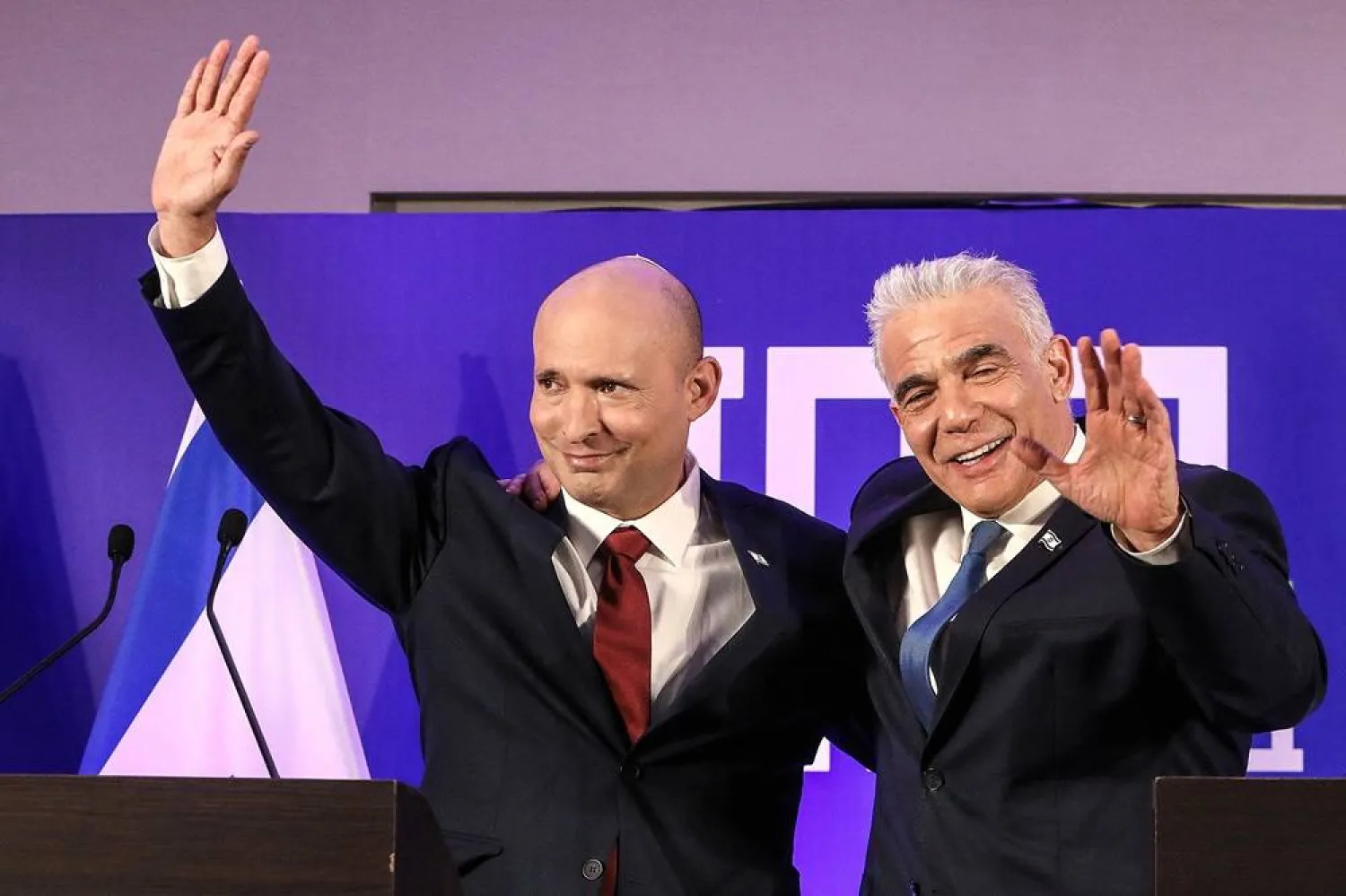

Netanyahu’s Rivals Are Joining Forces. Would They Shift Israel’s Security Policy?

Former Israeli Prime minister Naftali Bennett and Israeli opposition leader Yair Lapid gesture as they announce their political union ahead of this year's general election, the new party will be called "Together", in Herzliya, Israel April 26, 2026. (Reuters)
TT

Netanyahu’s Rivals Are Joining Forces. Would They Shift Israel’s Security Policy?

Former Israeli Prime minister Naftali Bennett and Israeli opposition leader Yair Lapid gesture as they announce their political union ahead of this year's general election, the new party will be called "Together", in Herzliya, Israel April 26, 2026. (Reuters)

Two of Israeli Prime Minister Benjamin Netanyahu's top rivals announced they would join forces in ‌an upcoming election to oust his coalition government, with a focus mainly on domestic issues such as military conscription for the ultra-Orthodox.

But on issues like Iran, Gaza and Lebanon, the joint party led by right-wing Naftali Bennett and centrist Yair Lapid is expected to pursue a security posture similar to that of Netanyahu - who heads the most right-wing government in Israel's history - meaning Israel's foreign policy would remain largely unchanged.

The new party, called "BeYachad" meaning "together" in Hebrew, has not released a formal policy platform. But below is what is known about their positions on regional conflicts, based on recent public comments.

IRAN

Bennett, 54, and Lapid, 62, have staunchly backed Netanyahu's decision to jointly attack Iran with the US, reflecting broad public support in Israel for the war.

At the start of Israel's aerial bombardment in Iran, Lapid told Reuters in an interview that it was a "just war against evil."

Both Bennett and Lapid have since criticized Netanyahu, 76, for what they describe as a failure to achieve Israel's main objectives in the war, including toppling Iran's clerical government.

However, neither man has called for a resumption in fighting since Israeli and US attacks and Iranian missile ‌fire was halted by ‌an April 8 ceasefire.

A source close to their new party described Bennett and Lapid as "hawkish" ‌and "tough on ⁠Iran."

They are also "pragmatic ⁠and understand the need for diplomatic agreements and the work that happens after the military use of force to achieve strategic goals," said the source, who spoke on condition of anonymity to describe their party's priorities.

LEBANON

Bennett and Lapid have also both staunchly supported Israeli military operations in Lebanon while questioning an April 17 ceasefire that has failed to halt fighting between the Israeli military and Iran-backed Hezbollah.

Shortly before Israel's military invaded southern Lebanon in March, Lapid said that Israel must take whatever steps were necessary to protect Israelis.

After the ceasefire with Hezbollah was announced in April, Lapid said the only solution was the permanent removal of the threat to northern Israel.

Bennett sharply criticized the ceasefire, saying in an April 17 Facebook ⁠post: "One can already count backwards towards the next round. Hezbollah began this morning to rebuild southern Lebanon ‌and is becoming stronger with missiles ahead of the next round."

GAZA

On the war in ‌Gaza, where Israel has continued to carry out deadly strikes despite a ceasefire last October, both Bennett and Lapid have criticized Netanyahu for not ‌fully destroying the Hamas group after the October 7, 2023 attack on Israel that it led.

In January, Lapid said Netanyahu's government ‌had achieved the "worst possible outcome" in Gaza, saying that Hamas still has tens of thousands of armed fighters. Hamas retained control of a sliver of territory on Gaza's coast under the ceasefire.

In a Facebook post this month, Bennett said Netanyahu's policies -- including allowing some aid into the enclave after restricting all humanitarian supplies for three months in 2025 -- had helped Hamas regain control.

"This is with the help of hundreds of aid trucks that Netanyahu's government brings ‌them every day," Bennett wrote.

Netanyahu has cast Israel's devastating military assault that destroyed much of Gaza and killed more than 72,000 Palestinians as a success. He has held out the ⁠possibility of resuming a full-scale war if ⁠Hamas fails to disarm under a US-backed process, something the group has thus far rejected.

PALESTINIAN STATEHOOD

With public opinion polling showing that most Israelis oppose the formation of an independent Palestinian state in the occupied West Bank, Gaza and East Jerusalem, a Bennett-Lapid government would be unlikely to bring a major policy shift on the Palestinians.

Netanyahu opposes the establishment of a Palestinian state, and his government has accelerated settlement building plans in the West Bank, in what ministers in his government say is part of a bid to destroy any future for Palestinian independence.

In 2022, Lapid, who like many in Israel's political center and left are not outright opposed to Palestinian sovereignty, said that a two-state solution to the Israeli-Palestinian conflict was the right thing to do.

When asked by US broadcaster ABC during a 2024 interview why he opposes a two-state solution, Bennett said he believed it would lead to violence against Israelis.

"What we've learned over the past 30 years is that every time we gave the Palestinians a piece of land, instead of building it into a beautiful Singapore they turned it into a terror state and began killing Israelis," Bennett said.

On the West Bank, Netanyahu, Bennett and Lapid have all spoken forcefully against settler violence toward Palestinians. Such attacks have escalated under Netanyahu, who critics accuse of allowing settlers free rein to burn Palestinian villages and harm villagers. Netanyahu's office denies this.



As Some Hijabs Come Off in Iran, Restrictions Still in Place

Iranian women walk along a busy street in Tehran on April 25, 2026. (AFP)
TT

As Some Hijabs Come Off in Iran, Restrictions Still in Place

Iranian women walk along a busy street in Tehran on April 25, 2026. (AFP)

Images of bareheaded women sipping coffee in cafes in Tehran, in apparent defiance of the country's strict dress rule, have stirred interest outside Iran -- but for Elnaz, 32, it is no breakthrough.

"It is not at all a sign of any change in the government in my opinion. Because no achievement has been made regarding women's rights," said Elnaz, a painter in Tehran, who like other women in the capital and elsewhere contacted by AFP in Paris asked that her full name not be published.

"Under the surface, in reality, no real change has taken place in people's freedom, especially when it comes to women's basic rights," she said.

Wearing the headscarf in public has been mandatory for women since shortly after the revolution of 1979 in what was long seen as an ideological pillar of the clerical leadership.

But enforcement of the rule appears to have slackened, at least in parts of Tehran and other cities.

The trend began following the 2022-2023 protests sparked by the death in custody of Mahsa Amini, who had been arrested in Tehran for allegedly ignoring the dress code.

It continued through the June 2025 war with Israel, January protests sparked by the cost of living and now the war against the US and Israel that is on hold with a ceasefire.

There is little sign of the dreaded white patrol vans of the so-called morality police that used to lurk in squares and on street corners to haul in women deemed to have violated the rules.

But the picture remains mixed and the situation evolving, with wearing hijab still a matter of choice for some women. It is not uncommon even in more liberal areas of Tehran to see women with and without the headscarf walking together.

- Years ago 'only a dream' -

In some areas the change has been startling, with scenes of women casually strolling without a headscarf that would have been unthinkable half a decade ago.

"I'm happy for all of them, because until just three years ago this was only a dream," said Zahra, 57, a housewife from Isfahan in central Iran.

"My youth has passed and I didn't get to have this experience; now I don't wear it anymore, but I wish I could have experienced these days when I was young."

But women can still be summoned by authorities for not wearing hijab, and cafes shut down for failing to enforce the rule, while often women must wear the garment to enter banks, educational establishments and official buildings.

Moreover, the rights of women are still restricted and they live under a system that arrested tens of thousands of people following the January protests and thousands more, including women, in the current war, according to rights groups.

"Beautiful photos of cafes and girls are being shared everywhere, but as cafe owners, we've been paying a lot for that," said Negin, 34, who owns a cafe in Tehran.

"We've been treated very harshly over these years, continuing until this day. We've been shut down multiple times, fined and had to pay bribes... What makes me even angrier is when they call this 'freedom' and they say women are being freer," she added.

- 'More widespread' -

Amnesty International said this month that "widespread resistance" to the obligatory hijab "forced authorities to retreat from the violent mass arrests and assaults of previous years".

"However, authorities continued to use existing laws and regulations to enforce compulsory veiling in workplaces, universities and other public sector institutions, leaving women and girls who resisted facing harassment, assault, arbitrary arrest, fines and expulsion from employment and education," it added.

One noticeable change has been state television broadcasting images of Iranian women not wearing hijab -- but only so long as they back the regime and denounce Iran's enemies in what critics see as a cynical ploy.

"More women are putting their fear aside each day and trying out what it's like to go out without hijab, and it's gradually becoming more widespread," said Shahrzad, 39, a Tehran housewife.

"But I don't see any change in the government system. It's the same as before, aside from those videos of girls going in front of state news cameras without hijab and saying 'my leader, my leader, I will sacrifice myself for him'."

- 'Don't see any significant change' -

The situation is far from uniform across Iran.

Mahsa, a 32-year-old student, said rules and observance are tighter in the major eastern city of Mashhad.

"Before the 12-day war (against Israel in June), in Mashhad they wouldn't let us in anywhere without hijab," she said.

"Now they do let people in, but unfortunately, we haven't had the same level of change that people in Tehran have seen over the past three years."

Farnaz, 41 from Isfahan, which is generally seen as one of Iran's more conservative big cities, said she had been summoned to appear in court over hijab observance later this month.

"In Isfahan, for the past few days they've started sealing cafes again over hijab issues. They didn't even wait for the situation with the war to be clarified.

"Here, you're dealing both with the government and with people. Like before in some neighborhoods, religious people sometimes warn you and harass you. It's not just about the morality police."

"I don't see any significant change," she added.

Maryam, 35, also from Isfahan, said women without hijab would not be served in some banks and shopworkers have to wear it.

"If you are involved in social or economic activity, you are expected to observe hijab."

Zahra, the housewife from Isfahan, said "we paid a very high price to get here", after the crackdown on the Mahsa Amini protests killed hundreds of people according to rights groups.

"Right now, they (the authorities) are just distracted by the war. But after that, who knows what they will do about it," she said.


How a Surgeon Kept a Sudan Hospital Functioning on the War’s Front Line

Dr. Jamal Eltaeb checks a patient at Al Nao Hospital in Omdurman, on the outskirts of Khartoum, Saturday, April 18, 2026. (AP)
TT

How a Surgeon Kept a Sudan Hospital Functioning on the War’s Front Line

Dr. Jamal Eltaeb checks a patient at Al Nao Hospital in Omdurman, on the outskirts of Khartoum, Saturday, April 18, 2026. (AP)

For three years, Dr. Jamal Eltaeb made excruciating choices. Who should live and potentially die? Should he operate without the right medicines if it might save someone's life? How would he find fuel to keep the hospital's lights on?

As Sudan 's war raged around him, only one decision was easy: Keep working.

The orthopedic surgeon was leading Al Nao hospital in Omdurman, just outside the capital, Khartoum, as control of the urban area shifted between Sudan's army and paramilitary fighters. As the front line moved closer and the hospital overflowed with patients, some colleagues lost their nerve and left.

The soft-spoken Eltaeb was a rare surgeon who remained. Even as the hospital was bombed more than once. Even as most medical supplies ran out.

“I weighed the options of staying here, and taking care of your patients and helping other people that need you as a skilled surgeon, rather than choose your own safety,” he told The Associated Press in an interview.

He is one of countless Sudanese who have pitched in to help as the world largely looks elsewhere, distracted by conflicts in the Middle East and Ukraine. He has seen the bodies behind the estimates of tens of thousands of people killed, and what it means — day to excruciating day — when the United Nations warns his country's health system is near collapse.

Nearly 40% of Sudan's hospitals no longer function. Many have been stripped for parts or used by armed groups as bases. Sudan’s army has since retaken the capital, and Al Nao remains one of the area's only functioning health centers.

Oxygen canisters and hospital beds at a war-damaged section of Al Shaabi Hospital in Khartoum, Saturday, April 18, 2026. (AP)

Some operations were done on the hospital floor

Walking through the complex, the 54-year-old showed AP journalists the remnants of some of the hardest months of his life.

Over there was a window that was struck, killing the relative of a patient. And there in the courtyard was the last tent standing of the many erected during the peak of the conflict to accommodate mass casualties.

“We were working everywhere, in tents, outside, on the floor, doing everything to save patients’ lives,” he said.

The work earned Eltaeb the $1 million Aurora Prize for Awakening Humanity, which honors individuals who risk their lives to save others. He gave some of the money to medical and humanitarian groups around the world.

Before the war, staffers said, Al Nao was a quiet hospital with its nearly 100 beds empty much of the time. But when fighting began in Khartoum and the paramilitary Rapid Support Forces captured swaths of the city, patients hurried in.

Eltaeb's own hospital elsewhere closed shortly after the war began in April 2023, and he moved to Al Nao. By July, most of the staff had fled, leaving him in charge.

He and a handful of employees and volunteers struggled to keep the place running. Electricity was out for weeks as the facility relied on the army to supply fuel for generators. Medicines like antibiotics and painkillers ran out.

‘From that moment, we knew that we are a target’

In August, a month after Eltaeb took charge, the hospital was hit for the first time.

“From that moment, we knew that we are a target ... And from that time, they didn’t stop targeting us,” he said. The RSF later struck the hospital three more times.

Normality had crumbled. A father of three, Eltaeb sat in his office and handed out sweets to a steady stream of patients and staff vying for his attention.

Decisions were nearly impossible. On a particularly harrowing day in late 2024, he and his team scrambled to triage over 100 wounded people after a strike hit a nearby market. Eight of them died.

“You choose ... as if you can choose who is going to live and who is going to die,” he said.

The day only got worse. Eltaeb had to decide whether to amputate on children without full anesthetic because they were bleeding heavily and he didn't have time to transport them to the operating room.

Using local anesthetic, he removed an arm and leg of a 9-year-old boy and a leg of his 11 year-old sister.

He now scrolls through photos of such surgeries on his phone, attempting to explain to the world a horror few can grasp.

A member of the military media accompanied the AP during the visit, including during interviews. The AP retains full editorial control of its content.

A guard walks through a war-damaged section of Al Shaabi Hospital in Khartoum, Saturday, April 18, 2026. (AP)

Volunteers delivered supplies by bicycle

The hospital relied on volunteers to keep supplies coming. They would post what they needed on social media, and pharmacists would provide the keys for their long-closed shops and allow volunteers to take medicines and other items for free.

One volunteer, Nazar Mohamed, spent months riding around Omdurman, often on a bicycle, delivering supplies while explosions echoed.

Other donations came from organizations and individuals abroad. A network of Sudanese doctors overseas provided remote advice on coping with mass casualties or what to do when antibiotics or anesthesia ran low.

The hospital's remaining staffers got creative, making beds and crutches out of wood and using clothes instead of gauze for makeshift splints.

The war moves on and support does, too

Fighting has shifted away from the Khartoum area. Some funding-strained organizations that supported Eltaeb's hospital now assist places more in need.

He said there is enough money until June to pay salaries and keep generators running, but they will need some $40,000 a month for the hospital to function.

While some countries have pledged support to help Sudan's reconstruction, there's concern the war with Iran might divert attention and resources.

Hospitals that were hit harder than Al Nao lie in ruins and need much more.

Across town, Dr. Osman Ismail Osman, director of Al Shaabi hospital, said the several hundred thousand dollars the government has provided is a drop in the bucket.

The RSF occupied his hospital during the war. Dusty, broken medical equipment worth millions of dollars is piled up, and chunks of concrete are scattered with metal beds.

The goal of opening the badly damaged hospital for emergency referrals within weeks is ambitious, but medical workers like Eltaeb have learned how to approach the impossible.

“I believe I did my best as a doctor as a Sudanese,” the surgeon said.


Dealing with the Dead in the Ruins of Sudan’s War

This photo taken on April 18, 2026 shows Sudanese Ali Gebbai, a volunteer responsible for handling burial procedures for unidentified bodies in the capital, Khartoum, examines one of the unidentified corpses at the mortuary of Omdurman's Al-Nao Educational Hospital. (AFP)
TT

Dealing with the Dead in the Ruins of Sudan’s War

This photo taken on April 18, 2026 shows Sudanese Ali Gebbai, a volunteer responsible for handling burial procedures for unidentified bodies in the capital, Khartoum, examines one of the unidentified corpses at the mortuary of Omdurman's Al-Nao Educational Hospital. (AFP)

At a makeshift morgue in Khartoum, engineer turned mortician Ali Gebbai clicked through a spreadsheet of the dead. Thousands of entries, each with a photo and burial site, keep a harrowing record of Sudan's war.

Every time the team of volunteers finds a body, they post to social media and wait 72 hours in the hopes that the victim's loved ones will come across the picture and claim the person.

"We photograph every body. We check if there's anything in their pockets to help us identify them, and we mark the spot where we buried them," Gebbai told AFP.

It was a blazing April day and a dead woman lay on the ground of the small, air-conditioned room in the Sudanese capital, her brown-speckled thobe pulled over her face and body.

If no one came to identify her, the team would prepare a clean white shroud, wash her according to Muslim custom and bury her nearby.

It is all anyone in Khartoum can hope for by way of a morgue. And it is far more than what most victims of Sudan's war receive: a shallow grave, hastily dug into the dirt where they fell.

The conflict, now in its fourth year, between Sudan's army and the paramilitary Rapid Support Forces has no confirmed toll, though it has killed at least tens of thousands, and aid workers give estimates of more than 200,000.

"It's disheartening, all these estimations. When you have a population not knowing what has happened, that trauma and the impact cannot be overlooked," Jose Luis Pozo Gil, the International Committee of the Red Cross's deputy Sudan chief, told AFP.

In the year since the army recaptured Khartoum, authorities have exhumed and reburied "around 28,000 people", Hisham Zein al-Abdeen, head of forensic medicine at Sudan's health ministry, told AFP. And they have only cleared a little over half the capital.

Gebbai said he and his teams have buried 7,000 dead since the war began.

Ethnic massacres in Darfur, meanwhile, have killed thousands of people at a time, and this year alone at least 700 died in drone strikes on Kordofan.

- Morgues destroyed -

Across the country, there is nowhere to store the dead, and no way to count them.

During the worst massacres, when firebombs tear through mosques and markets, rescuers routinely run out of shrouds. The dead are buried where they lay, wrapped in their own clothes or plastic bags, often in villages with no clinic to speak of, much less a morgue that can send information to a central authority.

Zein al-Abdeen, one of only two forensic doctors in Khartoum, said the capital's morgues "were already full before the war".

According to the ICRC, Khartoum's four morgues were all forced out of service by the war, but the dead remained inside.

"When we went inside the Omdurman morgue, there were still many bodies. And there hadn't been any electricity for a long time -- you can imagine the state," Pozo Gil said.

The Omdurman morgue was "completely destroyed" in a strike, Zein al-Abdeen said, its compressors looted while bodies lay rotting everywhere they looked.

His team has been exhuming Khartoum's dead for a year, focusing on "those buried in shallow graves, in public spaces, in sewers and along the Nile".

As bullets flew and artillery arched over the river to crash into homes and hospitals, trapped civilians could not reach the next street over, much less the cemetery. So people buried their loved ones in courtyards, at playgrounds and on street corners.

Over three years, it turned Khartoum into an open-air graveyard.

"That leaves a mark on society, it destroys human dignity and it normalizes death," Zein al-Abdeen said.

The same is true for the rest of Sudan: in Darfur, where pools of blood could be seen in satellite images; in al-Jazira, where bodies were dumped in canals; and in Kordofan, where killer drones still stalk civilians.

- Finding the missing -

Most of those exhumed and reburied in Khartoum are identified, Zein al-Abdeen said, by families who buried their loved ones themselves but needed authorities to give them a proper resting place.

But many are not. From every anonymous body, authorities remove a small bone or a piece of hair, in hopes they will one day be identified. But Sudan has no working DNA labs to test the samples, and nowhere to store them until then.

"The safest place to keep the DNA samples is buried separately in the ground, and marked clearly," Zein al-Abdeen told AFP, "or we'll exhume the bodies again later."

According to the ICRC, there are at least 11,000 missing persons in Sudan.

"We know that the lack of closure for families leaves an open wound. In any kind of recovery in the future, in order to find closure, to rebuild trust, the issue of the missing has to be addressed," Pozo Gil said.

Gebbai the mortician spoke with steely-eyed resolve, but it began to crack when he remembered one young man.

"He was looking for his father and his uncle for over a year. When he came to us, he found out they had both been shot dead in the street in the early weeks of the war. It broke him, he collapsed and cried for a long time."

But at last, at least, he could visit their graves.