UN Rights Investigator Aims to Probe Growing Israeli Settler Violencehttps://english.aawsat.com/arab-world/4392716-un-rights-investigator-aims-probe-growing-israeli-settler-violence
UN Rights Investigator Aims to Probe Growing Israeli Settler Violence
A man checks the destruction of parts of a house reportedly attacked by Israeli settlers, in the West Bank village of Jalud, on May 31, 2023. (AFP)
TT
TT
UN Rights Investigator Aims to Probe Growing Israeli Settler Violence
A man checks the destruction of parts of a house reportedly attacked by Israeli settlers, in the West Bank village of Jalud, on May 31, 2023. (AFP)
A member of a UN-mandated independent commission of inquiry said on Tuesday that increasing Jewish settler violence in the occupied West Bank was a "major concern" and announced plans to investigate further.
The West Bank, among territories taken by Israel in the 1967 Middle East war and which Palestinians seek for a state, has seen an increase in violence over the past 15 months with stepped-up Israeli raids amid a spate of Palestinian street attacks. On Tuesday, Palestinian gunmen opened fire near an Israeli settlement, killing four people.
US and European officials have also repeatedly raised the issue of settler attacks on Palestinians, which reached record levels last year and has continued to increase since Prime Minister Benjamin Netanyahu's religious-nationalist government took office in January and accelerated settlement expansion.
"We are very disturbed that violent settler activity has considerably increased in the last months and it's... becoming, in fact, the means through which (Israeli) annexation is insured," said Miloon Kothari, a member of a Commission of Inquiry mandated by the UN Human Rights Council.
The COI addressed the Geneva-based Human Rights Council earlier on Tuesday, accusing Israel's government of placing growing restrictions on Palestinian civil society groups.
Israel, which left its seat empty, said in a statement by its Foreign Minister Eli Cohen that the COI was a "stain on the UN and on the Human Rights Council".
At the same meeting, Israel's closest ally the United States issued a statement on behalf of 27 countries criticizing the COI which, unusually, has an open-ended mandate. The United States left the body in 2018 over what it described as its "chronic bias" against Israel, and only fully rejoined last year.
"We believe the nature of this COI is further demonstration of long-standing, disproportionate attention given to Israel in the Council, and must stop," said US Ambassador Michele Taylor.
Kothari later riposted: "As long as the occupation continues, the United Nations needs to continue to rigorously investigate the situation and therefore, we would like to see a sunset of the Israeli occupation."
The COI was opened in 2021. The council cannot make legally binding decisions, but evidence collected by the inquiries it establishes is sometimes used by international courts.
Israel PM Says Orders Army to Take Control of 70 Percent of Gaza Striphttps://english.aawsat.com/arab-world/5278159-israel-pm-says-orders-army-take-control-70-percent-gaza-strip
Palestinians gather on a heavily damaged street to perform morning prayers marking the start of Eid al-Adha in Khan Younis in the southern Gaza Strip on May 27, 2026. (AFP)
TT
TT
Israel PM Says Orders Army to Take Control of 70 Percent of Gaza Strip
Palestinians gather on a heavily damaged street to perform morning prayers marking the start of Eid al-Adha in Khan Younis in the southern Gaza Strip on May 27, 2026. (AFP)
Israeli Prime Minister Benjamin Netanyahu said Thursday he had ordered the country's military to take control of 70 percent of the Gaza Strip, in defiance of the terms of a fragile ceasefire that took effect in October.
"We are currently squeezing Hamas. We now control 60 percent of the territory in the strip," he said at a conference in an occupied West Bank settlement, according to a video aired by Israel's Channel 12 network.
He said the military had controlled 50 percent of Gaza under the terms of the ceasefire, adding: "My directive is to move to... 70 percent".
"We're squeezing them from all (sides). We'll deal with what's left afterwards."
The first phase of the truce saw the last hostages seized in Hamas's October 7, 2023 attacks on Israel, which triggered the war in Gaza, released in exchange for Palestinians detained by Israel.
The transition to the second phase, which was supposed to involve Hamas's disarmament and a gradual withdrawal of the Israeli army, has been stalled for months.
Under the terms of the ceasefire, Israeli forces were to pull back behind a so-called "yellow line", a demarcation between the area under Hamas control and that held by the Israeli army.
Netanyahu announced on May 15 that the Israeli army had expanded its grip on the Gaza Strip.
"There were those who said: get out, get out. We did not get out. Today we control... how much? 60 percent. Tomorrow we shall see," he said at the time.
Gaza remains gripped by daily violence, with both the Israeli military and Hamas accusing one another of violating the truce in effect since October 10.
Israel has killed more than 900 people since the ceasefire, according to Gaza's health ministry, which operates under Hamas authority and whose figures are considered reliable by the United Nations.
Israel said on Wednesday it had killed the new head of Hamas's armed wing in Gaza, Mohammed Odeh, after killing his predecessor earlier this month.
Since Hamas's October 2023 attack, Israel has systematically targeted the group's leaders, both in Gaza and across the region.
Odeh is the fourth head of the Ezzedine Al-Qassam Brigades that Israel says it has killed since the start of the Gaza war.
On Wednesday, Israeli Defense Minister Israel Katz repeated Israel's goal of ending Hamas's rule over the Palestinian territory and alluded to a plan for the forced displacement of its residents.
"The plan for voluntary migration from Gaza will also be implemented -- everything will be done at the right time and in the right way," he said.
Between Bringing Down Governments and Losing Control: Hezbollah Faces a New Political Equationhttps://english.aawsat.com/arab-world/5278147-between-bringing-down-governments-and-losing-control-hezbollah-faces-new
Between Bringing Down Governments and Losing Control: Hezbollah Faces a New Political Equation
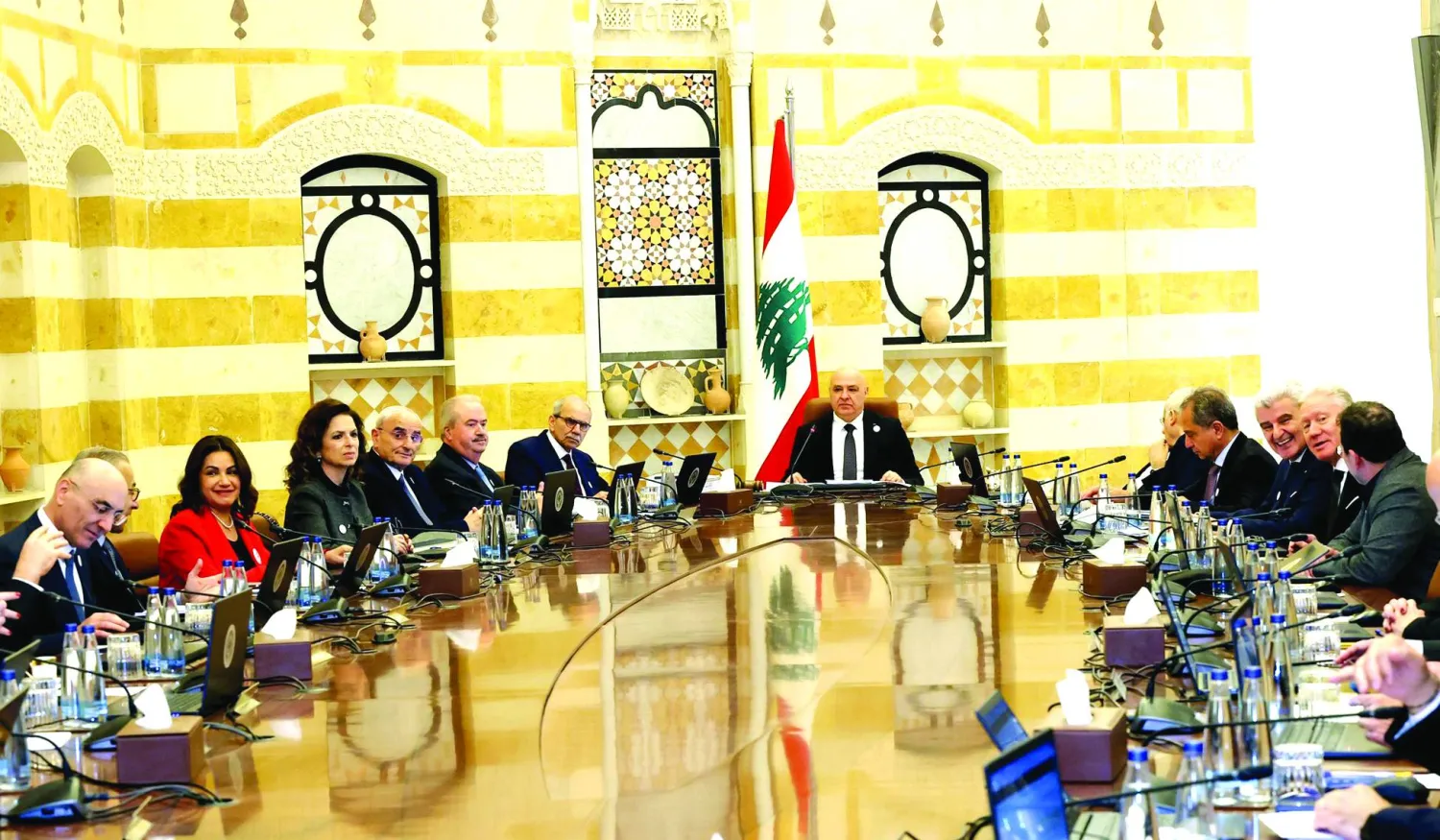
The Lebanese government in session chaired by President Joseph Aoun (Lebanese Presidency)
Since becoming involved politics in 1992, Hezbollah gradually evolved from a parliamentary player with limited influence into a central force in Lebanon’s governing equation. The group first engaged in legislative work and did not directly join governments until 2005, following the assassination of former Prime Minister Rafik Hariri and the withdrawal of Syrian troops from Lebanon.
Since then, Hezbollah has sought to impose its control and influence over successive governments, obstructing some and bringing down others after introducing the concepts of the “blocking third” and consensual decision-making, while it and its ally the Amal Movement monopolized the entire Shiite ministerial share to use as leverage to topple governments or prevent them from functioning.
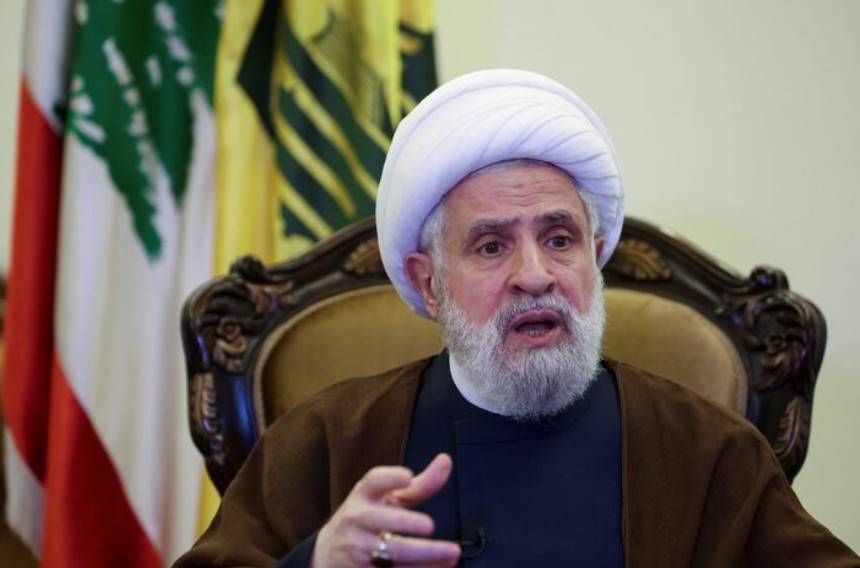
In this context, remarks by Hezbollah Secretary-General Sheikh Naim Qassem that “people have the right to take to the streets, bring down the government and bring down the US-Israeli project” did not come as a surprise to those who have closely followed Hezbollah’s conduct over the years in both the formation and collapse of governments. The same applies to comments by Hezbollah Political Council member and former minister Mahmoud Qamati, who said: “The president or anyone else, with a government majority, wants to target the resistance during this era. They should know that they are a passing side that comes and goes, while we are deeply rooted in this country.”
Hezbollah Secretary-General Naim Qassem
A Long Path of Pressuring Governments
Hezbollah’s first attempt to pressure the government in a bid to bring it down dates back to 2006, when it and the Amal Movement withdrew their ministers from the government of Prime Minister Fouad Siniora in protest against the vote in favor of establishing the international tribunal to prosecute Hariri’s killers.
The “Shiite duo” and the Free Patriotic Movement then organized a lengthy sit-in in downtown Beirut on the grounds that the government lacked sectarian legitimacy. Nevertheless, the cabinet continued functioning until May 2008, when Hezbollah launched a military move in Beirut and parts of Mount Lebanon in response to government decisions concerning its telecommunications network.
That escalation led Lebanese factions to convene in Qatar, resulting in what became known as the Doha Agreement, through which Hezbollah secured the “blocking third,” meaning that it and its allies obtained one-third of cabinet seats, enabling them to bring down the government.
That scenario materialized in 2011, when Hezbollah and its allies withdrew their ministers from the government of Prime Minister Saad Hariri, leading to its collapse.
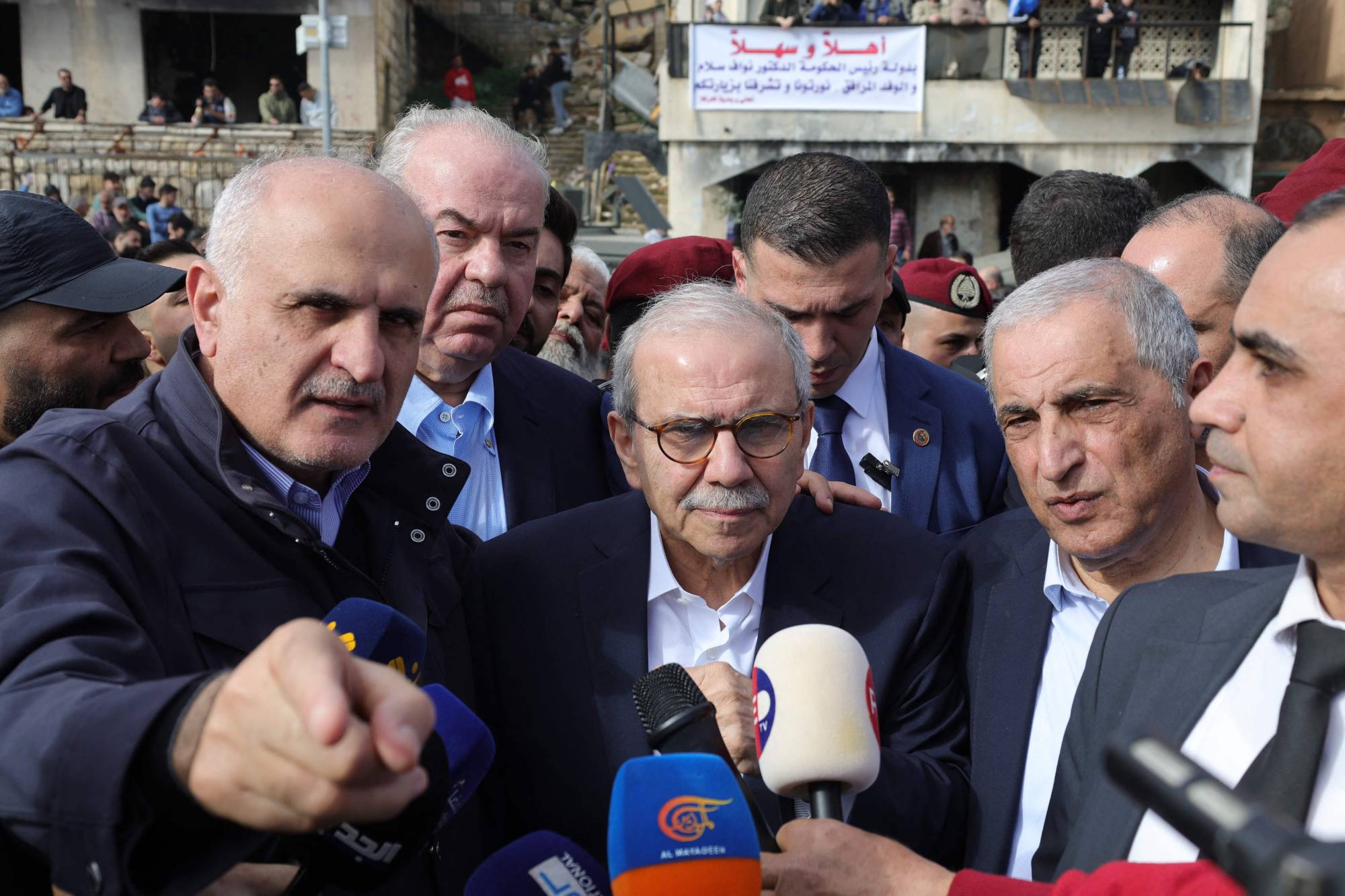
Former Lebanese finance minister, current member of parliament and a high ranking member of the Shiite Muslim Amal movement Ali Hasan Khalil (L), points as he stands next to Lebanon's Prime Minister Nawaf Salam during his visit to the heavily-damaged southern village of Kfar Shouba, near the border with Israel on February 8, 2026.(Photo by Rabih DAHER / AFP)
Salam Government “Freed” From Hezbollah’s Grip
Subsequent governments were formed with Hezbollah and its allies holding the “blocking third,” allowing them to control the decisions and fate of successive cabinets. Six governments were formed from 2011 onward, culminating in the current government headed by Nawaf Salam, which is considered the first government since 2008 to break free from Hezbollah’s dominance through the “blocking third.”
As a result, Hezbollah failed to prevent the government from adopting decisions placing arms exclusively under state control, classifying its military wing as illegitimate, and passing other measures opposed and criticized by the group.
Ali al-Amin, political writer and editor-in-chief of the Janoubia website, said Hezbollah had, since the Doha Agreement, “sought to blackmail successive governments through the invention of concepts such as the ‘guaranteeing third,’ consensus, or legitimacy.”
Speaking to Asharq Al-Awsat, Amin said that “during the current phase, specifically under the present government, the equations have completely changed. The government was formed on different foundations reflecting the new political balance.”
He added that “even if Hezbollah believes bringing down the current government through street pressure is possible, it realizes that forming another government on its own terms is no longer feasible. Therefore, its current threats to topple the government amount to intimidation and rhetorical escalation, nothing more than an expression of the predicament the party is facing, reflected in Sheikh Naim Qassem’s contradictory rhetoric.”
He added that Parliament Speaker Nabih Berri is unlikely to support Hezbollah in such a move, meaning the group has virtually no chance of bringing down the government or changing the policies it is complaining about.
Israel Carries Out Strike on Beirut Suburbs, First Near Capital in Weekshttps://english.aawsat.com/arab-world/5278113-israel-carries-out-strike-beirut-suburbs-first-near-capital-weeks
Lebanese army soldiers man a checkpoint in Beirut, Lebanon, 14 May 2026. Lebanese authorities announced that Internal Security Forces (ISF) and the Lebanese army have been mobilized as part of increased security measures to manage stability and protect displaced communities following a wave of internal displacement. EPA/WAEL HAMZEH
Israel Carries Out Strike on Beirut Suburbs, First Near Capital in Weeks
Lebanese army soldiers man a checkpoint in Beirut, Lebanon, 14 May 2026. Lebanese authorities announced that Internal Security Forces (ISF) and the Lebanese army have been mobilized as part of increased security measures to manage stability and protect displaced communities following a wave of internal displacement. EPA/WAEL HAMZEH
An Israeli strike hit a building in the southern suburbs of the Lebanese capital on Thursday, the first strike to hit near Beirut in weeks amid a ceasefire that has failed to halt fighting between Israeli troops and Hezbollah in south Lebanon.
The Israeli military said it had conducted a precise strike in Beirut but did not offer additional details. Two Israeli security sources said the target was Ali al-Husseini, whom they described as head of the missile division within the Imam Hussein Division, a militia that Israeli officials say is aligned with Hezbollah and Iran.
There was no immediate comment from Hezbollah or Iran on the attack. A Lebanese security source said it was carried out with two precision missiles targeting a building in Beirut's southern suburbs.
The strike dealt another blow to a fraying ceasefire announced by Washington on April 16 that was meant to halt the war raging between Israel and Iran-backed Hezbollah since March 2.
Exchanges of fire between the two longtime foes have continued, but have been mostly concentrated in southern Lebanon. Apart from a strike on Beirut's southern suburbs in early May that killed a Hezbollah commander, the capital and its suburbs had been spared new bombardment during the truce.
ISRAEL PUT OFF BEIRUT STRIKES DUE TO US, OFFICIALS SAY
Israeli officials say the military had held off from striking in Beirut for three weeks due to requests from the administration of US President Donald Trump. Still, Israeli surveillance drones are heard flying over Beirut on a daily basis.
The two Israeli security sources said Thursday's strike came following a “very intense dialogue” with the Trump administration in recent days. Heavy Israeli strikes hit towns and villages in southern Lebanon overnight and into Thursday, after Israel declared a new swathe of the area "a combat zone".
The Israeli military said residents should leave any towns south of the Zahrani River, which runs about 40 kilometres (25 miles) north of Israel's border with Lebanon. Together with a border zone occupied by its troops, Israel's evacuation orders over the last three months span about 2,000 sq km of Lebanon – about a fifth of the entire country.
An Israeli strike on Thursday morning killed six people including two children and their parents near the southern town of Adloun, Lebanon's health ministry said. Another strike, on the port city of Sidon, killed five people including two women. Sidon lies outside of the area designated as a combat zone by the Israeli military, and the strike was carried out without warning. Taghrida Ramadan, a woman living in Sidon, told Reuters she had been sleeping at home when she was jolted awake by the strike, which hit a building across from hers.
"We looked around and found the rubble on us - stones from the strike, because it was nearby and directly facing us," Ramadan said. While her house was damaged, her relatives were not seriously injured. Another Israeli strike later on Thursday killed two Syrian nationals, including a child, in the city of Tyre, which falls within the zone Israel said must be emptied.
لم تشترك بعد
انشئ حساباً خاصاً بك لتحصل على أخبار مخصصة لك ولتتمتع بخاصية حفظ المقالات وتتلقى نشراتنا البريدية المتنوعة