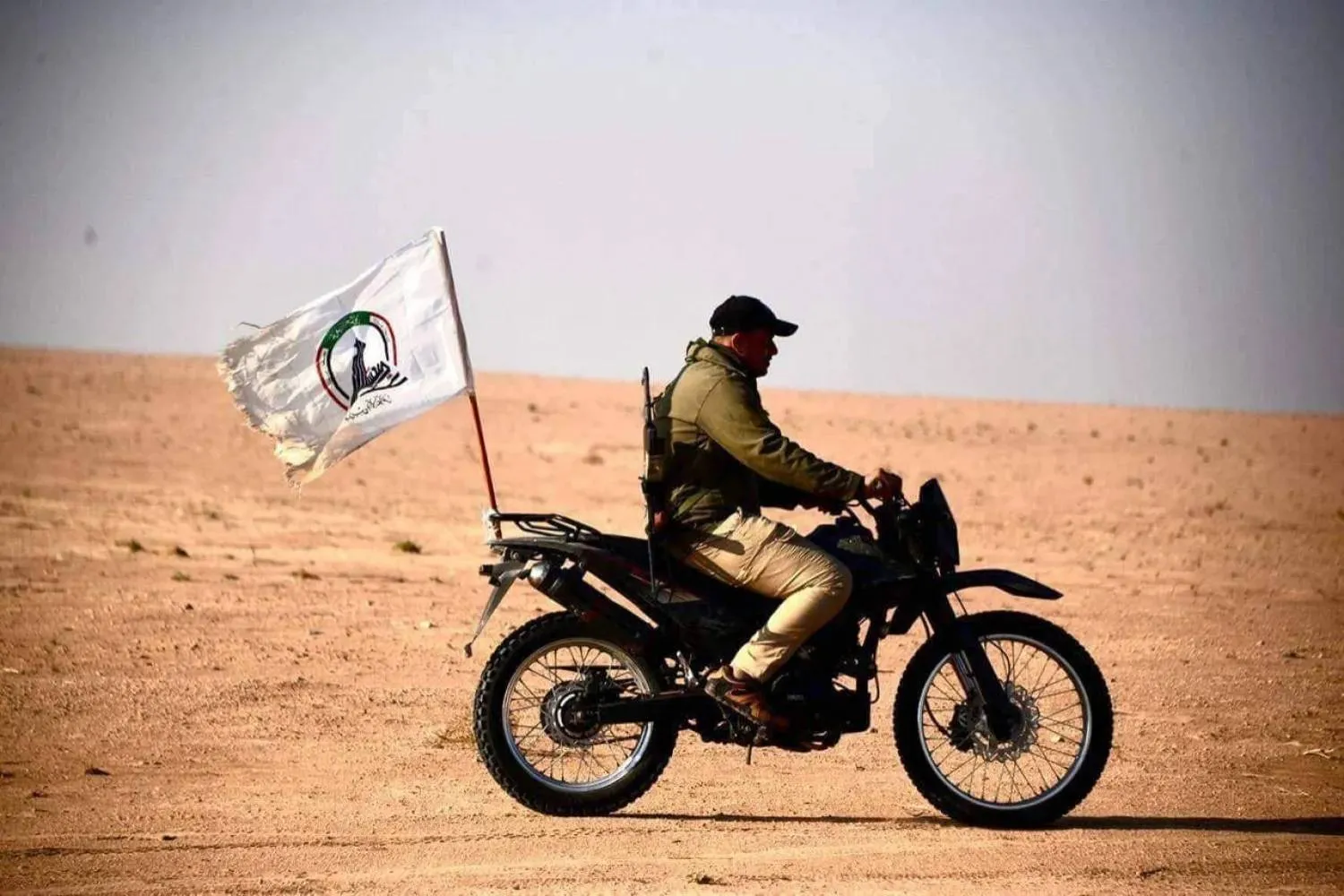
“If you must fall, be a meteor.” The phrase was written on a mural inside Baghdad’s Green Zone. Beside it was a drawing of faceless fighters in helmets, carrying rifles. They looked ready to fight on several fronts.
Senior officials and officers in Baghdad likely pass the mural on their way to government offices, including leaders of factions within the Popular Mobilization Forces. Nearly two months after the US-Iranian war, it is clear that many of them do not want to become falling meteors.
A day before the war, an Asharq Al-Awsat correspondent was trying to conduct interviews in Baghdad. The Iraqi officials they met were tied up in “emergency” meetings.
One said employees at Iraq’s Ministry of Migration had discussed a “possible alert,” which he considered “a very worrying signal.”
Baghdad awoke on the morning of February 28, 2026, to the sound of strikes in Tehran. By evening, we were told that a picture of Iranian Supreme Leader Ali Khamenei’s body had reached the phones of leaders in the Coordination Framework hours before US President Donald Trump announced his death.
Then began one of the strangest nights the Iraqi capital had seen.
In Baghdad, two kinds of Tehran’s allies appeared to stand on opposite sides. They seemed to be preparing to settle scores that had remained dormant for years, or bracing for another rebirth, one that has repeated itself again and again since 2003.
“Do these people really follow Khamenei?”
The second day of the war. The Green Zone was on high alert. Streets were closed, barriers and checkpoints were in place, and security forces inspected those without permits to enter the government district. No curfew had been declared, but in practice, people were moving through an undeclared one.
That evening, Asaib Ahl al Haq, led by Qais al Khazali, held a mourning gathering for Supreme Leader Ali Khamenei. Dozens gathered near Jumhuriya Bridge in central Baghdad. They arrived with a convoy of Chevrolet Tahoe vehicles, a model favored by many politicians, officials and leaders of armed groups. The demonstrators carried banners mourning Khamenei beneath the historic Freedom Monument, protected by a ring of security forces. There was no friction.
Traffic on the bridge remained normal. Cars moved smoothly toward the eastern entrance of the Green Zone, except for a small cluster of reporters from partisan channels funded by factions with influence in the government. They were interviewing “mourners over Khamenei’s killing.” It was a quiet show of solidarity. Before long, it dispersed.
In 2019, the same scene was bloody. Hundreds of young men were killed or wounded after taking part in almost daily protests against corruption and Iranian influence in Baghdad, under the slogan, “Iran out, out.” Seven years and 40 days of war later, their voices are no longer heard. Some have fully joined parties in the ruling coalition.
Four kilometers from the silent mourning gathering, the scene at the Suspension Bridge, leading to the western entrance of the Green Zone, was violent and loud. Dozens pushed toward security barriers without hesitation. They wanted to reach the US embassy. Asharq Al-Awsat’s correspondent spotted young men crying bitterly, staring at passersby and scrutinizing those who did not appear sad, as if asking: “How can you not grieve?”
At first, the protest looked improvised. The faces were as frightened as they were angry. Some hurled stones at security forces blocking the bridge entrance with steel barriers and large vehicles fitted with water cannons. Others carried Iranian flags and chanted against Trump, “the killer of the Leader.”
A large bulldozer forced its way through the crowd toward the barrier, followed by a black cloud, a wave of dust and masked men carrying sticks. Live fire and tear gas followed. The bulldozer stopped at a concrete barrier. Its engine failed before it could breach the security fortification, and the chants grew louder.
The correspondent asked one protester what he would do if the road to the US embassy were open. “I don’t know. It doesn’t matter. Even if I throw myself at a tank,” he said. He seemed surprised by the question and tried to make me understand: “They killed our leader. He is our guardian. Do you know what that means?” By night, authorities said dozens had been wounded on both sides, protesters and security forces.
The fact is, days earlier, they had all been on the same side, government and factions alike. The protesters at both bridges had also been in the same trench before Khamenei’s killing.
In the days that followed, the “factions,” the “resistance,” and the Popular Mobilization Forces opened the roads and skies to drones and US strikes.
Apart from these two kinds of Iran’s allies, who appeared to dominate Baghdad’s public space, a segment of Iraqi Shiites saw the war as a chance to criticize Iranian influence in the country. But “a campaign of intimidation silenced them,” according to activists we spoke to.
During the war, people close to Iran incited action against its opponents in Iraq. Images of complaints against them spread on social media. Some were arrested by security forces, but the courts have not yet acted on the complaints. Bloggers also posted pictures of influencers under the headline, “Your day of reckoning will come.”
On the ground, armed groups operating under the umbrella of what is known as the Islamic Resistance in Iraq launched dozens of attacks from the first hours after Khamenei’s killing.
The use of the term “resistance” was one of the methods the Revolutionary Guard and Iraqi factions used to conceal the original perpetrators. Many faction leaders, meanwhile, found themselves walking a fine line during the war, after long pledging to integrate into the state and keep weapons in its hands.
A leader in an armed faction said he was “not sure throughout the weeks of the war on Iran whether his armed followers had taken part in attacks on the Americans and on the Kurdistan Region.” It is not certain that he truly does not know.
In interviews with Iraqi and Western security and political figures, Asharq Al-Awsat sought to understand how the leaders of armed factions in Iraq, and, behind them, the Revolutionary Guard, manage the smooth movement of these groups between government institutions and militias, and how the war exposed dark zones of Iranian influence in the country.
There are different assumptions about the success of this process. But the most likely one is that Iran holds the “spinal cord” connecting everyone, those inside the government and the armed groups outside its authority. Between them lies a bitter, and possibly deadly, struggle over resources and influence.
Militias as “fiefdoms”
The car moves slowly along the bank of a small river in one of the vast fields south of Baghdad. As far as the eye can see, piles of bricks and building materials are scattered across the countryside.
For decades, residents here grew grains and vegetables and sold their crops to the government or local markets. Some had benefited from agricultural reform programs dating back to the 1960s, before those programs deteriorated during the Iraq-Iran war in the 1980s and gradually disappeared after the US invasion in 2003.
A 70-year-old notable from southern Baghdad describes the fields today: “It is as if we are being violently dragged back to the era of feudal estates. There is an advance by the new feudal lords. The issue is not just a dispute over ownership, but an invisible authority controlling resources.”
The man avoids giving details about how he lost his land about seven years ago, a vast area on the road between Baghdad and Babil to the south. But sources describe what happened as “a maze of multiple fraudulent operations protected by a government bureaucracy that armed factions have skillfully penetrated.”
“These lands are a jungle of investments, in whose shadows facilities belonging to armed groups disappear,” the man said. “I know them. They will seem extremely friendly to you, but with the latest war, they became very tense and suspicious.”
The factions’ strategy of taking over these lands appears to go beyond being a “goose that lays golden eggs,” as two officials, one former and one current, in Iraq’s Ministry of Agriculture put it. In the long run, it is “a continuous swallowing of geography in favor of Iran’s political influence.”
A Shiite leader in one of the factions said, “Every inch Hezbollah loses in southern Lebanon is compensated by Iran with kilometers in Iraq.”
But the factions collide as they advance into these lands. Friction often turns into clashes. In July 2025, a policeman, a civilian, and a member of Kataib Hezbollah were killed after a violent confrontation between a government force and the faction, which had stormed Baghdad’s Agriculture Directorate in the Dora area of southern Baghdad to prevent the appointment of a new director. In reality, the Shiite leader said, the operation was a cover for “recycling influence among armed groups.”
After the clashes, the government said the official in charge of regulating agricultural land contracts was involved, before his dismissal, in “forging contracts that led to the seizure of agricultural land from its rightful owners.”
The government’s account appears coherent, but it does not tell the whole story. Several government and factional sources say the Agriculture Directorate clashes were only the latest episode in political operations that had begun months earlier to change factional influence over these lands. One source said: “It is simply the management of the conflict over resources among the militias.”
This was not the first such friction in recent years. Since 2020, the Popular Mobilization Forces Security Directorate, the official umbrella for all armed factions in Iraq, has arrested militia leaders who once played a role in fighting ISIS and closed their offices in Baghdad.
This happened with Saraya Taliat al Khorasani, led by Ali al Yasiri and his deputy Hamid al Jazairi, as well as the Mukhtar Army faction led by Wathiq al Battat.
Before them came the arrest of Hamza al-Shammari, who had been a central figure in tourism activity between Baghdad and Beirut and was accused of money smuggling and drug trafficking. Several sources spoke of his close ties to Iraqi militias.
Incidents recorded as “the burning of poultry farms in Kut, a hospital in Babil, restaurants in Baghdad, and small companies in Basra” were in fact side effects of friction among armed groups, according to accounts from a security officer, a local official, and a member of an armed faction.
A Shiite leader close to the factions said: “Some armed groups operate as financial portfolios for the Iranian Revolutionary Guard, but when they obtain funds exceeding the share of the original sponsor, they are punished and removed from the game.”
US analyst Nick Gazette said clashes or arrests that surface from time to time among Iraqi militias are due to one of two things: a feverish struggle over resources, or a punishment carried out by the Revolutionary Guard against leaders or individuals who have broken away from its obedience.
Managing expansion
A number of these group leaders are seen as rebels against the Revolutionary Guard. The closest example often used to refer to them is Aws al-Khafaji, who leads the Abu Fadl al-Abbas faction. He took part in battles against ISIS in the provinces of Salahuddin and Anbar, but “his tongue became harsh toward Tehran.”
A force from the Popular Mobilization Forces Security Directorate arrested Khafaji in July 2019 and closed one of his headquarters in central Baghdad on the grounds that it was “fake.”
Four months later, he was released and said the reason for his arrest was his criticism of the Iranian project in Iraq and his opposition to the killing of young protesters in October 2019.
Hisham Dawoud, a researcher at the French National Center for Scientific Research, tends to see the repeated friction among the factions not merely as incidental struggles over influence or resources.
At its core, he says, it reflects deep internal shifts in the structure of these forces and their transition from a phase of “formation” to one of “repositioning” inside the state and society.
But he stresses that “the first thing that must be established is that these factions, especially those loyal to Iran, do not operate in a vacuum and do not have absolute freedom to shape reality according to their will.”
Sajjad Salem, a former member of parliament, says the assumption that helps explain factional friction lies in understanding the depth of the struggle over economic resources.
Influence is not only about the leaders of these groups, but also about a broad network operating beneath them, including social and tribal notables, traders, and an army of mid-level public sector employees. All of them have shifting interests, “and whenever they intersect, a spark of violence flashes. Usually, the Revolutionary Guard resolves the disputes.”
Just as it regulates the rhythm of competition, the Revolutionary Guard reaps the rewards of militia expansion on Iraqi territory. The “financial portfolios” grow as key resources for Iran, while military facilities needed for regional expansion are built simultaneously.
These areas were essential for establishing “training camps that hosted fighters of different nationalities from countries in the Axis of Resistance in recent years, along with missile and drone warehouses, private prisons, interrogation centers for opponents of Iran, and operational command centers,” according to leaders in two armed groups.
One of the two men said: “Every military facility was surrounded by fields, investment projects, and tourist resorts where the community of faction members and multiple circles of beneficiaries around them were active.”
In the latest war, the field advantage of this geographic expansion was exposed. Facilities were used to launch rocket or drone attacks from fields in southern and western Iraq, in areas near the border strip with Gulf Arab states that were hit by dozens of drone and missile attacks.
Around Baghdad, nearby sites were used to attack U.S. targets inside the capital. In the north, attacks were launched from Nineveh and Kirkuk, near targets in the Kurdistan Region.
The life of the factions, a history of integration
The second week of the war. Lawmakers, government officials and officers from various security agencies were joining mourning gatherings and symbolic funerals for Khamenei, who had still not been buried in his own country. Most likely, the occasion provided the time and place for rivals to meet without friction, a truce between two types of allies, one integrated into the state and another waiting in the “resistance.” In the end, everyone seemed to be in the same boat.
The gray zone disappeared from Iraq’s public space. Many people were no longer able to express middle-ground views. A well-known blogger on X told me he had attended a session organized by the Iranian embassy in Baghdad and heard an Iranian diplomat reprimand an Iraqi activist for not writing anything “in defense of Iran.”
Not far from this climate was what happened to Hadi al-Amiri, head of the Badr Organization, when members of a tribe in southern Iraq, rumored to have organic ties to armed factions and to be part of the network of loyalty to the Iranian supreme leader, attacked him.
The Shiite factions that had begun integrating into politics do not appear to enjoy Iran’s approval. Iranian anger at them grew as reciprocal strikes escalated during the war. On March 17, 2026, Mohammad Asad Qasir, director of the Iranian supreme leader’s office in Lebanon, criticized “the hesitant positions of Coordination Framework leaders regarding support for the Islamic Republic of Iran.”
In the November 2025 elections, representatives of armed factions won more than 100 seats in parliament, according to estimates circulating in local media. Since then, the fires of government formation have been burning. Most factions have been fighting over their shares in ministries, and their voices are decisive in determining the identity of the candidate to head the government.
A Shiite leader said: “The representatives of the factions do not monopolize political decision-making inside the Coordination Framework, but they can break the will of any party that does not represent their interests.”
The war coincided with the broadest process of integrating armed factions into official state institutions, both executive and legislative, that Iraq has seen since the fall of Saddam Hussein’s regime in 2003. The same thing has long happened at least once every five years, but with less intensity.
A Shiite official in the National Alliance, the former umbrella that formed the two governments of Nouri al-Maliki, says the state is the natural endpoint for resistance groups, “not necessarily in implementation of the desire of the Americans, who are bothered by uncontrolled weapons.” He adds: “It began with the Americans and ended with us. We are partners in this unintentionally.”
The first process of integrating militias into the state dates back to June 2004, when Paul Bremer, the US “civilian” administrator of Iraq at the time, issued Order 91, which allowed militias to merge into the state under the heading of banning them. The order created what can be seen as the founding moment of the “gray zone” in which Iranian influence flourished in later years.
The order treated militias as if they were security companies, according to a retired Interior Ministry officer who now lives abroad. “The faction would move into the ministries as if it had signed an investment contract, but in essence it was a political penetration,” he says.
Secrets of the integration game
With every wave of integration, new arms emerge outside the official framework, allowing the cycle of redistribution of influence between the institutional inside and the armed outside to continue, accompanied by friction that reflects a competitive growth process.
Dawoud explains that “some of these factions formed directly after 2003, while another section emerged through successive splits within the Sadrist movement, led by Muqtada al Sadr, which in its early days represented a broad incubator for differing currents before breaking apart into independent and hostile formations.”
Between 2005 and 2010, the first institutional penetration occurred, when groups such as the Badr Organization and the Mahdi Army, affiliated with the Sadrist movement, entered the Interior Ministry and law enforcement agencies, in parallel with the rise of their political influence. At that stage, the scene was not limited to ideological factions. Local groups also emerged, Dawoud says, “closer to war traders, born of social transformations in which tribal solidarity overlapped with the informal economy, producing formations with a mafia-like character.”
The features of a “state within the state” began to appear in the period before ISIS occupied a third of Iraq. Nouri al-Maliki, then prime minister, had reached an agreement with Washington for the withdrawal of its forces, and the factions began a new phase of activity, including Asaib Ahl al Haq, while also forming new armed wings.
Dawoud points to a third type of faction that “emerged after the US withdrawal, not before it, and arose with direct support and funding from the state, especially amid the rise in sectarian tensions between 2011 and 2014 and alongside the Syrian crisis.”
He explains that “the specificity of these factions is that they were not formed outside the state, but alongside it, and fed from the beginning on its resources, making them more tied to the logic of rent and less independent in terms of decision-making.”
The major legalization came in the period from 2014 to 2017, when the war against ISIS allowed the victors, who had made thousands of sacrifices to retake territory, to obtain legal integration and unprecedented political and social recognition, despite violations that accompanied the operations of these factions.
Dawoud reinforces this picture by saying that this stage “represented a transition to symbolic and material hegemony, based on the factions’ role in saving the state, especially through the Popular Mobilization Forces, which granted them double legitimacy.”
In recent years, armed factions have expanded into almost every aspect of the state. Their influence has become decisive in ministries and border crossings. From under their umbrella have come commercial contracts, investments and local financing networks. The number of affiliates has swollen to unprecedented levels, Dawoud notes, “turning them into a social and economic force, not merely a military formation.”
Many supporters of the Coordination Framework say that talk of armed groups’ influence inside the state is “exaggeration produced by regional narratives.” But the latest war between the United States and Iran erased the boundaries separating militias from the state.
Former lawmaker Salem said: “The militias are the ones ruling Iraq. This is a basic principle of Iranian influence, even if the prime minister is a figure accepted internationally and regionally.”
In the end, the factions will appear to have rolled like a small snowball inside the state 20 years ago, growing larger each time they integrated into it. From Salem’s perspective, what happened proves the error of the American view “that granting power can tame the factions’ behavior and limit Iranian influence.”
This view reached an advanced stage with the arrival of Mohammed Shia al-Sudani as Iraq’s prime minister in 2022, when “Washington imagined that Baghdad would carry out a soft domestication of uncontrolled weapons inside the state,” according to a former government official.
The integration of Iraqi factions into the state became the Revolutionary Guard’s “success story” in Baghdad. Gazette believes “Iraq is the ideal environment for the emergence of factions, and perhaps an ideal opportunity for the Revolutionary Guard, especially with their integration into Iraqi state institutions.”
According to Gazette, the Revolutionary Guard is effectively “preparing a cadre of state employees ideologically before integrating them into public life inside Iraqi state institutions, ensuring near absolute loyalty on ideological and material grounds as well.”
Dawoud says: “In this context, Sudani’s rise can be understood as an expression of the factional-political balance. Networks of influence and financial capacity to absorb the demands of factions with overlapping interests.”
These interests “sometimes send bags of money to those objecting to the balance deal, even if they are in Tehran,” according to a Shiite leader.
Changing skins, more gains?
Throughout the weeks of war, the Green Zone came under hundreds of rocket and drone attacks, most of them targeting the US embassy and government facilities. While Washington had expected Sudani’s government to preserve the usual rules of engagement during the 12-day war in July 2025, the relationship between them broke against the hard rock of the factions.
This war helped remove Iraqi ambiguity over groups outside the state, because they are positioned inside it. For months, Sudani had been struggling to secure a second term in office, relying on a parliamentary bloc that won about 45 seats in the latest legislative elections, more than half of them held by armed factions loyal to Iran.
Sudani leads the Reconstruction and Development bloc, the biggest Shiite winner, an uneven alliance that includes parties and armed groups. Among them are Faleh al-Fayyad, who heads the Popular Mobilization Forces Authority, Ahmed al-Asadi, commander of Kataib Jund al-Imam, and Haider al-Gharawi, commander of the Ansar Allah al Awfiya militia.
They have come to be seen as part of Iran’s striking force that carried out attacks in Iraq during the war.
How do these factions integrate into government institutions while simultaneously carrying out attacks against their will? There are different explanations, but the result is one.
In the testimony of a former Iraqi government official, a government force arrested a small cell of armed men specialized in installing and launching drones shortly after they carried out an attack on the US embassy. During the investigation, the leader of one faction submitted a “strange request” to the government: “I need information about one member of the cell. He is a member of my faction, but I did not assign him this mission.”
In Iraq, this was one of the riddles invented by the country’s Shiite groups. There is a political and economic structure for the armed faction that integrates into the state, while the combat elite remains outside the state, “resisting the state itself.”
The initial understanding, according to overlapping sources, was that the Revolutionary Guard forms a “striking force of elite fighters belonging to multiple factions who work under its command and carry out attacks without referring back to local leaders.” But the picture closer to reality is that Iranian officers, especially those active in the regional Quds Force, manage special groups inside each faction.
Salem agrees with this view. He says: “Iran deals with each Iraqi militia separately. Inside each of them are groups that follow Iran, not their local commander.” He adds: “Iran deals with Hezbollah in Lebanon or the Houthis in Yemen as one scene in a centralized way. But in Iraq, influence is managed by fragmentation.”
In April 2025, Shiite groups said the Revolutionary Guard had asked them to “do what is necessary” to avoid conflict with the United States, including handing over their heavy weapons. In March 2026, other groups said they had agreed to a truce that included halting attacks on the US embassy.
In fact, with special groups inside these factions that hierarchically follow the Revolutionary Guard, faction leaders can conclude agreements that include handing over weapons, halting attacks and reaping their political gains, without that meaning anything on the ground.
One cannot overlook the US Treasury Department sanctions in mid-April, when it accused Asaib Ahl al-Haq of using Iranian drones to attack US forces in northern Iraq through a faction leader named Safaa Adnan.
Since his strong participation in Mohammed Shia al Sudani’s government, Qais al Khazali has been trying to change his political language, suggesting he can also change his essence. But “to what extent can the process be considered more than a change of skin?” said a former US State Department official who had been interested in following “the striking transformations in the career of the man who split from Muqtada al-Sadr’s movement in 2006.”
The day after the war in Iraq
Since the announcement of a ceasefire and the faltering negotiations between Washington and Tehran, the Americans have been exerting harsh pressure to change the essence of rule in Baghdad. But Salem believes the war showed “who actually rules Baghdad,” referring to the factions. Whatever the outcome of the talks in Islamabad, he says, “Tehran has won Baghdad completely.”
Still, Dawoud imagines the “day after” the war, if the influence of factional forces is strengthened, as one in which Iraq’s central state “will not head toward total collapse, nor toward firm cohesion, but toward a transitional model of a central state that monopolizes rent, while in practice it is distributed among multiple networks of influence.”
Pressuring American messages have forced Shiite parties onto calculated paths in forming the new government and are pushing toward winning the battle with the Iranians by neutralizing the Popular Mobilization Forces from the ruling institution. But Tehran has so far shown strong resistance.
This is the real test for the leaders of the Coordination Framework. They are reaching a crossroads between protecting their growing influence within a new deal not far from regional changes, or protecting weapons as the means to reap new gains.
Gazette suggests a classical model, when American militias that emerged during the War of Independence in 1776 became the US National Guard. But he finds it difficult to apply this comparison to Iraq because of “the ideological narrative of Shiite groups.”
Because “ideology is not everything in Iraq,” as a senior political official in the Coordination Framework says, the possible transformation of Popular Mobilization Forces groups would be a hybrid of interest and loyalty.
Dawoud says: “The shape of the coming state will not be a post-militia state, but a state redefining itself by managing the space of the factions, not by eliminating them, inside the political system.”
In Baghdad, the ruling coalition is seen as an adversary that never stops fighting, refuses to disarm, and seeks to strike political deals with its surroundings, reflecting the broader picture in the region: neither war nor peace between the United States and Iran. The soldiers in the Green Zone mural of the “inevitable fall of meteors” will seem like an expressionist painting of the Coordination Framework leaders, carrying rifles to protect their gains, but with no intention of firing.