

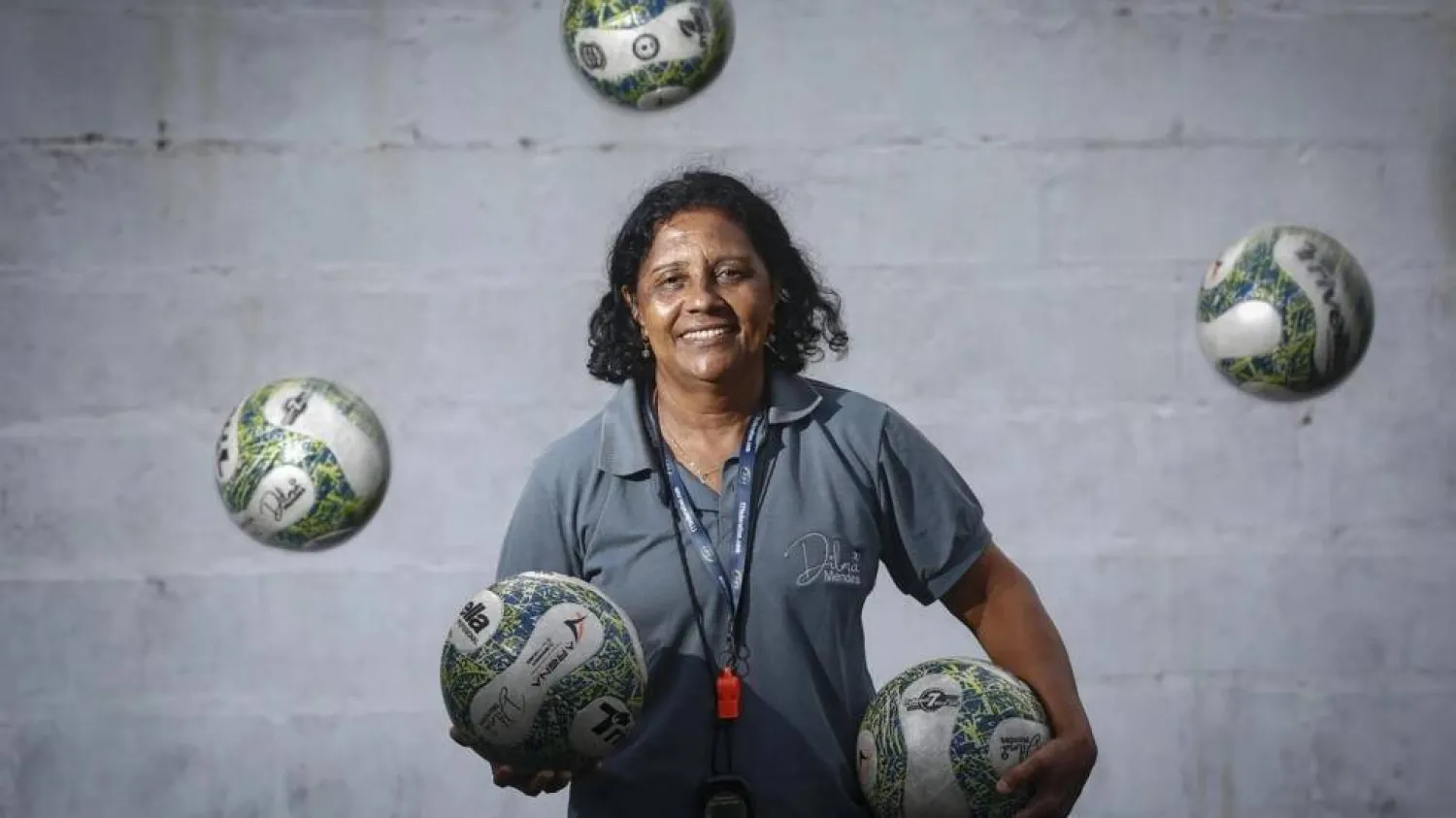

'Against their Nature': When Brazil Banned Women from Football

Women's football coach Dilma Mendes, 59, poses for a picture at the Arena 2 de Julho Football School located in the city of Camacari, Bahia state, Brazil. RAFAEL MARTINS / AFP
TT

'Against their Nature': When Brazil Banned Women from Football

Women's football coach Dilma Mendes, 59, poses for a picture at the Arena 2 de Julho Football School located in the city of Camacari, Bahia state, Brazil. RAFAEL MARTINS / AFP

Dilma Mendes does not remember how many times she was arrested as a child. Her crime? Playing football in Brazil.

The country may be synonymous with the beautiful game, but it banned women from the sport for nearly four decades until 1979, said AFP.

Ahead of the Women's World Cup starting next week in Australia and New Zealand, where Brazil will be in action, Mendes recalled the lengths she went to in order to fulfill her dream of becoming a footballer.

As a girl in the 1970s, she gave ice cream to the boys she played with in Camacari in Brazil's impoverished northeast in exchange for an early warning of the arrival of police busting girls flouting the prohibition.

She used to dig a hole next to the pitch to hide in until the enforcers left, then crawled out again to continue kicking the ball around with her male friends.

When they let her, which was not always the case.

Sometimes all her precautions failed and Mendes found herself hauled off to a police station.

"When I was a child I thought the police stopped those who did something wrong, and I didn't feel like I was doing anything wrong," Mendes, now 59, told AFP.

"The cops treated me well, but some said I couldn't play because football was for men."

Then-president Getulio Vargas promulgated a decree in 1941 to ban girls and women from football at a time many believed that participation in sport could inhibit childbearing ability.

The decree prohibited women from practicing "sports incompatible with the conditions of their nature."

No specific sanctions were mentioned, leaving it open to individual police officers to decide how to deal with offenders.

Football associations in other countries, such as Britain, Germany and France, also barred women from the sport, but Brazil's ban was the only one decreed by law.

It remained in place until 1979.

While many like Mendes continued to play, the 38-year prohibition stunted development of the sport among Brazilian women during a period in which their male counterparts lifted three of their five World Cups.

Beaten for playing
The ban came at a socially conservative time when women were viewed as "maternal figures reserved for the domestic space" -- a construct their presence on a sports field challenged head-on, said Brazilian sports researcher Silvana Goellner.

There are no records of women going to jail for violating the decree, but they would be detained and only released after questioning.

Many "never stopped playing" despite the threat of arrest, said Goellner, who co-authored a book on the topic. "They created strategies to circumvent the law."

Some dressed as men, others played at night or in places hidden from public view. When busted, they scattered in different directions to confuse their pursuers.

But many were unable to evade a reckoning much closer to home: their families.

Mendes remembers sitting at the police station praying that her father -- who supported her passion -- would be the one to fetch her.

If it was her mother, she could count on a hiding for practicing a "men's sport," said the youngest of seven siblings -- five of them boys.

"It was hard to arrive home and your mother and brothers beat you and the next day you have to be ready to play again," Mendes recalled.

"I saw many friends leave football because of that cruel process."

But she never gave up, making a modest career in futsal -- a variation of football played on a small court, often indoors -- and in professional football when it was officially opened to women in Brazil in 1983 amid growing calls for equal rights.

Never had a chance
After retiring as a player in 1995, Mendes moved into coaching and helped unearth Formiga, a legendary former midfielder for the Brazil women's team.

She also coached Brazil's women to victory in the seven-a-side world championship in 2019.

Brazil had "great players" who never had a chance, Mendes lamented in hindsight of the "cruel" ban, which has also meant a very patchy historic record of women's football in the South American country.

But things have changed, and now the "Selecao" are preparing to participate in their ninth Women's World Cup.

They will run out under veteran captain Marta, who has scored more World Cup goals (17) than any other player, man or woman.

Brazil's best showing in the event, first staged in 1991, was in 2007 when they were beaten in the final by Germany.



Florentino Pérez Faces First Election for Real Madrid Leadership in 20 Years

Real Madrid's President Florentino Pérez presents his campaign for the club's elections, under the slogan "A lot of history yet to be made", in Madrid, Spain, 27 May 2026. (EPA)
TT

Florentino Pérez Faces First Election for Real Madrid Leadership in 20 Years

Real Madrid's President Florentino Pérez presents his campaign for the club's elections, under the slogan "A lot of history yet to be made", in Madrid, Spain, 27 May 2026. (EPA)

For the first time in 20 years, Florentino Pérez's Real Madrid reign will be challenged at the ballot box.

The world’s most valuable and most successful football club will hold elections on Sunday.

Pérez, the 79-year-old executive who for the past two-and-a-half-decades has made Madrid the global powerhouse to beat, will face an upstart rival half his age who is making big promises to convince the club's 98,000 members to consider a change.

Enrique Riquelme, 37, was still a boy when Pérez first took over. He remained unknown to most Madrid fans until he stepped forward as a rival candidate after the incumbent called early elections last month in a press conference dominated by Pérez's claims the Spanish media is trying to "kill" his presidency.

"Why do they want to kill me?" an agitated Pérez told reporters on May 12. "Why? Because there are some kids out there saying they want to run? Well, let them. I would love them to."

Riquelme, a renewable energy executive, has surprisingly been able to mount a credible threat. That's thanks to the backing of former Madrid players like Raúl González and promising huge, and arguably far-fetched, signings like that of Manchester City star Erling Haaland.

Riquelme has the names, but does he have the clout? Riquelme got a big boost when Madrid great Raúl, its record holder for games played, former goalkeeper Iker Casillas and ex-defender Fernando Hierro joined his campaign.

Raúl would be Riquelme’s sports director, a role that doesn’t exist now, while Hierro would oversee its youth academy. Casillas’s exact role was not defined.

Riquelme also said he wanted to sign Spain midfielder Rodri, who has one year left on his contract with City.

But Riquelme’s big lure dangled to voters this week, his claim that "Haaland wants to come to Madrid," prompted City to dismiss any chance of negotiating for the sale of its top-scoring striker who is under contract until 2034.

That didn’t stop Riquelme going on Spain’s state broadcaster TVE and doubling down on his pledge.

"If I am made president of Real Madrid on Sunday, Haaland will play for Real Madrid," he said on Thursday.

Then it was the turn of Haaland's entourage to shoot it down.

"All very entertaining but not true. We wish all the best for both candidates in the Madrid elections," Haaland’s agent, Rafaela Pimenta, told the AP in a short statement on Friday.

"It must be a bluff," was Pérez's opinion.

Pérez has earned status as top dog

Not to be outdone, Pérez said Thursday that next week — after the election — he would announce the "most expensive transfer in the history of Real Madrid," worth, he said, at least 150 million euros ($173 million).

He knows a thing or two about promising apparently impossible signings — and then making them come true. He won his first elections in 2000 when he swore he would sign then-Barcelona forward Luis Figo. And that he did.

Now, Pérez has promised to bring back José Mourinho, Madrid’s coach from 2010-13, and sign Liverpool defender Ibrahima Konaté, a free agent, and Inter Milan’s Denzel Dumfries, if he is given another four years.

While those names are unlikely to thrill all of Madrid’s members, Mourinho’s abrasive style left the fanbase divided, Pérez’s pledges do have the value of being completely credible.

Besides Figo, he has consistently delivered on his transfer targets, from Zinedine Zidane and David Beckham, to Cristiano Ronaldo and, most recently, after years of trying, Kylian Mbappé.

And, regardless of his plans, Pérez's wildly successful record is his best pitch.

In his two stints, from 2000-2006 and from 2009 until now, Madrid has won seven of its record 15 European Cups, along with a slew of other titles, including seven La Liga crowns and three Copa del Reys.

That all has been fueled by healthy finances as it was transformed into a global brand under Pérez, who also runs a major international construction company: Madrid has topped the Forbes Money League of the world’s most valuable football clubs for five consecutive seasons.

But Pérez also has weak spots

Pérez's Super League project meant to transform European soccer and replace UEFA’s Champions League with a club-run competition flopped in the face of backlash from some fans, many smaller clubs, and UEFA.

And so far his bet on Mbappé has not panned out. In the star’s two seasons at Madrid it has won no major titles, while Pérez has parted ways with three coaches in Carlo Ancelotti, Xabi Alonso and Álvaro Arbeloa.

Riquelme is also taking aim at the idea

Pérez floated last year to sell 10% of the club to private investors, a move that would break with 124 years of the member ownership model.

Pérez ran unchallenged when elections were to be held in 2009, 2013, 2017, 2021 and 2025. His latest term was set to expire in 2029.

Riquelme has reiterated previous complaints that changes Pérez's board made to the club statutes in 2012 made it more difficult for members to present a candidacy for the presidency.

Since then, a presidential candidate has had to be a club member for 20 years and have collateral equivalent to 15% of the club budget.

"The most important thing is that after 20 years, due to a complete lack of democracy and impediments year after year so that other members of Real Madrid can run, now the moment to vote has arrived," Riquelme said.

Pérez stepped down in 2006 following a bad season but returned to power in 2009.


Barcelona Teenager Yamal Wins LaLiga Player of the Season Award

Barcelona's Spanish forward #10 Lamine Yamal celebrates scoring his team's third goal during the Spanish league football match between FC Barcelona and RCD Espanyol at the Camp Nou stadium in Barcelona on April 11 , 2026. (Photo by Josep LAGO / AFP)
TT

Barcelona Teenager Yamal Wins LaLiga Player of the Season Award

Barcelona's Spanish forward #10 Lamine Yamal celebrates scoring his team's third goal during the Spanish league football match between FC Barcelona and RCD Espanyol at the Camp Nou stadium in Barcelona on April 11 , 2026. (Photo by Josep LAGO / AFP)

Barcelona winger Lamine Yamal has been named LaLiga Player of the season, the Spanish league announced on Friday.

The 18-year-old helped Barca retain their domestic crown, became the first player to win the league's Player of the Month award three times in one season and finished as the club's top scorer in La Liga with 16 goals and 11 assists.

Barcelona's Hansi Flick was named the Coach of the Year on Thursday, Reuters reported.

Regarding Yamal, Barca said in a statement: "He is the proverbial headache for opponent defenses, who have to make a real effort to try to stop the blaugrana's attacking threats.

"Beyond the intangibles, the young Catalan scored 16 goals and provided 11 assists, with no other LaLiga player providing that many passes leading to goals."

Yamal, who has been sidelined with groin issues multiple times this term, is expected to be fit for Spain at the World Cup starting next week in Canada, Mexico and the US.

He missed the last six games of the season for Barcelona due to a hamstring injury.

Yamal exploded onto the scene at 16 and was an integral part of Spain's record fourth European Championship triumph in 2024.


FIFA Cancels Dozens of World Cup Tickets Issued for Free by Mistake

04 June 2026, Canada, Toronto: A General view of the Toronto Stadium, during a media tour one week ahead of the first match of the 2026 FIFA World Cup. Photo: Leonardo Ramirez/eyepix via ZUMA Press Wire/dpa
TT

FIFA Cancels Dozens of World Cup Tickets Issued for Free by Mistake

04 June 2026, Canada, Toronto: A General view of the Toronto Stadium, during a media tour one week ahead of the first match of the 2026 FIFA World Cup. Photo: Leonardo Ramirez/eyepix via ZUMA Press Wire/dpa

FIFA canceled World Cup tickets for about 60 fans who mistakenly received them for free because of a website error.

The governing body's acknowledgment of the glitch adds to the ongoing controversy surrounding the ticketing program for the tournament in North America, which begins next week.

The tickets were issued at no charge "due to a prior payment issue during the checkout process," FIFA said in a news release on Thursday. The tickets were sold through the official World Cup site on May 21.

"FIFA regrets the error and any inconvenience caused," the statement said, adding that "the tickets requested by these fans remain reserved, and the affected fans have been invited to complete payment of the correct amount."

The high price of tickets for the 2026 FIFA World Cup, which begins on Thursday in Mexico City, has been a hot topic since they went on sale. The costs are considerably higher than any previous World Cup.