


Study Finds Climate Change Fingerprints on July Heat Waves in Europe, China and America

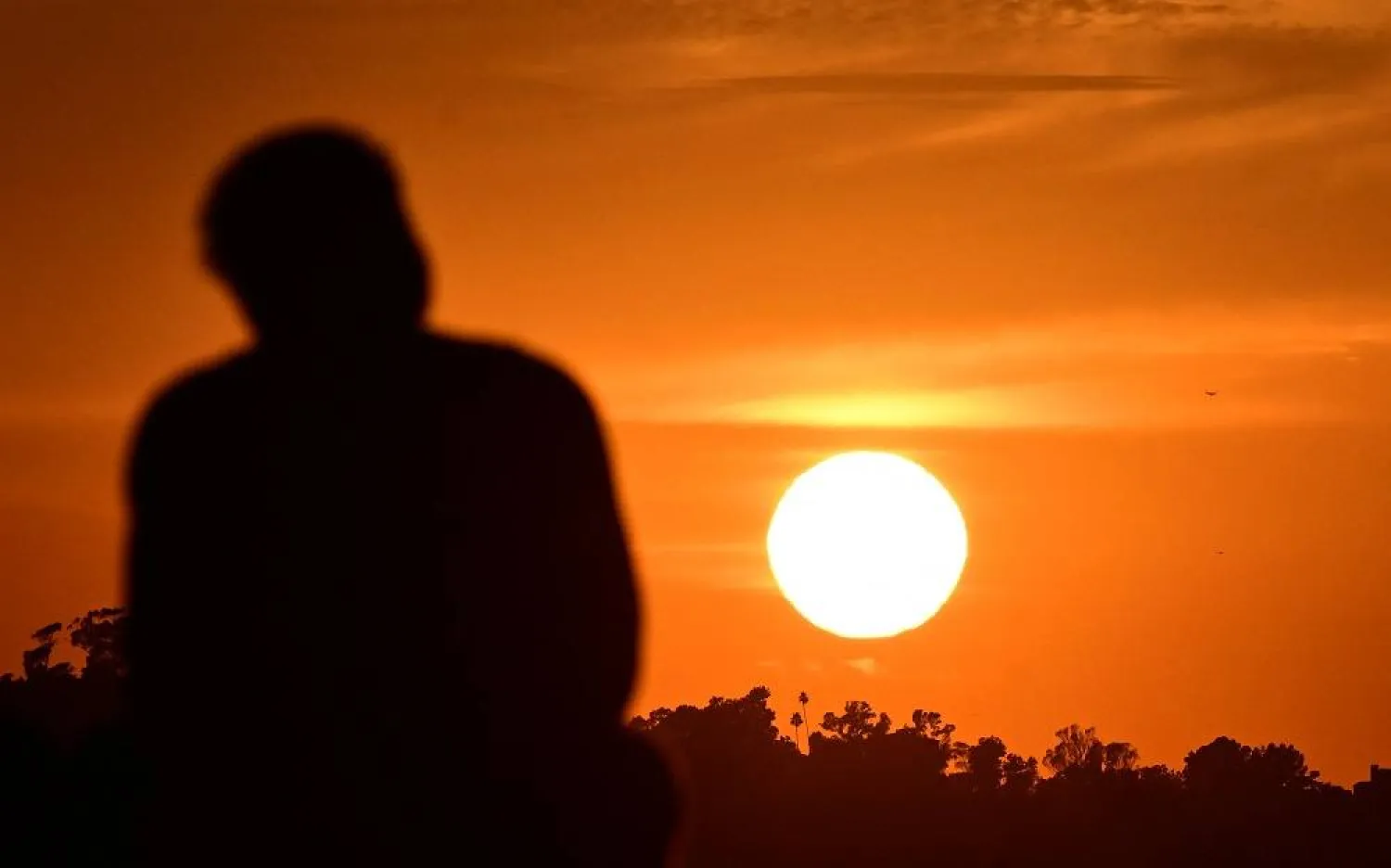
A man watches the setting sun in Los Angeles, California, on July 24, 2023. (AFP)
TT

Study Finds Climate Change Fingerprints on July Heat Waves in Europe, China and America

A man watches the setting sun in Los Angeles, California, on July 24, 2023. (AFP)

The fingerprints of climate change are all over the intense heat waves gripping the globe this month, a new study finds. Researchers say the deadly hot spells in the American Southwest and Southern Europe could not have happened without the continuing buildup of warming gases in the air.

These unusually strong heat waves are becoming more common, Tuesday's study said. The same research found the increase in heat-trapping gases, largely from the burning of coal, oil and natural gas has made another heat wave — the one in China — 50 times more likely with the potential to occur every five years or so.

A stagnant atmosphere, warmed by carbon dioxide and other gases, also made the European heat wave 4.5 degrees Fahrenheit (2.5 degrees Celsius) hotter, the one in the United States and Mexico 3.6 degrees Fahrenheit (2 degrees Celsius) warmer and the one in China one 1.8 degrees Fahrenheit (1 degree Celsius) toastier, the study found.

Several climate scientists, using tree rings and other stand-ins for temperature records, say this month’s heat is likely the hottest Earth has been in about 120,000 years, easily the hottest of human civilization.

“Had there been no climate change, such an event would almost never have occurred,” said study lead author Mariam Zachariah, a climate scientist at Imperial College of London. She called heat waves in Europe and North America “virtually impossible” without the increase in heat from the mid 1800s. Statistically, the one in China could have happened without global warming.

Since the advent of industrial-scale burning, the world has warmed 2.2 degrees Fahrenheit (1.2 degrees Celsius), so “they are not rare in today’s climate and the role of climate change is absolutely overwhelming,” said Imperial College climate scientist Friederike Otto, who leads the team of volunteer international scientists at World Weather Attribution who do these studies.

The particularly intense heat waves that Texas, California, Arizona, New Mexico, Nevada, Baja California, Sonora, Chihuahua and Coahuila are now roasting through are likely to happen about once every 15 years in the current climate, the study said.

But the climate is not stabilized, even at this level. If it warms a few more tenths of a degree, this month's heat will become even more common, Otto said. Phoenix has had a record-shattering 25 straight days of temperatures at or above 110 degrees Fahrenheit (43.3 degrees Celsius) and more than a week when the nighttime temperature never dropped below 90 degrees Fahrenheit (32.2 Celsius)

The heat in Spain, Italy, Greece and some Balkan states is likely to reoccur every decade in the current climate, the study said.

Because the weather attribution researchers started their analysis of three simultaneous heat waves on July 17, the results are not yet peer reviewed, which is the gold standard for science. But it used scientifically valid techniques, the team’s research regularly gets published and several outside experts told The Associated Press it makes sense.

The way scientists do these rapid analyses is by comparing observations of current weather in the three regions to repeated computer simulations of “a world that might have been without climate change,” said study co-author Izidine Pinto, a climate scientist at the Royal Netherlands Meteorological Institute.

In Europe and North America, the study doesn’t claim human-caused climate change is the sole cause of the heat waves, but it is a necessary ingredient because natural causes and random chance couldn’t produce this alone.

Texas state climatologist John Nielsen-Gammon said the study was reasonable, but looks at a broad area of the US Southwest, so it may not be applicable to every single place in the area.

“In the United States, it’s clear that the entire southern tier is going to see the worst of the ever-worsening heat and this summer should be considered a serious wake-up call,” said University of Michigan environment dean Jonathan Overpeck.

With heat waves, “the most important thing is that they kill people and they particularly kill and hurt and destroy lives and livelihoods of those most vulnerable,” Otto said.



'Large-scale' Avalanche Kills Two Skiers in French Alps

Members of the CRS Alpes Grenoble mountain rescue team prepare to board a Securite Civile helicopter (emergency management) after after an avalanche emergency response rescue mission in an off-piste area of the Ecrins massif, French Alps on January 29, 2026. (Photo by JEFF PACHOUD / AFP)
TT

'Large-scale' Avalanche Kills Two Skiers in French Alps

Members of the CRS Alpes Grenoble mountain rescue team prepare to board a Securite Civile helicopter (emergency management) after after an avalanche emergency response rescue mission in an off-piste area of the Ecrins massif, French Alps on January 29, 2026. (Photo by JEFF PACHOUD / AFP)

An avalanche has killed two off-piste ski tourers in the French Alps, a local prosecutor said on Sunday.

According to local rescue services, the two men died when an avalanche was triggered on Saturday afternoon near the village of Saint-Veran, known as the highest village in the French Alps.

The two victims-- one born in 1997 and the other in 1991 -- were part of a group of four unguided skiers when a "large-scale" avalanche swept down the north side of the Tete de Longet mountain peak, Gap prosecutor Marion Lozac'hmeur told AFP.

The other two skiers were unharmed, Lozac'hmeur added.

An autopsy has been ordered as part of an investigation into the cause of death, according to the prosecutor.

Avalanches have already claimed the lives of more than 20 skiers across the French, Swiss and Austrian Alps so far this season.


Olympic Tourists in Cortina Can Explore the Dolomites with the New ‘Uber Snowmobile’ Service

 The peaks of the Dolomites are seen from the Cortina Sliding Centre during the Milano Cortina 2026 Winter Olympic Games in Cortina d'Ampezzo on February 5, 2026. (AFP)
The peaks of the Dolomites are seen from the Cortina Sliding Centre during the Milano Cortina 2026 Winter Olympic Games in Cortina d'Ampezzo on February 5, 2026. (AFP)
TT

Olympic Tourists in Cortina Can Explore the Dolomites with the New ‘Uber Snowmobile’ Service

 The peaks of the Dolomites are seen from the Cortina Sliding Centre during the Milano Cortina 2026 Winter Olympic Games in Cortina d'Ampezzo on February 5, 2026. (AFP)
The peaks of the Dolomites are seen from the Cortina Sliding Centre during the Milano Cortina 2026 Winter Olympic Games in Cortina d'Ampezzo on February 5, 2026. (AFP)

The peaks of the Dolomites are seen from the Cortina Sliding Centre during the Milano Cortina 2026 Winter Olympic Games in Cortina d'Ampezzo on February 5, 2026. (AFP)

For one month starting on Saturday, Olympic spectators keen for a side trip to a UNESCO World Heritage Site can use Uber to reserve a ride on a snowmobile along the snow-covered road to the base of the Three Peaks of Lavaredo.

The dramatic, jagged limestone pinnacles stand just 23 kilometers (14.3 miles) from the Cortina venues where athletes are competing in the 2026 Winter Olympics and Paralympics.

One of the Olympic torchbearers, Giulia Baffetti, runs snowmobiling tours through Cortina-based winter activities outfit Snowdreamers. The company partnered with Uber, the official ride-hailing sponsor for the Games, to offer free tours on the weekends in February to people in town.

"Uber Snowmobile" tours, which can only be booked through Uber, include a ride in an Uber transfer bus for up to eight people from Cortina to the spot where riders mount their snowmobiles for departure. Tourgoers then follow the instructor, who leads the line of snowmobiles.

The first slots offered went fast, but Uber spokesperson Caspar Nixon said Friday that it planned to add more.

The three peaks are a magical place, Baffetti said, and this is a way for more people to experience it. Hikers and climbers flock there in the warmer months. In the winter, it’s a prime spot for cross-country skiing, snowshoeing and sledding. Snowmobiling is allowed in a limited area in order to protect the environment.

"We want to give an experience to the tourists, so they can feel the mountains in a different way," she said.

The Associated Press took the one-hour tour on Thursday, ahead of the Saturday launch, along with one other person. Helmets are essential, while heated handgrips are a most welcome feature. And that red button? Passengers can push it to stop the snowmobile if it veers off course or they feel unsafe.

The adrenaline-filled ride reaches speeds up to 40 kph (25 mph) when zooming past snow-covered trees, and drivers are instructed to slow when coming upon cross-country skiers and sledders. Deer and wolves are sometimes seen along the 7-kilometer (4.3-mile) route up to the base of the peaks.

Also visible on Thursday was the southernmost of the three Lavaredo peaks, rising sharply out of the fog. While the Dolomites are breathtaking from Cortina — and on Friday, the sun shone and the view was clear from town — they are even more impressive up close.

The route back includes a short loop around Lake Antorno. Before traversing all the ups and downs, the snowmobile instructor leading the tour offers a reminder about that red button.

Saher Deeb, an Israeli tourist, was along for the ride Thursday, one day after his 29th birthday. It was his first time on a snowmobile, and he was all smiles as he climbed off at the end.

"It was perfect," he said.


French Duo Finish Walking from France to Shanghai After 1.5 Years

 Performers throw molten iron to create sparks during a performance on the Bund promenade along the Huangpu river, ahead of the upcoming Lunar New Year of the Horse in Shanghai on February 2, 2026. (AFP)
Performers throw molten iron to create sparks during a performance on the Bund promenade along the Huangpu river, ahead of the upcoming Lunar New Year of the Horse in Shanghai on February 2, 2026. (AFP)
TT

French Duo Finish Walking from France to Shanghai After 1.5 Years

 Performers throw molten iron to create sparks during a performance on the Bund promenade along the Huangpu river, ahead of the upcoming Lunar New Year of the Horse in Shanghai on February 2, 2026. (AFP)
Performers throw molten iron to create sparks during a performance on the Bund promenade along the Huangpu river, ahead of the upcoming Lunar New Year of the Horse in Shanghai on February 2, 2026. (AFP)

Two French adventurers reached the end of an epic walk from France to Shanghai on Saturday, after nearly a year and a half crossing 16 countries almost entirely on foot.

Loic Voisot and Benjamin Humblot embraced as they stood by the river on the Bund promenade, the financial hub's distinctive skyline glittering in the background.

Voisot and Humblot set off from Annecy in September 2024.

"We were thinking about this moment almost every day for more than a year now, so it's a really strong feeling," Humblot said of reaching their destination.

Hanging out after work one day, the two friends realized they both yearned for a "great adventure".

They wanted to visit China -- but without flying, which they believe is too harmful to the environment.

A plan to set out on foot was hatched, and except for a stretch in Russia which was done by bus for safety reasons, 518 days and around 12,850 kilometers (7,980 miles) later they took the last steps to completing it.

Around 50 people gathered at the start point for the last 10km stretch of their odyssey, many local people who have been following them on social media.

Along the way their numbers swelled, as media, French residents of Shanghai and others joined.

"If your dreams are crazy, just take it step by step and sometimes you will not succeed, but sometimes you will," said Voisot.

Asked what he would do first now the walk was over, he joked: "Sleep a lot!"