Ukrainian Presidency: Jeddah Peace Consultations Were Very Productive

Representatives from more than 40 countries pose for a family picture as they attend talks in Jeddah, Saudi Arabia, August 6, 2023. (SPA)
TT

Ukrainian Presidency: Jeddah Peace Consultations Were Very Productive

Representatives from more than 40 countries pose for a family picture as they attend talks in Jeddah, Saudi Arabia, August 6, 2023. (SPA)

Officials from over 40 countries concluded in Jeddah on Sunday meetings on the Ukrainian crisis after two days of very productive and open consultations.

National security and foreign ministry representatives from over 40 countries were present at the talks.

A Saudi source said the heads of delegations concluded their main meetings on Saturday evening, while technical meetings, aimed at future coordination and cooperation, continued on Sunday.

German Foreign Minister Annalena Baerbock praised the consultations. She told Germany’s Bild that “every millimeter of progress toward a fair and honest peace brings a glimmer of hope for the people of Ukraine.”

Ukrainian President Volodymir Zelenskiy's head of staff Andriy Yermak said in a statement: “We had very productive consultations on the key principles on which a just and lasting peace should be built.”

Yermak said different viewpoints emerged during the talks in Saudi Arabia, calling them “an extremely honest, open conversation.”

He said all the countries present had demonstrated a commitment to the principles of international law and respect for the sovereignty and inviolability of the territorial integrity of states.

Saudi Arabia’s hosting of the Jeddah consultations is an extension of the humanitarian initiatives and efforts carried out by Prince Mohammed bin Salman, Crown Prince and Prime Minister, and the contacts he had held with the Russian and Ukrainian leaderships in the early days of the conflict.

He had expressed to them his country’s willingness to pursue efforts that would lead to lasting peace and to support all initiatives aimed at easing the humanitarian impact of the crisis.

In remarks to the Ukrainian presidency website, Yermak said: “Saudi Arabia, hosted the second meeting of diplomatic national security advisors and political directors of foreign policy departments of the world's leading countries on the key principles of restoring lasting and just peace for Ukraine, following the launch of the relevant format in Copenhagen in June.”

“In total, more than 40 states were represented in Jeddah, almost three times as many as at the Copenhagen consultations. This indicates the world's great interest in establishing a sustainable and lasting peace,” he added.

The format of the consultations included in-person and online participation of national security advisors and political directors from Saudi Arabia, Australia, Argentina, Bahrain, Bulgaria, Brazil, the United Kingdom, Denmark, Estonia, the European Union, Egypt, India, Spain, Italy, Jordan, Canada, Qatar, China, Kuwait, Latvia, Lithuania, the Netherlands, Germany, Norway, the United Arab Emirates, the Republic of South Africa, Poland, the Republic of Korea, Romania, Slovakia, the Union of the Comoros, the United States of America, Türkiye, Finland, France, the Czech Republic, Chile, Sweden, Japan, and the United Nations.

The meeting in Jeddah was a step towards the practical implementation of peace initiatives proposed by Ukraine. Each state participating in the consultations has the opportunity to show leadership in global efforts for peace. And most of them have already defined their role in the implementation of certain points of the Formula, added Yermak.

The parties agreed to continue working at various representative levels to establish a just and comprehensive peace, he revealed.

As part of the consultations in Jeddah, the Ukrainian delegation headed by Yermak held a series of bilateral meetings on Sunday. The Ukrainian officials discussed with partners the details of implementing peace initiatives and cooperation in this area.

Czech Deputy Foreign Minister Jan Marian offered help with implementing the peace plan, especially in the area of nuclear security and prosecution of Russian war crimes.

“The Czech Republic’s representation at the high-level consultations is based on our strong and long-standing support for Ukraine,” he stressed.

Meanwhile, Russian Deputy Foreign Minister Sergei Ryabkov was quoted by state media on Sunday as saying the Jeddah meeting was “a reflection of the West's attempt to continue futile, doomed efforts” to mobilize the Global South behind Zelenskiy's position.
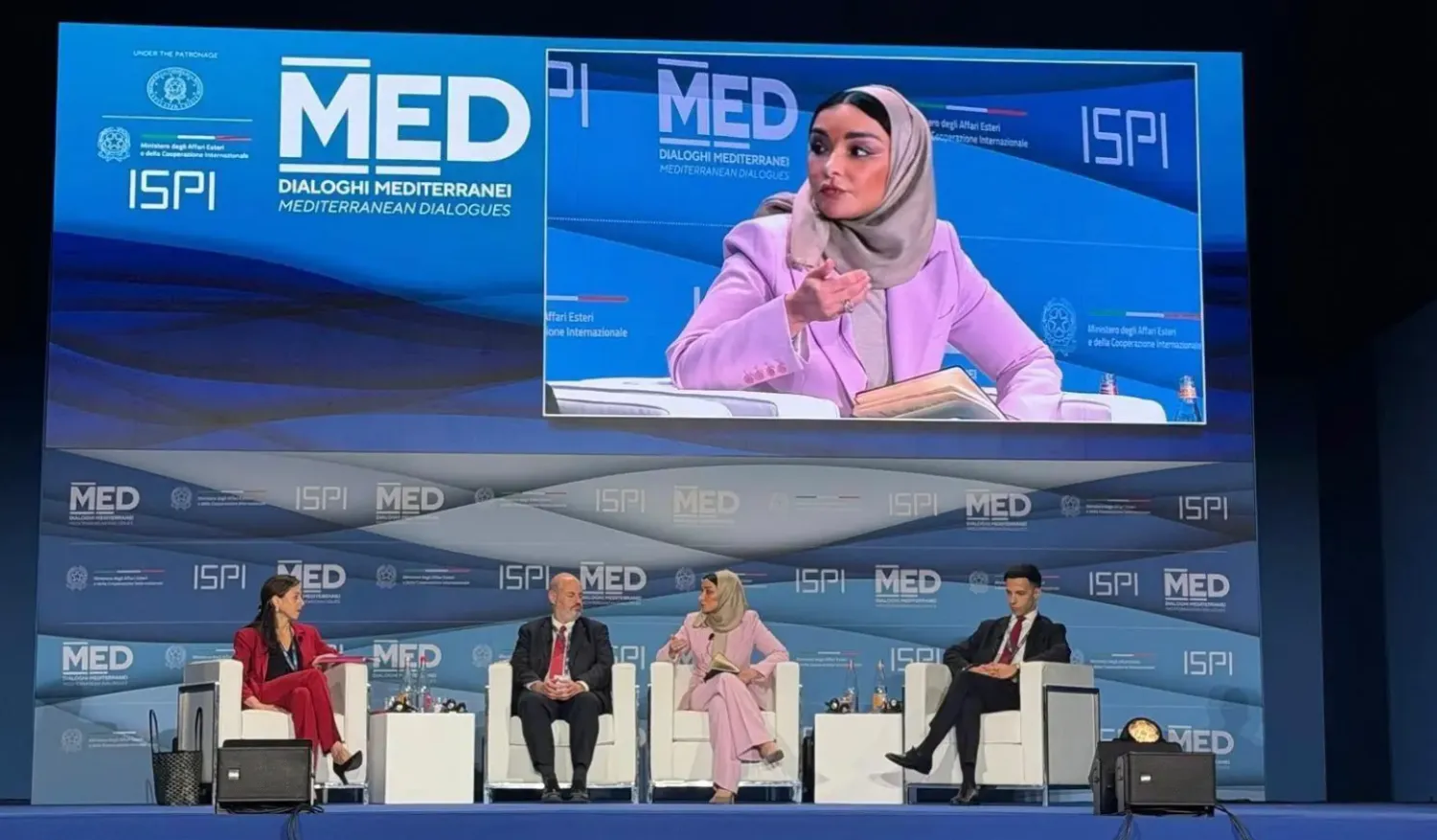


Saudi Arabia Calls for Sustainable Regional Security Architecture Based on Mutual Guarantees

On Yemen, Radwan said the war is at its core an intra-Yemeni conflict, and the Kingdom supports a resolution through political and economic tracks in line with the UN-led roadmap - SPA
TT

Saudi Arabia Calls for Sustainable Regional Security Architecture Based on Mutual Guarantees

On Yemen, Radwan said the war is at its core an intra-Yemeni conflict, and the Kingdom supports a resolution through political and economic tracks in line with the UN-led roadmap - SPA

Advisor and Special Envoy of the Minister of Foreign Affairs for Negotiations and Peace Efforts Manal Radwan took part in a session titled "Redefining Security: Iran, the Straits, and the Future of the Regional Order" at the Mediterranean Dialogues (MED) conference in Naples, Italy.

Radwan said the Kingdom of Saudi Arabia continues to pursue an approach combining containment, deterrence, and dialogue, and that its defense of its own security, the security and stability of the Gulf, and the vital waterways of the Strait of Hormuz and Bab al-Mandab Strait serves the interests of the whole world.

According to SPA, she called for a sustainable regional security architecture in which each state's security is linked to that of its neighbors and not achieved at another's expense, founded on mutual security guarantees, so that the end of one round of conflict does not merely set the stage for a more violent one.

Temporary arrangements will not work unless they are aligned with long-term strategic frameworks, Radwan said. Dealing with armed groups outside state control requires a political vision, not only a security one, that addresses the local causes of their emergence and their links to the external parties that support and exploit them.

She said Gulf Cooperation Council (GCC) member states are united in their objectives and that their roles should complement one another in supporting mediation, de-escalation, and the prevention of a new war, paving the way for confidence-building. Regional dialogue and international stability are closely linked, she added, and there is no place in the region for any hegemonic power.

On Yemen, Radwan said the war is at its core an intra-Yemeni conflict, and the Kingdom supports a resolution through political and economic tracks in line with the UN-led roadmap.

She warned that merely managing the region's crises for years to come without addressing their root causes could have catastrophic consequences for all, and called for collective action to seize the current opportunity for a comprehensive and sustainable solution that serves all parties, includes the realization of a Palestinian state, fosters regional integration, and keeps pace with global geostrategic shifts.


Arab Coalition Intercepts 3 Ballistic Missiles, UAV

Official Spokesperson for the Coalition to Restore Legitimacy in Yemen Major General Turki Al-Malki
TT

Arab Coalition Intercepts 3 Ballistic Missiles, UAV

Official Spokesperson for the Coalition to Restore Legitimacy in Yemen Major General Turki Al-Malki

Official Spokesperson for the Coalition to Restore Legitimacy in Yemen Major General Turki Al-Malki said on Saturday that air defenses intercepted and destroyed three ballistic missiles launched by the terrorist Houthi militia toward Riyadh.

Al-Malki, said in a separate statement, that a UAV launched by the Houthis toward the southern region was also intercepted and destroyed.


Oman Marks National Day Amid Economic Diversification Push, Diplomatic Efforts to Ease Tensions

Sultan Haitham bin Tariq attends a military parade marking Oman's National Day (Oman News Agency)
TT

Oman Marks National Day Amid Economic Diversification Push, Diplomatic Efforts to Ease Tensions

Sultan Haitham bin Tariq attends a military parade marking Oman's National Day (Oman News Agency)

Oman marked its National Day on Friday, Nov. 20, facing two pressing challenges: weaning its economy off oil and gas and preserving its diplomatic role in a region roiled by political and security tensions, particularly the military escalation between the United States and Iran and threats to shipping through the Strait of Hormuz.

The occasion comes as the sultanate presses ahead with its 11th Five-Year Development Plan (2026-2030), the second phase of Oman Vision 2040, aimed at diversifying revenue, expanding the private sector's role, creating jobs and improving public services.

Figures published by the Oman News Agency point to improving public finances, but also underscore persistent challenges in boosting non-oil growth and creating jobs.

Public finances improve

Oman posted a budget surplus of about 90 million Omani rials ($234 million) in the first nine months of 2026, reversing a deficit of 433 million rials ($1.13 billion) in the same period last year.

Government revenue climbed 16% to 9.828 billion rials ($25.56 billion), while public spending stood at 9.738 billion rials ($25.33 billion).

Public debt fell by about 600 million rials ($1.56 billion) to 14.1 billion rials ($36.67 billion) by the end of September, extending the government's efforts to rein in borrowing.

According to the Oman News Agency, the public debt-to-GDP ratio dropped from 65.9% to 34.6% during the first phase of Oman Vision 2040.

In September, S&P Global Ratings affirmed Oman's BBB- credit rating with a stable outlook and raised its real economic growth forecast for 2026 to about 3.5%.

Yet stronger public finances have not loosened the economy's reliance on energy. Oil and gas accounted for roughly 73% of government revenue in the first nine months, leaving the budget exposed to swings in global markets.

GDP figures reveal a stark divide between oil and non-oil sectors.

Oman's economy expanded 5.1% in the second quarter of 2026, fueled by a 14.7% surge in oil activity. Non-oil activity, by contrast, grew just 0.7%.

The gap underscores a central challenge for policymakers: turning new investments and projects into productive industries and revenue streams independent of energy exports.

Oman is banking on manufacturing, logistics, tourism and financial services to drive that shift.

Cargo volumes rose 15% at the Port of Salalah and 52% at the Port of Sohar in the first half of the year.

The Special Economic Zone at Duqm also launched the first phase of a wind turbine manufacturing project worth more than 70 million rials ($182 million), with annual production capacity of up to 1,000 megawatts.

The Sultanate also established the Oman Global Financial Center this year in a push to attract financial institutions and investment and expand its financial services sector.

Jobs put economic transition to the test

Economists see the labor market as a crucial test of Oman's economic transformation, particularly as more young people enter the workforce.

The Ministry of Labor reported 53,525 employment opportunities by the end of September 2026, including direct hiring, workforce replacement and job-linked training, according to the Oman News Agency. That represented 89% of its annual target.

But distinguishing actual hires from training and workforce replacement programs remains essential to gauging their impact on unemployment and the sustainability of jobs.

On the social front, Oman earmarked about 614 million rials ($1.60 billion) in its 2026 budget for its social protection system, which served more than 1.5 million people by the end of 2025.

The year also saw the opening of healthcare facilities, including Al Suwaiq Referral Hospital, built at a cost of more than 75 million rials ($195 million), and Khasab Referral Hospital, alongside other service projects across the country's governorates.

Diplomacy faces a mounting test

Abroad, Muscat has stayed the course on diplomacy, keeping channels open with rival parties and seeking political solutions to regional crises.

That approach has taken on greater significance as tensions persist between Iran and the United States, fueling concerns over shipping security in the Strait of Hormuz and surrounding waterways.

Oman's ties with Gulf Cooperation Council states, coupled with its continued contacts with Tehran and Washington, have enabled it to relay messages and help bridge differences.

But its policy of avoiding escalation and pursuing diplomatic solutions faces a growing test: maintaining access to opposing sides as regional divisions widen and lasting settlements become harder to secure.

As the sultanate enters a new phase of economic development, its domestic and foreign priorities are becoming increasingly intertwined.

Regional stability directly affects trade and investment, particularly for an economy seeking a bigger role in maritime transport and logistics.

Oman's National Day therefore comes at a pivotal moment. The challenge at home is to sustain fiscal gains and translate them into broader growth and more jobs.

Abroad, Omani diplomacy is striving to help resolve one of the region's most serious military conflicts as the risk of further escalation grows.