


Sudan: Rights Group, UN Experts Single Out Paramilitary with Accusations of Sexual Abuse

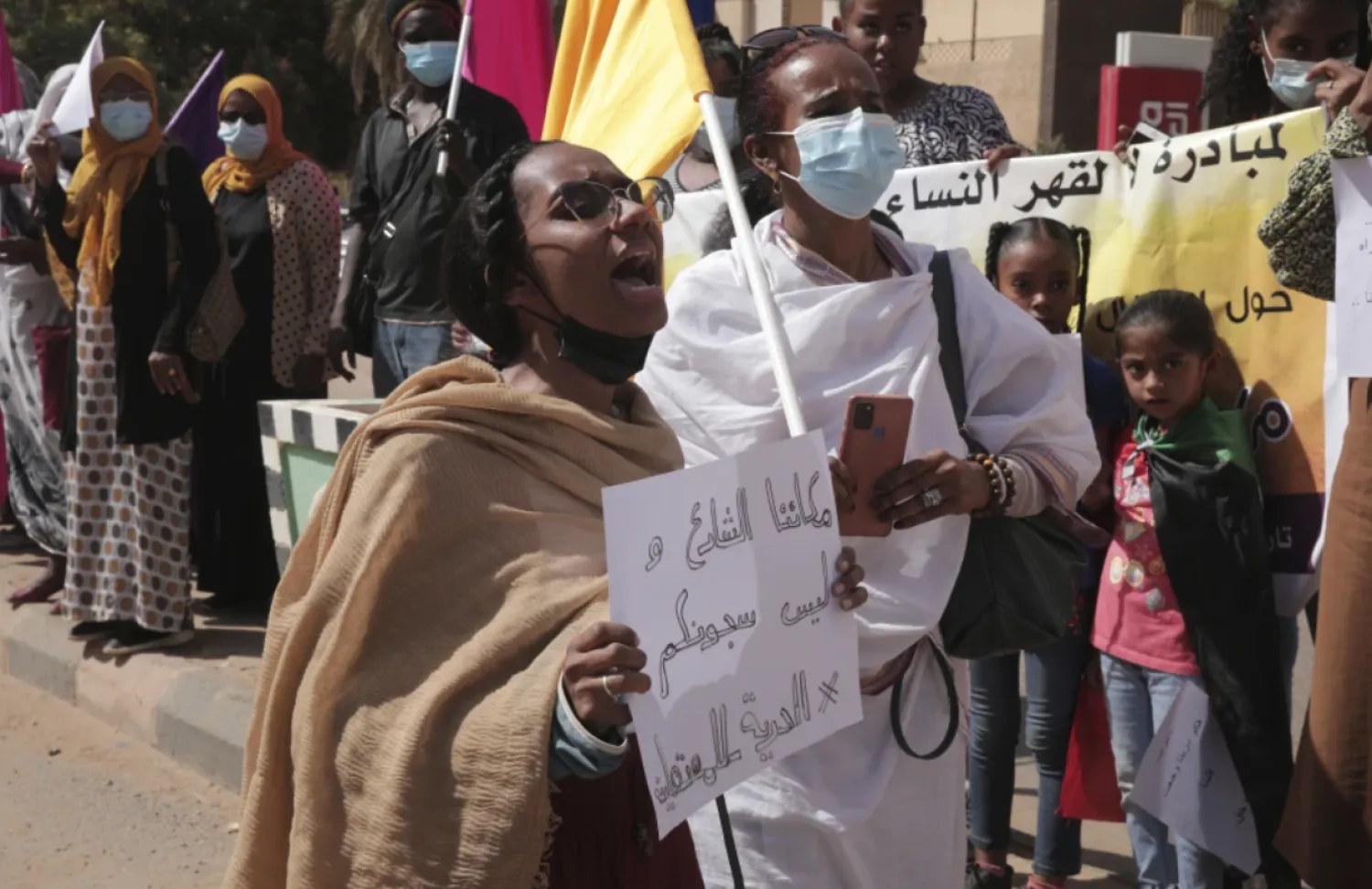
FILE - Women chant slogans protesting violence against women and demanding the release of all detainees before the UN rights office in Khartoum, Sudan, Feb. 2, 2022. AP
TT

Sudan: Rights Group, UN Experts Single Out Paramilitary with Accusations of Sexual Abuse

FILE - Women chant slogans protesting violence against women and demanding the release of all detainees before the UN rights office in Khartoum, Sudan, Feb. 2, 2022. AP

A leading rights group and UN experts accused Sudan’s powerful paramilitary on Thursday of sexual violence and attacks on women in the restive western Darfur region as the African country entered its fifth month of conflict.

Sudan plunged into chaos in mid-April, when months of simmering tensions between the military and its rival, the Rapid Support Forces, or RSF, exploded into open fighting.

Human Rights Watch said the paramilitary group apparently targeted women and girls in the western Darfur region of non-Arab ethnicity, as well as activists recording human rights abuses during the conflict.

The New York-based watchdog said it had documented 78 victims of rape between April 24 and June 26, The Associated Press reported.

UN officials warned in June that the fighting in Darfur has taken an ethnic dimension, with the RSF and allied militias targeting African communities.

Darfur was the scene of genocidal war in the early 2000s, when state-backed Arab militias known as the Janjaweed were accused of widespread killings, rapes and other atrocities. The Janjaweed later evolved into the RSF.

Several victims, who had fled Darfur for neighboring Chad, told HRW they were targeted because they were from the African Massalit community or because they were activists reporting on the conflict. At least one victim said she was pregnant after being raped by a paramilitary member.

In the report, the rights group stated it spoke with nine women and one girl who said they had all been victims of rape, four by multiple men. HRW also spoke with four women who witnessed sexual assaults as well as five service providers, including medical workers, who assisted victims in the West Darfur capital of Geneina.

Rapes and sexual violence reported during the conflict so far by activists and rights groups — including HRW and Amnesty International — have been attributed to the RSF and their allied militias.

Earlier this month, Amnesty accused the paramilitary of abducting 24 women and girls — some as young as 12 — and holding them for days in conditions amounting to “sexual slavery” during which “they were raped by several RSF members.”

“The Rapid Support Forces and allied militias appear responsible for a staggering number of rapes and other war crimes during their attack on El Geneina,” Belkis Wille, associate crisis and conflict director at Human Rights Watch, said in the report.

Several women who spoke to HRW also said they did not receive emergency post-rape care because it was not available or because they did not report the sexual assault they suffered to humanitarian staff in neighboring Chad.

HRW said the paramilitaries’ acts of sexual violence could amount to crimes against humanity. It called on the UN human rights council to launch an investigation and initiate “a way to preserve evidence of the abuses.”

Also Thursday, a group of 30 independent UN experts expressed alarm at reports “of widespread use of rape and other forms of sexual violence” by the Sudanese paramilitary.

“Sudanese women and girls in urban centers as well as in Darfur have been particularly vulnerable to violence,” they said in a brief statement. The group called on the RSF to “demonstrate its commitment to upholding humanitarian and human rights obligations.”

The RSF did not immediately respond to a request for comment.

The International Criminal Court’s prosecutor, Karim Khan, told the UN Security Council last week they were investigating alleged new war crimes and crimes against humanity in Darfur.

At least 4,000 people are estimated to have been killed in the conflict, the UN human rights office said. Activists and doctors on the ground say the death toll is likely far higher.

Rights groups and UN officials have criticized the military for bombing residential areas with artillery fire and airstrikes. Amnesty said both sides have committed extensive war crimes in the ongoing conflict.

According to the latest UN statistics, the conflict has displaced over 4.3 million people. More than 900,000 of the displaced have fled to neighboring countries.



Sudan Oil Minister Says War Losses in Billions

File photo of the Heglig oil field in southern Kordofan, Sudan (Reuters)
TT

Sudan Oil Minister Says War Losses in Billions

File photo of the Heglig oil field in southern Kordofan, Sudan (Reuters)

Sudan’s Oil and Energy Minister Al-Mutasim Ibrahim said the estimated cost of heavy losses and damage inflicted on the oil and energy sector by the war amounts to billions of dollars, blaming the Rapid Support Forces for directly targeting infrastructure across the country.

In exclusive remarks to Asharq Al-Awsat, Ibrahim said the government had fully restarted the Heglig oil field and that “all employees on site are carrying out their duties normally.”

He said the protection and operation of the field are a joint responsibility between Sudan and the Republic of South Sudan, as provided for in previously signed agreements between the two countries.

Ibrahim strongly denied recent reports of a three-way agreement between the governments of Sudan and South Sudan and the Rapid Support Forces regarding the Heglig field, located in the far south of the Kordofan region bordering South Sudan.

Authorities in South Sudan announced a settlement between the Sudanese army and the Rapid Support Forces after the latter took control of the area, stipulating the withdrawal of both sides and assigning the South Sudan army the task of securing oil facilities in Heglig.

Heglig is Sudan’s largest oil field, producing between 40,000 and 80,000 barrels per day of crude. Output fell by about 20,000 to 25,000 barrels per day after the outbreak of war due to the shutdown of many wells and damage to infrastructure.

The field also serves as the central processing facility for South Sudan’s crude, which produces nearly 130,000 barrels per day and is exported through Sudanese ports on the Red Sea coast.

China talks

Meanwhile, the minister said negotiations with the Chinese government were ongoing over its return to operations in Block 6 in the Balila area of West Kordofan. China had announced the termination of its agreement with the Sudanese government due to deteriorating security conditions and the collapse of supply chains caused by the fighting.

“Work at the Balila field is currently suspended, but the Chinese partner has not withdrawn from the country,” Ibrahim said.

“We recently held joint meetings with the Chinese side in Cairo and informed them of our desire to continue the partnership in the field, and we also presented opportunities to invest in other fields.”

He expressed optimism about the continuation of the partnership between Khartoum and Beijing in the sector, pointing to various oil investments expected to flow in after the war ends, particularly in areas under army control, which he said are witnessing significant security stability.

Last December, the Chinese government informed Sudan that it was ending the oil partnership after years of cooperation.

Khartoum refinery

According to the minister, preliminary estimates of heavy losses to the oil and energy sector since the war erupted in mid-April 2023 amount to billions of dollars, with damage assessments still underway.

He said the Rapid Support Forces had deliberately sabotaged infrastructure in both sectors, adding that the government had made progress in rehabilitating them after the army pushed the forces out of many areas across the country.

Ibrahim put losses at the Khartoum oil refinery at around $6 billion, saying it would need to be rebuilt from scratch.

“We have begun preparing the necessary designs and securing requirements to restart it,” he said, noting that several countries had expressed serious interest in investing in refineries in Khartoum, El-Obeid, and Port Sudan.

Before the war, the Al-Jaili refinery north of the capital, Khartoum, met more than 40 percent of the country’s demand for gasoline, diesel, and cooking gas. Still, it halted operations due to severe damage to its processing and refining facilities.

Ibrahim said petroleum products were flowing normally and that their availability had helped stabilize fuel supplies nationwide. He added that most fuel stations in areas without electricity had been equipped with solar power.


US Increases its Pressure on Iran in Iraq

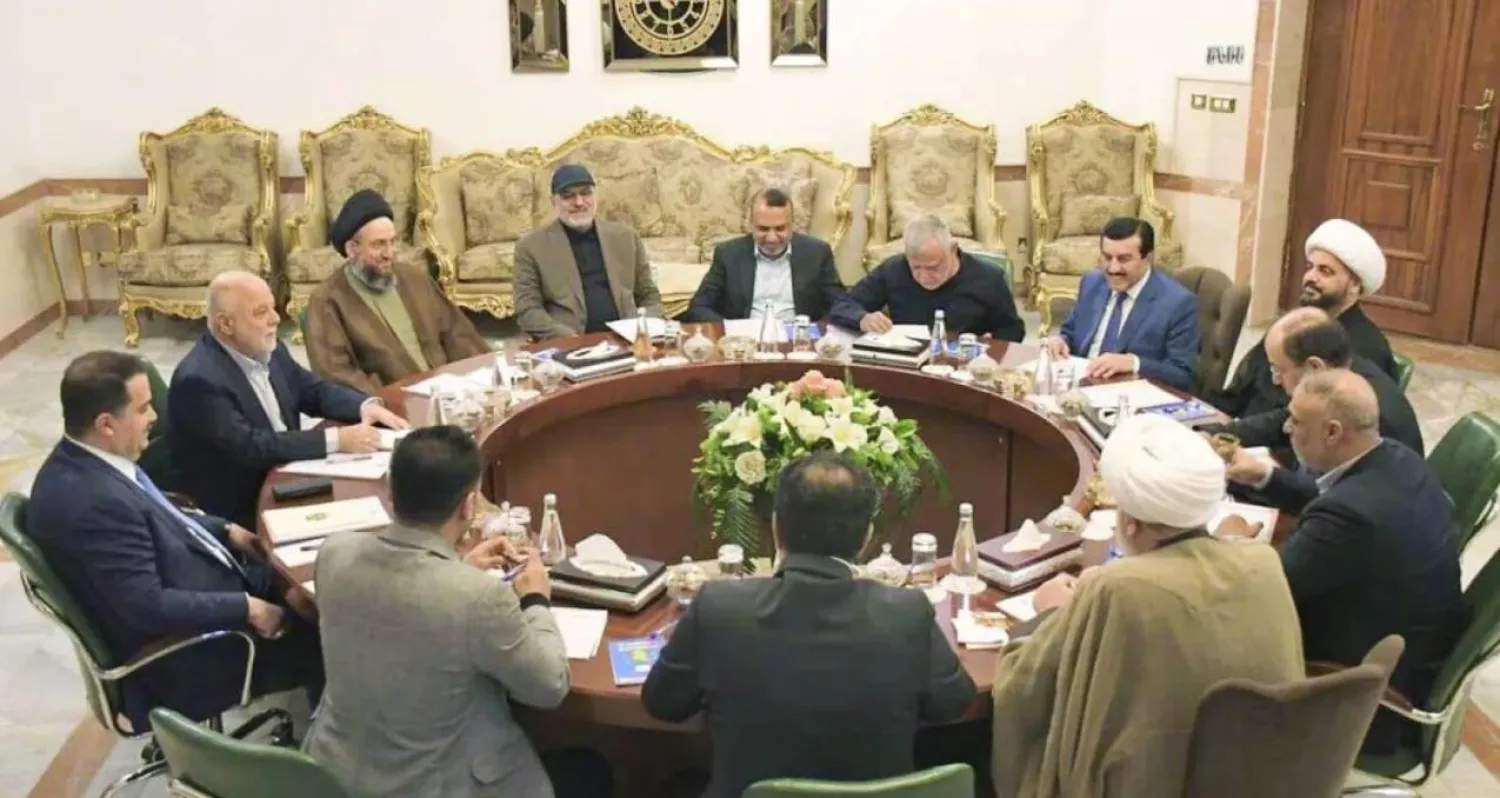
Coordination Framework leaders during a meeting in Baghdad. Iraqi News Agency
TT

US Increases its Pressure on Iran in Iraq

Coordination Framework leaders during a meeting in Baghdad. Iraqi News Agency

US pressure over Iranian influence in Iraq is increasing amid consultations to form a new government and messages from Washington affirming its willingness to use “the full range of tools” to counter what it describes as “Iran’s destabilizing activities.”

US Chargé d’Affaires Joshua Harris confirmed during a meeting on Thursday with Abdul Hussein Al-Mousawi, head of the National Approach Alliance, that any Iraqi government “should remain fully independent and focused on advancing the national interests of all Iraqis.”

A US embassy statement said the meeting addressed the importance of a strong partnership between the United States and Iraq that delivers “tangible benefits” for both sides within the framework of safeguarding Iraqi sovereignty, bolstering regional stability, and strengthening economic ties.

Harris stressed his country’s readiness “to use the full range of tools to counter Iran’s destabilizing activities in Iraq,” a statement seen as a dual message directed at forces linked to Tehran and at blocs engaged in government formation negotiations.

The media office of the National Approach Alliance, which is part of the Coordination Framework, stated that the meeting discussed the latest developments in Iraq and the region, and ways to strengthen bilateral relations “in line with the principle of mutual sovereign respect and shared interests.”

It also addressed consultations among political parties to abide by constitutional mechanisms and the results of elections.

Both sides stressed the importance of ensuring the success of negotiations between the US and Iran in a way that contributes to de-escalation and the adoption of dialogue.

Last month, US President Donald Trump warned Iraq over a reinstatement of Nouri al-Maliki as prime minister, saying that the country “descended into poverty and total chaos” under his previous leadership.

“That should not be allowed to happen again” Trump wrote on social media.

Al-Maliki, who has long-standing ties to Iran, dismissed Trump’s threat as “blatant American interference in Iraq’s internal affairs,” and vowed to “continue to work until we reach the end.”

The Coordination Framework, which holds a parliamentary majority, has named al-Maliki to serve again as Iraq’s prime minister, citing his “political and administrative experience and role in managing the state.”


German Parliament Speaker Visits Gaza

Displaced Palestinians fleeing Israeli military operations in Beit Lahia in the northern Gaza strip walk along the Salah al-Din main road in eastern Gaza City making their way to the city center, on October 22, 2024, amid the ongoing war in the Palestinian territory between Israel and Hamas. (AFP)
TT

German Parliament Speaker Visits Gaza

Displaced Palestinians fleeing Israeli military operations in Beit Lahia in the northern Gaza strip walk along the Salah al-Din main road in eastern Gaza City making their way to the city center, on October 22, 2024, amid the ongoing war in the Palestinian territory between Israel and Hamas. (AFP)

The speaker of Germany's lower house of parliament briefly visited the Israeli-controlled part of the Gaza Strip on Thursday, the body told AFP.

Julia Kloeckner spent "about an hour in the part of Gaza controlled by Israeli army forces", parliament said, becoming the first German official to visit the territory since Hamas's attack on Israel in October 2023 that sparked the devastating war.

Since the start of the conflict, Israel has drastically restricted access to the densely populated coastal strip.

In a statement shared by her office, Kloeckner said it was essential for politicians to have access to "reliable assessments of the situation" in Gaza.

"I expressly welcome the fact that Israel has now, for the first time, granted me, a parliamentary observer, access to the Gaza Strip," she said.

However, she was only able to gain a "limited insight" into the situation on the ground during her trip, she said.

Kloeckner appealed to Israel to "continue on this path of openness" and emphasised that the so-called yellow line, which designates Israeli military zones inside the Gaza Strip, must "not become a permanent barrier".

Contacted by AFP, the German foreign ministry said it would "not comment on travel plans or trips by other constitutional bodies that wish to assess the situation on the ground".

Germany has been one of Israel's staunchest supporters as the European power seeks to atone for the legacy of the Holocaust.

But in recent months, Chancellor Friedrich Merz has occasionally delivered sharp critiques of Israeli policy as German public opinion turns against Israel's actions in Gaza.

In August, Germany imposed a partial arms embargo on Israel, which was lifted in November after the announcement of what has proved to be a fragile ceasefire for Gaza.

Merz visited Israel in December and reaffirmed Germany's support.

But in a sign of lingering tension, Germany's foreign ministry on Wednesday criticized Israeli plans to tighten control over the occupied West Bank as a step toward "de facto annexation".