
Digital Clones and Vocaloids May Be Popular in Japan. Elsewhere, They Could Get Lost in Translation 

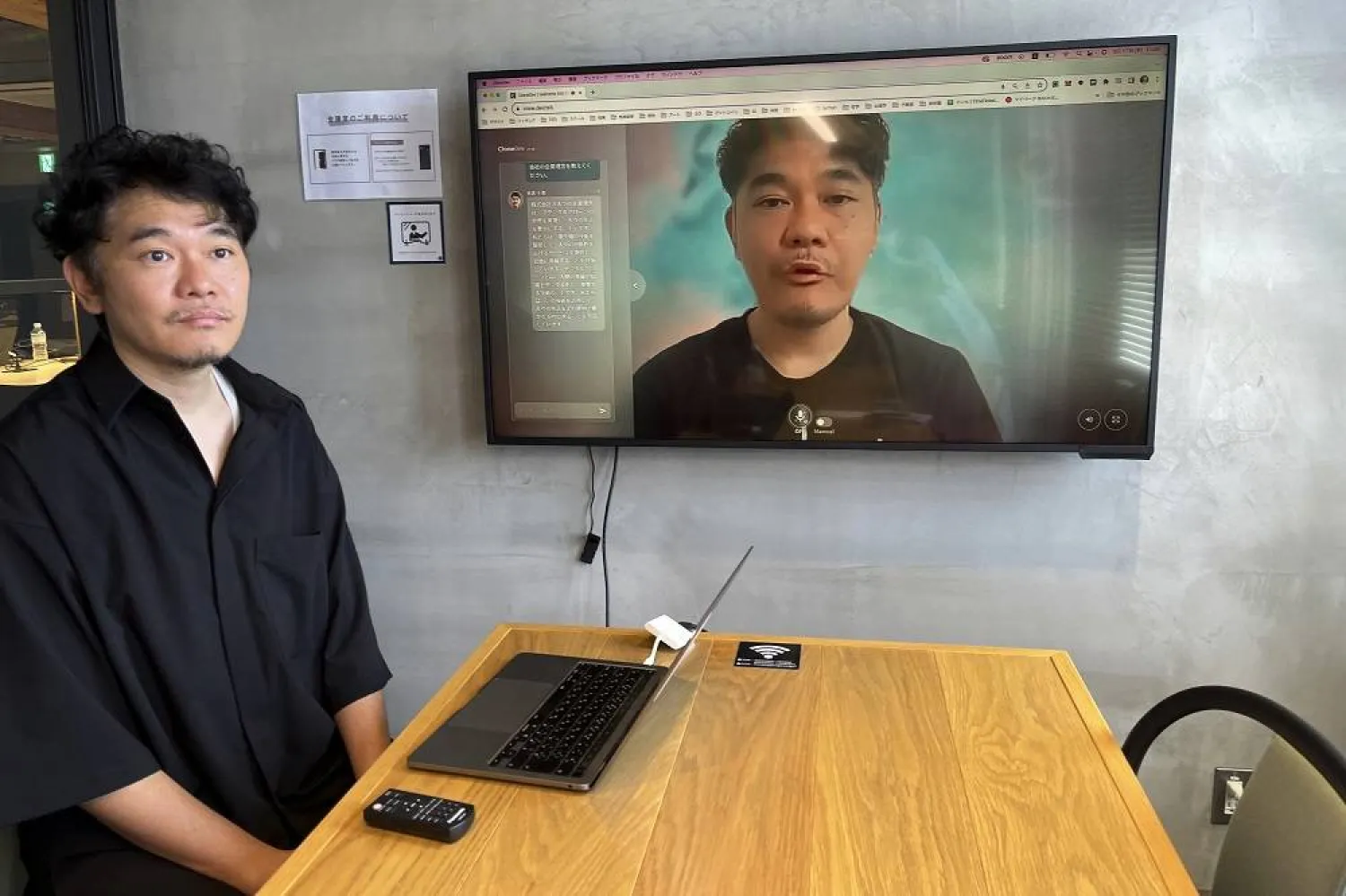
Kazutaka Yonekura, chief executive of Tokyo startup Alt Inc., demonstrates his digital clone on a personal computer at his office in Tokyo, Aug. 17, 2023. (AP)
TT

Digital Clones and Vocaloids May Be Popular in Japan. Elsewhere, They Could Get Lost in Translation 

Kazutaka Yonekura, chief executive of Tokyo startup Alt Inc., demonstrates his digital clone on a personal computer at his office in Tokyo, Aug. 17, 2023. (AP)

Kazutaka Yonekura dreams of a world where everyone will have their very own digital "clone" — an online avatar that could take on some of our work and daily tasks, such as appearing in Zoom meetings in our place.

Yonekura, chief executive of Tokyo startup Alt Inc., believes it could make our lives easier and more efficient.

His company is developing a digital double, an animated image that looks and talks just like its owner. The digital clone can be used, for example, by a recruiter to carry out preliminary job interviews, or by a physician to screen patients ahead of checkups.

"This liberates you from all the routine (tasks) that you must do tomorrow, the day after tomorrow and the day after that," he told The Associated Press as he showed off his double — a thumbnail video image of Yonekura on the computer screen, with a synthesized version of his voice.

When his digital clone is asked "What kind of music do you like," it pauses for several seconds, then goes into a long-winded explanation about Yonekura's fondness for energetic rhythmical music such as hip-hop or rock 'n' roll.

A bit mechanical perhaps — but any social gaffes have been programmed out.

Yonekura, 46, argues that the technology is more personal than Siri, ChatGPT or Google AI. Most importantly, it belongs to you and not the technology company that created it, he said.

For now, having a digital double is expensive. Each Alt clone costs about 20 million yen ($140,000), so it will likely take some time before there's a clone for everyone.

In creating a digital double, information about a person is skimmed off social media sites and publicly available records in a massive data collection effort, and stored in the software. The data is constantly updated, keeping in synch with the owner's changing habits and tastes.

Yonekura believes a digital clone could pave the way for a society where people can focus on being creative and waste less time on tedious interactions.

For many Japanese — the nation that gave the world Pokemon, karaoke, Hello Kitty and emojis — the digital clone is as friendly as an animation character.

But Yonekura acknowledges cultures are different and that Westerners may not like the idea of a digital clone as much.

"I can’t tell you how many times I’ve been asked: Why does it have to be a personal clone, and not just a digital agent?" he said, a hint of exasperation in his voice.

Yonekura’s company has drawn mostly domestic investments of more than 6 billion yen ($40 million), including venture capital funds run by major Japanese banks, while also building collaborative relationships with academia, including the University of Southern California and the University of Tokyo.

But large-scale production of digital doubles is a long way off — for now, the company offers more affordable voice recognition software and virtual assistant technology.

Matt Alt, who co-founded AltJapan Co., a company that produces English-language versions of popular Japanese video games and who has written books about Japan, including "Pure Invention: How Japan Made the Modern World," says the digital clone idea makes more sense culturally in Japan.

Ninjas, the famous feudal Japanese undercover warriors, were known for "bunshin-jutsu" techniques of creating the illusion of a double or a helper in battle to confuse the opponent. The bunshin-jutsu idea has been adopted and is common in modern-day Japanese video games and manga comic books and graphic novels.

"Who wouldn’t want a helping hand from someone who understood them intimately?" Alt said but added that in the West, the idea of an existing double is "more frightening."

"There is the ‘Invasion of the Body Snatchers,’ for instance, or even the brooms that multiply like a virus in Disney’s ‘Fantasia’," he said.

INCS toenter Co., another Tokyo-based startup, has been successful as a production company of computerized music for animation, manga, films, virtual realities and games that uses so-called Vocaloid artists. The synthesized singers or musical acts known as Vocaloid are often paired up with anime- or manga- style characters.

Like Yonekura’s digital clone, Vocaloids are an example of Japanese technology that uses computer software to duplicate human traits or likeness.

Among INCS toenter's hits is "Melt," created on a single desktop in 2007 and performed by a group called Supercell, which has been played 23 million times on YouTube.

A more recent hit is "Kawaikute gomen," which means "Sorry for being so cute," by HoneyWorks, a vocaloid unit. Another is Eve, who performs the theme song of megahit animation series "Jujutsu Kaisen," and has 4.6 million subscribers on his YouTube channel.

Some wonder whether digital clones or Vocaloids could become popular outside Japan. Digital assistant and voice software, as well as computerized music exist in the West, but they are not clones or Vocaloids.

Yu Tamura, chief executive and founder of INCS toenter, says he is encouraged by the increasing global popularity of Japanese animation and manga but that one thing to watch out for is the "Galapagos syndrome."

The term, referring to the isolated Pacific islands where animals evolved in unique ways, is widely used in Japan to describe how some Japanese products, while successful at home, fail to translate abroad.

Overseas consumers could see it as quirky or too cutesy, except for Japanophiles, Tamura said.

"They simply won't get it," he said.


Microsoft to Invest $10 bn for Japan AI Data Centers

Microsoft's Vice Chair and President Brad Smith (4th L) and (L-R) Sakura Internet Inc President and CEO Kunihiro Tanaka, SoftBank Corp. President and CEO Junichi Miyakawa, Microsoft Japan President Miki Tsusaka, hold a meeitng with Japan's Prime Minister Sanae Takaichi (2nd R) and Vice Minister of Economy, Trade and Industry Toshiro Ino (R) at the Prime Minister's Office in Tokyo on April 3, 2026. Kazuhiro NOGI / POOL/AFP
TT

Microsoft to Invest $10 bn for Japan AI Data Centers

Microsoft's Vice Chair and President Brad Smith (4th L) and (L-R) Sakura Internet Inc President and CEO Kunihiro Tanaka, SoftBank Corp. President and CEO Junichi Miyakawa, Microsoft Japan President Miki Tsusaka, hold a meeitng with Japan's Prime Minister Sanae Takaichi (2nd R) and Vice Minister of Economy, Trade and Industry Toshiro Ino (R) at the Prime Minister's Office in Tokyo on April 3, 2026. Kazuhiro NOGI / POOL/AFP

Microsoft said Friday it will invest $10 billion in Japan over the next four years to build artificial intelligence data centers and related infrastructure.

Power-hungry data centers -- warehouse-like facilities that power AI tools from chatbots to image generators -- are springing up worldwide, and the sector is growing particularly fast in Asia.

Microsoft President Brad Smith met Japanese Prime Minister Sanae Takaichi at her office on Friday to announce the investment, said AFP.

Smith said in a statement that it was a "response to Japan's growing need for cloud and AI services".

Businesses in Japan, the world's fourth-largest economy, are keen to get ahead in the fast-moving AI field.

But data centers expansion there is constrained by limited space and relatively expensive electricity.

The US tech giant will collaborate with Japan's SoftBank Group and Sakura Internet to expand domestic tech infrastructure, it said in a press release.

It follows a $2.9 billion two-year investment Microsoft announced in 2024 to bolster the country's push into AI and strengthen its cyber defenses.

The investment unveiled Friday also includes funds to enhance cybersecurity partnerships with Japanese government agencies, and to train one million engineers in cooperation with telecom and tech giants NTT and NEC.

A rush to build data centers in the Asia-Pacific region, especially in India and Southeast Asia, has sparked concerns over the facilities' environmental impact.

That includes increased demand on electricity grids that are often reliant on fossil fuels, and on local water supplies used to cool the hot servers inside.

Microsoft says it has pledged to become carbon negative, zero-waste and "water positive" by 2030.

On Tuesday, the company announced plans to invest more than $1 billion in cloud and AI data center infrastructure and operations in Thailand over the next two years.


Kia to Sell Lower-priced Electric Vehicle in US

A KIA logo on an electric vehicle is seen on display at the Canadian International AutoShow in Toronto, Ontario, Canada, February 13, 2025. REUTERS/Carlos Osorio
TT

Kia to Sell Lower-priced Electric Vehicle in US

A KIA logo on an electric vehicle is seen on display at the Canadian International AutoShow in Toronto, Ontario, Canada, February 13, 2025. REUTERS/Carlos Osorio

Kia said Wednesday it will begin selling a lower-priced electric vehicle in the United States later this year as automakers work to recharge EV sales.

The Korean automaker said at the New York Auto Show it will offer the EV3 in the US market starting later this year, Reuters reported.

Automakers are facing a tougher EV market in the United States after Congress repealed the $7,500 EV tax credit last year but higher gasoline prices in recent weeks has prompted new interest in the EVs.


Passengers Stranded in Moving Traffic after Robotaxi Outage in China

This file photo taken on August 1, 2024 shows a general view of a driverless robotaxi autonomous vehicle developed as part of tech giant Baidu's Apollo Go self-driving project, in Wuhan, in central China's Hubei province. (Photo by PEDRO PARDO / AFP)
TT

Passengers Stranded in Moving Traffic after Robotaxi Outage in China

This file photo taken on August 1, 2024 shows a general view of a driverless robotaxi autonomous vehicle developed as part of tech giant Baidu's Apollo Go self-driving project, in Wuhan, in central China's Hubei province. (Photo by PEDRO PARDO / AFP)

Some robotaxi passengers were left stranded in the middle of fast-moving traffic in a major Chinese city after their driverless vehicles stopped running, according to police and media reports on Wednesday.

A preliminary investigation indicates more than 100 robotaxis came to a halt because of a “system malfunction,” police in the city of Wuhan said in a statement, without elaborating. No injuries were reported.

One passenger told Chinese media that their robotaxi stopped after turning a corner. An instruction on a screen read: “Driving system malfunction. Staff are expected to arrive in 5 minutes.” After no one showed up, the passenger pushed an SOS button and was told that staff were on their way. The car door could be opened, so the passenger got out on their own.

It is the first time a mass shutdown of robotaxis has been reported in China, The Associated Press said. In December, many of Waymo’s self-driving cars came to a stop in San Francisco because of a power outage.

The taxis in Wuhan are operated by Baidu, a major Chinese internet and AI company that is expanding its Apollo Go robotaxi business to overseas locations in Europe and the Mideast.

Baidu did not have any immediate comment.

Police said reports that taxis were coming to a halt started coming in around 9 p.m., while media reports said multiple people were rescued.

While some passengers were able to exit their taxis on their own, others were afraid to get out because their vehicle had stopped in the middle lane of a ring road with other vehicles passing on both sides, the reports said. Ring roads are elevated roads without traffic lights designed to move traffic quickly in urban areas.

Baidu operates hundreds of robotaxis in Wuhan, which hosted an early pilot project for the company.