


Musk Loses Blockbuster OpenAI Suit as Jury Says Too Late

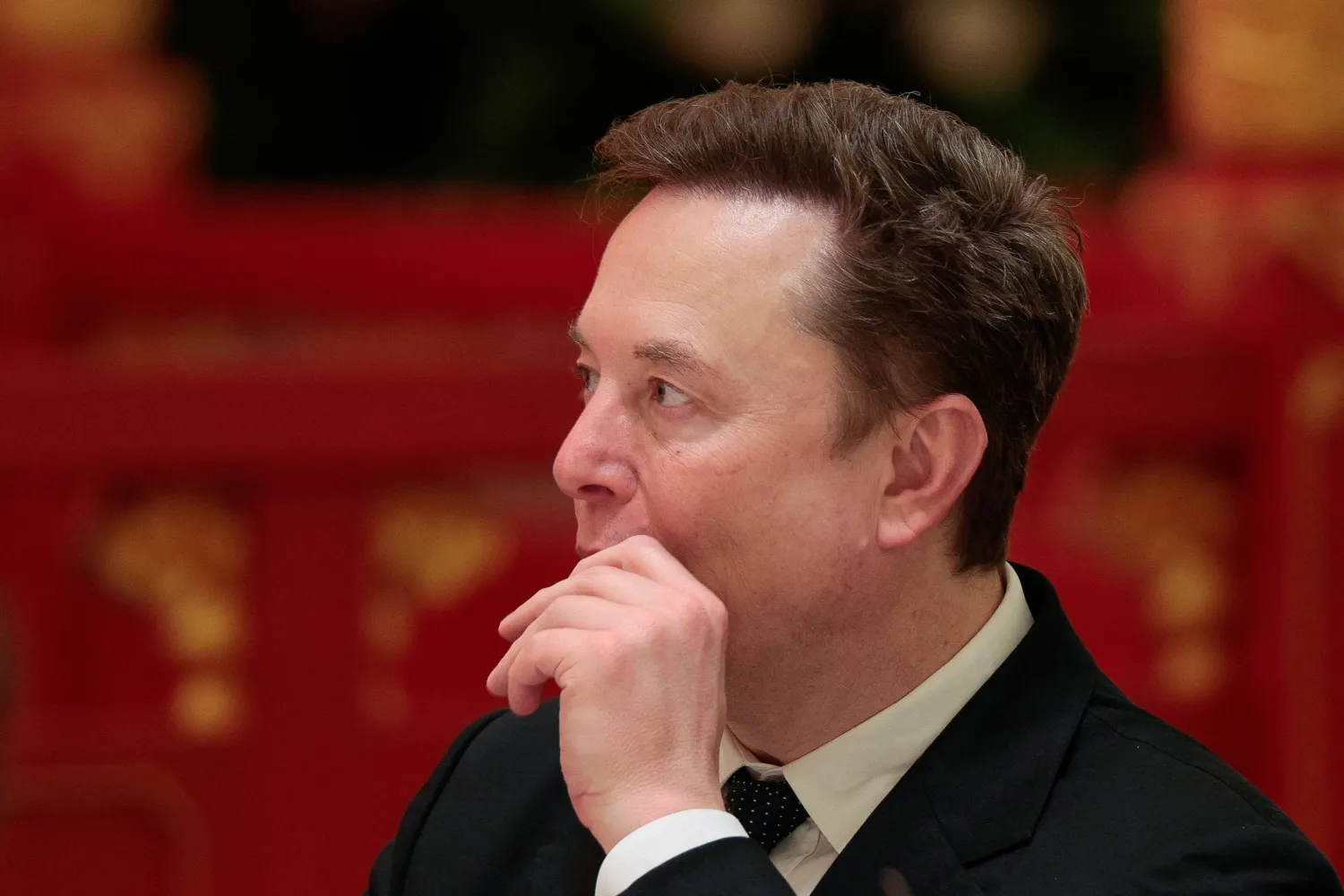
Tesla CEO Elon Musk attends a state banquet with US President Donald Trump and Chinese President Xi Jinping at the Great Hall of the People in Beijing, China, May 14, 2026. (Reuters)
TT

Musk Loses Blockbuster OpenAI Suit as Jury Says Too Late

Tesla CEO Elon Musk attends a state banquet with US President Donald Trump and Chinese President Xi Jinping at the Great Hall of the People in Beijing, China, May 14, 2026. (Reuters)

A federal jury ruled Monday that billionaire Elon Musk waited too long to sue OpenAI and its co-founders, delivering a decisive victory to the ChatGPT startup and ending one of Silicon Valley's most closely watched courtroom battles.

The swift decision caps a three-week trial that saw a parade of tech titans take the stand, with Musk arguing that OpenAI's pivot to a profit-driven business betrayed its original nonprofit mandate.

The jury in Oakland federal court found that Musk's claims against OpenAI CEO Sam Altman, President Greg Brockman, The OpenAI Foundation and Microsoft were barred by statutes of limitations, leaving the core arguments of the world's richest person largely unaddressed.

Judge Yvonne Gonzalez Rogers, who had asked the jury to advise her on the matter, accepted and confirmed their decision.

- 'Sabotage' -

The outcome spared OpenAI from a potentially existential legal threat.

Had Musk prevailed, he potentially could have forced the company to revert to its nonprofit structure -- a move that would have derailed its planned IPO and unwound ties to major investors including Microsoft, Amazon and SoftBank.

"The finding of the jury confirms that this lawsuit was a hypocritical attempt to sabotage a competitor," OpenAI attorney William Savitt said outside the courthouse.

"Musk can bring his claims, and he can tell his stories, but what the nine members of this jury found is that his stories were just that -- stories, not facts," he added.

Musk, the chief executive of both SpaceX and Tesla, had sued OpenAI over its transformation from a scrappy nonprofit into the $850 billion juggernaut behind ChatGPT.

He claimed Altman and Brockman improperly used a $38 million donation intended to sustain OpenAI as a research lab devoted to developing artificial intelligence for the benefit of humanity.

But in their deliberations, the jury first had to resolve a threshold issue of whether Musk, who filed suit in 2024 -- four years after his last contribution -- had done so within the statutory time limit.
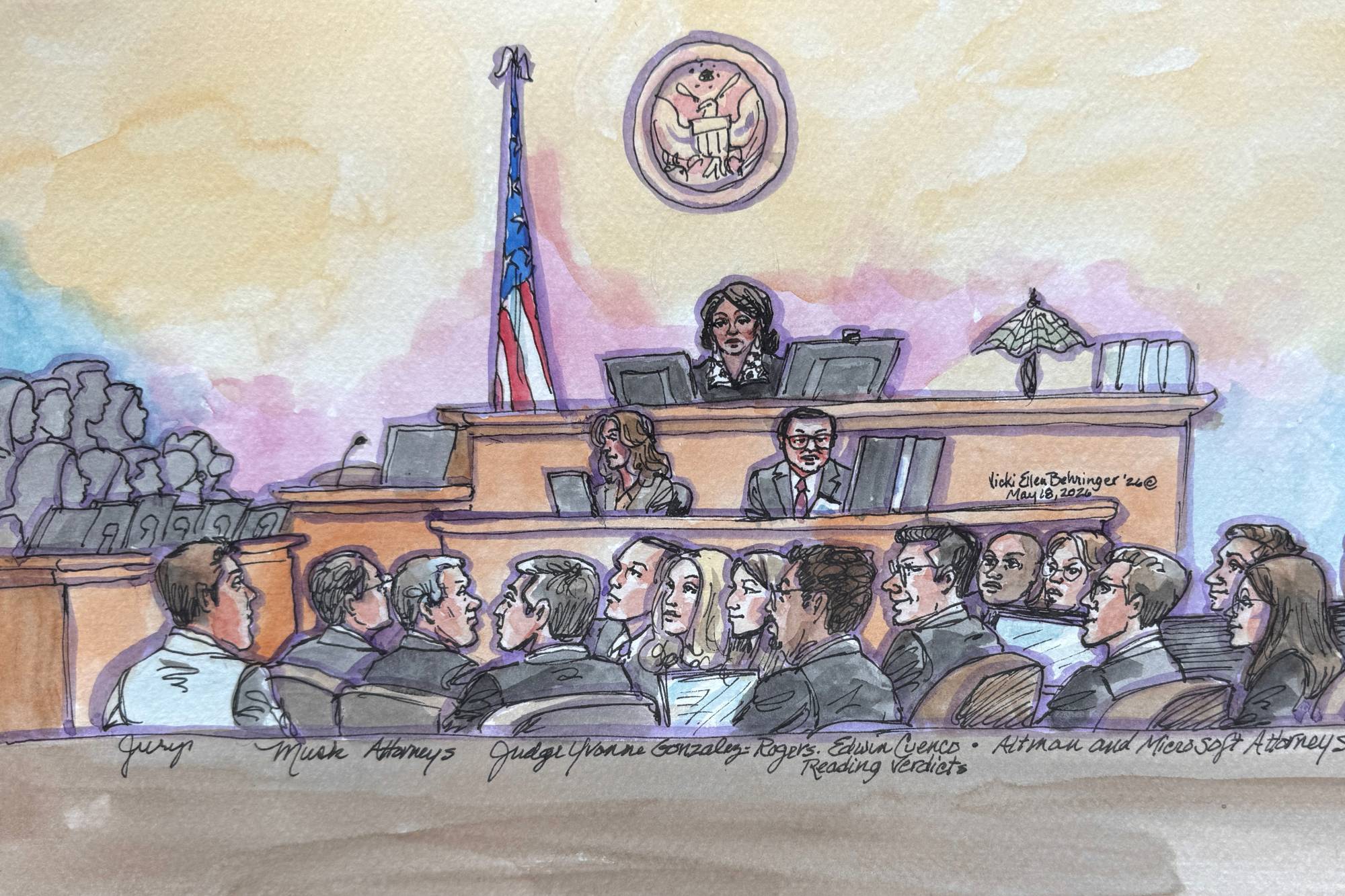
Designated courtroom deputy Edwin Cuenco reads the verdict before US District Judge Yvonne Gonzalez Rogers at Elon Musk's lawsuit trial over OpenAI's for-profit conversion at a federal courthouse in Oakland, California, US, May 18, 2026 in a courtroom sketch. (Reuters)

Musk on X said he would appeal, as the "jury never actually ruled on the merits of the case" and that to "loot charities is incredibly destructive to charitable giving in America."

The tycoon also lashed out at Judge Gonzalez Rogers for setting a "terrible precedent," writing in a since-deleted post accusations that she was an "activist judge" who used the jury as a "fig leaf" for a flawed ruling she could have made herself.

- 'Soap opera' -

The outcome had largely been expected to come down to which of the bickering billionaires the jury would believe.

Testimony centered heavily on Altman's integrity and behind-the-scenes maneuvering that rankled colleagues, many of whom have since left OpenAI.

Attorneys for OpenAI countered with attacks on Musk, pointing to his varying narratives about the early days of the company and parsing testimony from Shivon Zilis -- a business associate with whom he has four children -- who served as an intermediary between the executives.

Altman, fired by OpenAI's board in November 2023 for a lack of candor before being reinstated under employee pressure, emerged with allegations of manipulation and a toxic work culture unresolved.

Microsoft, OpenAI's largest backer with $13 billion committed, was also spared.

"This is an important victory for Altman and OpenAI and clears the path for an IPO by removing this black cloud," Dan Ives of Wedbush Securities told AFP.

"Musk was creating noise around this lawsuit but ultimately it was more of a soap opera than a long-term negative for OpenAI," he added.




KSrelief Holds Workshop on AI’s Role in Advancing Humanitarian and Development Work

The workshop discussed emerging trends and risks. SPA
TT

KSrelief Holds Workshop on AI’s Role in Advancing Humanitarian and Development Work

The workshop discussed emerging trends and risks. SPA

The King Salman Humanitarian Aid and Relief Center (KSrelief), in collaboration with the UK Foreign, Commonwealth & Development Office (FCDO) and the Saudi Fund for Development (SFD), organized a two-day workshop titled “Data and Artificial Intelligence in the Humanitarian and Development Sectors: A Saudi-UK Partnership for Leadership and Impact” at its headquarters in Riyadh.

The workshop that started Tuesday was attended by KSrelief Director of Information Technology Eng. Tamim Al-Husain and UK Deputy Ambassador to Saudi Arabia Dr. Alice Burt.

The event brought together experts from the Saudi Data and Artificial Intelligence Authority (SDAIA), the King Abdulaziz City for Science and Technology (KACST), and specialists from KSrelief, SFD, and FCDO.

The workshop discussed emerging trends and risks, facilitated the exchange of expertise, and explored opportunities for future cooperation and partnerships between Saudi Arabia and the United Kingdom in the field of artificial intelligence to advance humanitarian and development work.

It also highlighted the importance of data and AI in humanitarian and development leadership, reviewed practical applications of AI in humanitarian needs assessments, early warning systems, inclusion efforts, and demographic trend analysis, and examined AI governance and safeguards for the safe and responsible use of emerging technologies.

In addition, participants discussed Saudi Arabia’s approach to leveraging technology in the humanitarian sector and developed a roadmap for the next round of strategic dialogue between the two countries.

The workshop was held as part of efforts to strengthen cooperation and coordination between Saudi Arabia and the UK in data and AI, to advance humanitarian, relief, and development work through the effective use of modern technologies.


Saudi Arabia: Tuwaiq Academy, Google Cloud Launch AI, Cloud Computing Initiative

The initiative was launched during Google Cloud’s annual AI Live + Labs event in Riyadh. SPA
TT

Saudi Arabia: Tuwaiq Academy, Google Cloud Launch AI, Cloud Computing Initiative

The initiative was launched during Google Cloud’s annual AI Live + Labs event in Riyadh. SPA

Saudi Arabia’s Tuwaiq Academy, in collaboration with Google Cloud, has launched the AI & Cloud Champions Program, aiming to build national capabilities and empower local talent to develop innovative cloud-based solutions using AI and emerging technologies.

The initiative, launched during Google Cloud’s annual AI Live + Labs event in Riyadh, builds on the strategic partnership between the two sides. It focuses on developing digital skills while expanding the Kingdom’s ecosystem of developers, tech startups, and tech professionals.

The program includes developing specialized training content and programs, as well as access to hands-on sandbox environments, cloud service credits, and vouchers for professional certification exams. It is further supported by a grant from Google Cloud’s economic and community development team to help drive its implementation.

Running from June through December, the program targets students, graduates, employees, tech startup entrepreneurs, and tech enthusiasts.

The initiative features three main tracks, including training programs and professional certifications designed to help participants strengthen their skills in applying AI in cloud computing. Additionally, a dedicated track will support more than 60 tech startups through intensive sessions and practical consulting to help them advance their growth and development.

The program will also offer a series of workshops and knowledge-sharing sessions led by experts and specialists to enhance participants’ expertise and capabilities in AI and cloud computing.


Intense AI Use Still Rare Among Euro Zone Firms, ECB Researchers Find

FILE PHOTO: AI (Artificial Intelligence) letters and robot hand miniature in this illustration taken, June 23, 2023. REUTERS/Dado Ruvic/Illustration/File Photo
TT

Intense AI Use Still Rare Among Euro Zone Firms, ECB Researchers Find

FILE PHOTO: AI (Artificial Intelligence) letters and robot hand miniature in this illustration taken, June 23, 2023. REUTERS/Dado Ruvic/Illustration/File Photo

Only a small fraction of euro zone firms use artificial intelligence intensely and they tend to be small, young, service-oriented companies, leaving plenty of room for diffusion, a European Central Bank blog post said on Wednesday.

The vast majority of firms now say they have been using AI but economists have been debating just how intense this use is and whether it can yield the sort of efficiency gains that ⁠are relevant on a ⁠macroeconomic level.

Surveying more than 5,000 companies across the bloc, the ECB found that over 70% report using AI and much of the rest plan to start this year, Reuters reported. But use is moderate or infrequent and ⁠only 7% use AI intensely, the survey found.

"The intensive use that drives transformation and generates macroeconomic gains remains rare," the authors, all ECB researchers, said, in a post that does not necessarily represent the ECB's views.

Intense use is skewed towards smaller companies with large firms clearly lagging behind, the survey results showed. Younger firms also used AI more intensely than older companies ⁠and ⁠use was skewed towards high-tech, knowledge-intensive services.

"Firms at an early stage of adoption often cite cost reductions and improvements in operational efficiency as their main reasons for using it," the blog said. "Intensive users are more frequently motivated by growth and innovation."

Firms tend to invest in AI when their competitors do, succumbing to peer pressure, and intensive users spend heavily on customized solutions that go well beyond just purchasing licenses, the blog said.