

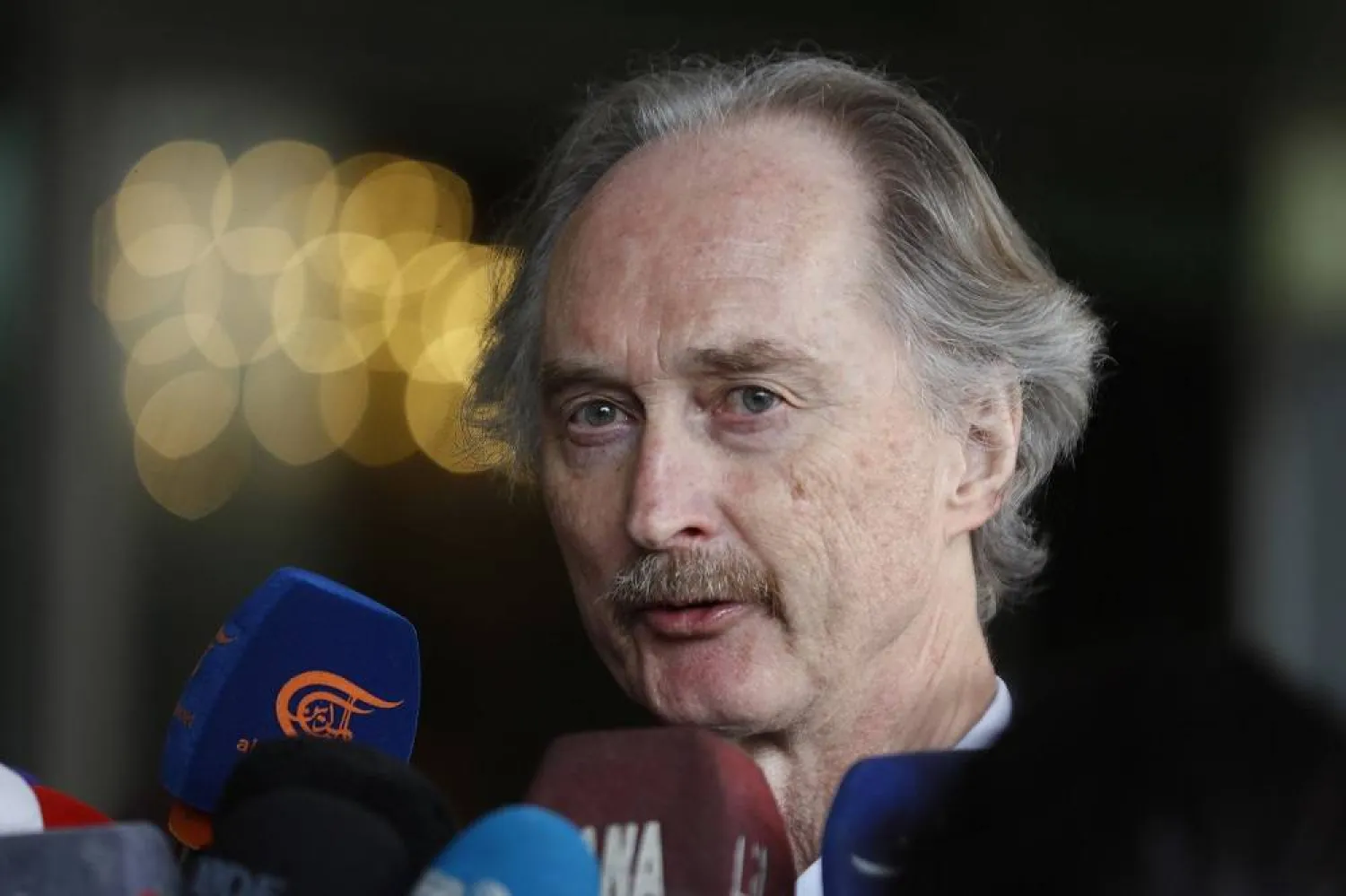

UN Envoy Says Israel-Hamas War Spilling into Syria, Adding to Growing Instability 

The United Nations special envoy for Syria, Geir Pedersen, speaks to journalists in Damascus, Syria, Feb. 13, 2023. (AP)
TT

UN Envoy Says Israel-Hamas War Spilling into Syria, Adding to Growing Instability 

The United Nations special envoy for Syria, Geir Pedersen, speaks to journalists in Damascus, Syria, Feb. 13, 2023. (AP)

The Israel-Hamas war is spilling into Syria, fueled by growing instability, violence and a lack of progress toward a political solution to its 12-year conflict, the United Nations special envoy for the country said Monday.

Geir Pedersen told the Security Council that, on top of violence from the Syrian conflict, the Syrian people now face “a terrifying prospect of a potential wider escalation” following Hamas’ Oct. 7 attacks on Israel and the ongoing retaliatory military action.

“Spillover into Syria is not just a risk; it has already begun,” the UN envoy for Syria said.

Pedersen pointed to airstrikes attributed to Israel hitting Syria's airports in Aleppo and Damascus several times, and retaliation by the United States against what it said were multiple attacks on its forces “by groups that it claims are backed by Iran, including on Syrian territory.”

With the region “at its most dangerous and tense,” he said, “fuel is being added to a tinderbox that was already beginning to ignite” in Syria, which was seeing a surge in violence even before Oct. 7.

Pedersen said the number of Syrians killed, injured and displaced is at its highest since 2020, citing a significant intensification of attacks in government-controlled areas, including an unclaimed attack on a graduation ceremony at a military academy in Homs, which the government attributes to terrorist organizations.

He also reported government rocket attacks throughout October on Hayat Tahrir al Sham — the insurgent group that rules much of opposition-held northwest Syria — as well as a major escalation of Turkish strikes in the northeast following an attack on Turkish government facilities in Ankara. The Turkish strikes have killed dozens, damaged health facilities, schools and camps, and displaced more than 120,000 civilians, he said.

US Ambassador Linda Thomas-Greenfield accused “terrorist groups,” some backed by Syria and Iran, of threating to expand the Gaza conflict “by using Syrian territory to plot and launch attacks against Israel.” She also accused Syria of allowing Iran and terrorist groups to use its international airports for military purposes.

“We call on the regime to curb the activities of Iran-backed militias in Syria, stop the flow of foreign arms and fighters through its territory, and cease escalatory actions in the Golan Heights,” she said.

“The United States has warned all actors not to take advantage of the situation in Gaza to widen or deepen the conflict,” Thomas-Greenfield said. “And we’ve made clear that we will respond to attacks on our own personnel and facilities in Syria or against US interests, and where appropriate exercise our right to self-defense forcefully, proportionately and in a manner that minimizes civilian harm.”

Ambassador Vassily Nebenzia of Russia, Syria’s closest ally, accused Israeli forces of striking sites in Syria, including civilian airports, and called US attacks in the country “illegitimate actions” and “a gross violation of Syria’s sovereignty.” He also claimed US economic interests and involvement “in contraband with Syrian grain and oil” have prevailed over political interests.

Nebenzia said there is a sharp increase in tensions around the Israel-Hamas conflict and attacks like the ones by the US might provoke spillover to the entire region. “This must not be deemed acceptable," he said.

Iran’s UN Ambassador Amir Iravani refuted all US claims, saying his country is in Syria at Damascus' request to fight terrorism. He accused Washington of attempting “to shift the blame from the culprit to the victim.”

Iravani told the council the United States’ “unwavering support” for Israel “has rendered it part of the problem.” He said the US and some Western countries were attempting to give Israel an unjust right to self-defense while ignoring the Palestinian people’s right to self-determination, and equating the Palestinian resistance with terrorism.

“Iran’s primary objective is to avoid any escalation in the region,” the ambassador stressed, which is why it has endorsed international calls for an immediate cease-fire and humanitarian aid for people in Gaza.

However, Iravani said Iran will respond to any threat, attack or aggression endangering its security.



Three Deadly Attacks on Health Centers in Sudan's South Kordofan in Past Week, Says WHO

Sudanese families prepare to ride on trucks while on their way to Egypt through the Qustul border, after the crisis in Sudan's capital Khartoum, in the Sudanese city of Wadi Halfa, Sudan May 1, 2023. (Reuters)
TT

Three Deadly Attacks on Health Centers in Sudan's South Kordofan in Past Week, Says WHO

Sudanese families prepare to ride on trucks while on their way to Egypt through the Qustul border, after the crisis in Sudan's capital Khartoum, in the Sudanese city of Wadi Halfa, Sudan May 1, 2023. (Reuters)

Sudan's South Kordofan region has seen attacks on three health facilities in the past week alone, leaving more than 30 dead, the World Health Organization said Sunday, AFP reported.

"Sudan's health system is under attack again," WHO chief Tedros Adhanom Ghebreyesus said on X, pointing out that, since February 3, "three health facilities were attacked in South Kordofan, in a region already suffering acute malnutrition".


Killing of Seif al-Islam al-Gadhafi Raises Succession Questions in September Current

Seif al-Islam al-Gadhafi (file photo, Reuters)
TT

Killing of Seif al-Islam al-Gadhafi Raises Succession Questions in September Current

Seif al-Islam al-Gadhafi (file photo, Reuters)

Since the killing of Seif al-Islam al-Gadhafi, son of Libya’s late leader Moammar Gadhafi, in the western Libyan city of Zintan last Tuesday, urgent questions have surfaced over who might succeed him in leading the political current he represented.

The questions reflect Seif al-Islam’s symbolic status among supporters of the former regime, known as the September Current, a reference to backers of the September 1 Revolution led by Moammar Gadhafi in 1969.

Search for new leadership

Othman Barka, a leading figure in the National Current that backed Seif al-Islam al-Gadhafi, said supporters of the former regime had yet to agree on a new leader but retained the organizational and political capacity to overcome the current phase and later move toward an alternative leadership framework.

Barka told Asharq Al-Awsat that ties to Gadhafi and his sons had been both emotional and political, but said that what he described as national work would continue. He said organized efforts would be made to reach a new leadership after the repercussions of the killing were overcome.

It remains unclear how Ahmed Gaddaf al-Dam, the political official in the Libyan National Struggle Front and one of the most prominent figures of the former regime, views the future leadership of the September Current following Seif al-Islam’s killing.

Sources close to him told Asharq Al-Awsat it was too early to speak of a new leadership while mourning ceremonies continued in Bani Walid.

Gaddaf al-Dam limited his public response to reposting a statement by those describing themselves as supporters of the Jamahiriya system on his Facebook page. He stressed unity, saying the killing would not lead to the fragmentation of the current and that September supporters remained a single, solid bloc.

In Bani Walid in western Libya, where Seif al-Islam was buried on Friday, shock was evident in the tone of Libyan activist Hamid Gadhafi, a member of the late leader’s tribe. He told Asharq Al-Awsat that clarity over the future leadership would emerge after about 10 days.

Possible successors

Libyan social media pages circulated the names of potential successors, including Seif al-Islam’s sister, Aisha, and his brother, Saadi. Libyan political analyst Ibrahim Belqasem rejected that view, telling Asharq Al-Awsat that the only remaining driver for supporters of the former regime would be the emergence of an unexpected, nonpolitical figure, describing it as an attempt to rescue the current.

After the fall of Gadhafi’s rule in 2011, following 42 years in power since the 1969 revolution, his supporters reemerged under the banner of the September Current. They are popularly known as the Greens, a reference to the Green Book.

Fragmented components and the absence of unified leadership mark the September Current. Seif al-Islam was widely seen as a central symbol among supporters, as well as among political figures and groups calling for the reintegration of former regime supporters into political life and for the recognition of their rights.

Nasser Saeed, spokesman for the Libyan Popular National Movement, one of the political arms of former regime supporters, said he expected a national political leadership to take shape in the coming phase to continue what he described as national work until the country stabilizes. Libyans can determine their future.

He said the emergence of a new leader or symbol was a matter for a later stage, stressing that the project was ideological rather than tied to individuals.

Saeed told Asharq Al-Awsat that Seif al-Islam al-Gadhafi’s legacy lay in a unifying national project that rejected foreign intervention and sought to restore sovereignty and stability. He said Seif al-Islam had represented hope for overcoming the crisis and that his project extended the path of the September Revolution as a liberation choice that still retained supporters.

Structural challenges

Organizationally, the former regime cannot be confined to a single political framework. Its structures and leadership are diverse, including independent organizations and figures.

Among the most prominent are the Libyan Popular National Movement, founded in 2012, and the Popular Front for the Liberation of Libya, formed in 2016 by politicians and tribal leaders in support of Seif al-Islam al-Gadhafi.

Their representatives increased their presence after 2020, whether in the Geneva forum that led to the formation of the Government of National Unity or in UN-sponsored structured dialogue tracks, before suspending participation following Seif al-Islam’s killing.

Voices within the September Current believe the killing marked a decisive turning point that cast heavy shadows over the ability of former regime supporters to forge unified leadership, citing structural difficulties rooted in historical disagreements between what is known as the old guard and supporters of change led by Seif al-Islam.

Khaled al-Hijazi, a prominent political activist in the September Current, agreed with that assessment, saying Seif al-Islam’s symbolic role had helped balance internal disputes due to his reformist project before the February 17 uprising.

Al-Hijazi told Asharq Al-Awsat that the loss of that symbolism could revive old divisions and complicate efforts to recreate an inclusive leadership, amid internal and external factors that make unification highly complex in the foreseeable future.

Barka said differences were natural, stressing that the current was not a closed party and believed in democracy and pluralism. He said generational competition did not amount to conflict and noted there had been no violent clashes between supporters of different paths within the September Current.

He concluded by saying that the diversity of approaches served a single goal: the freedom and prosperity of Libyan citizens and the building of a sovereign state capable of overcoming the crisis that has persisted since 2011.


Hezbollah Overhaul Gives Qassem Tighter Administrative Control

Wafiq Safa, head of Hezbollah’s Liaison and Coordination Unit, speaks to the media at the site of the killing of Hassan Nasrallah, Hezbollah’s secretary-general, in Beirut’s southern suburbs last year (Social media)
TT

Hezbollah Overhaul Gives Qassem Tighter Administrative Control

Wafiq Safa, head of Hezbollah’s Liaison and Coordination Unit, speaks to the media at the site of the killing of Hassan Nasrallah, Hezbollah’s secretary-general, in Beirut’s southern suburbs last year (Social media)

The resignation of Wafiq Safa, head of Hezbollah’s Liaison and Coordination Unit, a move that bore the hallmarks of a dismissal, has lifted the lid on a far-reaching internal shake-up of the group’s organizational structure after the heaviest blows it has suffered in its history.

The restructuring follows Hezbollah’s latest war with Israel, which decimated the group’s senior leadership, killing its long-time secretary-general Hassan Nasrallah, his designated successor Hashem Safieddine, a third potential successor Nabil Qaouq, along with much of its military command.

Well-informed Lebanese sources told Asharq Al-Awsat that Safa’s exit marks only the visible edge of bigger changes underway as the group moves to overhaul its leadership, security, and political apparatus in response to the unprecedented damage inflicted by the war.

Previously, that post led the organization without delving into the executive council's responsibilities, which function as a government-like body within the party.

Another key shift is the growing role of political figures in decision-making at the expense of clerics who had dominated the leadership in the previous phase.

New figures have also entered the decision-making circle, including individuals who worked with Qassem in the Islamic Daawa Party and Islamic committees before joining Hezbollah after its founding.

Raad seen as deputy secretary-general

The picture becomes clearer with the entry of Mohammad Raad, head of Hezbollah’s parliamentary bloc Loyalty to the Resistance, into the party’s decision-making core. There is a clear trend toward appointing him deputy secretary-general.

However, the decision is unlikely to be announced before parliamentary elections. MP Hassan Fadlallah is expected to assume leadership of the bloc after the latest elections.

Fneish to lead the party’s executive council

Sources told Asharq Al-Awsat that former minister and MP Mohammad Fneish has taken over responsibility for Hezbollah’s executive council, where he is tasked with reorganizing the party’s administrative and institutional structure. Sheikh Ali Daamoush is handling operational and organizational duties within the council.

Internal organizational measures

Opposition sources familiar with Hezbollah’s internal affairs said Safa was among the first officials affected by internal organizational decisions that curtailed media activity. A directive from the secretary-general’s office barred him from making statements without prior approval from the party’s media relations department.

The same sources said the measures went beyond media restrictions and were accompanied by a noticeable reduction in Safa’s political role, including contacts with political forces and involvement in elections and nominations. According to this account, he has had no public presence in recent months as a political envoy, neither to allies nor rivals.

Redistribution of roles

Sources explained that the unit, previously known in practice as the Security Committee, had handled internal security disputes and field tensions within Hezbollah’s environment or with other parties, intervening directly before coordinating with relevant actors and later with Lebanese state institutions, including security and judicial bodies. It also followed detainee cases and brokered reconciliations.

They added that the unit’s head benefited from growing influence within the party, particularly after being pushed to the forefront in sensitive files such as indirect negotiations and prisoner exchanges, enabling him to build political and international networks, including external channels.

Limiting political authority

Sources tracking the organizational file said the expansion of this role eventually led the unit to exceed its strictly security mandate by performing political functions, including receiving delegations and relaying messages.

They said that after the current leadership took charge, clear instructions were issued to restrict the Liaison and Coordination Unit’s role to security and technical coordination only, barring it from any political, negotiating, or media activity.

According to sources, all political decisions and contacts are now confined to the party’s political leadership, specifically to Secretary-General Naim Qassem, parliamentary bloc head Mohammad Raad, or the secretary-general’s political aide, Hussein Khalil. The security unit’s role is limited to technical coordination with Lebanese security agencies.

Broader structural shifts

Observers link these changes to broader transformations within Hezbollah since Qassem assumed leadership. They note that the previous phase saw prominent roles for clerical figures in the second and third ranks, such as Hashem Safieddine and Nabil Qaouq, who Israel killed in the recent war.

The current scene, by contrast, is marked by the rise of non-clerical political figures, including Mohammad Raad, Mahmoud Qmati, and Ibrahim Mousawi, signaling a gradual shift toward reinforcing the party’s political character.

The sources said media affairs have been centralized under a single administration overseen by MP Ibrahim Mousawi, with direct coordination with the leadership, as part of a policy aimed at unifying messaging and restricting public statements to authorized figures.

War fallout behind Safa’s removal

Political analyst Ali al-Amin told Asharq Al-Awsat that Safa’s sidelining comes amid the fallout from the war and its direct repercussions on Hezbollah, as well as the impact of Iran’s retrenchment and ongoing US-Iran negotiations. He said the party has come to realize that what was possible in the past is no longer sustainable.

Al-Amin said the decision affects a body with both personal and institutional dimensions, noting that Safa is subject to US sanctions, making the move a clear signal that Hezbollah no longer enjoys the same level of control over security bodies amid US pressure and Lebanese state demands to dismantle the apparatus.

He said Hezbollah is trying to adapt to new realities, adding that acceptance of this path will depend on how the party handles implementation of the principle of exclusive state control over weapons.

He noted that recent statements by Mohammad Raad had a tone that could appear positive about weapons exclusivity but fell short of complete clarity. He described the current step as an initial practical measure whose impact will be assessed later, both at the Lebanese official level and by US officials closely following the Lebanese file.

Al-Amin said Hezbollah will continue, whenever possible, to present itself as a political party, even if only superficially, in an effort to project a peaceful, civilian image and show alignment with state institutions.

He added that any progress or disruption in US-Iran negotiations would be reflected in greater flexibility in the party’s domestic behavior, unless a decisive international decision is taken to end Hezbollah’s current status.

In this context, reports have circulated that Hussein Abdallah has been tasked with heading the Liaison and Coordination Unit. Abdallah previously served as Hezbollah’s security chief in southern Lebanon and is considered close to Naim Qassem. Responsibility for contacts with the state and abroad has reportedly been assigned to his deputy, Ahmed Mahna.

Party-aligned account

A source close to Hezbollah offered a different account, telling Asharq Al-Awsat that the measures affecting Safa are part of an organizational restructuring the party has pursued since the end of the war as part of a comprehensive internal review affecting multiple positions and officials.

The source stressed that Safa remains within Hezbollah’s organizational structure.

By contrast, Al-Jadeed television reported that Safa submitted his resignation as head of the Liaison and Coordination Unit with internal approval, citing deep disagreements with Secretary-General Naim Qassem, Shura Council member and parliamentary bloc head Mohammad Raad, and the curtailment of his powers.