Civilians Fleeing Northern Gaza Report Terrifying Journey on Foot Past Israeli Tanks 

Palestinians walk after Israeli bombardment in Khan Yunis in the southern Gaza Strip on November 7, 2023, amid continuing battles between Israel and the Palestinian militant group Hamas. (AFP)
TT

Civilians Fleeing Northern Gaza Report Terrifying Journey on Foot Past Israeli Tanks 

Palestinians walk after Israeli bombardment in Khan Yunis in the southern Gaza Strip on November 7, 2023, amid continuing battles between Israel and the Palestinian militant group Hamas. (AFP)

What was once Gaza’s busiest thoroughfare has become a terrifying escape route for Palestinian civilians fleeing combat on foot or on donkey carts. On their way south, those running for their lives said they raised their hands and waved white flags to move past Israeli tanks along the four-lane highway.

Some reported Israeli soldiers firing at them and said they passed bodies strewn alongside the road.

Many escaped with just the clothes on their back. One woman, covered head-to-toe in a black veil and robe, cradled a toddler and clutched a black purse. A man walked alongside a covered donkey cart that transported his family. It was piled high with mattresses.

In the north of the Gaza Strip, Israeli ground forces backed by relentless airstrikes have encircled Gaza City, the base of Hamas ' power, since the weekend. They cut the strip in half and sought to drive Palestinians from northern Gaza as troops advanced.

From early on in the war, now in its second month, the army has urged civilians to move south, including by announcing brief windows for what it said would be safe passage through Salah al-Din, which runs through the center of the besieged enclave.

But tens of thousands of civilians have remained in the north, many sheltering in hospitals or United Nations facilities.

Those who have stayed put say they are deterred by overcrowding in the south, along with dwindling water and food supplies, and continued Israeli airstrikes in what are supposed to be safe areas. Some said fear of the treacherous journey south, following reports from other travelers about coming under fire, initially made them hesitate.

On Monday, Health Ministry in Gaza spokesperson Ashraf al-Qidra dismissed the Israeli offers of safe passage as "nothing but death corridors." He said bodies have lined the road for days, and called for the International Committee of the Red Cross to accompany local ambulances to retrieve the dead.

Israel’s military said that at one point, troops came under Hamas fire when trying to open the road temporarily for civilians. Israel’s Prime Minister Benjamin Netanyahu echoed the army's claims in an interview with ABC News broadcast late Monday.

"We are fighting an enemy that is particularly brutal. They are using their civilians as human shields, and while we are asking the Palestinian civilian population to leave the war zone, they are preventing them at gunpoint," Netanyahu said.

The claims could not be verified independently.

During a four-hour evacuation window Sunday, fewer than 2,000 made the move, followed by about 5,000 on Monday, according to UN monitors.

Some of those were from Gaza City and the adjacent Shati refugee camp, fleeing Monday after heavy Israeli bombardment there overnight.

"Last night was very difficult," said Amal, a young woman who declined to give her family name due to safety concerns. She was part of a group of 17 people making the journey Monday. She said tanks fired near the group. Soldiers then ordered everyone to raise their hands and white flags before being allowed to pass.

Nour Naji Abu Nasser, 27, arrived Sunday in Khan Younis in southern Gaza. She described an hourslong frightening journey.

"They fired at the sand around us. They wanted to scare us," she said, adding that she saw bodies lying along the road outside Gaza City.

Once those fleeing the north had reached the evacuation zone, residents from the Bureij refugee camp along the highway offered water — a scarce resource in war-time Gaza — to the evacuees.

The four-week war has displaced about 1.5 million people across Gaza, according to UN figures.

The Israeli military said thousands heeded its orders to move south, but UN humanitarian monitors said thousands of evacuees returned to their homes in the north because of ongoing bombardment across Gaza and the lack of shelters in the south.

The UN agency for Palestinian refugees says more than 530,000 people are sheltering in its facilities in southern Gaza, and it's now unable to accommodate new arrivals. Many displaced people sought safety by sleeping in the streets near UN shelters, the agency said.


From Gaza to Congress: Adam Hamawy Becomes First Muslim to Represent New Jersey in the House

Dr. Adam Hamawy (File photo/AFP)
TT

From Gaza to Congress: Adam Hamawy Becomes First Muslim to Represent New Jersey in the House

Dr. Adam Hamawy (File photo/AFP)

Adam Hamawy, a surgeon who previously volunteered in the Gaza Strip, won a seat in the US House of Representatives on Tuesday, defeating Republican Gregg Mele in New Jersey's 12th Congressional District.

The Associated Press called the race for Hamawy at 8:26 p.m. Eastern Time. At the time, he had secured 70.8% of the vote, with 80% of ballots counted.

With his victory, Hamawy becomes the first Muslim elected to Congress from New Jersey.

Hamawy was among 12 active candidates who competed in the crowded Democratic primary to succeed liberal Rep. Bonnie Watson Coleman, who is retiring after 12 years in office. A 13th candidate remained on the primary ballot despite withdrawing from the race.

The former US Army combat surgeon comfortably defeated Mele, an attorney, to succeed the Democratic congresswoman.

The result came as little surprise. Watson Coleman, an influential progressive voice in the House, won reelection in 2024 by a margin of nearly 25 percentage points.

Hamawy's victory keeps the reliably Democratic seat in the party's hands, according to The Hill.

Earlier this year, Hamawy secured the Democratic nomination after emerging from a competitive primary field.

Early Life and Humanitarian Work

Hamawy grew up in New Jersey after his family emigrated from Egypt when he was an infant.

He attended Rutgers University and its medical school before later earning a Master of Business Administration degree from the same university.

After completing his military service, he returned to New Jersey and established a private plastic surgery practice in Princeton.

According to his campaign website, Hamawy has also volunteered to treat patients in Syria, Lebanon, Sudan, Jordan, Turkey, Bosnia, Haiti, Belize and Colombia.

He served eight years as a surgeon in the US Army, including a nine-month deployment with the 31st Combat Support Hospital in Baghdad during the Iraq War.

His Journey to Gaza

Hamawy, who lives in South Brunswick and operates a plastic surgery practice in Princeton, entered the congressional race as a political newcomer.

His campaign quickly gained momentum amid growing frustration among progressives over Israel and its war against Hamas in the Gaza Strip.

Hamawy came to national attention in 2024 when he was among a group of doctors stranded in Gaza after Israel closed the Rafah border crossing.

Democratic Sen. Tammy Duckworth of Illinois, who credits Hamawy with saving her life after her helicopter was shot down in Iraq in 2004, intervened to help secure his departure from Gaza along with that of other medical workers.

Duckworth's intervention was widely viewed as an opportunity to repay the surgeon who had helped save her life, according to The Hill.

Hamawy's volunteer work at a Gaza hospital during the war helped strengthen support for his candidacy.

He also received endorsements from prominent progressive figures, including Sen. Bernie Sanders and Rep. Ro Khanna, according to Politico.

Opposition to War

New Jersey is home to a substantial Arab American community of approximately 179,000 people. The Egyptian American population, in particular, has grown rapidly.

Hamawy's congressional district includes approximately 11,000 residents of Arab descent, according to data from the Arab American Institute.

In a video posted on his official X account, Hamawy urged voters to support his campaign, saying: "Do you want to make Trump mad? Return your mail-in ballot today."

Hamawy has called for an end to US military aid to Israel. More broadly, he has expressed opposition to providing American military assistance to countries that commit human rights violations.

In a May interview with the New Jersey Monitor, Hamawy opposed the ongoing war against Iran, describing it as "an illegal and immoral war" that needed to end.

He also accused the United States of catering to the special interests of defense contractors and warmongers, as well as organizations such as the American Israel Public Affairs Committee (AIPAC) and Israel's own special interests.

On domestic policy, Hamawy has advocated expanding access to healthcare, increasing funding for public schools and reducing costs for working-class families.

The Democrats are poised to take control of Congress following the midterm elections, having secured majorities in both the Senate and the House of Representatives, turning Tuesday's vote into a stinging defeat for President Donald Trump and his Republican Party.


Abdul El-Sayed: 'As Michigan as You Get'

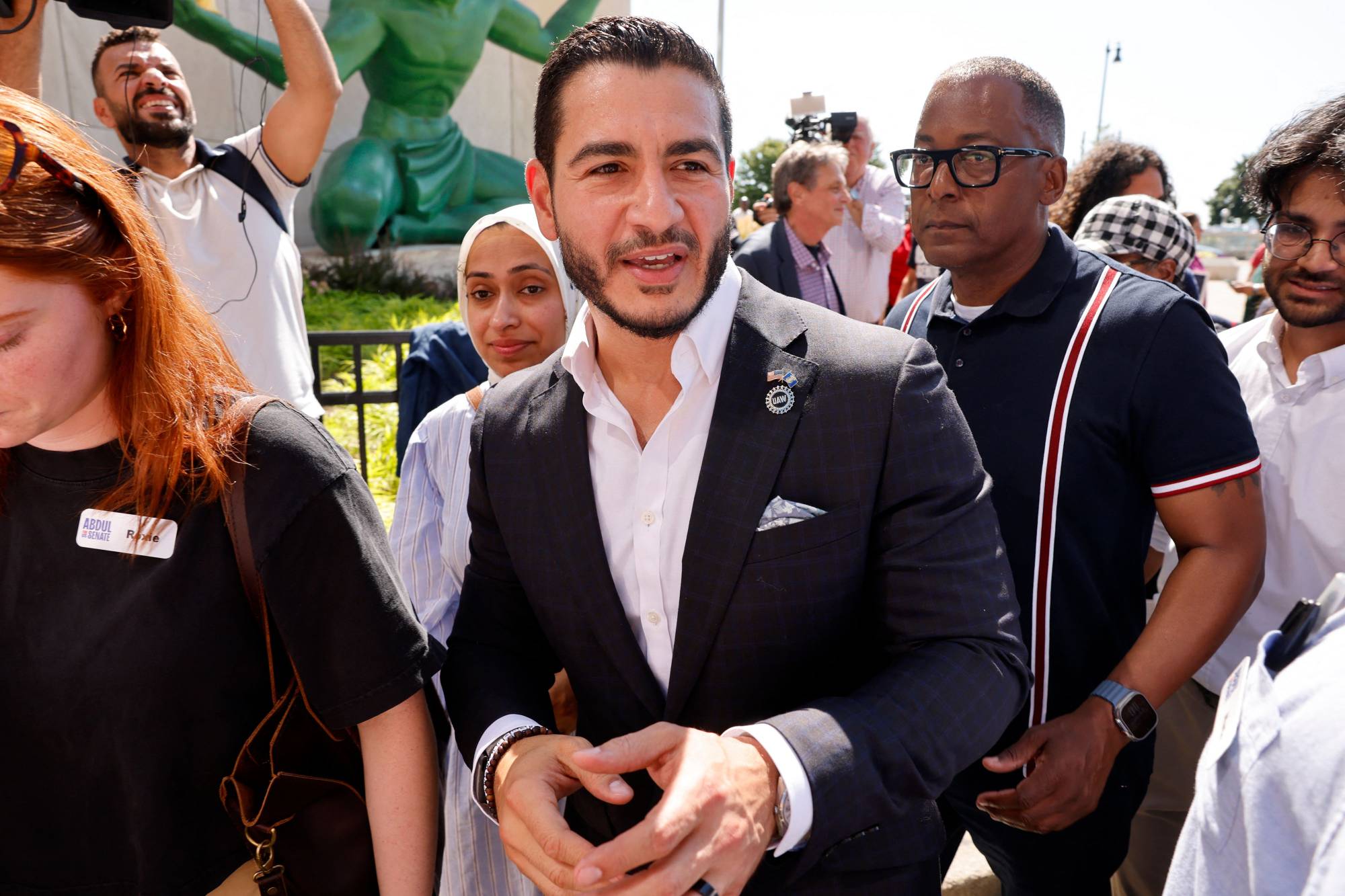
Michigan Democratic Senate candidate Abdul El-Sayed speaks at an election night event, early Wednesday, Nov. 4, 2026, in Detroit. (AP Photo/Julia Demaree Nikhinson)
TT

Abdul El-Sayed: 'As Michigan as You Get'

Michigan Democratic Senate candidate Abdul El-Sayed speaks at an election night event, early Wednesday, Nov. 4, 2026, in Detroit. (AP Photo/Julia Demaree Nikhinson)

Abdul El-Sayed, 42, made history as the first Muslim elected to the US Senate after winning a crucial seat in Michigan in Tuesday's congressional midterm elections.

Born in Michigan on October 31, 1984, El-Sayed previously served as a public health official in Wayne County, in the battleground state. He has never held elected office, but he is no stranger to politics. In 2018, he ran for governor of Michigan, finishing second to Gretchen Whitmer in the Democratic primary.

El-Sayed grew up in the Detroit area with his father, Mohamed, an Egyptian immigrant who came to the United States to study at Wayne State University, and his stepmother, Jackie. His biological mother, Fatten Elkomy, is a psychiatric nurse in Missouri.

El-Sayed describes himself as "as Michigan as you get." He attended local schools, graduating from high school in 2003. During his school years, he captained the lacrosse, wrestling and football teams.

He went on to the University of Michigan, where he majored in biology and political science and played on the university's lacrosse team. He graduated in 2007 with highest distinction and was selected to deliver the student commencement address.

"We have the audacity to believe that we can change this world, and that each of us will," he told his fellow graduates, describing what made Michigan exceptional.

El-Sayed received a full-tuition scholarship to the University of Michigan Medical School. After completing two years of medical school, he was awarded a Rhodes Scholarship for 2009 to study at Oriel College, Oxford University, where he completed a doctorate in public health in 2011.

US Democratic Senate candidate from Michigan Abdul El-Sayed departs after a press conference declaring victory in the primary election in Detroit, Michigan, on August 5, 2026. (Photo by JEFF KOWALSKY / AFP)

He was the University of Michigan's first Rhodes Scholar since 2004. At Oxford, he continued playing lacrosse and earned a Full Blue, the university's highest sporting honor, as team captain.

By 2014, El-Sayed had completed his medical education, earning his medical degree from Columbia University's College of Physicians and Surgeons.

He subsequently joined Columbia's faculty as an assistant professor of epidemiology. Months later, then-Detroit Mayor Mike Duggan appointed him health officer and executive director of the city's Health Department.

El-Sayed rebuilt Detroit's Health Department following the city's bankruptcy. He later restructured Wayne County's Department of Health, Human and Veterans Services, which serves 1.8 million residents in Michigan's largest and most diverse county.

As a public servant, El-Sayed secured free eyeglasses for children in need, challenged some of Michigan's biggest polluters and expanded access to the lifesaving overdose-reversal medication naloxone, commonly known by the brand name Narcan.

He also spearheaded a program to eliminate up to $700 million in medical debt for 300,000 Michigan residents over two years.

His work earned him recognition as Public Official of the Year from the Michigan League of Conservation Voters and a place on Crain's Detroit Business's 40 Under 40 list.

Nationally recognized for his expertise in improving the American healthcare system, El-Sayed is the author of Medicare for All: A Citizen's Guide.

He later returned to public service as director of Wayne County's Department of Health, Human and Veterans Services, serving from December 2022 until April 2025, when he resigned to seek elected office once again, this time in the US Senate.

El-Sayed has also made a name for himself as a podcast host, including through America Dissected.

His medical credentials have attracted controversy, largely because he has described himself as a physician despite not holding a license to practice medicine in Michigan.

Although he studied medicine, El-Sayed came to believe that a broken political system was what was making people sick. That conviction ultimately led him to run for the Senate.

According to his campaign website, he entered the race because he believes life in America should not be so difficult and wants to build a government that serves ordinary Americans rather than Elon Musk, Donald Trump and their billionaire allies.

Responding to questions about his medical credentials in July, El-Sayed said: "I did graduate from a school that's literally called Columbia College of Physicians and Surgeons. So, you know, you can go have that argument with Columbia University if you'd like."

In his only previous bid for elected office, El-Sayed finished second to Gretchen Whitmer in Michigan's 2018 Democratic gubernatorial primary, ahead of Shri Thanedar, who subsequently won a seat in the state legislature and later in the US House of Representatives.

Throughout his Senate campaign, El-Sayed distilled his platform into a three-part message: "Money out of politics, money in your pocket, Medicare for All."

He repeatedly emphasized that he was the only candidate running for the US Senate in Michigan who had never accepted a dime of corporate campaign money and never would.

El-Sayed lives in Ann Arbor with his wife, Sarah, and their two young daughters, Emmalee and Serene.


Numbers That Tell the Story of the Democrats’ Midterm Blowout

This aerial view shows Union Station illuminated with the colors of the US flag after the midterm elections in Kansas City, Missouri, in the early hours of November 4, 2026. (AFP)
TT

Numbers That Tell the Story of the Democrats’ Midterm Blowout

This aerial view shows Union Station illuminated with the colors of the US flag after the midterm elections in Kansas City, Missouri, in the early hours of November 4, 2026. (AFP)

Democrats stormed back to power in Congress and governors' mansions across America in Tuesday's midterm elections, a stunning repudiation of Donald Trump's political agenda.

These are the numbers that tell the tale of a historic night.

- Record turnout -

Total turnout numbers were not in yet, but Americans cast more than 61.7 million votes even before election day, according to the University of Florida's Election Lab.

That figure, a runaway record for early voting in US midterms, undoubtedly boosted Democrats, who traditionally cast their ballots early more often than Republican voters.

The numbers showed large turnout among African Americans, young people and other groups that typically support Democratic candidates, National Public Radio reported.

The surge contributed to a wave election, with Democrats running the table on key races and seizing control of both chambers of Congress.

- Record fundraising -

Total spending for the 2026 midterms soared to a record $11.9 billion, substantially higher than the $8.9 billion racked up in 2022, according to OpenSecrets, a non-partisan authority on spending in US politics.

Campaign fundraising and ad buys jumped in the 2026 races, driven by the outside spending of so-called political action committees.

Such outside spending, led by Trump's mega-billionaire ally Elon Musk, favored Republicans by some $360 million.

But Democratic candidates proved adept at raising their own funds.

House and Senate candidates spent an unprecedented $3.7 billion from their campaign warchests, with Democrats outspending Republicans by $800 million, according to OpenSecrets.

In Texas, Democratic Senate candidate James Talarico broke records by bringing in a staggering $145 million, several times the $22 million raised by his Republican rival Ken Paxton who was forced to rely on outside groups to fund his campaign.

- First wins in decades -

Ninety-four years ago was the last time Kansas sent a Democrat to the US Senate. But on Tuesday night, Adam Hamilton unseated Republican incumbent Roger Marshall.

Hamilton, the pastor of a Methodist megachurch who was registered as a Republican until recently, became the first Democrat to win a Senate race in the largely rural, conservative state since 1932.

Texas also went blue for the first time in decades, with Talarico scoring a massive upset to flip a Senate seat in the Lone Star State for the first since 1988 -- the year before Talarico was born.

South Carolina also defied history, ousting Senator Darline Graham -- who had been appointed earlier this year to fill the seat of her late brother Lindsey Graham -- in favor of Democrat Annie Andrews. No South Carolina Democrat had been elected to the Senate since 1998.

- Young voters, Latinos turn away -

Young men and Latino voters -- two segments of the American electorate crucial to Trump -- turned sharply away from the president and his Republican Party, exit polls showed.

Hispanic voters had helped bring Trump to power in 2016, and were instrumental in his victory in 2024, when they only narrowly went to Democrat Kamala Harris in the presidential election, 51 percent to 48 percent, according to Pew Research.

But in recent weeks, several Latino voters have expressed anger at Trump, saying they felt betrayed.

It showed in NBC News exit polls on Tuesday, when Latino voters backed Democratic candidates by 62 percent to 35 percent over Republicans.

Young voters also soured on Trump. NBC News reported that its exit polls showed 18-29-year olds, men and women, voted for Democrats by a 72 percent to 25 percent margin. That is a sharp shift from 2024 when young voters were split between Trump and Harris.