Israel and Hamas Agree to Extend Temporary Truce

A Palestinian man sits in an armchair outside a destroyed building in Gaza City on Wednesday, Nov. 29, 2023, the sixth day of the temporary cease-fire between Hamas and Israel. (AP Photo/Mohammed Hajjar)
TT

Israel and Hamas Agree to Extend Temporary Truce

A Palestinian man sits in an armchair outside a destroyed building in Gaza City on Wednesday, Nov. 29, 2023, the sixth day of the temporary cease-fire between Hamas and Israel. (AP Photo/Mohammed Hajjar)

Israel and Hamas struck a last-minute agreement on Thursday to extend their six-day ceasefire by at least one more day to allow negotiators to keep working on deals to swap hostages held in Gaza for Palestinian prisoners.
The truce has allowed much needed humanitarian aid into Gaza after much of the coastal territory of 2.3 million was reduced to wasteland in response to a deadly rampage by Hamas militants into southern Israel on Oct. 7, said Reuters.
"In light of the mediators' efforts to continue the process of releasing the hostages and subject to the terms of the framework, the operational pause will continue," the Israeli military said in a statement, released minutes before the temporary truce was due to expire at 0500 GMT.
Hamas, which freed 16 hostages in exchange for 30 Palestinian prisoners on Wednesday, said in a statement the truce would continue for a seventh day.
The conditions of the ceasefire, including the halt of hostilities and the entry of humanitarian aid, remain the same, according to a foreign ministry spokesperson from Qatar, which has been a key mediator between the warring sides, along with Egypt and the United States.
"A short time ago, Israel was given a list of women and children in accordance with the terms of the agreement, and therefore the truce will continue," the Israeli prime minister’s office said in a statement.
Hamas earlier said Israel had refused to receive a further seven women and children and the bodies of three other hostages in exchange for extending the truce.
Hamas had said a family of three Israeli hostages, including the youngest hostage, 10-month-old Kfir Bibas, had been killed during Israel's bombardment of the enclave.
Before the agreement, both Israel and Hamas had said they were ready to resume fighting.
Ninety-seven hostages have been freed since the start of the truce, according to a Reuters tally. The Israeli military says 145 hostages remain in Gaza.
On Wednesday night, two Russian citizens and four Thai citizens were released outside the framework of the agreement while the 10 Israeli citizens freed included five dual nationals, officials said. They were a Dutch dual citizen, who is also a minor, three German dual citizens and one US dual citizen.
DIPLOMATIC PUSH
Israel has sworn to annihilate Hamas, which rules Gaza, in response to the Oct. 7 rampage by the militant group, when Israel says gunmen killed 1,200 people and took 240 hostages.
Before the truce, Israel bombarded the territory for seven weeks and killed more than 15,000 Palestinians, according to health authorities in the coastal strip.
US Secretary of State Antony Blinken had arrived in Tel Aviv earlier on Thursday, his third trip to the region since the Oct. 7 attack, to discuss extending the pause in fighting.
US President Joe Biden was determined to secure the release of all hostages held by Hamas after American Liat Beinin was freed on Wednesday, the White House said in a statement.
The US is urging Israel to narrow the zone of combat and clarify where Palestinian civilians can seek safety during any Israeli operation in southern Gaza, US officials said on Wednesday, to prevent a repeat of the massive death toll from Israel's northern Gaza attacks.
Jordan will host a conference attended by the main UN, regional and international relief agencies on Thursday to coordinate aid to Gaza, official media said.
UN Secretary-General Antonio Guterres warned on Wednesday the Gaza Strip was in the midst of an "epic humanitarian catastrophe," and he and others called for a ceasefire to replace the temporary truce.
China called on the Security Council on Thursday to formulate a "concrete" timetable and roadmap for a two-state solution to achieve a "comprehensive, just and lasting" settlement of the Palestinian issue


Yemen Warns against Houthis Using Red Sea to Extort Int’l Community

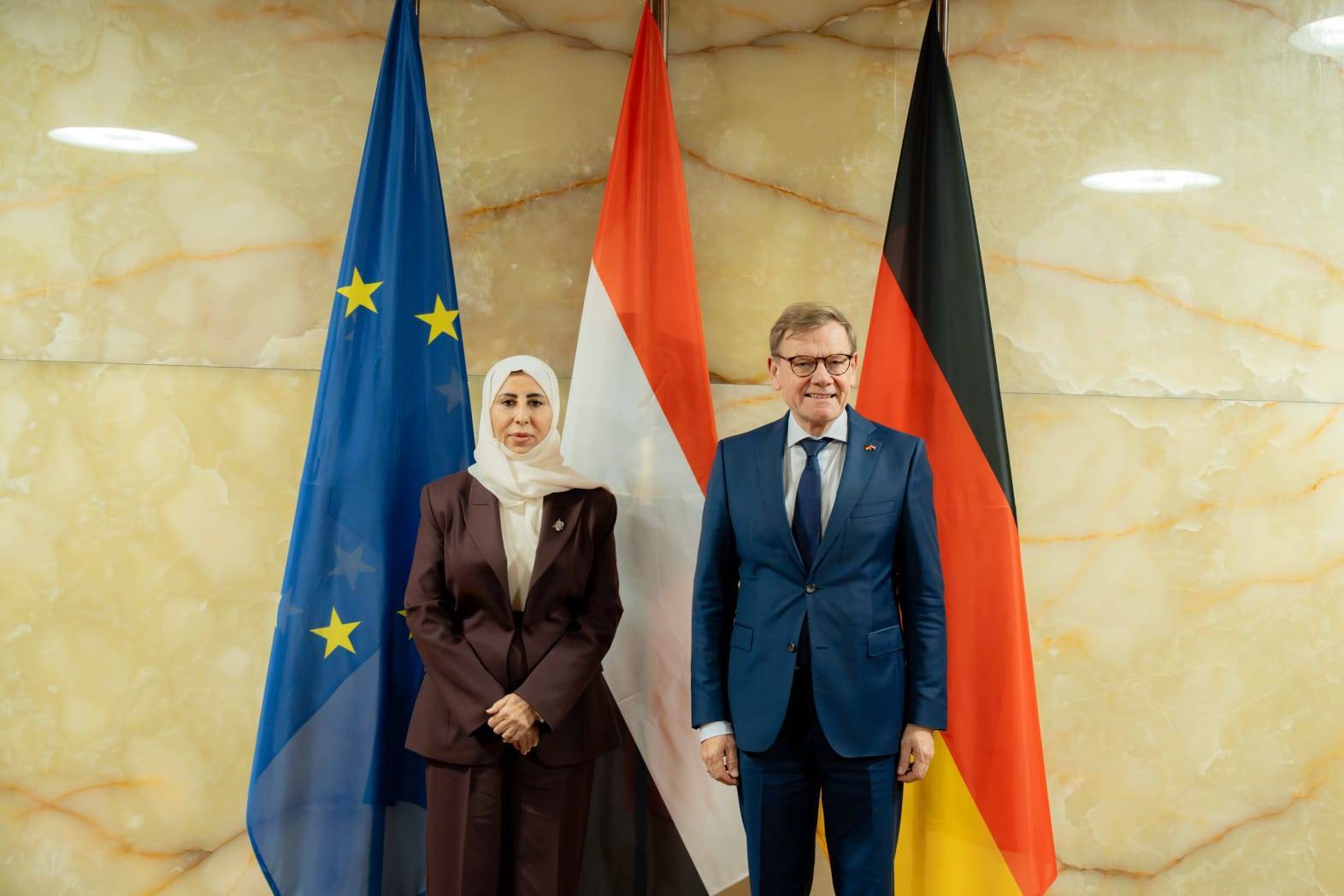
The Yemeni and German delegations meet in Berlin. (Yemeni government media)
TT

Yemen Warns against Houthis Using Red Sea to Extort Int’l Community

The Yemeni and German delegations meet in Berlin. (Yemeni government media)

The Yemeni government warned of an expanding threat posed by the terrorist Houthi militia to regional security and international navigation, citing growing Iranian involvement in managing Houthi military operations and growing ties with terrorist organizations in the Horn of Africa. The warning coincided with continued Houthi attacks on civilians and the tightening of the siege on the city of Taiz.

Yemeni Foreign Minister Afrah Al-Zouba presented these concerns during a series of meetings in Berlin with German officials and experts at think tanks and research centers specialized in Yemeni affairs.

The discussions addressed the developments of the Houthi escalation since last June, as well as its military, humanitarian, and security repercussions on Yemen and the wider region.

Al-Zouba stated that the Houthis intensified their attacks following the landing of an aircraft belonging to Iran's Mahan Air, which is linked to the Iranian Revolutionary Guard Corps (IRGC), at Hodeidah airport.

She explained that the plane carried Iranian experts, funds, and advanced weaponry to support Houthi military operations, in direct violation of Yemeni sovereignty and international laws and resolutions.

The escalation reached the west coast and Bab al-Mandeb regions prior to a government deployment under Operation Dawn of Yemen.

Authorities cautioned against renewed efforts by the militia to expand along the west coast, threaten shipping lanes in the Red Sea and Bab al-Mandeb Strait, and leverage maritime corridors to pressure the international community.

Meeting with German Foreign Minister Johann Wadephul, Al-Zouba warned that the Houthi threat extends beyond Yemen's borders, pointing to the militia’s targeting of Saudi territory and international shipping lanes, and the resulting risks to regional security and global energy and food supplies.

Yemeni Foreign Minister Afrah Al-Zouba meets with her German counterpart Johann Wadephul. (Yemeni government media)

She presented the Yemeni government's announcements regarding the participation of experts from the IRGC and Hezbollah in managing Houthi operations, in addition to the group's links with terrorist organizations in the Horn of Africa, chief among them the Somali Al-Shabaab movement.

These ties raise the level of threat to maritime security and regional stability, she warned.

The two sides discussed ways to develop the capabilities of the Yemeni Coast Guard to protect territorial waters and secure international trade routes, while strengthening bilateral consultation and information exchange regarding security developments in Yemen and the region.

Al-Zouba delivered a written letter from Chairman of the Presidential Leadership Council Dr. Rashad Al-Alimi to German Chancellor Friedrich Merz.

The message addressed bilateral relations, regional issues, and the latest updates on the situation in Yemen.

On the humanitarian level, Al-Zouba highlighted the Houthi siege on the city of Taiz, the targeting of civilian and health facilities, and the resulting closure of medical centers, medicine shortages, and lack of safe corridors, warning of catastrophic impacts on civilians.

She detailed the Houthi recruitment of child soldiers, indiscriminate landmine deployment, and the ongoing detention of UN and humanitarian personnel, noting the death of several detainees including UN staff member Mohammed Ibrahim Al-Shami.


Houthis Under Govt Pressure in al-Jawf, Lahj

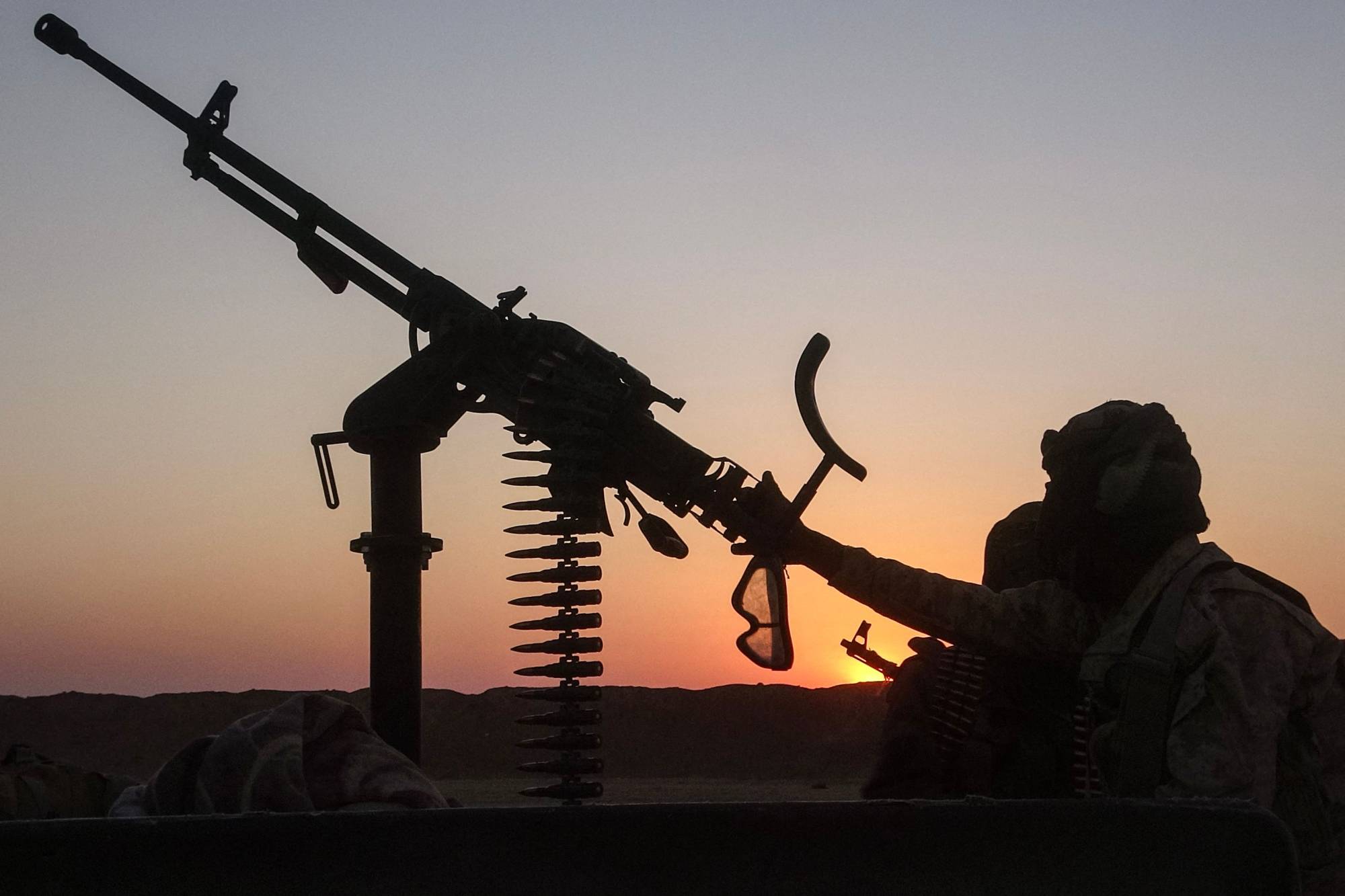
Yemeni troops hold a position during clashes with Iran-backed Houthis in Yemen's northwestern al-Jawf province on November 2, 2026. (AFP)
TT

Houthis Under Govt Pressure in al-Jawf, Lahj

Yemeni troops hold a position during clashes with Iran-backed Houthis in Yemen's northwestern al-Jawf province on November 2, 2026. (AFP)

Yemeni government forces have advanced to a new phase of offensive operations against the Houthis in al-Jawf and Lahj governorates, according to military developments reflecting the expanding scope of Operation Dawn of Yemen.

The shift to offensive maneuvers coincided with government forces thwarting Houthi attempts to recapture previously lost positions in Marib and Taiz.

In the latest field updates, government forces successfully secured their positions across strategic mountain ranges in eastern Al-Jawf. This follows tactical advances into areas formerly controlled by the terrorist Houthi group.

Military officials said the breakthrough reinforces current positions and establishes the necessary conditions to sustain the advance toward al-Hazm, the governorate's capital.

Armed forces spokesman Majed al-Nuzaili said troops managed to recapture positions from the Houthis in several regions in al-Jawf.

He stressed that the operations will continue to reclaim positions from the group.

Government forces have advanced through the al-Dahidha mountain range, breaching Houthi fortifications and seizing military equipment. Airstrikes and drone operations also targeted Houthi strongholds and weapons depots across several locations.

Yemeni forces sit on a pick-up truck mounted with a heavy machine-gun as they hold a position during clashes with Iran-backed Houthis in Yemen's northwestern al-Jawf province on November 2, 2026. (AFP)

This territorial gain holds strategic importance due to the mountainous terrain and its proximity to routes leading to al-Hazm, the Houthis' primary administrative and military hub in the governorate. Government forces are currently working to secure these newly recaptured positions before pressing forward with further operations.

In an attempt to contain this advance, the Houthi group launched a broad attack on government force positions in the Halhalan area. However, government forces managed to repel the assault and force the militants to retreat, said government military sources.

In Lahj, government forces have regained the initiative after reorganizing their military deployment along the Tur al-Baha axis, launching a swift counteroffensive to recapture areas seized by the Houthi group in the al-Maqatirah district.

Supported by warplanes, government troops breached the border of the district and advanced into Bani Abdan village, where heavy fighting continues in the surrounding vicinity. Military operations also expanded to target Houthi positions in the Hayfan and al-Zuraiqah al-Sham regions of the neighboring Taiz governorate.

These latest field updates indicate that government forces have successfully shifted from containing the initial Houthi push in al-Maqatirah to executing direct offensive operations to reclaim lost ground.

Military officials said the transition follows a strategic reinforcement of troops and a reorganization of the military command along the Tur al-Baha axis, effectively shifting the balance of power on this front.


Lebanon's Military Judiciary Begins Legal Proceedings in Hezbollah Explosives Case

A Hezbollah flag hangs at the entrance to the town of Zawtar al-Gharbiya in southern Lebanon, from which Israeli troops withdrew under the framework agreement for southern Lebanon. (Reuters)
TT

Lebanon's Military Judiciary Begins Legal Proceedings in Hezbollah Explosives Case

A Hezbollah flag hangs at the entrance to the town of Zawtar al-Gharbiya in southern Lebanon, from which Israeli troops withdrew under the framework agreement for southern Lebanon. (Reuters)

Two Hezbollah members have been ordered detained after questioning by a Lebanese military judge over a truckload of explosives seized at a checkpoint in eastern Lebanon about a month ago.

Ali al-Kurdi and Haitham Amhaz appeared before First Military Investigating Judge Ghada Abu Alwan, who issued arrest warrants for both men following a hearing attended by their lawyer, Maan al-Asaad.

The warrants stem from charges brought by Judge Claude Ghanem, the government commissioner to the military court, against the two men and 11 other Hezbollah members who remain at large.

The charges include offenses against internal state security, violating government decisions, possessing weapons and explosives, and forming "illegal associations" aimed at undermining the state's authority and prestige.

The explosives-laden truck was intercepted at the Dahr al-Baidar checkpoint in eastern Lebanon.

Probe Enters New Phase

The questioning marks a turning point in the case, shifting it from preliminary investigations to formal judicial proceedings and bringing sharper scrutiny to three central questions: Where did the explosives come from, where were they headed and who was responsible for transporting them?

Asaad has also been authorized to represent Hezbollah members and operatives who remain at large, including Ibrahim Hussein, known as "Sajed"; Bilal al-Sabbouri, known as "Dhul Fiqar"; Mohammed Ayoub; Mohammed Zaiter; Mohammed Hazimeh, the truck's owner; and Perina Krishiona, Amhaz's wife.

Five other suspects have been identified only by aliases, with their full identities still unknown. Asaad filed preliminary procedural objections on behalf of the fugitives.

Despite the strict secrecy surrounding the questioning, a judicial source told Asharq Al-Awsat that Kurdi and Amhaz stood by their initial statements to army intelligence, insisting they knew neither the explosives' destination nor their intended use.

The source said the men told Abu Alwan their role was limited to collecting the explosives from "Sajed" in Baalbek, in the Bekaa Valley, and delivering them to "Dhul Fiqar" in Musharrafieh, in Beirut's southern suburbs.

Key Questions Remain Unanswered

The detainees' denials leave critical questions unresolved, particularly the shipment's destination, the circumstances of its transportation and the purpose for which the explosives were intended.

Legal sources following the case said the men's claims of ignorance were not enough to settle the question of responsibility.

"The statements of Kurdi and Amhaz are now being assessed by the investigating judge against all the evidence and information in the case file," the sources told Asharq Al-Awsat.

One potentially significant piece of evidence has yet to reach the judge.

Abu Alwan is still awaiting records of the preliminary investigation conducted by the Internal Security Forces' Information Branch, which analyzed mobile phones belonging to Kurdi, Amhaz and his wife.

The phones are expected to contain important information, the sources said, raising the possibility that Abu Alwan could summon the two detainees for further questioning about material recovered from the devices.

Legal Challenge Delays Questioning of Fugitives

Meanwhile, Asaad filed preliminary procedural objections on behalf of the defendants who remain at large, delaying their questioning until Nov. 17.

Legal sources said the filing was intended to delay formally notifying the defendants and the issuance of arrest warrants in absentia if they refuse to appear for questioning, as expected.

Details of the objections and their legal grounds were not immediately available.

Abu Alwan referred the filing to Ghanem for review and an opinion before ruling on the objections.