
Powerful Earthquakes Leave at Least 48 Dead, Destroy Buildings Along Japan’s Western Coast 

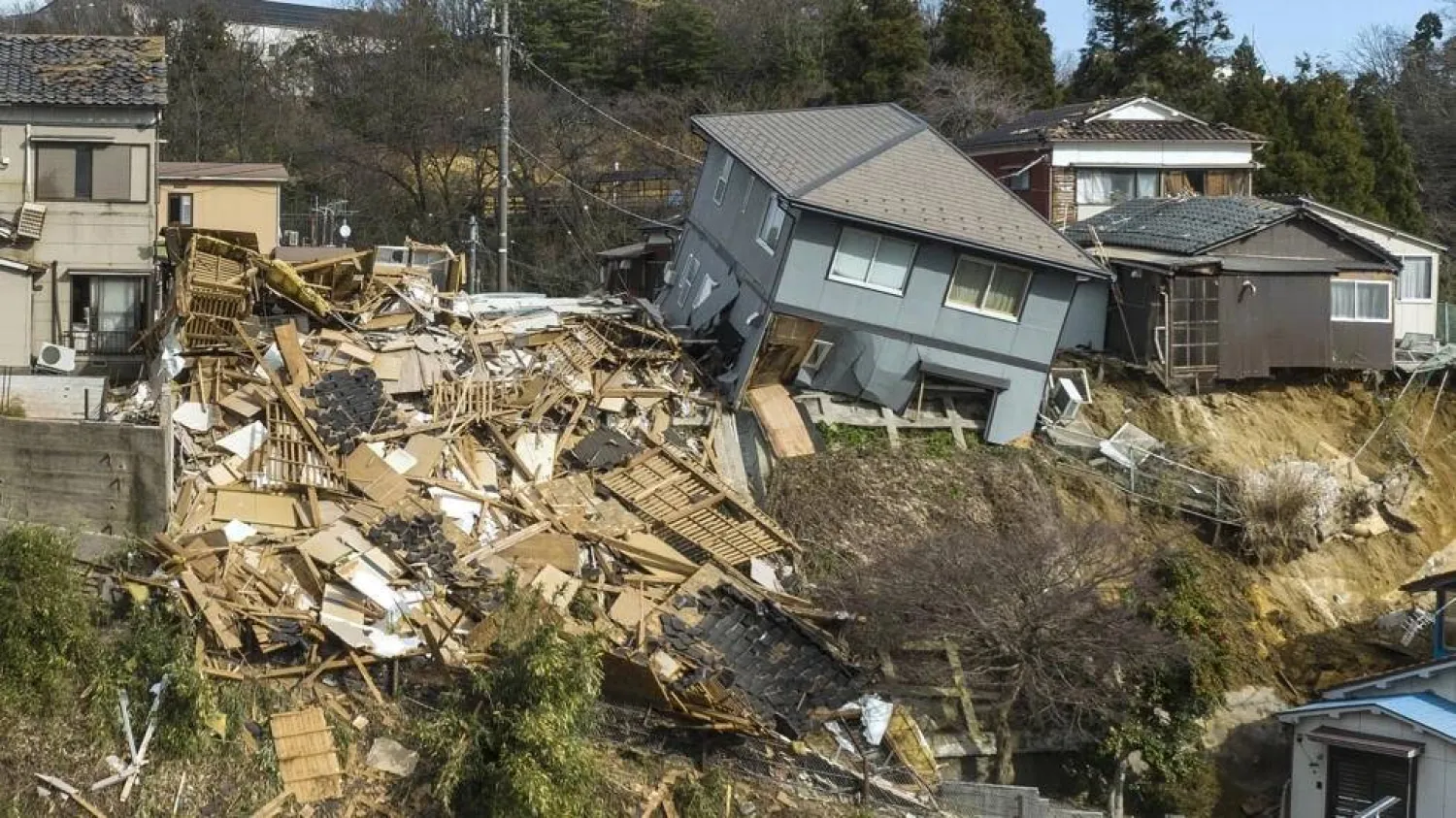
Damaged houses, including one totally collapsed (C), are pictured along a street in Wajima, Japan. Fred MERY / AFP
TT

Powerful Earthquakes Leave at Least 48 Dead, Destroy Buildings Along Japan’s Western Coast 

Damaged houses, including one totally collapsed (C), are pictured along a street in Wajima, Japan. Fred MERY / AFP

A series of powerful earthquakes that hit western Japan have left at least 48 people dead and damaged thousands of buildings, vehicles and boats. Officials warned that more quakes could lie ahead. 

Aftershocks continued to shake Ishikawa prefecture and nearby areas a day after a magnitude 7.6 temblor slammed the area on Monday afternoon. 

Forty-eight people were confirmed dead in Ishikawa, officials said. Sixteen others were seriously injured, while damage to homes was so great that it could not immediately be assessed, they said. 

Japanese media reports said tens of thousands of homes were destroyed. Government spokesperson Yoshimasa Hayashi said 17 people were seriously injured and gave a slightly lower death tally, while saying he was aware of the prefecture's tally. 

Water, power and cell phone service were still down in some areas, and residents expressed sorrow about their destroyed homes and uncertain futures. 

"It’s not just that it’s a mess. The wall has collapsed, and you can see through to the next room. I don’t think we can live here anymore,” Miki Kobayashi, an Ishikawa resident, said as she swept around her house. 

Their house was also damaged in a 2007 quake, she said. 

Although casualty numbers continued to climb gradually, the prompt public warnings, relayed on broadcasts and phones, and the quick response from the general public and officials appeared to have kept at least some of the damage under control. 

The rescue efforts that quickly followed from firefighters, police and the military proved a testament to how this nation has repeatedly withstood disasters, which have practically become a part of everyday life. 

Toshitaka Katada, a University of Tokyo professor specializing in disasters, said the people were prepared because the area had been hit by quakes in recent years. They had evacuation plans and emergency supplies in stock. 

“There is probably no people on earth other than Japanese who are so disaster-ready,” he said in a telephone interview with The Associated Press. 

Katada warned the situation remains precarious and unpredictable. The March 2011 quake and tsunami in northeastern Japan had been preceded by other quakes. 

“This is far from over,” Katada said. 

Predictions by scientists have repeatedly been proven wrong, such as with the 2016 quake in southwestern Kumamoto, an area previously seen as relatively quake-free. The only real projection possible is that you can't make projections, Katada added. 

“Having too much confidence in the power of science is very dangerous. We are dealing with nature.” 

Japanese media aerial footage showed widespread damage in the hardest-hit spots, with landslides burying roads, boats tossed in the waters and a major fire that had turned an entire section of Wajima city to ashes. 

Japan’s military dispatched 1,000 soldiers to the disaster zones to join rescue efforts, Prime Minister Fumio Kishida said Tuesday. 

“Saving lives is our priority and we are fighting a battle against time,” he said. “It is critical that people trapped in homes get rescued immediately.” 

A quake with a preliminary magnitude of 5.6 shook the Ishikawa area as he was speaking. More quakes continued to rock the area, reaching more than 100 aftershocks over the past day. 

Nuclear regulators said several nuclear plants in the region were operating normally. The 2011 quake and tsunami caused three reactors to melt and release large amounts of radiation at a nuclear plant in northeastern Japan. 

News videos showed rows of collapsed houses. Some wooden structures were flattened and cars were overturned. Half-sunken ships floated in bays where tsunami waves had rolled in, leaving a muddied coastline. 

On Monday, the Japan Meteorological Agency issued a major tsunami warning for Ishikawa and lower-level tsunami warnings or advisories for the rest of the western coast of Japan’s main island of Honshu, as well as for the northern island of Hokkaido. 

The warning was downgraded several hours later, and all tsunami warnings were lifted as of early Tuesday. Waves measuring more than one meter (3 feet) hit some places. 

People who were evacuated from their houses huddled in auditoriums, schools and community centers. Bullet trains in the region were halted, but service was mostly restored by Tuesday afternoon. Sections of highways were closed. 

Weather forecasters predicted rain, setting off worries about already crumbling buildings and infrastructure. 

The region includes tourist spots famous for lacquerware and other traditional crafts, along with designated cultural heritage sites. 

US President Joe Biden said in a statement that his administration was “ready to provide any necessary assistance for the Japanese people.” 

Japan is frequently hit by earthquakes because of its location along the “Ring of Fire,” an arc of volcanoes and fault lines in the Pacific Basin. 


Iran, US Race to Find Crew Member of Crashed American Fighter Jet

A US Air Force F-16 Fighting Falcon aircraft refuels from a KC-135 Stratotanker aircraft during a mission supporting Operation Epic Fury during the Iran war at an undisclosed location, April 2, 2026.  US Air Force/Handout via REUTERS
A US Air Force F-16 Fighting Falcon aircraft refuels from a KC-135 Stratotanker aircraft during a mission supporting Operation Epic Fury during the Iran war at an undisclosed location, April 2, 2026. US Air Force/Handout via REUTERS
TT

Iran, US Race to Find Crew Member of Crashed American Fighter Jet

A US Air Force F-16 Fighting Falcon aircraft refuels from a KC-135 Stratotanker aircraft during a mission supporting Operation Epic Fury during the Iran war at an undisclosed location, April 2, 2026.  US Air Force/Handout via REUTERS
A US Air Force F-16 Fighting Falcon aircraft refuels from a KC-135 Stratotanker aircraft during a mission supporting Operation Epic Fury during the Iran war at an undisclosed location, April 2, 2026. US Air Force/Handout via REUTERS

Iranian and American forces raced each other Saturday to recover a crew member from the first US fighter jet to go down inside Iran since the start of the war.

Tehran said it had shot down the F-15 warplane and US media reported United States special forces had rescued one of its two crew members, with the other was still missing.

Iran's military also said it downed a US A-10 ground attack aircraft in the Gulf, with US media saying the pilot of that plane was rescued, reported AFP.

The war erupted more than a month ago with US-Israeli strikes on Iran that killed supreme leader Ali Khamenei, triggering retaliation that spread the conflict throughout the Middle East, convulsing the global economy and impacting millions of people worldwide.

US Central Command did not immediately respond to a request for comment on the loss of the F-15, but White House Press Secretary Karoline Leavitt said: "The president has been briefed."

President Donald Trump told NBC the F-15 loss would not affect negotiations with Iran, saying: "No, not at all. No, it's war."

On Saturday, there were fresh strikes on Israel, Lebanon and Iran, as well as on Gulf states.

An AFP journalist saw a thick haze of grey smoke covering Tehran's skyline after hearing several blasts over the capital. It was not immediately clear what had been targeted.

- 'Valuable reward' -

A spokesperson for the Iranian military's central operational command earlier said "an American hostile fighter jet in central Iranian airspace was struck and destroyed by the IRGC Aerospace Force's advanced air defense system".

"The jet was completely obliterated, and further searches are ongoing."

An Iranian television reporter on a local official channel said anyone who captured a crew member alive would "receive a valuable reward".

Retired US brigadier general Houston Cantwell, who has 400 hours of combat flight experience, said a pilot's training would likely kick in before he or she parachutes to the ground.

"My priority would be, first of all, concealment, because I don't want to be captured," he told AFP.

Mohammad Ghalibaf, the speaker of Iran's parliament, mocked the Trump administration.

He wrote on X: "After defeating Iran 37 times in a row, this brilliant no-strategy war they started has now been downgraded from 'regime change' to 'Hey! Can anyone find our pilots? Please?'

"Wow. What incredible progress. Absolute geniuses."


Explosion Hits Pro-Israel Center in the Netherlands

Rotterdam Police officers. (Getty Images/AFP)
TT

Explosion Hits Pro-Israel Center in the Netherlands

Rotterdam Police officers. (Getty Images/AFP)

A blast hit a pro-Israeli center in the Netherlands, police said Saturday, adding it caused minimal damage and no injuries.

A police spokeswoman told AFP no one was inside the site run by Christians for Israel, a non-profit, in the central city of Nijkerk when the explosion went off outside its gate late on Friday.

An investigation was ongoing.

The incident comes after a string of similar night-time attacks on Jewish sites in the Netherlands and neighboring Belgium in recent weeks that has heightened concerns in the wake of the war in the Middle East.


Iran Says Strike Hit Close to Its Bushehr Nuclear Facility, Killing a Guard and Damaging a Building

Iran's Bushehr nuclear reactor (Reuters)
TT

Iran Says Strike Hit Close to Its Bushehr Nuclear Facility, Killing a Guard and Damaging a Building

Iran's Bushehr nuclear reactor (Reuters)

Iran’s atomic agency says an airstrike has hit near its Bushehr nuclear facility, killing a security guard and damaging a support building. It is the fourth time the facility has been targeted during the war.

The agency announced Saturday’s attack on social media.

The US AP’s military pressed ahead Saturday in a frantic search for a missing pilot after Iran shot down an American warplane, as Iran called on people to turn the pilot in, promising a reward.

The plane, identified by Iran as a US F-15E Strike Eagle, was one of two attacked on Friday, with one service member rescued and at least one missing. It was the first time the United States lost aircraft in Iranian territory during the war, now in its sixth week, and could mark a new turning point in the campaign.

The conflict, launched by the US and Israel on Feb. 28, has rippled across the region. It has so far killed thousands, upended global markets, cut off key shipping routes, spiked fuel prices and shows no signs of slowing as Iran responds to US and Israeli airstrikes with attacks across the region.